
A ductless mini-split typically uses the least electricity per hour of cooling, running on roughly 600 to 1,500 watts depending on size and technology, well below the 2,275 watts a central air system draws on average.
But the lowest energy consumption AC for your situation depends on more than a single spec sheet number.
Most efficiency guides rank units only within their own category, comparing portable models against other portables or central systems against other central systems, so a reader never sees how those categories stack up against each other in real kilowatt-hours.
This guide puts the numbers side by side across formats, ratings, and two very different electricity markets, so the comparison reflects what you will pay to run the unit rather than a manufacturer’s marketing claim.
What Type of Air Conditioner Uses the Least Electricity?
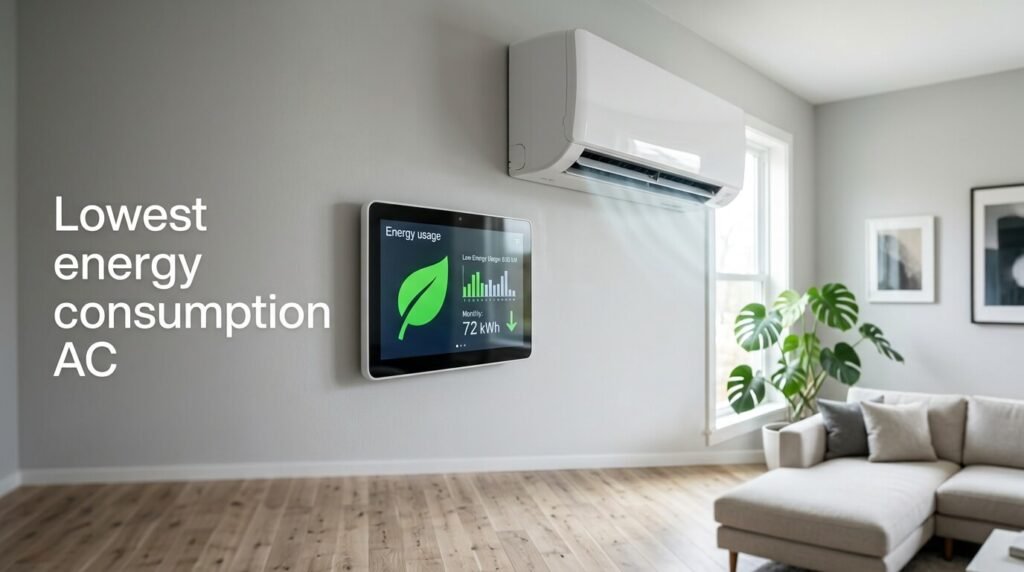
Comparing air conditioner power consumption across types shows a clear pattern: ductless mini-splits use the least electricity per hour of cooling, followed by window units, then portable units, with central air using the most overall despite cooling far more space.
Real Electricity Use by AC Type (Portable, Window, Mini-Split, Central)
| AC type | Typical running wattage | Monthly kWh (8 hrs/day, 30 days) | Monthly cost at $0.16/kWh |
|---|---|---|---|
| Portable | 800-1,500W | ~276 kWh | ~$44 |
| Window | 900-1,500W | ~288 kWh | ~$46 |
| Ductless mini-split | 600-1,500W | ~180 kWh | ~$29 |
| Central | 2,000-4,000W (avg. ~2,275W) | ~546 kWh | ~$87 |
The lowest-wattage air conditioners on the market are small inverter mini-splits and inverter window units, some drawing as little as 400–600 watts when running on their lowest cooling setting.
That figure sits below even the low end of the mini-split range in the table above, which reflects typical running wattage rather than the minimum an inverter compressor can throttle down to during a light cooling load.
These figures assume comparable room sizes and eight hours of daily operation, not a whole-home comparison against a single room.
A central system still costs more per month because it conditions far more square footage, not because the technology itself is inherently wasteful.
See the guide on 1HP vs 1.5HP air conditioner comparison for how these wattage figures map onto HP-labeled room units sold outside the US.
Why Ductless Mini-Splits Usually Win
Mini-splits avoid the energy losses that come with ductwork, since air travels a few feet from the indoor unit directly into the room instead of through a network of ducts that leak conditioned air before it reaches its destination.
Most residential duct systems lose 20 to 30 percent of cooled air to leaks, gaps, and poorly insulated runs, a loss a ductless system does not have because there are no ducts to lose air through.
Mini-splits also let you cool only the rooms in use, called zoning, instead of conditioning an entire home to cool the one room someone is sitting in.
A three-bedroom house with a central system cools every hallway and unused bedroom along with the living room, while a multi-zone mini-split setup can run one indoor head at full output and leave the others idle or on a lower setting.
Combine that with the variable-speed inverter compressors found in most modern mini-splits, and the result is a system that spends less energy per degree of cooling delivered than almost any other residential format.
Which AC uses the least electricity in Nigeria?
An inverter split unit uses the least electricity in Nigeria, drawing roughly 650 to 950 watts compared to 1,000 to 1,350 watts for a non-inverter split of the same HP rating, which translates into a real difference on both the DisCo bill and generator fuel costs.
On Band B tariffs at approximately ₦117 per kWh, an inverter 1HP unit running eight hours a day costs around ₦18,720 a month, against roughly ₦28,080 for a non-inverter 1HP unit doing the same job.
The generator-sizing gap adds a second layer of savings: because inverter compressors soft-start instead of surging to three times their running wattage, they can run on a generator roughly half the size a non-inverter unit of the same capacity would need.
How Do You Read an AC’s Energy Efficiency Rating?
An AC’s efficiency rating tells you how much cooling it produces per unit of electricity, and a higher number always means better efficiency, but which rating applies depends on the unit type and where it was sold.
SEER2, EER2, and CEER Explained
SEER2 (Seasonal Energy Efficiency Ratio 2) measures cooling output across a full season of varying outdoor temperatures, divided by total energy used, and applies mainly to central air conditioners and larger mini-split systems in the US.
EER2 measures the same ratio at a single fixed outdoor temperature of 95°F, which makes it more useful for comparing performance during actual peak-heat conditions rather than an averaged season.
CEER (Combined Energy Efficiency Ratio) is the rating used for smaller room units like window and portable ACs, factoring in both active cooling and low-power standby draw.
Beginning January 1, 2023, new U.S. residential central air-conditioner standards use SEER2 rather than the old SEER test metric.
Minimum requirements are generally 13.4 SEER2 in the North, 14.3 SEER2 for split systems under 45,000 Btu/h in the Southeast and Southwest, and 13.8 SEER2 for larger split systems in those regions.
Higher SEER2 ratings may reduce electricity use, but SEER2 16 and 20 are not federal classifications for “efficient” or “most efficient”; actual savings depend on climate, operating hours, equipment size, installation quality, electricity prices, and system performance.
What the Energy Star Label Actually Indicates
The ENERGY STAR label indicates that a product has met efficiency and related performance criteria established through the ENERGY STAR program, administered by the U.S. EPA in cooperation with the Department of Energy.
For window or room air conditioners, the required CEER varies by capacity, design, and product class; it is not simply “around 12 or higher.” Portable room air conditioners are currently not ENERGY STAR certified.
Residential central air conditioners and qualifying mini-split or heat-pump systems generally must meet a minimum SEER2 of 15.2, together with applicable EER2 or HSPF2 requirements.
ENERGY STAR is a useful screening criterion, but certified products can still differ in efficiency, capacity, controls, installation quality, and operating cost, so buyers should compare the actual CEER, SEER2, EER2, estimated annual energy use, and correct sizing.
Converting Star Ratings and EU Energy Labels to SEER2
| US SEER2 | Approximate AU/NZ star rating | Approximate EU label |
|---|---|---|
| 13-14 (federal minimum) | 2-3 stars | C to D |
| 15-16 | 3-4 stars | B to A |
| 17-19 | 4-5 stars | A to A+ |
| 20-21 | 5-6 stars | A++ |
| 22 and above | 6+ stars | A+++ |
These are approximate equivalencies drawn from how each region defines its efficiency bands, not an official government conversion table, since the three systems use different test conditions and climate assumptions.
If you are shopping outside the US and comparing a unit rated in stars or an EU letter grade against a SEER2-rated product, use this table as a directional guide and confirm against the specific EER or wattage figures printed on the unit’s spec sheet whenever exact comparisons matter.
Does Inverter Technology Really Use Less Energy?
Yes, inverter air conditioners use less energy than non-inverter models doing the same job, typically 20 to 40 percent less, because the compressor adjusts its speed to match the room’s actual cooling demand instead of switching fully on and off.
Inverter vs Non-Inverter Power Draw Compared
For a closer look at specific models, see the best inverter air conditioners for 2026. The table below shows why the technology choice matters more than most buyers assume.
| Technology | How it runs | Typical energy savings |
|---|---|---|
| Non-inverter (fixed-speed) | Compressor runs at full power, then shuts off completely, then restarts at full power again | Baseline |
| Inverter (variable-speed) | Compressor speed ramps up and down continuously to hold the set temperature | 20-40% less energy for the same cooling output |
Fixed-speed compressors burn 20 to 30 percent more energy during each startup surge, and that surge repeats every time the unit cycles back on, sometimes multiple times per hour in a poorly sized system.
An inverter unit avoids most of those surges entirely, which is why the technology difference often matters more for your electricity bill than the difference between two units with similar SEER2 or CEER numbers.
Is a Higher EER or SEER2 Always Worth the Extra Cost?
Not automatically, and the answer depends on your climate and how many hours a day the unit runs.
In hot climates with 1,500 or more annual cooling hours, a SEER2 22 or higher unit typically pays back its price premium over a lower-rated model within four to five years through lower electricity bills.
In milder climates where an AC runs only a few weeks a year, that same premium can take a decade or longer to recover, making a mid-range SEER2 16 to 18 unit the more practical choice.
A household in Phoenix or Houston running the AC most of the day for five or six months a year will see the premium units pay for themselves faster than a household in Seattle or Portland running the same unit for a few scattered weeks.
Match the rating tier to your actual runtime rather than assuming the highest number on the shelf is automatically the better financial decision.
Does 220V AC Use More Electricity Than 110V?
No, voltage by itself does not determine how much electricity an AC uses; wattage does, and a 220V unit and a 110V unit delivering the same cooling output consume the same amount of power.
What Actually Determines Power Draw
- Start with the electrical relationship Watts = Volts × Amps, which means the same wattage can be delivered at a higher voltage with lower amperage, or a lower voltage with higher amperage.
- Check the wattage printed on the unit’s nameplate or Energy Guide label rather than assuming voltage tells you anything about efficiency.
- Compare two units by their watts and their EER or SEER2 rating, since those numbers reflect how much cooling each watt produces, which is what actually drives your bill.
- Remember that a 900-watt AC costs the same to run whether it draws about 8.2 amps at 110V or about 4.1 amps at 220V, because the electric meter measures kilowatt-hours, not amperage or voltage directly.
- Treat any claim that “220V costs more” or “110V costs more” as a red flag, since real-world efficiency comes from the compressor technology and rating, not the voltage of the circuit feeding it.
When Voltage Does Matter
- Higher-capacity units, generally above about 15,000 BTU, usually require a 220V to 240V circuit simply because delivering that much power at 110V would need an impractically high amperage and heavier wiring.
- A 220V circuit runs at roughly half the amperage of an equivalent 110V circuit, which reduces heat buildup in the wiring and is one reason larger systems are built around it.
- Central air systems and most multi-zone mini-splits require a dedicated 220V to 240V circuit regardless of efficiency rating, so voltage becomes a wiring and installation requirement rather than an operating-cost variable.
- Before buying a larger unit, check your home’s electrical panel and circuit capacity, since upgrading from a 110V to a 220V circuit is an installation cost that has nothing to do with the AC’s energy consumption. For a full breakdown of circuit sizing, amperage, and what your panel needs to support, see air conditioning power requirements.
How Much Does Running an AC Actually Cost?
Running costs vary enormously by market, since electricity pricing structures in Nigeria and the United States work in completely different ways, and buyers in unreliable-grid regions also have to factor in generator fuel on top of the utility bill.
For a full breakdown of what installation itself adds to the total cost, see the full air conditioner installation cost guide.
Nigeria Generator and Grid Cost Comparison by AC Type
| AC type (Nigeria) | Running wattage | Recommended generator size | Grid cost, Band B (₦117/kWh), 8 hrs/day |
|---|---|---|---|
| Non-inverter split, 1HP | ~1,000W | 2.5-3 kVA (startup surge up to 3x running load) | ~₦28,080/month |
| Non-inverter split, 1.5HP | ~1,350W | 3.5-4 kVA | ~₦37,908/month |
| Inverter split, 1HP | ~650-700W | 1.5-2 kVA (soft-start, minimal surge) | ~₦18,720/month |
| Inverter split, 1.5HP | ~950W | 2-2.5 kVA | ~₦26,676/month |
The generator sizing gap matters as much as the electricity bill in markets with unstable grid power.
A non-inverter compressor pulls a startup surge of up to three times its running wattage, so a 1,000-watt non-inverter 1HP unit can spike to around 3,000 watts for a second or two on startup, which pushes the recommended generator size up to 2.5 or 3 kVA.
An inverter unit’s soft-start electronics avoid that spike almost entirely, so the same cooling output needs a generator roughly half the size, which lowers both the generator’s purchase price and its fuel consumption per hour of use.
For a household that runs a generator for several hours a day during grid outages, that smaller generator requirement compounds over months into real naira saved on petrol or diesel, on top of whatever the DisCo bill itself shows.
US Monthly Cost Comparison by SEER2 Rating
| SEER2 rating | Efficiency tier | Approximate monthly cost, 1.5-ton unit, 8 hrs/day at $0.16/kWh |
|---|---|---|
| 13-14 (federal minimum) | Baseline | ~$58-$62 |
| 16 | Efficient | ~$48-$52 |
| 18-20 | High efficiency | ~$38-$44 |
| 22+ | Premium efficiency | ~$30-$36 |
Moving from a baseline SEER2 13 unit to a SEER2 18 system can cut cooling costs by up to 40 percent, which on a typical $60 monthly bill works out to roughly $24 in monthly savings during peak cooling season.
Over a five-month cooling season, that gap alone can cover a meaningful share of the price premium for the higher-rated unit.
How Can You Reduce AC Energy Consumption Without Buying a New Unit?
You can meaningfully cut an existing AC’s energy use through sizing checks, placement adjustments, and settings changes, often without spending anything beyond routine upkeep.
Sizing and Placement Fixes
- Confirm your current unit is not oversized or undersized for the room, since both mistakes waste energy in different ways: an oversized unit short-cycles and an undersized one runs constantly without reaching the set temperature. Run your room’s dimensions through our free aircon BTU calculator tool to check.
- Move furniture, curtains, or other obstructions away from the indoor unit’s airflow path, since blocked vents force the compressor to work harder to reach the same temperature.
- Seal gaps around window units and portable AC exhaust hoses, since even small air leaks let warm outside air back into the room and force the unit to run longer.
- Check whether your current unit shows the signs of being undersized for its room, covered in detail in signs your air conditioner is undersized, before assuming a setting change alone will fix a persistent cooling problem.
Settings and Habits That Cut Consumption
- Use the unit’s “Eco” or “Energy Save” mode when available, since it cycles the fan off between cooling cycles instead of running continuously, which is the setting most manufacturers optimize for lowest consumption.
- Set the thermostat a few degrees higher than your instinct suggests, since each degree closer to the outdoor temperature meaningfully reduces the compressor’s workload over a full day.
- Clean or replace air filters every two to four weeks during heavy use, since a clogged filter restricts airflow, drops evaporator coil efficiency, and can raise energy consumption by 5 to 15 percent.
- Run the unit during cooler parts of the day when possible, and use fans to circulate air, since moving air feels cooler at the same thermostat setting and reduces how long the compressor needs to run.
Not sure your current unit is the right size for the room it’s cooling? Run it through our free aircon BTU calculator ( link above) to see if you’re paying for capacity you don’t actually need, or if an undersized unit is quietly driving your bill up by running nonstop.
Frequently Asked Questions
What type of air conditioner uses the least electricity overall?
A ductless mini-split typically uses the least electricity per hour of cooling, running on roughly 600 to 1,500 watts compared to 900 to 1,500 watts for window units, 800 to 1,500 watts for portable units, and around 2,275 watts on average for central air.
The gap comes mainly from the absence of ductwork, since ducted systems lose 20 to 30 percent of conditioned air to leaks before it reaches the room, and from zoning, which lets a mini-split cool only the space in use instead of an entire home.
Central air still makes sense for whole-home cooling despite the higher wattage, since comparing it to a single-room mini-split on a per-watt basis is not comparing the same job.
Does 220V AC really use more electricity than 110V?
No, voltage does not determine electricity consumption on its own; wattage does, and two units delivering identical cooling output consume identical power regardless of whether they run on 110V or 220V.
The relationship is Watts = Volts × Amps, so a higher voltage simply means lower amperage for the same wattage, similar to how higher water pressure through a narrower pipe can still deliver the same volume of water.
Voltage becomes relevant only for larger units above roughly 15,000 BTU, which typically require a 220V to 240V circuit because delivering that much power at 110V would demand impractically high amperage and heavier wiring, a circuit and installation consideration rather than an efficiency one.
To learn more about air conditioner power consumption, use our AC Power Consumption Calculator Free Tool.
Can I make my current AC use less energy without replacing it?
Yes, several no-cost or low-cost changes can meaningfully cut an existing unit’s consumption, starting with confirming it is correctly sized for the room rather than oversized or undersized.
Cleaning or replacing the air filter every two to four weeks during heavy use prevents the 5 to 15 percent efficiency loss that comes from restricted airflow, and using the unit’s Eco or Energy Save mode lets the fan cycle off between cooling bursts instead of running continuously.
Setting the thermostat a few degrees higher than your instinct suggests and sealing any gaps around window units or portable AC exhaust hoses round out the changes that typically produce a noticeable difference within the first billing cycle.
[…] units typically hold a steadier temperature and use less energy when you cool often or for long […]