
Nigeria’s heat is no joke, and you know it. There have been an increasing number of heat waves affecting various states across Nigeria that started in late 2024.
Between the scorching sun, high humidity, and the coastal weather of cities like Lagos and Port Harcourt, staying cool has become a necessity.
The best air conditioners in Nigeria do more than just drop the temperature. They have to work efficiently on unstable power, handle dust, and keep your electricity bills from spiralling out of control.
Choosing the wrong AC can mean poor cooling, frequent breakdowns, or shocking monthly bills. This guide breaks down what to look for, which types work best, and how to make a smart buying decision.
What Makes an Air Conditioner the Best in Nigeria?
Cooling Performance
A good AC cools a room fast and maintains that temperature without struggling. In Nigeria’s tropical climate, you need a unit with enough cooling capacity measured in BTU or horsepower (HP) to match your room size.
An undersized unit runs non-stop and still leaves you sweating, while an oversized one short-cycles and wastes power.
Brands like Panasonic, Midea, Skyrun, LG Electronics and Daikin Industries are known for units that hit target temperatures quickly and hold them steady, even during peak afternoon heat.
Energy Efficiency
Electricity is expensive in Nigeria, and supply is unreliable. An energy-efficient AC reduces your electricity consumption significantly, which matters whether you’re on the grid or running a generator.
Inverter ACs, like those from Samsung Electronics, adjust their compressor speed based on cooling demand rather than cycling on and off.
Over time, this saves a considerable amount on fuel and utility bills compared to conventional non-inverter units. If you want a deeper breakdown of how this works, check out our Inverter vs non-inverter AC guide.
Durability in Nigerian Conditions
Not every AC is built for Nigeria’s realities, such as voltage fluctuation, high humidity, dust, and heat stress on outdoor units.
An AC with a copper condenser coil handles corrosion and heat better than aluminium condenser alternatives.
Look for units with built-in auto restart so the AC resumes cooling automatically after a power outage, and consider pairing your unit with a voltage stabiliser like those from Binatone to protect against the irregular power supply from the Nigerian grid.
Availability of Spare Parts and Service
An air conditioner is a long-term investment. If the brand has no service centres or spare parts available in Nigeria, you’ll be stuck when something goes wrong.
Established brands like Panasonic, Samsung, Skyrun, Midea, Gree, Thermocool, LG Electronics, Hisense, and Daikin Industries have strong after-sales support networks across major Nigerian cities, making servicing, gas refills, and routine maintenance easier to manage.
Best Types of Air Conditioners in Nigeria
Understanding the different AC types helps you pick what suits your space and budget. For a full breakdown of each category, read our complete guide to the various types of Air conditioners.
Split Air Conditioners
The split AC is the most popular choice for Nigerian homes and offices. It has two units: an indoor evaporator coil unit and an outdoor condenser unit, which separates the noisy components from your living space.
This design keeps indoor noise levels low while delivering powerful, consistent cooling. Panasonic, Midea, Hisense, LG Electronics, Samsung Electronics, and Daikin Industries dominate this category in Nigeria, offering reliable models across different horsepower ratings.
Inverter Air Conditioners
An inverter AC uses a variable-speed compressor that adjusts power usage based on the room’s current cooling load.
Rather than cycling on and off like a non-inverter AC, it runs continuously at lower speeds once the target temperature is reached.
This makes it significantly quieter, longer-lasting, and more energy-efficient. For anyone spending several hours a day in an air-conditioned room, an inverter AC pays for the price difference within a couple of years through energy savings.
Window Air Conditioners
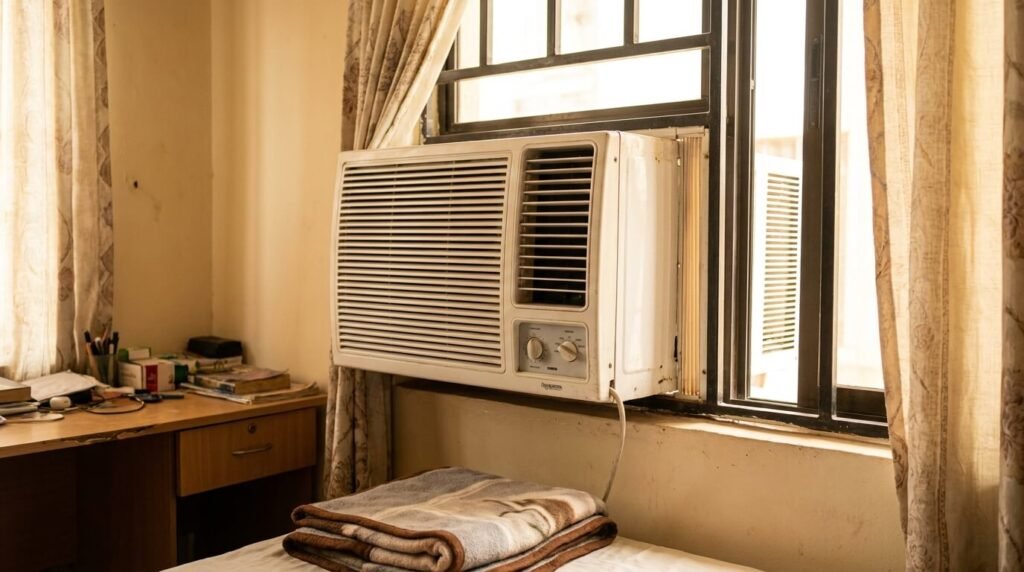
Window ACs are single-box units that fit into a wall or window opening. They’re budget-friendly and don’t require professional installation of two separate units.
Midea Group offers compact window AC models that work well for small bedrooms or studio apartments. The trade-off is noise — the compressor is inside the room, and they’re only practical for smaller spaces.
Portable Air Conditioners
A portable AC moves easily from room to room, making it a flexible option for renters or people who don’t want a permanent installation. Brands like Honeywell produce portable units that vent through a window kit.
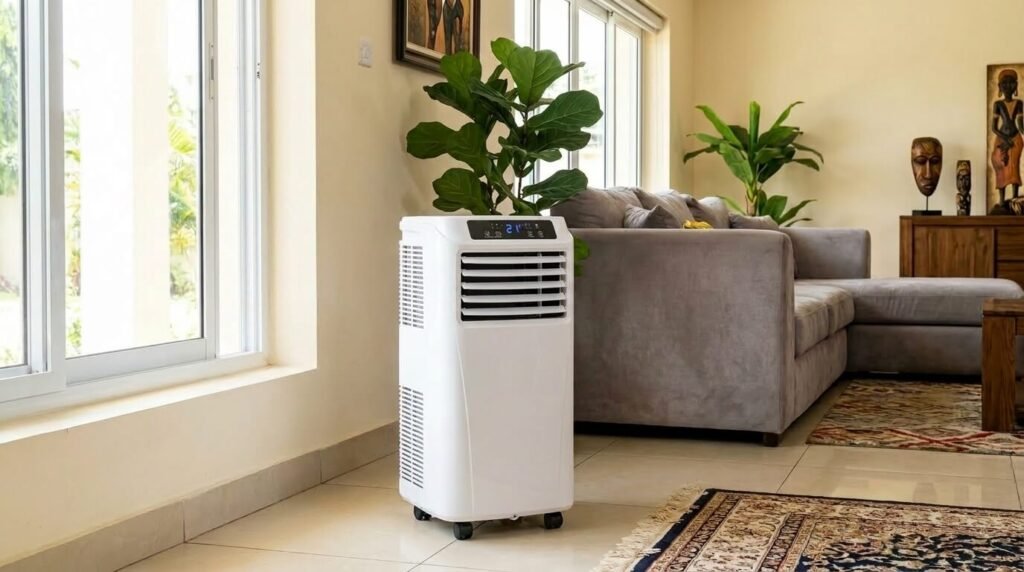
They’re not as efficient as split systems and work best for temporary setups or rooms where installation isn’t possible.
Floor-Standing Air Conditioners
Also called standing ACs or floor-standing units, these are high-capacity systems designed to cool large rooms.
Panasonic, LG, Samsung, Skyrun, and Gree Electric produce powerful standing AC models popular in showrooms, large offices, and open-plan spaces.
They’re visible and don’t require ceiling or wall mounting, but they use more power and take up floor space.
Best Air Conditioners for Nigerian Homes
Best AC for Bedrooms
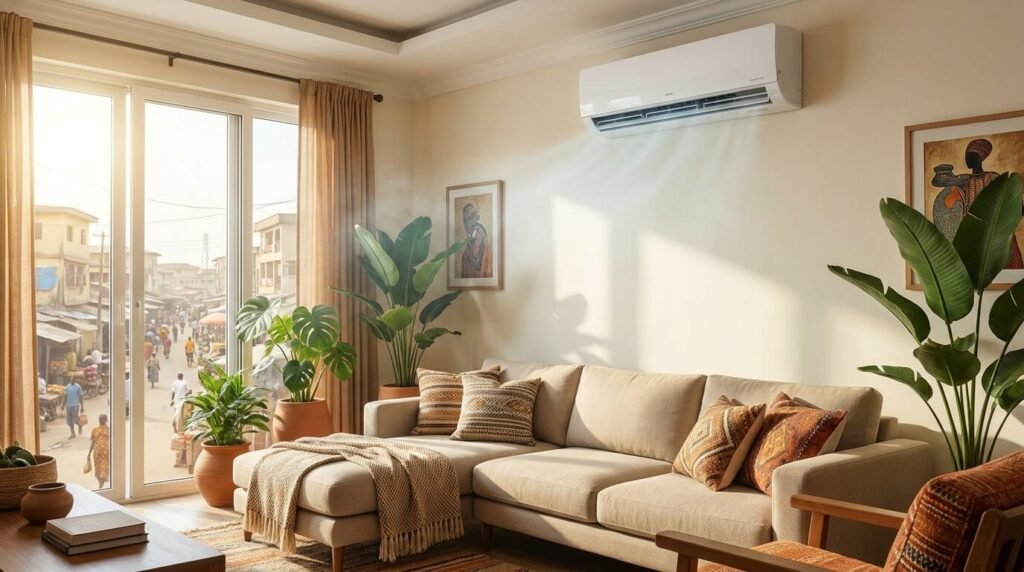
Bedrooms need quiet operation and efficient overnight cooling. An inverter split AC from LG Electronics with sleep mode is ideal, as it gradually adjusts the temperature through the night, saving power and keeping you comfortable without noise disturbance.
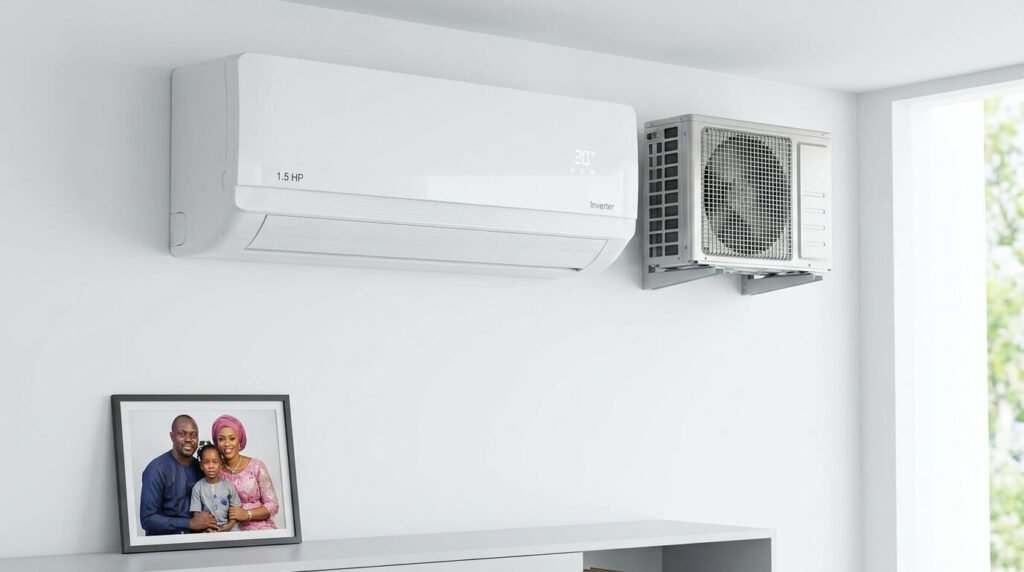
For a standard Nigerian bedroom of around 12–16 square metres, a 1HP unit or 1.5HP is typically sufficient. Noise level is a key factor here; look for units rated below 40 decibels for indoor operation.
Even a non-inverter AC can still provide a quiet operation. Make sure that the outdoor condenser unit is mounted properly and the rubber holding the compressor is firm and not shaking or hitting against the body of the condenser.
Best AC for Living Rooms
Living rooms are usually larger and open to other areas of the house, which means you need more cooling capacity and better airflow distribution.
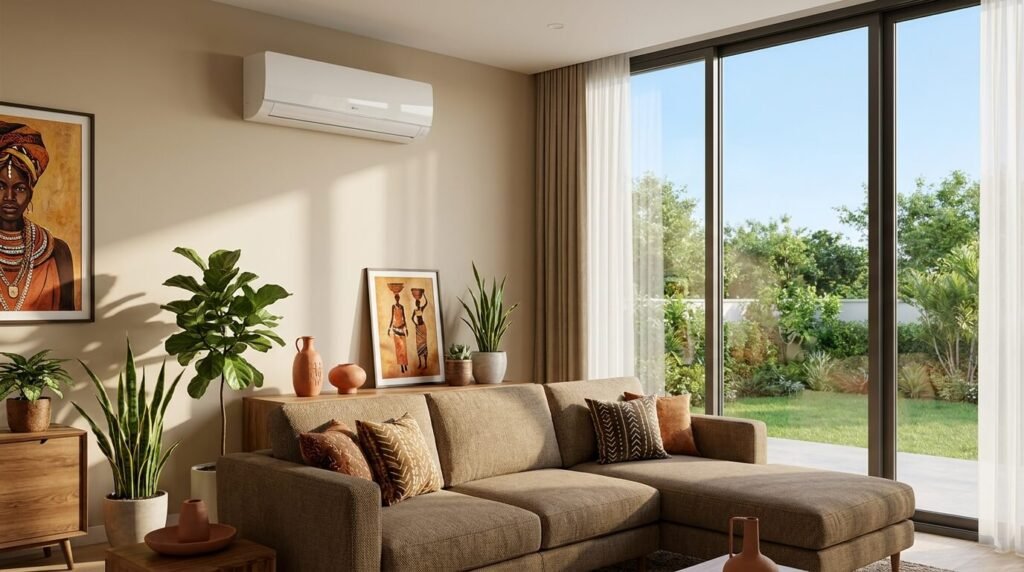
A 1.5HP or 2HP inverter split AC handles this well. Samsung Electronics, Panasonic, and Daikin Industries both offer living room models with turbo cooling features that bring the temperature down quickly when you first turn the unit on, then settle into efficient steady-state cooling.
Best AC for Small Apartments
For studio apartments or small one-bedroom flats, a compact 1HP inverter split AC or a window AC from Midea Group can handle the load affordably.
The goal is to balance upfront installation cost with ongoing electricity consumption. A well-sized inverter unit for a small space will run less aggressively and use less power than an oversized non-inverter unit short-cycling in the same room.
Best Air Conditioners for Nigerian Offices
Best AC for Small Offices
A single 1HP or 1.5HP inverter split AC is usually enough for a private office or small workspace of up to 20 square metres.
Consistent cooling matters more in an office setting than speed, and inverter technology delivers this efficiently.
Panasonic Holdings produces reliable split ACs suited to compact office environments, with air filter systems that maintain cleaner indoor air quality throughout the workday.
Best AC for Large Offices
Open-plan offices with multiple workstations need either multiple split LG, SAMSUNG or Panasonic AC units placed strategically or a cassette AC mounted in the ceiling to distribute air evenly across the space.
Gree Electric and Daikin Industries offer commercial-grade split and cassette systems designed for continuous operation in larger office environments.
Generator compatibility is important here; the AC must be able to start and run reliably on backup power without straining the generator.
Best AC for Commercial Buildings
Large commercial spaces like malls, hospitals, or multi-floor office buildings typically use central AC systems or multiple cassette AC units networked together.
Carrier Global is a leading name in commercial HVAC solutions. Central AC cools buildings through a duct system and works best when designed into the building from the start.
For retrofits, multiple high-capacity floor-standing or cassette units are more practical.
Best AC for Industrial Panel Rooms
While I was working at AB Inbev International Breweries, Onitsha Plant, for 5 years as an AC technician, we recommended Panasonic 5HP Standing Air conditioners becasue they have the ability to withstand high heat, withstand the pressure of all MCC rooms or Panel rooms that controlled all Packaging and Brewing Lines.
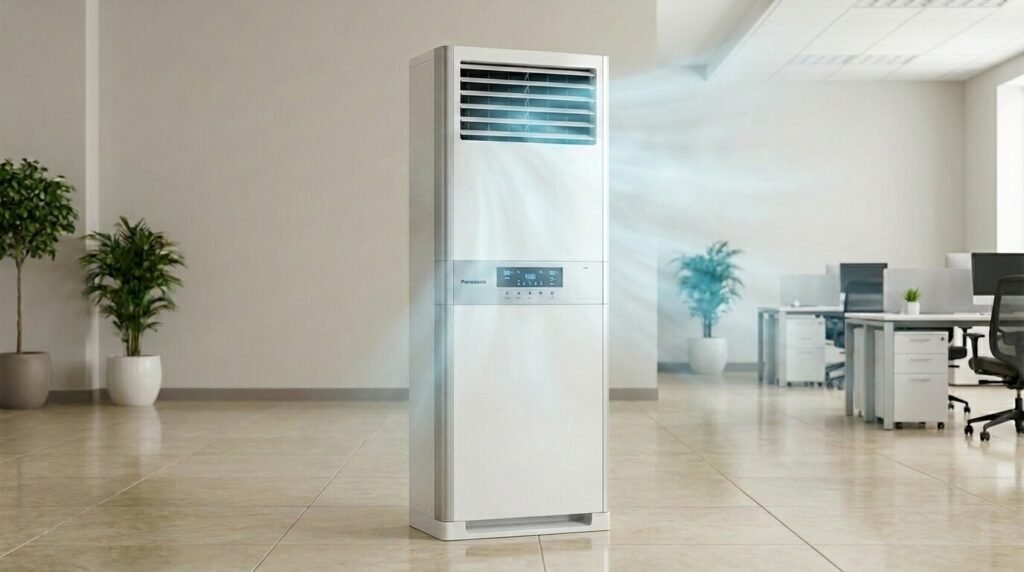
If you need an Air conditioner that can stay rugged in an industrial complex working 24 hours non-stop, then I highly recommend Panasonic 5HP Air Conditioners.
How to Choose the Best AC in Nigeria
Before you buy, read our AC buying guide and tips to know for a comprehensive walkthrough. Here are the most critical factors specific to Nigeria.
Choose the Right Horsepower (HP)
Matching AC capacity to room size is the most important buying decision. A 1HP AC handles roughly 10–14 square metres, a 1.5HP handles 15–20 square metres, and a 2HP handles 20–30 square metres.
These figures assume reasonable insulation and a standard ceiling height. If your room has large windows, poor insulation, or gets direct sun exposure, you may need to go one size up to account for the higher heat gain.
Check Energy Efficiency
Look for inverter technology and energy efficiency ratings. Brands that are Energy Star certified or carry clear energy labels give you a better picture of long-term running costs.
An AC with a dual inverter compressor, like those from Hisense and LG Electronics, offers even greater power savings than standard inverter models by reducing vibration and compressor wear simultaneously.
Consider Power Supply Conditions
Nigeria’s power grid, regulated by the Nigerian Electricity Regulatory Commission, is known for voltage fluctuation and frequent outages.
Choose an AC with built-in auto restart functionality so it resumes cooling automatically after a power cut. If your power supply is particularly unstable, pair your AC with a voltage stabiliser.
Also, confirm the unit is generator compatible; some higher-capacity ACs require a larger generator to start safely.
Budget and Running Cost
Don’t just look at the purchase price. Factor in installation cost, expected electricity consumption, and routine maintenance costs. A cheaper non-inverter AC might cost less to buy, but cost more to run monthly.
Over 5 years, an inverter AC almost always works out cheaper in total cost of ownership for anyone using their AC regularly.
Features to Look for in a Good Air Conditioner
Beyond capacity and efficiency, these features make a real difference in day-to-day use. For more context on what these mean technically, see our complete guide on understanding Air conditioners.
Fast Cooling Mode
Turbo cooling mode runs the AC at maximum capacity for a short period to bring the room temperature down quickly. This is useful when you walk into a hot room and need rapid relief.
Hisense includes turbo cooling in many of its Nigerian market models, and it’s a feature worth looking for if you frequently return to an uncooled room.
Low Noise Operation
Noise level matters, especially in bedrooms and offices. Daikin Industries is particularly well-regarded for producing some of the quietest AC units available, with indoor noise levels as low as 19–22 decibels on certain models.
For reference, normal conversation is around 60 decibels, so a quiet AC barely registers. Check the dB rating in the product specifications before buying.
Air Purification Filters
Standard ACs have basic air filters that catch dust and particles. Some models, particularly from Panasonic Holdings, include more advanced air purification systems that capture finer particles, reduce bacteria, and improve overall indoor air quality.
In Nigerian urban environments where dust and pollution are common, this feature genuinely improves the air you breathe daily.
Smart Controls
Smart ACs connect via Wi-Fi and can be controlled through a smartphone app, even when you’re not home. This lets you turn the AC on before you arrive, set schedules, and monitor energy usage remotely.
Some units integrate with Google Home and other smart home platforms. While not essential, smart controls add convenience and can help manage electricity consumption more intentionally.
Common Problems Nigerians Face With Air Conditioners
Power Fluctuation Damage
Voltage fluctuation is arguably the biggest threat to ACs in Nigeria. Sudden voltage spikes can damage the compressor, control board, and other electronic components.
This is why using a voltage stabiliser is strongly recommended, particularly for non-inverter ACs, which are more vulnerable. Some modern inverter ACs have wider voltage tolerance built in, but a stabiliser still adds a layer of protection.
Poor Cooling Performance
If an AC isn’t cooling properly, the most common causes are low refrigerant from a gas leak, a dirty air filter blocking airflow, or a condenser coil clogged with dirt.
Routine maintenance, cleaning the filter monthly and having a qualified HVAC technician service the unit every 6 months prevent most of these issues.
Refrigerant, whether R-410A or the newer R-32, should only be handled by a professional during a gas refill.
High Electricity Bills
If your electricity bills are higher than expected, the most likely causes are using a non-inverter AC for long hours, setting the thermostat too low unnecessarily, a refrigerant leak making the unit work harder, or simply choosing an AC that’s too large or too small for the room.
Matching the right AC capacity to room size and upgrading to an inverter model are the most effective fixes.
Common Mistakes to Avoid When Buying an AC in Nigeria
Buying Based Only on Brand Name
Brand reputation matters, but it’s not the whole picture. A well-known brand can still sell models that underperform in Nigerian conditions or lack key features like auto restart and generator compatibility.
Focus on the specific model’s specifications, cooling capacity, energy efficiency, refrigerant type, and included features — rather than buying purely on brand recognition.
Choosing the Wrong Size
This is one of the most common and costly mistakes. An AC that’s too small for your room size will run continuously at full load, wear out faster, and still not cool effectively.
An oversized unit will short-cycle, leaving the room too cold and humid. Use room dimensions and the standard HP-to-area guidelines to calculate what you need before buying.
Ignoring Maintenance Costs
The purchase price is just the beginning. Factor in the cost of professional installation, filter cleaning, periodic servicing by an HVAC technician, and potential gas refills over the unit’s life.
Some cheaper AC brands may save you money upfront, but require more frequent repairs and have harder-to-find spare parts, which adds up significantly over time.
Using Poor Installers
A poorly installed AC will underperform regardless of how good the unit is. Incorrect pipe lengths, poor refrigerant charging, bad mounting angles, and inadequate outdoor unit placement all reduce efficiency and lifespan.
Use experienced, certified installers and don’t choose the cheapest option available. A good installation is part of getting the best out of your AC investment.
Conclusion
The best air conditioners in Nigeria come down to matching the right unit to your specific needs — room size, usage hours, power supply conditions, and long-term budget.
There’s no single answer for everyone, but inverter technology, copper condensers, auto restart, and proper horsepower sizing should be non-negotiable priorities.
Compare AC types carefully, factor in energy efficiency and maintenance support, and don’t cut corners on installation. An AC that’s well-chosen and properly maintained will serve you reliably through Nigeria’s toughest heat for years to come.