
An air conditioner’s power requirements come down to four numbers: the amps it draws while running, the voltage it needs, the breaker or switch that protects its circuit, and, if you’re planning for an outage, the much higher surge watts needed to start it.
Most guides answer one of these questions well and ignore the rest, which is how someone ends up sizing a generator off the wrong number or installing a breaker that trips every time the compressor kicks on.
This guide walks through all four in order, with real figures for window, portable, mini-split, and central systems, plus a Nigeria-specific section for readers dealing with generator backup rather than a stable grid.
How Many Amps Does an Air Conditioner Actually Use?
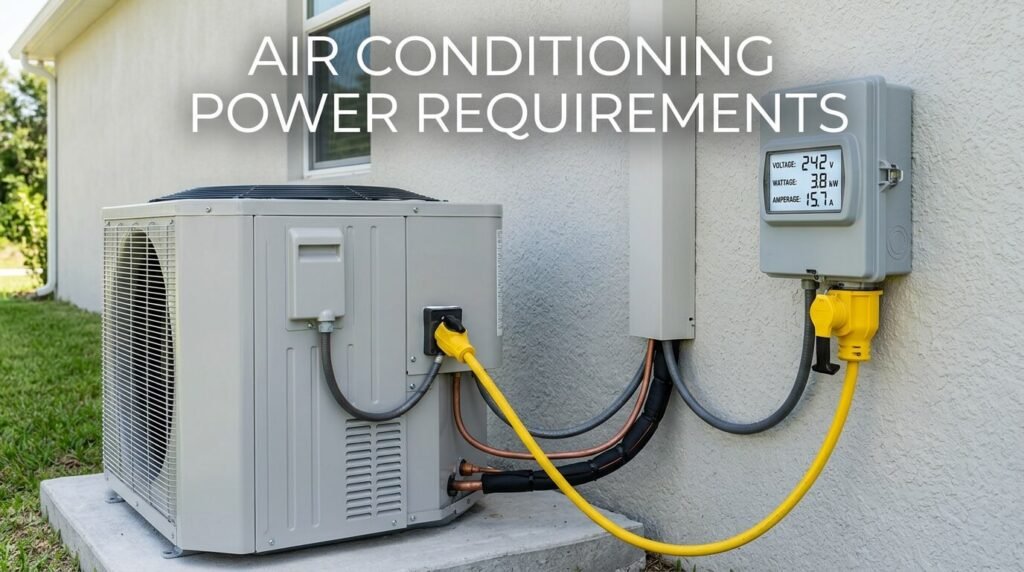
A typical residential air conditioner draws between 5 and 40 amps, depending on its size and the voltage of its circuit.
Small window units on a 115V outlet need the least current, while central systems on a 230V dedicated circuit need the most.
Amp Draw by AC Type and Tonnage
| AC type | Capacity | Typical amp draw |
|---|---|---|
| Window unit | 5,000-8,000 BTU | 5-7A at 115V |
| Window unit | 8,000-12,000 BTU | 7-10A at 115V |
| Window unit | 12,000-24,000 BTU | 10-15A at 115V |
| Mini-split | Smaller systems | 15-20A, dedicated circuit |
| Mini-split | Larger systems | 30-40A, dedicated circuit |
| Central AC | 2-ton | 15-20A |
| Central AC | 3.5-ton | 25-30A |
| Central AC | 5-ton | 30-40A |
Amp Draw by Exact BTU Size
| BTU rating | Running watts (8–13 EER range) | Amps at 115V | Amps at 230V |
| 9,000 BTU | 690–1,125W | 6.0–9.8A | 3.0–4.9A |
| 12,000 BTU | 920–1,500W | 8.0–13.0A | 4.0–6.5A |
| 15,000 BTU | 1,150–1,875W | 10.0–16.3A | 5.0–8.2A |
| 18,000 BTU | 1,385–2,250W | N/A — requires 230V circuit | 6.0–9.8A |
| 24,000 BTU | 1,845–3,000W | N/A — requires 230V circuit | 8.0–13.0A |
Ranges reflect the difference between older, lower-efficiency units and modern inverter models. Always confirm against the nameplate’s rated load amps (RLA) for an exact figure.
What Determines an AC’s Amp Draw
- Cooling capacity is the biggest factor, since a larger BTU or tonnage rating always requires more current to move the same amount of heat in the same amount of time.
- Efficiency rating changes the draw within the same tonnage: a 2-ton unit at 20 SEER draws around 6.6 amps, while a 2-ton unit at 8 SEER can draw nearly 16.5 amps for the identical cooling output.
- Voltage and amperage trade off directly, so a unit wired for 115V draws roughly double the amps of the same wattage unit wired for 230V.
- The compressor’s startup moment briefly spikes current far above its running amps, which matters for breaker sizing and matters even more for generator sizing, covered later in this guide.
- Room size and insulation quality affect how long and how hard the compressor runs, which changes total energy used even when the rated amp draw stays the same. Run your room’s dimensions through our free aircon BTU calculator to check whether you’re sizing for the right capacity in the first place.
- Kilowatts convert to amps the same way watts do: divide the AC’s kW rating by its voltage, then multiply by 1,000. A 3.5 kW air conditioner draws about 15.2 amps on a 230V circuit or roughly 30.4 amps on a 115V circuit — well above what a standard 115V outlet is rated for, which is why most 3.5 kW-plus units are wired to 230V.
What Voltage Does Your Air Conditioner Need?
Most small AC units run on a standard 120V household circuit, while larger window units, all mini-splits, and every central system need a dedicated 208V to 240V circuit.
Voltage Requirements by AC Type
| AC type | Standard voltage | Notes |
|---|---|---|
| Portable | 110/120V | Plugs into a standard outlet |
| Window (small, under 15,000 BTU) | 110/120V | Standard outlet |
| Window (large) | 208/240V | Specialized plug, dedicated circuit |
| Through-the-wall (TTW) | 110/120V or 208/240V | Depends on capacity |
| Mini-split | 208/240V (smaller units sometimes 110/120V) | Always a dedicated circuit |
| Central | 208/240V | Hard-wired, dedicated circuit |
The normal voltage for residential AC in the US falls into one of these two bands: 120V for smaller plug-in units and 208 to 240V for anything with meaningful cooling capacity.
Outside North America, split and window units commonly run on a 220 to 240V single-phase supply, which is why the wiring conversation looks different once you cross into Nigeria, the UK, or most of Europe.
Does a Mini Split Need a Dedicated Circuit?
Yes, every mini-split system needs its own dedicated circuit, regardless of size.
Smaller mini-splits typically need a 15- to 20-amp dedicated circuit, while larger BTU systems can require 30 to 40 amps, and running one on a shared circuit with other appliances risks nuisance tripping and voltage sags that shorten compressor life.
Both the indoor air handler and the outdoor condenser draw from this same circuit in most residential installations, so the dedicated-circuit requirement applies to the system as a whole, not just the outdoor unit.
Portable Air Conditioner Power Requirements
Portable units run on a standard 110/120V household outlet, drawing noticeably less current than window or split systems of the same cooling capacity because most stay under 14,000 BTU.
Portable AC Power Requirements by Size
| Portable AC size | Running amps (110–120V) | Plug type |
| 8,000–10,000 BTU | 6–9A | Standard NEMA 5-15 (15A) |
| 10,000–12,000 BTU | 9–11A | Standard NEMA 5-15 (15A) |
| 12,000–14,000 BTU | 11–13A | Often NEMA 5-20 (20A); dedicated circuit recommended |
Because portable units plug into an existing outlet rather than a dedicated circuit, they’re more likely to share that circuit with other appliances.
Running one on the same 15A circuit as a microwave or space heater is a common cause of nuisance tripping, even though the AC itself is well within its rated amps.
How Much Electricity Does an Air Conditioner Actually Use?
An AC’s power in watts equals its voltage multiplied by its amperage, and residential units typically range from about 500 watts for a small portable unit to over 4,000 watts for a large central system at startup.
Watts by BTU and HP (12,000 BTU and 1.5HP Examples)
| Unit | Running watts | Starting watts (surge) |
|---|---|---|
| 1HP / 9,000-10,000 BTU | 900-1,100W | 1,800-3,300W |
| 1.5HP / 12,000-14,000 BTU | 1,200-1,500W | 2,400-4,500W |
| 12,000 BTU (1-ton, general) | ~1,100-1,200W | 2,400-3,600W |
| Central, 24,000 BTU (2-ton) | ~2,275W average | 4,500-11,000W, depending on LRA |
A 12,000 BTU unit running at a typical 10 EER rating draws roughly 1,200 watts while cooling, which lines up closely with a 1.5HP split unit’s non-inverter running draw.
See the 1HP vs 1.5HP air conditioner comparison for how these same wattage figures translate into room-size recommendations.
How Many Amps Does a 1HP–3HP Air Conditioner Use?
Amp draw for HP-rated units follows the same watts-over-volts math as BTU-rated ones, using a standard 220–230V supply common outside North America.
Amps by HP Rating (220–230V)
| HP rating | Approx. BTU | Running amps | Starting amps (surge) |
| 1HP | 9,000–10,000 BTU | 4.1–5.0A | 8.2–15.0A |
| 1.5HP | 12,000–14,000 BTU | 5.5–6.8A | 10.9–20.5A |
| 2HP | ~18,000 BTU | ~8.2A | 16.4–30A |
| 3HP | 24,000–27,000 BTU | ~12.3A | 24.5–45A |
These figures scale from the running and starting watts already covered above, converted at 220–230V.
As with tonnage, HP is a rough sizing label — two “1.5HP” units from different manufacturers can carry different rated currents, so treat the nameplate’s RLA and LRA figures as final.
Daily and Monthly Consumption: Nigeria vs USA Examples
| Unit | Daily kWh (8 hrs/day) | Nigeria cost/month (Band B, ₦117/kWh) | USA cost/month ($0.16/kWh) |
|---|---|---|---|
| 1HP (~1,000W avg) | 8 kWh | ~₦28,080 | ~$38.40 |
| 1.5HP (~1,350W avg) | 10.8 kWh | ~₦37,908 | ~$51.84 |
| 12,000 BTU / 1-ton (~1,150W avg) | 9.2 kWh | ~₦32,270 | ~$44.16 |
A 1.5HP air conditioner running eight hours a day uses about 324 kWh a month, which costs roughly ₦37,908 on Nigeria’s Band B tariff or about $51.84 in a typical US market at $0.16 per kWh.
The gap between these two figures is not just a currency conversion; it reflects genuinely different electricity pricing structures, so a US-focused “average monthly AC cost” figure is close to meaningless for someone budgeting in naira, and vice versa.
For a full walkthrough of how HP size affects this monthly total, use the split AC power consumption calculator to run your own unit and usage hours through the math.
What Size Breaker or Switch Do You Need for an Air Conditioner?
Breaker and switch sizing comes from the nameplate’s minimum circuit ampacity, not the unit’s tonnage alone, and installing one sized purely by guesswork risks either nuisance tripping or a genuine fire hazard.
Reading MCA and MOP on the Nameplate
MCA (Minimum Circuit Ampacity) is the smallest wire gauge and breaker rating the unit can safely run on, printed directly on the outdoor condenser’s nameplate.
MOP (Maximum Overcurrent Protection) is the largest breaker rating allowed on that same circuit, set as a ceiling to protect the wiring if something goes wrong internally.
For example, a 4-ton AC with an MCA of 20 amps and an MOP of 35 amps needs a breaker sized somewhere between those two numbers, and the wire gauge must handle at least the 20-amp MCA continuously.
Choosing a breaker below the MCA causes nuisance tripping, while exceeding the MOP leaves the wiring unprotected in a fault condition.
Breaker Size by Tonnage (NEC 125% Rule)
| Tonnage | Typical breaker size |
|---|---|
| 1 ton | 15A |
| 1.5 ton | 20A |
| 2 ton | 20-25A |
| 3 ton | 25-30A |
| 3.5 ton | 25A |
| 5 ton | 30-40A |
These figures are approximate starting points, not a substitute for the nameplate.
The National Electrical Code treats air conditioning as a continuous load, which means the breaker and wire must be sized for 125 percent of the unit’s rated running amperage rather than the raw amp figure alone, so a unit drawing 40 amps needs a breaker rated for at least 50 amps under this rule.
Is a 16A Switch Enough for Your AC?
Yes, a 16A isolator switch is enough for most residential split units up to about 2HP, but it becomes a bottleneck for larger 3HP-plus systems and central air.
At a typical 230V supply, a 16A switch supports roughly 3,680 watts at full load, and applying the same 80 percent continuous-load derating used elsewhere in AC wiring brings the safe continuous capacity to about 2,944 watts.
A 1HP unit running at 900 to 1,100 watts and a 1.5HP unit at 1,200 to 1,500 watts both sit comfortably within that limit, but a 3HP unit or larger, along with most central systems, exceeds it and needs a 20A- or 32A-rated switch instead.
Always confirm against the specific MCA on your unit’s nameplate rather than relying on HP alone, since two “1.5HP” units from different manufacturers can carry different rated currents.
What Happens If the Breaker Is Too Small
- The breaker trips repeatedly, often right at compressor startup, which can eventually damage the breaker itself from repeated stress.
- Nuisance tripping during hot weather leaves the AC unusable exactly when it’s needed most, since the surge that trips the breaker happens every single time the compressor cycles on.
- An undersized circuit run at its limit generates excess heat in the wiring, which is a genuine fire risk over time rather than just an inconvenience.
- Repeated hard stops from tripping can shorten the compressor’s lifespan, since the motor doesn’t get to complete its normal startup and run cycle. For a full breakdown of what correcting an undersized circuit adds to your total installation cost, see the full air conditioner installation cost guide.
What Size Wire Do You Need for an Air Conditioner?
Wire gauge depends on the circuit’s amperage, not directly on the AC’s tonnage, and undersized wire is one of the most common defects found during electrical inspections of AC installations.
Wire Gauge by Amp Load
| Circuit amperage | Minimum wire gauge (copper) |
|---|---|
| Up to 15A | 14 AWG |
| 15-20A | 12 AWG |
| 20-30A | 10 AWG |
| 30-40A | 8 AWG |
| 40-55A | 6 AWG |
Why Wire Size and Breaker Size Aren’t Always Matched
Unlike most household circuits, an air conditioner’s wire size and breaker size don’t need to match exactly, because compressors contain a built-in thermal cutout that shuts the motor down before wiring temperatures become a hazard.
This is why a data plate can list a maximum overcurrent protection rating well above the minimum circuit ampacity: the wire is sized to the MCA, and the breaker can legally sit closer to the MOP without the mismatch being a safety defect.
An electrician sizing your circuit should still follow both numbers from the nameplate rather than assuming one figure covers both requirements, since getting this wrong is flagged in home inspections more often than almost any other AC wiring issue.
What Size Generator Do You Need to Run an Air Conditioner?
Generator sizing depends on starting watts, not running watts, and undersizing based on the wrong number is the single most common mistake people make when planning AC backup power.
Before sizing a generator, it helps to know your unit’s actual running wattage, covered in the lowest energy consumption AC guide, since a more efficient unit needs a smaller generator on both counts.
Why Running Watts Are the Wrong Number to Start From
Running watts (also called RLA, or rated load amps, multiplied by voltage) is what the compressor draws once it’s already spinning and stable.
Starting watts come from a different number entirely: LRA, or locked rotor amps, the current the motor draws for a fraction of a second while it overcomes the resistance of a stationary compressor.
Starting watts typically run 2 to 6 times higher than running watts, and central systems specifically tend toward the higher end of that range, sometimes 3 to 5 times running wattage.
A worked example makes the gap concrete: an AC with an LRA of 75 amps on a 240V circuit needs 75 × 240, or 18,000 starting watts, even if its running wattage is only a few thousand watts once it stabilizes.
A generator sized only for the running number will stall or trip its own breaker the instant the compressor tries to start.
Starting Watts vs Running Watts by AC Type
| AC type | Running watts | Starting watts (surge) |
|---|---|---|
| Portable | 500-1,600W | 1,000-3,200W |
| Window | 900-1,500W | 1,800-3,000W |
| Mini-split, inverter | 600-1,500W | Close to running watts, soft-start |
| Mini-split, non-inverter | 600-1,500W | 1,800-4,500W |
| Central, per ton | ~1,100-1,600W | 3,500-7,000W or more per ton |
How Soft Start Kits Change the Generator Math
A soft-start device, such as the Micro-Air EasyStart used widely in RV and residential HVAC installations, cuts a compressor’s starting-watt surge by 60 to 70 percent by ramping the motor up gradually instead of slamming it to full current all at once.
This changes the generator conversation significantly: a 7,500-watt generator normally can’t handle the 10,000-plus starting watts a standard 3- to 4-ton central AC demands, but with a soft-start kit installed, that same 7,500-watt generator can start and run the unit, provided other household loads are managed carefully during the compressor’s startup moment.
If your existing generator trips every time your AC kicks on, a soft-start kit is usually a cheaper fix than buying a larger generator outright.
How Do Power Requirements Change in an Unreliable Grid Market Like Nigeria?
In markets with frequent outages, generator and battery sizing matters as much as the electricity bill itself, and the inverter-versus-non-inverter choice changes both numbers substantially.
Matching Generator Size to Inverter vs Non-Inverter AC
For a closer look at specific models, see the best inverter air conditioners for 2026. The table below shows why the technology choice changes your generator budget as much as your electricity bill.
| AC type (Nigeria) | Running wattage | Recommended generator size |
|---|---|---|
| Non-inverter split, 1HP | ~1,000W | 2.5-3 kVA (startup surge up to 3x running load) |
| Non-inverter split, 1.5HP | ~1,350W | 3.5-4 kVA |
| Inverter split, 1HP | ~650-700W | 1.5-2 kVA (soft-start, minimal surge) |
| Inverter split, 1.5HP | ~950W | 2-2.5 kVA |
A non-inverter compressor’s startup surge is the same mechanism covered earlier in this guide: a 1,000-watt non-inverter 1HP unit can spike to roughly 3,000 watts for a second or two, which forces the generator size up.
An inverter unit’s soft-start electronics avoid most of that spike, so the same cooling output runs on a generator roughly half the size, which lowers both the upfront generator cost and the fuel burned per hour of daily use.
Sizing a Solar/Battery Backup Instead of a Generator
- Size the inverter component of a solar or battery system to comfortably exceed the AC’s starting watts, not just its running watts, using the same LRA-based math covered earlier in this guide.
- Choose an inverter-technology AC over a non-inverter one wherever possible for battery backup specifically, since the smaller starting surge lets you use a smaller, less expensive inverter and battery bank for the same cooling output.
- Calculate battery capacity by multiplying the AC’s running watts by your desired backup runtime in hours, then convert to kWh; a 700-watt inverter AC running for four hours during an outage needs roughly 2.8 kWh of usable battery capacity.
- Favor lithium battery banks over lead-acid where the budget allows, since lithium tolerates deeper daily discharge cycles without the rapid capacity loss that shortens a lead-acid bank’s usable life under frequent generator-replacement duty.
Not sure which AC size fits your room before you size the electrical circuit? Run it through the free aircon BTU calculator first so you’re wiring for the unit you actually need, not the one a generic chart suggested.
Frequently Asked Questions
Why did my generator trip when my AC started, even though it’s rated for more watts than the AC uses?
Your generator is almost certainly sized for the AC’s running watts rather than its starting watts, and the startup surge, which can run 2 to 6 times higher than the running figure, is what’s tripping it.
Check the compressor’s LRA (locked rotor amps) rating on the nameplate, multiply it by the circuit voltage, and compare that number, not the running-watts figure, against your generator’s rated and surge capacity.
If the gap is large, a soft-start device can cut that starting surge by 60 to 70 percent and may let your existing generator handle the load without needing to buy a larger unit.
Is 110V or 220V better for an air conditioner?
Neither voltage is inherently better, since power in watts, not voltage, determines how much electricity a unit uses and what it costs to run.
A 900-watt AC draws about 8.2 amps at 110V or about 4.1 amps at 220V, consuming identical wattage either way; voltage only changes the amperage needed to deliver that power.
Voltage becomes a real factor once a unit’s capacity climbs past roughly 15,000 BTU, since delivering that much power at 110V would require impractically high amperage and heavier wiring, which is why larger window units, all mini-splits, and every central system are built around a 220 to 240V circuit instead.
What size generator do I need to run a 1.5 ton AC?
A 1.5-ton AC typically needs a generator rated for at least 3,500 to 4,500 starting watts, since its running wattage of roughly 1,200 to 1,500 watts is not the number that matters for generator sizing.
Check the unit’s nameplate for its LRA rating and multiply by the circuit voltage for an exact figure rather than relying on a generic tonnage rule of thumb, since two 1.5-ton units from different manufacturers can have meaningfully different starting-current profiles.
If your generator options top out below that starting-watt figure, a soft-start kit is usually the more affordable fix compared to buying a larger generator outright.
Can I run my AC for 24 hours straight?
Yes, most residential air conditioners are designed to run continuously for 24 hours or more without damage, provided the unit is correctly sized for the room, and the circuit breaker and wiring were sized to handle a continuous load in the first place.
The main risk isn’t the compressor itself, which is built for long duty cycles, but an undersized circuit that was never rated for continuous operation, since the NEC’s 125 percent continuous-load rule exists specifically to keep wiring safe under exactly this kind of sustained use.
If you’re running an AC around the clock during extended hot weather, a clean air filter and a properly sized unit for the space matter more for long-term reliability than the hours of operation themselves.