
The best air conditioning for most homes or offices is either a standard air conditioner (non-inverter) or an inverter unit of the right type, sized to the room with a BTU number you can trust.
Get those two things right, and the brand matters far less.
Should we care less about brands? Of course not! When comparing air conditioning system brands, there are basic things every buyer should have in mind before deciding: the location of the AC, how many hours it will run in a day, durability, and the maintenance and repair costs of that brand.
We don’t want you to guess in the dark. This guide answers your questions first, then covers sizing, the ratings printed on the box, and the models we have installed over 5 years.
| Your situation | Best type | Typical size |
|---|---|---|
| Small bedroom or office (up to 150 sq ft) | Window unit | 5,000 BTU |
| Bedroom or living room (150-450 sq ft) | Inverter window unit or mini-split | 9,000-12,000 BTU |
| A window that can’t hold a unit | Dual-hose portable | Size by SACC rating |
| Open-plan area (450-1,000 sq ft) | Mini-split or large window unit | 18,000-24,000 BTU |
| Whole home | Central or ducted split system | Set by a Manual J load calculation |
Top 10 Air Conditioning System Brands: Which One Fits Your Home or Office?
Here is our aircon brand list, with the names of air conditioners we see most often and what each brand is best for.
The right pick depends on your budget, how long the AC runs each day, and how easy it is to get parts and a technician near you.
| Brand | Best for |
|---|---|
| Daikin | Long-term reliability and efficiency |
| LG | All-round pick for homes |
| Samsung | Quiet bedrooms and smart features |
| Mitsubishi Electric | Quiet, premium cooling |
| Panasonic | Robust cooling, reliability, efficiency, cleaner air, heavy use and steady performance |
| Carrier | Offices and heavy daily use |
| Midea | Value for money |
| Hisense | Tight budgets, inverter and smart control |
| Haier (Thermocool) | Local service and spare parts |
| Gree | Affordable inverter options and robust cooling features. |
1. Daikin
Daikin builds air conditioners and little else, and it shows. Its inverter units are known for efficiency and for lasting years with little trouble. They cost more upfront, but if the AC runs 10 to 12 hours a day, the savings on power and repairs add up. Best for: people who want to buy once.
2. LG
LG is the safe choice for most homes. The Dual Inverter range cools fast, runs fairly quietly, and the brand is easy to find in most stores. Parts and technicians are not hard to get. Check the compressor warranty terms before you buy. Best for: homes that want a dependable all-rounder.
3. Samsung
Samsung’s strength is quiet operation and smart features. The WindFree models spread cool air gently instead of blowing it straight at you, which many people like in a bedroom. You pay a bit extra for the tech. Best for: bedrooms and small living rooms.
4. Mitsubishi Electric
Mitsubishi Electric is a premium brand with very low noise and strong energy efficiency. It is not the cheapest, and fewer shops stock it, so confirm that a service partner is near you. Best for: buyers who value silence and efficiency over price.
5. Panasonic
Panasonic units are steady and well-built, and many models add air-cleaning features like nanoe technology. They suit people who care about air quality as much as cooling. Best for: families, industrial complexes, and anyone with allergies or dust at home.
6. Carrier
Carrier has been in air conditioning for over a century, and its units hold up under hard daily use. That makes it a common choice for offices, shops, and larger spaces. Best for: workplaces and rooms that run all day.
7. Midea
Midea is among the world’s biggest makers, and it sells good inverter models at lower prices than the big Japanese and Korean names. Quality is solid for the money. Best for: people who want an inverter without the premium price tag.
8. Hisense
Hisense is a budget-friendly pick with decent inverter options. It won’t match Daikin on lifespan, but it cools well for the price. Make sure you buy from a seller who can honour the warranty. Best for: first-time buyers and tight budgets.
9. Haier (Thermocool)
In Nigeria, Thermocool is part of the Haier family, and its biggest advantage is local support. Parts and repairs are easier to find than for some imported brands. Best for: buyers who worry most about after-sales service.
10. Gree
Gree is the world’s largest AC maker by volume, and it prices its inverter units to compete. Cooling is good, though service coverage varies by area, so ask where repairs are handled before you pay. Best for: cost-conscious buyers who still want an inverter.
How to choose between them
If you can only remember three things: pick the right BTU for your room size, match inverter or non-inverter to how many hours you run it, and choose a brand whose parts and technicians are close to you.
A well-sized mid-range unit with good local service beats an expensive unit nobody nearby can fix.
Which Type of Air Conditioner is Best?
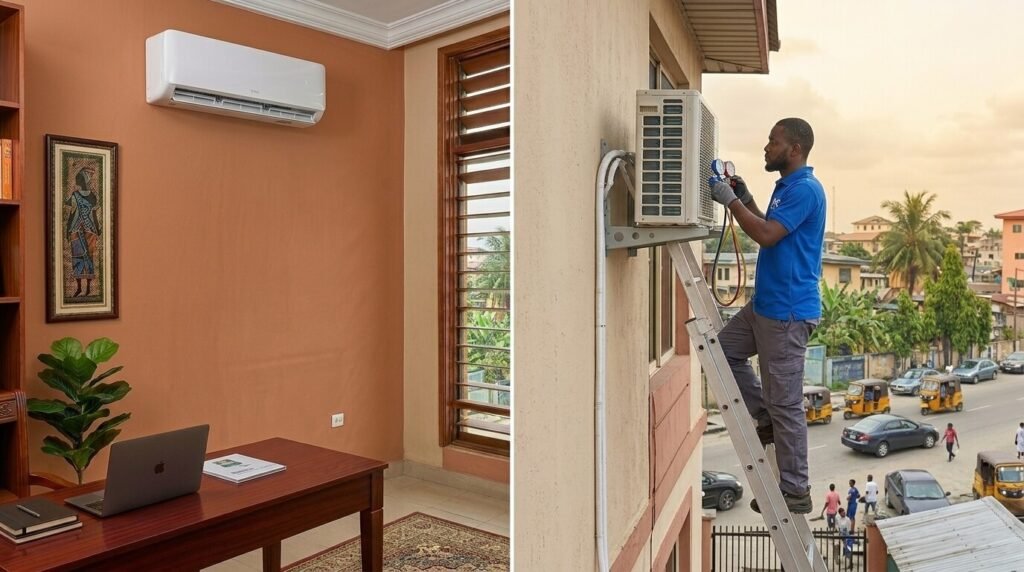
There is no single best air conditioner brand to use because each brand does come with various features.
Rather, the best air conditioner starts with the right AC type for your space.
Window units fit single rooms; mini-splits of either1HP, 1.5HP, or 2HP split AC systems fit rooms or offices where you want quiet, efficient cooling; portables fit spaces where nothing else can be installed, and central systems fit whole homes.
To learn more about different mini AC split capacity rating sizes, read our comprehensive guide on the difference between 1HP versus 1.5HP air conditioners.
You would agree with me that Window units remain one of the affordable ways to cool a room no matter your country, while central air is usually the better value once you are cooling most of a house.
Window vs portable vs mini-split vs central AC
| Type | Upfront cost | Installation | Cooling and efficiency | Best for | Main drawback |
|---|---|---|---|---|---|
| Window | Low | Simple, DIY | Efficient, especially inverter models | One room | Takes up a window |
| Portable, single-hose | Low to medium | Window kit | Weakest; pulls warm air in through gaps | Short-term use, no alternative | Real output well below the label |
| Portable, dual-hose | Medium | Window kit | Cools more efficiently than single-hose | Rooms where windows can’t hold a unit | Bulky, still behind window units |
| Mini-split | High | Professional | Quiet, efficient, can also heat | Single rooms or zones, homes without ducts | Installation cost |
| Central or split system | Highest | Professional, ducts required | Best value for whole homes | Whole-home cooling | Cost and ductwork |
| Portable AC-heater combo | Medium | Window kit | Adds heat; check heating and SACC ratings | Year-round single-room use | Compromises on both jobs |
5-question decision router
- Are you cooling one room or the whole home? For one room, go to question 3. For the whole home or three or more rooms, go to question 2.
- Does the home already have ductwork? If yes, choose a central split system. If no, choose a multi-zone mini-split.
- Can you make a permanent installation, either because you own the home or your landlord allows it? If yes, choose a ductless mini-split. If no, go to question 4.
- Does a window open and fit a standard bracket? If yes, choose an inverter window unit. If no, choose a dual-hose portable sized by SACC.
- Is the room hot, humid, or sun-facing? If yes, size at 30 BTU per square foot or more and choose an inverter. If no, size at 20 to 25 BTU per square foot.
Is an inverter air conditioner worth it?
Inverter compressor: a compressor that changes speed to match the cooling load instead of switching fully on and off.
- Inverter units typically hold a steadier temperature and use less energy when you cool often or for long stretches.
- Inverter and U-shaped window units tend to be the quietest.
- The technology has moved beyond premium models and is now common in the midrange.
- A non-inverter unit can still make sense if you cool only occasionally or have the smallest upfront budget.
For a full comparison, read inverter vs non-inverter AC and the comprehensive guide on Inverter Air Conditioner systems.
What size Air Conditioner do you Need?
You can begin at 20 to 25 BTU per square foot in a moderate climate with average insulation.
Hot, humid, or leaky homes may need 30 or more.
One ton of cooling equals 12,000 BTU per hour, and whole-home systems should be finalized with a Manual J load calculation rather than square footage alone.
BTU chart by room size
| Room size (sq ft) | Capacity | Tonnage | Typical use |
|---|---|---|---|
| Up to 150 | 5,000 BTU | 0.4 | Small bedroom, home office |
| 150-300 | 9,000 BTU | 0.75 | Bedroom, small office |
| 300-450 | 12,000 BTU | 1.0 | Master bedroom, small living room |
| 450-700 | 18,000 BTU | 1.5 | Open living area |
| 700-1,000 | 24,000 BTU | 2.0 | Large open-concept space |
For example, the 150-1,000 sq ft row is for inverter mini-split heads. The 5,000 BTU row reflects small window units rated to 150 sq ft.
Adjustments: sun, ceiling height, people, kitchen
- Rooms with large west- or south-facing windows gain more solar heat and need more capacity; for example, in West Africa or East Africa’s climate, this sizing comes in handy.
- Tall ceilings add air volume to cool, so raise capacity as ceiling height goes up.
- We also recommend adding about 600 BTU for each person beyond two who regularly use the room, and about 4,000 BTU for a kitchen.
- An older, poorly insulated home in a hot climate can need a full ton.
Portable ACs: SACC vs ASHRAE BTU ratings
ASHRAE BTU: the older rating, measured at 80°F and 51% relative humidity, which ignores the warm air a portable pulls back into the room.
SACC (Seasonally Adjusted Cooling Capacity): the Department of Energy’s rating, a weighted average across temperatures and humidity levels that accounts for duct heat transfer and infiltration air. It has been required on portable AC EnergyGuide labels since October 2017.
Size a portable by its SACC, not the headline BTU. A single-hose unit exhausts room air, which draws hot outdoor air in through every gap, and no single formula converts one rating to the other.
| Unit example | Advertised (ASHRAE) | SACC |
|---|---|---|
| LG portable | 14,000 BTU | 10,000 BTU |
| Midea | 10,000 BTU | 7,100 BTU |
| Typical 12,000 BTU portable (Tonnage Calculator) | 12,000 BTU | 6,800 BTU |
Window and central units lose less to infiltration, so their labels are more reliable.
What happens if the AC is too big or too small?
- An oversized unit cycles on and off often, which wastes energy and leaves humidity uneven.
- Inverter units tolerate minor oversizing because they modulate output, but a unit far larger than the room still short-cycles.
- An undersized unit runs nonstop without reaching the set temperature, which raises energy use and causes compressor issues; electronic components ( in the evaporator and condenser units) might burn out and wear.
- Placing the thermostat away from direct airflow reduces short-cycling in small rooms.
How to read AC efficiency ratings and 2026 rules
Three changes shape 2026 purchases in the US. SEER2 replaced SEER as the efficiency test, new residential systems now use A2L as new refrigerants (R-32 or R-454B), and AHRI directory listings require SEER2 values.
These are US rules, but the ratings and refrigerant names appear on units sold worldwide.
SEER vs SEER2 vs EER vs CEER
SEER: Seasonal Energy Efficiency Ratio, seasonal cooling output divided by energy used, measured under the older test.
SEER2: the same measure under the Department of Energy’s updated, tougher test. A 15 SEER system from five years ago does not equal 15 SEER2 today.
EER: cooling output in BTU per hour divided by watts, measured at one fixed test condition.
CEER: Combined Energy Efficiency Ratio, the room air conditioner rating, which includes standby power.
Minimum SEER2 by region
| Region | Minimum SEER2 (split-system AC) |
|---|---|
| Northern states | 13.4 |
| Southern states, including Texas | 14.3 |
| Utility rebate programs | 15.2 and above |
Confirm current minimums with the Department of Energy before buying.
R-454B and R-32: Does your old AC become illegal?
No. A working R-410A or R-22 unit is still legal to run and repair. Only new equipment has changed.
| Feature | R-410A (old) | R-32 | R-454B |
|---|---|---|---|
| Global warming potential | 2,088 | 675 | 466 |
| Safety class | A1 | A2L (mildly flammable) | A2L (mildly flammable) |
| New US residential installs from Jan. 1, 2026 | Not permitted | Permitted | Permitted |
| Service outlook | Refrigerant cost rising as supply tightens | Widely stocked | Widely stocked |
- Old units cannot simply be converted. Equipment must be designed and approved for A2L refrigerants unless the manufacturer says otherwise for your exact system.
- A2L does not mean highly flammable. The class denotes lower toxicity and mild flammability.
Best Air Conditioners By Type
These picks reflect the various AC brands that we have installed, maintained, and repaired for over 5 years.
Check current price and availability before you buy, as prices depend on AC brand, model, and country.
Best window air conditioners
| Pick | Best for | Capacity | Why it stands out |
|---|---|---|---|
| LG Medium Dual Inverter Smart | Overall | 10,000 BTU | Powerful, efficient, quiet, and easy to operate |
| Midea U-Shaped Inverter | Efficiency | 10,000 and 12,000 BTU | Balances efficiency with a modern design |
| Midea Smart | Most households | 8,000 BTU | Efficient and quiet, with app timers |
| TCL or Samsung 5,000 BTU | Small rooms | 5,000 BTU | Lightweight, compact, easy to install |
| LG or Panasonic | Homes or Offices | 6,000 BTU | Durability and Effective Cooling |
| Whirlpool 24,000 BTU | Large spaces | 24,000 BTU | Electronic controls |
Best portable air conditioners
| Pick | Best for | Advertised capacity | Why it stands out |
|---|---|---|---|
| Midea Duo | Overall | 14,000 BTU | Fast cooling, lowest energy use |
| Whynter | Larger rooms | 12,000 BTU | Effective cooling |
| Whynter | Dual-hose | 14,000 BTU | Cooled more efficiently than single-hose models |
| LG | Quiet | 10,000 BTU SACC | Quietest and smartest |
Note: Models differ for each AC brand; confirm with your local retail stores which particular AC Model brand can fit your budget and features that are important to you.
Best mini-split ( 1HP, 1.5HP or 2HP) and central AC brands
| Brand | Best for |
|---|---|
| Carrier | Flexible budgets, smart controls |
| Panasonic, LG, or Samsung | Flexible budgets, smart controls, and best for Homes, Offices and Industrial sites ( especially Panasonic 5HP AC brand) |
| Lennox | Quiet whole-home comfort |
| American Standard | Heat pump buyers |
| Daikin | Homes, offices and very quiet ductless cooling |
| Samsung | Very quiet ductless cooling |
Important feature: One important piece of information we can’t rule out is this: All the air conditioner brands mentioned above are durable and give effective cooling.
However, if you want a comprehensive guide to most of the AC brands above, read our in-depth reviews on LG vs Samsung vs Panasonic air conditioners and DAIKIN vs Panasonic AC.
How Much Does Air Conditioning Cost to Buy and Run?
Upfront price is the smaller half of the decision for a unit you run daily, because inverter models cost more to buy but typically use less energy.
Window and portable units are priced per unit. Mini-split and central prices come from installer quotes.
Upfront cost by type
| Type | Price | What drives the final cost |
|---|---|---|
| Window | LG ( check your local retailer) | Capacity, inverter, smart features |
| Portable | Check your local retailer and installer | SACC rating, dual-hose, inverter |
| Mini-split | Quote-based | Installer labor, number of indoor units |
| Central | Quote-based | Manual J load, ductwork, refrigerant platform |
Running costs, rebates and tax credits
- We can’t argue that air conditioning is one of the largest energy uses in a home, so an inverter model’s lower consumption also means less fuel burned when a generator supplies the power.
- Check your country of origin for any tax-related matters.
- Utility rebates – check your country if necessary
- To match a generator to your unit, follow this generator sizing guide for your AC at home or office.
Once you know the type, the BTU load, and the running cost, the last step is turning those numbers into a specific unit.
Use our FREE customized BTU AC size calculator to enter your room size, sun exposure, and occupants, then match the result against a unit’s SACC or rated capacity.
Frequently asked questions about Air Conditioning
Why does my portable AC say 14,000 BTU but cool like 10,000?
The 14,000 figure is the older ASHRAE rating, which ignores heat leaking back into the room, while 10,000 is the Department of Energy’s SACC rating.
Single-hose units lose more because they exhaust room air and pull warm outdoor air in through gaps. Size the unit by SACC, printed on its EnergyGuide label.
Is a 6,000 BTU AC too big for a 120 sq ft room?
No, a 6,000 BTU inverter unit is acceptable for a 120 sq ft room.
Small window units of 5,000 BTU are typically rated for 150 sq ft, so 6,000 BTU is a modest step up.