
A dirty AC filter is the most common reason a cooling system suddenly feels weaker than it used to.
Learning how to clean AC filter takes less than fifteen minutes for most units, and you don’t need tools or HVAC training to do it.
The cleaning itself is easy. What’s harder is knowing which filter type you have, whether it’s even safe to wash, and how long to let it dry before it goes back in.
This guide covers the full process, checking whether your filter is washable, the step-by-step wash for reusable filters, separate instructions for window, split, central, and major brand-name units, and what a clean filter actually fixes once it’s done.
Is Your AC Filter Actually Due for a Clean?
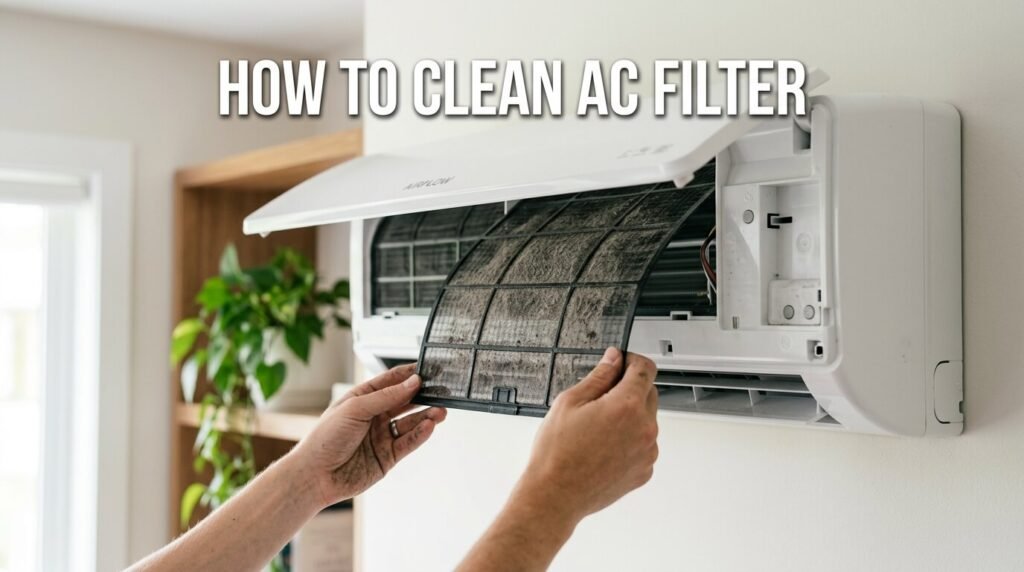
You can tell a filter needs attention before you even pull it out. Airflow from the vents feels weaker than normal, the unit runs longer to hit the same temperature, or the filter itself looks grey and matted instead of white or light-colored.
Any one of these on its own is worth a look. Two or more together means stop reading and go check it.
Visual and Performance Signs to Check
- Airflow from the vents or unit feels noticeably weaker than it did a few weeks ago.
- Dust builds up faster than usual on nearby furniture and surfaces.
- The unit runs longer or cycles more often to reach the same set temperature.
- The filter looks grey, matted, or visibly clogged instead of its original color.
- Energy bills have crept up without a matching jump in how much you’re running the AC.
- A musty or stale smell comes through the vents when the system starts.
How Often You Should Clean or Replace It
| Filter type | Clean or replace every | Sooner if… |
|---|---|---|
| Disposable fiberglass | 30 days | You have pets or live somewhere dusty |
| Pleated disposable | 60–90 days | You run the AC most of the day |
| Washable foam or mesh | 30–60 days | The unit runs constantly through a hot season |
| HEPA-style cartridge | 6–12 months | Anyone in the home smokes or has severe allergies |
Washable or Disposable? Confirm Your Filter Type First
Not every AC filter can be washed, and guessing wrong damages the filter or the unit behind it. The fastest way to know is to look at the frame, not the manual. Manuals get lost, frames don’t.
How to Tell the Difference in 10 Seconds
Disposable filter: a flat filter with a cardboard or paper frame and a thin fiberglass or pleated paper mat. It can’t be washed — the paper frame softens and the media tears. Replace it when dirty; don’t soak it.
Washable filter: a filter with a plastic or metal frame holding foam, woven mesh, or electrostatic material. It’s built to handle water and detergent repeatedly. Clean it instead of throwing it away.
If the frame doesn’t make it obvious either way, check for a printed “washable” or “reusable” label before assuming.
What Happens If You Wash a Disposable Filter
Washing a disposable filter doesn’t just waste your time. The cardboard frame absorbs water and softens, which lets it warp out of shape inside the housing.
Gaps open up around the edges, and air starts bypassing the filter media entirely, pulling in the same dust the filter was supposed to catch.
A damp paper filter sitting inside a closed unit is also exactly the environment mold needs. If you’ve already washed one by mistake, dry it completely, inspect it for warping or soft spots, and replace it if you see either.
How to Clean a Washable AC Filter, Step by Step
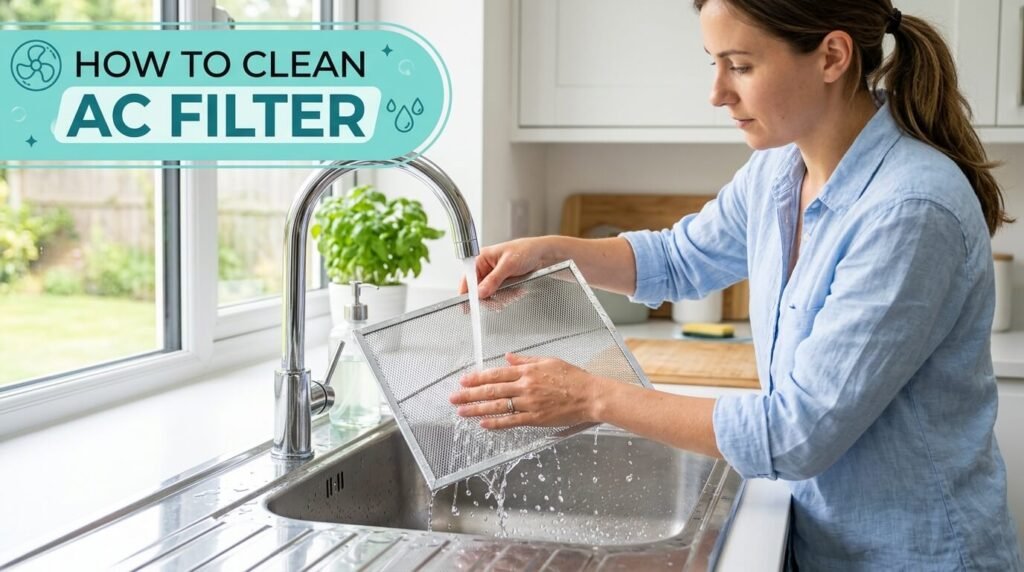
Once you’ve confirmed the filter is washable, the process is the same no matter what brand of AC you own. Five steps, most of them just waiting for things to dry.
Tools You’ll Need
- A vacuum cleaner with a brush or hose attachment.
- A bucket or basin large enough to submerge the filter.
- Mild dish soap or a small amount of laundry detergent.
- A soft-bristled brush for stubborn spots.
- A clean towel or a shaded and ventilated spot to air dry.
The Full Cleaning Process
- Turn off the AC at the unit or the breaker before touching the filter.
- Remove the filter and note which way it was facing, so reinstalling it is easy.
- Vacuum both sides to clear loose dust before any water touches it.
- Wash with warm water and a small amount of mild soap, working from the clean side through to the dirty side.
- Rinse until the water running off is clear, not cloudy.
- Shake off excess water and lay the filter flat in a shaded, ventilated spot.
- Let it dry completely — usually 2 to 4 hours, longer in humid weather — before sliding it back in.
When to Use a Vinegar Soak Instead of Soap
Soap and water handle everyday dust. A vinegar soak is for filters with a musty smell or visible mold spots that soap alone didn’t clear.
Mix one part white vinegar with one part warm water, submerge the filter for 15 to 60 minutes, depending on how bad the smell is, then rinse it the same way you would after a soap wash.
Vinegar’s acidity breaks down mold and mineral residue that soap doesn’t always clear. Skip it if the filter is just dusty, since soap already handles that fine.
Cleaning Steps by Unit Type
The wash-rinse-dry process above doesn’t change based on what AC you own, including the choice between window AC vs. split AC: key differences.
What changes is how you get to the filter in the first place — and most guides online only cover one device type, which is fine if you happen to own that one, but not much help if you don’t. Find your unit below.
Window Unit Filters
- Unplug the unit before touching anything.
- Lift or unlatch the front grille — most window units release with side or top tabs, no screwdriver needed.
- Slide the filter out from its slot behind the grille.
- Vacuum first, then wash if it’s still dirty, following the process above.
- Let it dry fully before sliding it back into the same slot and closing the grille.
Split / Ductless AC Filters
- Turn off the unit at the remote or the wall switch.
- Lift the front panel upward until it clicks and stays open on its own.
- Pull the filter down and out — most split units have two filters, one on each side.
- Vacuum or wash both filters the same way, since they collect dust at the same rate.
- Dry fully, slide each filter back into its tracks, and close the panel until it clicks shut.
If outages are part of why you’re maintaining this unit so carefully, sizing a generator for your AC unit is worth checking before the next one hits.
Central HVAC Filters
- Turn off the system at the thermostat or the breaker.
- Open the filter slot, usually behind the return air grille or inside the air handler — a screwdriver may be needed for the cover.
- Slide the filter out, noting the airflow arrow printed on the frame.
- Most central filters are disposable cardboard-frame filters — check the frame using the test above before attempting to wash one.
- If it’s washable, clean it the same way as any other filter; if it’s disposable, replace it with a new one of the same size.
How to Clean an LG AC Filter
- Lift LG’s front panel until it clicks and locks open.
- Slide the washable mesh filter down and out of its tracks.
- Rinse it under running water, or vacuum if it’s only lightly dusty.
- Dry it fully out of direct sunlight, which can warp the mesh.
- Slide it back into the tracks until it clicks, then close the panel.
How to Clean a Wall-Unit (PTAC) Air Conditioner Filter
- Switch off the unit at its control panel.
- Unclip the front grille — most PTAC units used in apartments and hotel rooms release without tools.
- Vacuum the filter first, then wash it with mild soap and water if it’s foam or mesh.
- Dry it completely before reinstalling.
- Snap it back into the grille clips and close the cover.
How to Clean a Samsung AC Filter
- Lift the front panel until it locks open.
- Pull the mesh filter down and out.
- Rinse under lukewarm water — never hot, which can warp the frame.
- Shake off excess water and dry it in a shaded spot.
- Line up the filter tabs with the unit’s grooves to reinstall it.
How to Clean an AC Filter Without Removing It
- Vacuum the filter in place using a brush attachment, moving in the same direction as the mesh weave.
- Wipe the visible side with a damp microfiber cloth to lift surface dust.
- Treat this as a stopgap between full cleans, not a replacement for one — it doesn’t reach dust trapped deeper in the filter.
How to Clean a GREE AC Filter
- Lift the hinged front panel until it locks open.
- Pull the filter straight down to release it.
- Wash with mild soap and water, or vacuum if it’s only lightly dusty.
- Dry away from direct sun to prevent the frame from warping.
- Reinsert the filter and close the panel.
How to Clean an AC Filter Without a Vacuum
- Tap the filter against a soft outdoor surface to knock loose dust free.
- Rinse it under a tap or hose, running water from the clean side through to the dirty side so debris is pushed out rather than driven deeper in.
- Air dry fully before putting it back.
How to Clean an AC Filter in an Apartment
- Clean over a bathtub, sink, or balcony rather than open floor space, since a dripping filter can damage the flooring or carpet below.
- Use a basin or large bowl for soaking if there’s no tub available.
- Check your lease or building rules before doing anything to a wall-mounted PTAC unit, since it’s often tied to a shared building system.
- Dry the filter somewhere with airflow — a balcony rail or a spot near an open window works better than a closed bathroom.
How to Remove an AC Filter
- Turn the unit off completely before touching the filter.
- Open the front panel, grille, or housing cover for your unit type.
- Locate the filter slot and note which way the filter is facing.
- Slide or lift the filter straight out without bending or creasing it.
Drying and Reinstalling the Filter Correctly
A filter that goes back in even slightly damp is worse than a dirty one. Trapped moisture inside a closed unit grows mold fast. Dry time depends on the filter material and the air around it, not a fixed number of minutes.
How Long Does It Actually Take to Dry
| Filter material | Typical dry time | Faster if… |
|---|---|---|
| Thin foam or mesh | 2–4 hours | Placed in a shaded, breezy spot |
| Thick pleated washable | 4–6 hours | Flipped halfway through drying |
| Soaked in vinegar or soap | Add 1–2 extra hours | Rinsed thoroughly before drying starts |
| Humid climate | Up to 24 hours | Dried indoors near a fan instead of outside |
Getting the Airflow Direction Right
Most filters have a small arrow printed on the frame showing which way air should flow through it.
That arrow points toward the blower or the indoor unit, not toward the room. Install it backward, and the filter still fits, but it traps less dust and creates pressure problems inside the housing.
But if your filter doesn’t have an arrow at all, just reinsert it facing the same direction it came out, which is why noting the orientation during removal matters more than it seems at the time.
What a Clean Filter Does (and Doesn’t) Fix
A clean filter restores airflow and protects the parts behind it. It is not a guaranteed fix for a high electricity bill, and the energy-savings number gets repeated more confidently than the research behind it actually supports.
The Energy-Savings Claim, Fact-Checked
Before deciding whether a clean filter will move your bill, it helps to know how much electricity your AC actually uses in the first place.
“According to the U.S. Department of Energy, replacing a dirty air filter with a clean one can reduce air conditioner energy use by 5% to 15%. ENERGY STAR likewise notes that a dirty filter slows airflow and makes the system work harder, so regular filter replacement helps avoid wasted energy.”
Those numbers show up on nearly every AC maintenance page online, almost always without the conditions attached to them.
“Independent data and pressure‑drop charts show that MERV‑13 filters typically present higher initial pressure drop than MERV‑8 designs, which may reduce airflow in systems not designed for that resistance.”
Whole-house energy consumption barely moved across any filter type, including the dirty ones.
A field study in 10 California homes found that, compared with a baseline MERV 5 filter, MERV 10–13 filters caused only moderate changes in blower energy use, generally less than 5%. The direction of the change depended on blower motor type: blower energy tended to increase in homes with BPM motors and decrease in homes with PSC motors as filters loaded.”
So which is right? Both, depending on what’s actually causing the airflow restriction. The 15% figure tends to hold up when a filter is severely clogged or badly mismatched to the system, and blower motor design changes the size and even the direction of the effect.
For a filter that’s moderately dusty rather than fully blocked, the energy hit sits much closer to the lab studies’ near-zero finding than to the DOE’s headline number.
Clean your filter because it protects the coil from freezing, keeps dust out of the air you breathe, and stops the blower motor from straining, not because it’s guaranteed to cut your bill by double digits.
The more reliable payoff is avoiding a frozen coil or a burned-out blower motor, and either one costs far more than 15% of a monthly bill.
When the Problem Isn’t the Filter
- Weak airflow that doesn’t improve after cleaning often points to a blocked duct or a failing blower motor, not the filter.
- Ice on the indoor coil means airflow was restricted long enough to freeze condensation — clean the filter, then have the coil checked before running the system again.
- A musty smell that persists after the filter is clean usually means mold somewhere else in the system, like the drain pan or the ductwork.
- Rising bills with a clean filter and no change in usage point toward the outdoor unit, the refrigerant level, or aging equipment rather than filtration.
If you’ve cleaned the filter and nothing’s changed, the next step is ruling out the rest of the system. AC not cooling? Try these fixes first
Troubleshooting After Cleaning
A filter that’s clean and properly dry can still leave you with a noisier unit or a smell that wasn’t there before. Both usually trace back to how the filter was cleaned or reinstalled, not a new problem with the AC itself.
Unusual Noise or Weak Airflow
- A new rattling or whistling sound usually means the filter isn’t seated flush, leaving a gap for air to leak around the edges.
- Weaker airflow than before cleaning can mean the filter went back in facing the wrong direction.
- A filter that’s still slightly damp restricts airflow almost as much as a dirty one, so weak airflow right after cleaning often just means it needs more drying time.
- And if the noise continues after reseating and fully drying the filter, the issue is likely the blower motor or the ductwork, not the filter.
Musty Smell or Visible Mold
- Mold growing on a filter usually means it went back in damp, and how AC mold affects indoor air quality is worth understanding before assuming a quick wipe-down solves it.
- A musty smell that shows up right after cleaning often means the filter wasn’t fully dry, not that the cleaning method failed.
- Visible black or green spots on the filter mean it’s past the point of cleaning; replace it instead of trying to scrub the mold out.
- A smell that returns within days of replacing the filter points to moisture sitting somewhere else in the unit, like the drain pan or the evaporator coil.
Most AC filters need attention every 30 to 60 days during peak cooling season. Set a reminder now if you don’t already have one.
A forgotten filter is the easiest way to end up back here in three months, wondering why the unit feels weaker again.
Frequently Asked Questions
How often should I clean my AC filter?
Clean a washable filter every 30 to 60 days during the season you’re running the AC most. Pets, allergies, or constant use push that toward the 30-day end.
A disposable filter follows a replacement schedule instead of every 30 to 90 days, depending on the type.
Can I wash my AC filter with soap and water?
Yes, if it’s a washable foam, mesh, or electrostatic filter, mild dish soap and warm water are all you need. Skip soap entirely on disposable cardboard-frame filters, since washing those breaks down the frame instead of cleaning it.
What happens if I never clean my AC filter?
Airflow drops, the system runs longer to hit the same temperature, and energy use climbs. Left long enough, a fully blocked filter can freeze the indoor coil and shut the system down entirely.
Can a dirty AC filter really increase my electricity bill?
Yes, but the size of the increase depends on how clogged the filter is and what kind of blower motor the system has.
DOE puts the ceiling at around 15%, while controlled lab testing found close to no change for moderately dirty filters, the real number sits somewhere between those two, depending on your setup.
Is it OK to clean a disposable AC filter instead of replacing it?
No. Disposable filters have cardboard or paper frames that soften and warp when wet. Replace them instead of washing them, even if they look like they could survive a rinse.
How long does an AC filter need to dry before I put it back?
Most washable filters dry in 2 to 4 hours in a shaded, ventilated spot. Thicker pleated filters or humid climates can stretch that to 6 hours or more. When in doubt, wait longer rather than risk reinstalling it damp.
Why is my AC noisier after I cleaned the filter?
A new rattle or whistle almost always means the filter isn’t seated flush, leaving a gap around the edges. Remove it, check that it’s facing the right direction, and reseat it fully into the slot.
Can a dirty AC filter cause mold or a musty smell?
A dirty filter on its own doesn’t usually grow mold, but a damp filter put back in too soon does. If the smell persists after a full clean and dry cycle, check the drain pan and evaporator coil next.
Is the cleaning process different for a window AC vs. a split AC?
The wash, rinse, and dry steps are identical, except that how you access the filter changes. Window units release the filter through a front grille, while split units require lifting a hinged panel to pull the filter out from inside.