
A 1.5HP air conditioner cools roughly 50% more space than a 1HP unit, but the number printed on the box tells you less than most buying guides suggest.
Manufacturers do not build a 1HP or 1.5HP compressor to one fixed BTU rating. Depending on the brand and region, a “1HP” unit can output anywhere from about 9,000 to 10,000 BTU per hour, while a “1.5HP” unit typically lands closer to 12,000 BTU.
That gap is why room-size charts for 1HP vs 1.5HP air conditioners rarely agree with each other.
The real decision comes down to three things: your room’s actual cooling load, what each size costs to run in your market, and whether you would rather undersize slightly or pay for cooling power you may not use.
What Does HP Mean in an Air Conditioner?
HP stands for horsepower, a unit borrowed from motor engineering that manufacturers use as shorthand for an air conditioner’s compressor size and cooling output.
A higher HP number generally means more cooling capacity, but HP itself isn’t a certified cooling measurement the way BTU (British Thermal Units) or watts are.
In practice, “1HP” and “1.5HP” are category labels, not exact specifications; the actual BTU and wattage figures behind each label vary by brand, covered in detail below.
What’s the Real Difference Between a 1HP and 1.5HP Aircon?
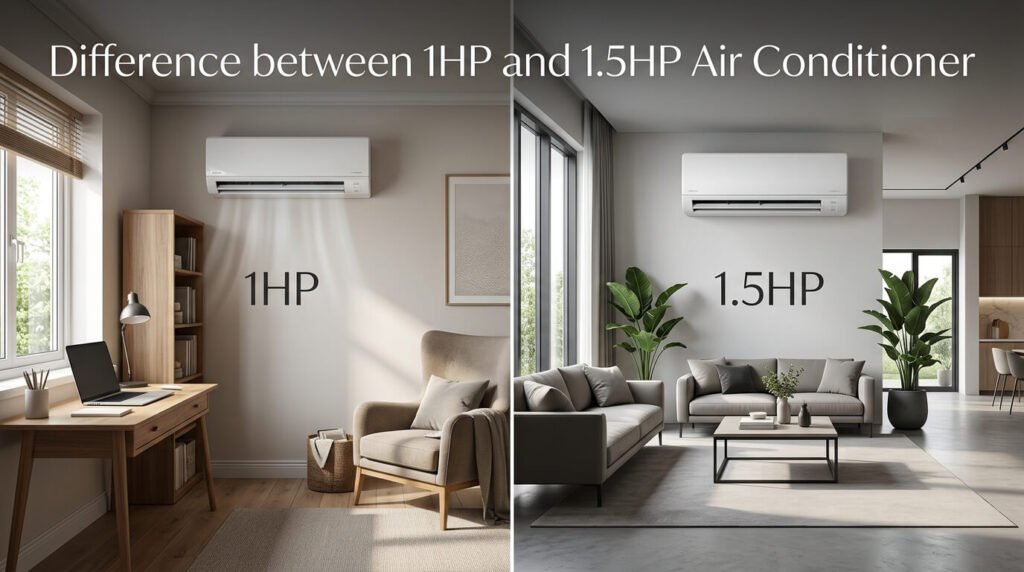
The difference is cooling output, not physical size or “strength” in any engineering sense.
A 1.5HP unit moves heat out of a room faster and can handle a larger area, but “HP” on an air conditioner label is a marketing shorthand borrowed from motor horsepower, not a certified cooling measurement like BTU or watts.
Cooling Capacity and Wattage Draw (BTU and Watts)
| Spec | 1HP | 1.5HP |
|---|---|---|
| Cooling output (BTU/hr) | 9,000-10,000 | 12,000-14,000 |
| Cooling output (watts) | ~2,600-2,800W | ~3,500W |
| Power draw, non-inverter | 900-1,100W | 1,200-1,500W |
| Power draw, inverter (average) | 600-750W | 850-1,050W |
| Typical room fit | Small bedroom, single office | Master bedroom, small living room |
The wattage figures above cover typical residential split units.
A unit’s actual draw still depends on the compressor brand, the refrigerant, and how hard the room is working the system at any given moment, which is why two “1HP” air conditioners from different manufacturers can pull noticeably different amounts of power.
Physical Size: 1HP vs 1.5HP Unit Dimensions
The HP rating also roughly tracks physical size, though this varies more by brand than cooling capacity does; always check the specific model’s spec sheet rather than assuming size from HP alone.
| Component | 1HP (typical) | 1.5HP (typical) |
| Indoor unit (W×H×D) | ~700–850 × 280–300 × 190–210 mm | ~890–1,110 × 280–315 × 200–230 mm |
| Outdoor unit (W×H×D) | ~660–750 × 480–550 × 240–260 mm | ~720–900 × 480–650 × 240–320 mm |
| Indoor unit weight | ~8–10 kg | ~11–14 kg |
| Outdoor unit weight | ~20–24 kg | ~27–32 kg |
These are representative ranges drawn from published manufacturer specs across several major brands. Exact dimensions vary enough between models that they’re worth confirming before buying if wall space, alcove size, or outdoor mounting bracket capacity is tight.
Why “HP” Isn’t a Fixed, Standardized Number
“1 HP” for an air conditioner traces back to steam-era horsepower ratings for motors, not a cooling-industry standard.
When manufacturers apply that label to a compressor, they round to whatever BTU figure fits their product line, so one brand’s 1HP unit can output 9,000 BTU while another’s reaches 10,000.
This is the reason a room-size chart built around Chinese manufacturing standards and a chart built around a US HVAC calculator will not match: they start from different BTU-per-HP assumptions.
Treat the HP number as a rough category, and use BTU or watts when you need an exact figure.
Can a 1HP AC Actually Cool a Room Adequately?
Yes, for a room that matches its capacity. A 1HP unit handles a small bedroom or single office comfortably, typically up to about 12 square meters (129 square feet) under normal insulation and ceiling height.
Problems start when a 1HP unit is installed in a room built for 1.5HP or larger: the compressor runs at full output nonstop, never reaches the set temperature, and wears out faster from the constant strain.
If your room falls near the boundary between the two sizes, the safer call is almost always to round up rather than down.
How Many Square Feet Does Each Size Actually Cool?
A 1HP unit generally covers rooms up to about 129 square feet (12 square meters), and a 1.5HP unit extends that to roughly 194 square feet (18 square meters). Past that point, most installers move buyers to 2HP.
These ranges assume a standard 3-meter ceiling, moderate insulation, and no unusual heat sources in the room.
Room Size Chart by HP (Bedroom, Living Room, Office)
1HP Air Conditioner Room Size
A 1HP air conditioner covers rooms up to about 129 square feet (12 square meters) — a small bedroom or single home office, under standard 3-meter ceiling height and moderate insulation.
1.5HP Air Conditioner Room Size
A 1.5HP air conditioner extends that range to roughly 150–250 square feet (14–23 square meters) — enough for a master bedroom or a small living room under the same standard conditions.
Room Size Chart by HP (Bedroom, Living Room, Office)
| Room type | Approximate size | Recommended HP |
| Small bedroom, home office | Up to 129 sq ft (12 m²) | 1HP |
| Master bedroom | 150–250 sq ft (14–23 m²) | 1.5HP |
| Small living room, shared office | 250–400 sq ft (23–37 m²) | 2HP |
| Open-plan living/dining area | 269+ sq ft (25+ m²) | 2HP or above, sometimes two units |
These figures work as a starting point, not a final answer. A room right at 194 square feet with a west-facing window and a poorly insulated roof needs more capacity than the same square footage in a shaded, well-insulated apartment.
Do-It-Yourself BTU Calculator (Step-by-Step Formula)
- Measure your room’s length and width in meters and multiply them to get the area in square meters.
- Multiply that area by 500 to get your baseline required BTU per hour. A 15 m² room needs roughly 7,500 BTU/hr as a starting figure.
- Convert your baseline BTU into HP using the 9,000 to 10,000 BTU-per-HP range: under 9,000 BTU points to 1HP, between 9,000 and 12,000 BTU points to 1.5HP, and above 12,000 BTU points to 2HP.
- Apply the adjustment factors below for sun exposure, ceiling height, and heat-generating appliances in the room.
- Round the adjusted number up to the nearest standard HP size rather than down, since undersizing causes more problems than modest oversizing. Our free aircon BTU calculator runs all five steps automatically if you would rather skip the manual math.
Adjustments That Change Your Number (Sun Exposure, Ceiling Height, Kitchen Heat)
- A room with strong afternoon sun or a west-facing wall needs 20% to 30% more cooling capacity than the base calculation.
- A top-floor room or apartment under an uninsulated roof needs about 15% more capacity to offset heat transfer from above.
- An open-plan kitchen attached to the cooled space adds roughly 4,000 BTU to the requirement because of stove and appliance heat.
- Every foot of ceiling height above the standard 10 feet adds about 10% more required BTU, since the unit has to cool a larger volume of air, not just a larger floor area.
- A room that regularly holds several people, gaming PCs, or other electronics generates extra heat that a bare square-footage formula does not account for.
Which One Costs More to Run: 1HP or 1.5HP?
A 1.5HP unit costs more to run than a 1HP unit of the same technology, but the gap is smaller than most people expect, and an inverter 1.5HP can end up cheaper to operate than a non-inverter 1HP.
Before comparing prices, it helps to see the best inverter air conditioners for 2026, since the inverter-versus-non-inverter choice affects the electricity math more than the HP size does.
Nigeria Electricity Cost Comparison (Band Tariffs, Inverter vs Non-Inverter)
Running 8 hours a day for 30 days, a non-inverter 1HP unit at roughly 1,000W draws about 240 kWh per month, and a non-inverter 1.5HP unit at roughly 1,350W draws about 324 kWh. Applied to Nigeria’s DisCo band tariffs, the monthly cost difference looks like this:
| Band | Rate (₦/kWh) | 1HP monthly cost | 1.5HP monthly cost | Difference |
|---|---|---|---|---|
| Band A | ₦231 | ₦55,440 | ₦74,844 | ₦19,404 |
| Band B | ₦117 | ₦28,080 | ₦37,908 | ₦9,828 |
| Band C | ₦82 | ₦19,680 | ₦26,568 | ₦6,888 |
Inverter technology changes this comparison more than the HP jump does. Inverter compressors adjust their speed instead of cycling on and off at full power, and typically use 30% to 50% less electricity than non-inverter units doing the same job.
Run that math through the numbers above, and an inverter 1.5HP, averaging around 194 kWh a month once it settles into a room, can use less electricity than a non-inverter 1HP running at 240 kWh.
Buyers focused only on HP size miss this and end up assuming bigger always means a higher bill.
Unit and Installed Price Comparison: Nigeria vs USA
Nigeria and the United States price air conditioners in completely different ways, which is part of why generic “how much does it cost” answers rarely help. Nigeria sells room units by HP, priced in naira.
The US mostly sells central and mini-split systems by tonnage, priced in dollars, with installation usually bundled into the quote.
| Market | Size | Typical unit price | Notes |
|---|---|---|---|
| Nigeria (Panasonic, split, non-inverter) | 1HP | From ₦250,000 | Entry-level split unit |
| Nigeria (Panasonic, split, non-inverter) | 1.5HP | From ₦299,900 | Entry-level split unit |
| Nigeria (Panasonic, inverter) | 1HP | From ₦546,200 | Higher upfront cost, lower running cost |
| Nigeria (Panasonic, inverter) | 1.5HP | From ₦611,300 | Higher upfront cost, lower running cost |
| Nigeria (LG, inverter) | 1HP | From ₦365,000 | Mid-tier brand pricing |
| Nigeria (LG, inverter) | 1.5HP | From ₦388,900 | Mid-tier brand pricing |
| USA (mini-split, DIY equipment) | 1 ton | From $699 | Equipment only, no installation |
| USA (mini-split, single zone installed) | 1-1.5 ton | $2,000-$5,500 | Installed cost changes little between 1 and 1.5 tons on a single indoor unit |
| USA (central air, national average) | 1.5 ton | $4,853-$18,657 | Full system including installation |
Two things stand out in this table. First, in Nigeria, the naira gap between a 1HP and 1.5HP unit of the same brand and technology is often under ₦50,000, smaller than most buyers assume before they check prices.
Second, in the US market, moving from a 1-ton to a 1.5-ton single-zone mini-split adds only a few hundred dollars to the installed price, since labor and line-set costs stay roughly the same regardless of the compressor’s exact capacity within that range.
In both markets, the installation and technology choice (inverter or not, ducted or ductless) usually moves the price more than the HP or ton step itself.
For a full breakdown of labor, line sets, and permit costs on top of the unit price, see the full air conditioner installation cost guide.
What Happens If You Choose the Wrong Size?
Both undersizing and oversizing cause real problems, just different ones. An undersized unit runs constantly and still fails to cool the room, while an oversized unit cools too fast, shuts off before removing enough humidity, and cycles on and off more than it should.
Signs Your 1HP Unit Is Undersized
- The unit runs continuously, even overnight, without the room reaching your set temperature.
- The electricity bill climbs noticeably higher than the manufacturer’s stated average consumption, because the compressor rarely rests.
- Ice or frost builds up on the indoor coil from the unit straining against a cooling load it cannot meet.
- The room feels cool directly under the unit but stays warm in the corners farthest from it.
- The compressor’s lifespan shortens from running at full capacity for extended stretches. See the signs your air conditioner is undersized for a fuller breakdown of what to check before assuming the unit itself is broken.
Signs You Oversized With a 1.5HP Unit
- The room cools very quickly, then the compressor shuts off and restarts repeatedly, a pattern called short cycling that wears down the system faster than steady operation.
- The room feels cold but clammy because the unit shuts off before it has run long enough to pull moisture out of the air.
- Energy bills run higher than they should for the room’s actual size, since the unit spends more time restarting than operating efficiently.
- The noise from frequent compressor starts and stops becomes noticeable in a way a properly sized unit would not produce.
How to Check What HP Your Current Aircon Actually Is
The HP rating is almost always printed on the unit’s nameplate or in the model number, so you rarely need to guess or measure anything to find it.
Reading the Model Number and Nameplate
- Check how to read your aircon’s model number first, since most manufacturers encode the capacity directly into the model number printed on the indoor unit.
- Look at the metal nameplate on the outdoor condenser unit, usually on the side or back panel, which lists cooling capacity in BTU/hr or kW alongside the HP rating.
- Compare the BTU or kW figure on the nameplate to the ranges in the table earlier in this guide: 9,000 to 10,000 BTU points to 1HP, and 12,000 to 14,000 BTU points to 1.5HP.
- If the nameplate is worn or missing, check the original purchase receipt or the installation paperwork, which typically lists the capacity.
How to Identify a 1.5HP Unit Specifically
- Confirm the BTU rating falls in the 12,000 to 14,000 range rather than the 9,000 to 10,000 range used for 1HP units.
- Check the rated power draw on the nameplate: a non-inverter 1.5HP unit typically lists 1,200 to 1,500W, noticeably above the 900 to 1,100W range for 1HP.
- Look at the physical size of the outdoor condenser, since 1.5HP condensers are generally larger than 1HP condensers from the same product line, though this varies by brand and should be treated as a secondary check rather than the primary one.
- If the unit has a remote control with a model number, search that number against the manufacturer’s spec sheet to confirm the exact capacity.
When to Call a Technician to Confirm
If the nameplate is unreadable, the paperwork is missing, and the model number does not turn up a clear match online, a technician can confirm the HP rating in a few minutes using a clamp meter to measure the actual running current, then cross-reference it against known compressor specifications.
This is worth doing before buying a replacement or a second unit for the same space, since installing the wrong size based on a guess creates the undersizing or oversizing problems covered above.
1.5HP vs 2HP AC: Which One Should You Choose?
The main difference between a 1.5HP and a 2HP air conditioner is cooling capacity, which determines the room size each one suits.
| Feature | 1.5HP AC | 2HP AC |
| Cooling capacity | About 12,000 BTU/hr | About 18,000 BTU/hr |
| Suitable room size | Around 150-250 sq ft (14-23 m²) | Around 250-400 sq ft (23-37 m²) |
| Typical use | Bedroom, small office | Large bedroom, living room, shop |
| Power consumption | Roughly 1.0-1.3 kW | Roughly 1.6-2.0 kW |
| Electricity bill | Lower | Higher |
| Purchase price | Cheaper | More expensive |
| Indoor and outdoor unit size | Smaller and lighter | Larger and heavier |
| Cable and breaker | Standard, usually 10-16A breaker | Thicker cable, usually 16-20A breaker |
| Generator or inverter load | Lighter | Needs a larger one |
When to choose a 1.5HP AC: Pick it if your room is small to medium, you want lower running costs, or your power supply (generator or inverter) is limited.
When to choose a 2HP AC: Pick it for a large room, a room with high ceilings or lots of windows, a room that gets direct afternoon sun, or one with many people or heat-producing appliances.
Avoid under-sizing and over-sizing. An AC that is too small runs non-stop, wears out faster, and never cools the room properly.
One that is too big cools the room quickly and shuts off before it removes humidity, leaving the room cold but damp. It also wastes money on a larger unit.
Note: Capacities vary slightly between brands, so always confirm the BTU rating on the specification sheet.
How to Identify a 2HP Air Conditioner
If you are unsure what HP your AC is, these checks will tell you.
- Check the specification label. Look on the side of the indoor unit, behind the front panel, or on the outdoor unit. A 2HP AC is usually rated around 18,000 BTU/hr (about 5.0-5.3 kW cooling capacity).
- Read the model number. Many brands include the capacity in the model name. Codes like “18K”, “18000,” or “18” usually mean 2HP, while “12” means 1.5HP. Some brands use “24” for 2.5HP or 2 tons.
- Look at the box or manual. The packaging and user manual state the HP or BTU rating.
- Check the current and power rating. A 2HP unit draws more current than a 1.5HP unit, usually around 7-9 amps.
- Compare the unit sizes. A 2HP indoor unit is noticeably longer (often about 90-110 cm), and the outdoor unit is bigger and heavier because of its larger compressor and coil.
- Look at the refrigerant pipe size. Many 2HP split ACs use a thicker gas pipe (commonly 1/2 inch) than a 1.5HP (commonly 3/8 inch).
- Check the power cable and plug. A 2HP unit usually has a thicker power cable and often needs a dedicated, higher-rated socket or breaker.
Quick tip: If the label shows only BTU, remember that 12,000 BTU is about 1.5HP, 18,000 BTU is about 2HP, and 24,000 BTU is about 2.5HP or 2 tons.
Frequently Asked Questions
Is a 1.5HP aircon better than 1HP for a small bedroom?
No, a 1.5HP unit is not automatically better for a small bedroom, and installing one where a 1HP unit fits can create the oversizing problems covered earlier in this guide.
A small bedroom under about 129 square feet cools more evenly with a properly matched 1HP unit, which runs longer cycles and removes humidity more effectively than a 1.5HP unit that cools the room quickly and then shuts off.
The upgrade to 1.5HP makes sense once the room approaches 150 to 190 square feet, gets strong afternoon sun, or regularly holds more heat-generating electronics than a typical bedroom.
Is a 2HP AC too big for a bedroom?
It depends on the bedroom size.
A 2HP AC is too big for a small bedroom (under about 250 sq ft or 23 m²) because it cools the room too quickly and shuts off before removing humidity, which leaves the room cold but damp.
It also uses more power and costs more upfront.
A 2HP AC suits a large master bedroom (around 250-400 sq ft), or a room with high ceilings, large windows, or direct afternoon sun. For a standard bedroom, a 1.5HP is usually enough.
Does a 2HP AC consume more electricity than a 1.5HP?
Yes. A 2HP AC typically draws about 1.6-2.0 kW, while a 1.5HP draws about 1.0-1.3 kW, so it uses roughly 30-50% more electricity when running.
However, a 2HP AC in a large room may reach the set temperature faster and rest more often, while a 1.5HP in the same room would run non-stop.
An inverter AC will also use much less power than a non-inverter of the same HP.
Can a 1.5HP AC cool a large room?
It can, but poorly. In a room larger than about 250 sq ft, a 1.5HP AC will run continuously without reaching the set temperature, which wastes power and shortens the compressor’s life. For a large room, go for a 2HP.
Can I use a 2HP AC with a 1.5HP AC’s breaker and cable?
Not safely. A 2HP AC draws more current, so it usually needs a thicker cable and a higher-rated breaker (commonly 16-20A). Have an electrician check your wiring before installation.
Can my inverter or generator carry a 2HP AC?
Usually only a larger one. A 2HP AC typically needs at least a 3.5-5 kVA inverter or generator to run alongside other appliances, and it needs even more headroom because the compressor draws a surge of current at startup. A 1.5HP is easier on smaller setups.
Is a 2HP AC the same as a 1.5-ton AC?
No. In many markets, 1.5HP is sold as a 1-ton AC (12,000 BTU) and 2HP as a 1.5-ton AC (18,000 BTU). Brands label it differently, so always confirm the BTU rating.
Which is better value, 1.5HP or 2HP?
Neither is better overall. Value depends on matching the AC to your room. The right-sized AC cools efficiently, uses less power, and lasts longer.
What’s the price difference between 1HP and 1.5HP units in Nigeria vs the USA?
In Nigeria, the naira gap between a 1HP and 1.5HP unit from the same brand is usually under ₦50,000 for split units and closer to ₦65,000 for inverter models, based on current Panasonic and LG pricing.
In the United States, moving from a 1-ton to a 1.5-ton single-zone mini-split typically adds only a few hundred dollars to the installed cost, since labor and line-set expenses stay similar across that range.
Both markets show the same pattern: the jump between adjacent HP or ton sizes costs far less than most buyers expect, while the choice between inverter and non-inverter technology moves the price more substantially.
Which type of AC has the lowest energy consumption?
An inverter air conditioner has the lowest energy consumption for a given room size, using 30% to 50% less electricity than a non-inverter unit of the same HP rating because it adjusts compressor speed instead of cycling fully on and off.
This means an inverter 1.5HP unit can cost less to run monthly than a non-inverter 1HP unit in the same room, even though it has more cooling capacity.
For a ranked look at specific models and their measured consumption, see the lowest energy consumption AC guide, which breaks down real wattage figures by brand rather than relying on the HP label alone.
Note: Power figures are approximate and vary by brand, inverter technology, and room conditions.