
The right air conditioner size comes down to one number: BTU per hour, adjusted for your room’s specific conditions.
Get that number wrong, and you either pay for cooling power you don’t use, or you buy a unit that runs nonstop and still can’t keep the room comfortable.
This guide walks through the exact math; the calculator does it for you in seconds, and if you want the fuller picture on choosing a unit afterward, our complete air conditioner buying guide covers what to do with that number once you have it.
What Is a BTU and Why It Matters for Air Conditioning
A BTU, or British Thermal Unit, measures heat energy. One BTU is the energy needed to raise one pound of water by one degree Fahrenheit.
For air conditioners, the BTU rating tells you how much heat the unit can pull out of a room every hour. A 9,000 BTU unit removes 9,000 BTUs of heat per hour; an 18,000 BTU unit removes twice that.
The higher the number, the more heat the machine can handle, and the larger or hotter the space it can cool.
BTU vs Tonnage vs HP vs kW — How the Units Relate
Air conditioners get labeled in four different units depending on where you’re shopping, and the conversions trip up more buyers than almost anything else in the sizing process.
| BTU/hr | Tonnage | HP (market label) | HP (mechanical) | kW |
|---|---|---|---|---|
| 9,000 | 0.75 tons | 1 HP | 3.5 HP | 2.64 kW |
| 12,000 | 1.0 ton | 1.5 HP | 4.7 HP | 3.52 kW |
| 18,000 | 1.5 tons | 2 HP | 7.1 HP | 5.28 kW |
| 24,000 | 2.0 tons | 2.5 HP | 9.4 HP | 7.03 kW |
| 28,000 | 2.3 tons | 3 HP | 11.0 HP | 8.21 kW |
The tonnage and kW columns are simple unit conversions: one ton equals 12,000 BTU, and one kW equals roughly 3,412 BTU. The HP columns are where the confusion starts, because there are two completely different HP numbers in circulation.
The market label convention, printed on the box of nearly every AC sold as “1HP,” “1.5HP,” or “2HP,” uses a rounded shorthand of about 9,000 BTU per HP.
That’s the number that matters when you’re comparing units at a shop or reading a spec sheet, because it’s what manufacturers use to name their products.
The mechanical conversion, based on the actual physics formula (1 HP = 2,545 BTU/hr), gives a completely different figure: that same “1.5HP” unit works out to roughly 4.7 mechanical horsepower.
Neither number is wrong; they’re just answering different questions. When you’re buying, use the market label. When an engineer talks about compressor horsepower, that’s the mechanical figure.
For a deeper breakdown of what these labels mean for two of the most commonly confused sizes, see our 1HP vs 1.5HP air conditioner comparison.
How to Read the BTU Rating on an AC Nameplate
- Locate the nameplate, usually on the side or back panel of the indoor unit, or printed on the outdoor compressor housing.
- Look for “Cooling Capacity” or “BTU/hr” listed near the top of the specification block.
- Note whether the figure is listed only in BTU, or also converted to HP, tons, or kW on the same label.
- Cross-check that figure against the room size chart below before assuming the unit fits your space.
- If the nameplate lists a range (common on inverter units), use the maximum rated BTU for sizing comparisons.
Use the Free Aircon BTU Calculator (Best BTU Calculator for Room Sizing)
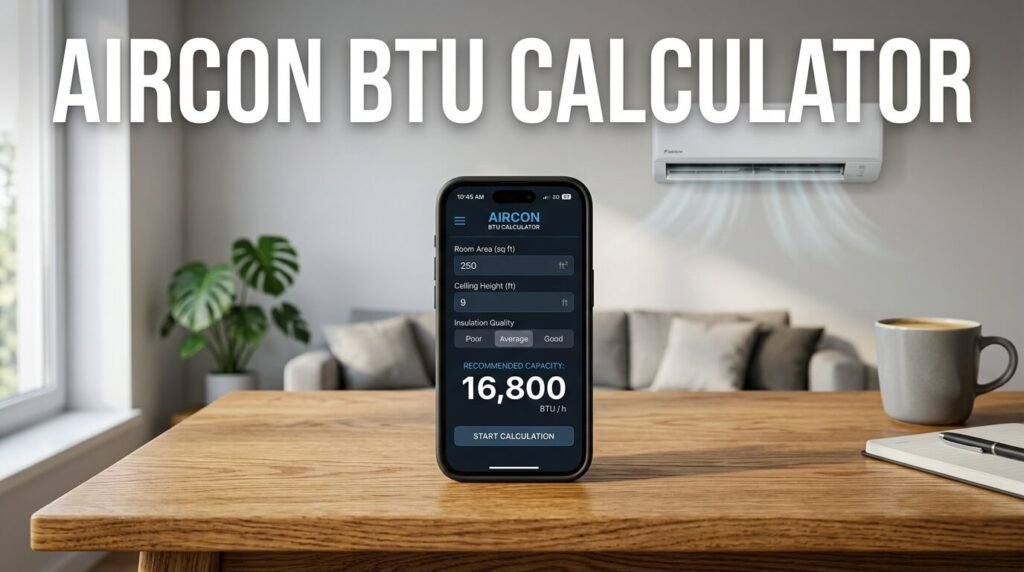
The fastest way to get an accurate number is to skip the manual math entirely and run your room’s details through the calculator below.
It factors in ceiling height, sun exposure, insulation, occupancy, and kitchen adjacency automatically, so you get a tailored recommendation instead of a flat estimate.
Aircon BTU Calculator
Enter your room details to get a recommended cooling capacity in BTU/hr.
This is a sizing estimate for a typical room. Unusually high heat loads (large glass walls, server equipment, industrial spaces) may need a professional load calculation.
Example: a 15×12 ft bedroom (180 sq ft) with average sun, average insulation, and two occupants comes out to roughly 4,000 BTU/hr using this aircon BTU calculator — a 5,000 BTU unit once rounded up to the nearest available size.
How to Use the Calculator — Step by Step
- Measure your room's length and width in feet, then enter both values into the calculator.
- Select your ceiling height from the dropdown: standard (up to 8 feet), tall (9 to 10 feet), or very tall (10 feet or more).
- Enter the number of people who typically occupy the room.
- Select your room's sun exposure: shaded most of the day, average, or very sunny.
- Select your insulation quality: good, average, or poor.
- Check the kitchen box if the room is a kitchen or opens directly onto one.
- Click Calculate BTU to get your recommended capacity.
How to Read Your Result
- The main BTU figure is your recommended cooling capacity, rounded to the nearest 500 BTU for easy matching against real product listings.
- The typical range shown below it gives you roughly 10% either side of that figure, which is useful if the exact BTU size you need isn't sold locally.
- The tonnage conversion translates your BTU figure into the unit some manufacturers and installers use instead, particularly for larger split and central systems.
- The suggested unit type points you toward the category of air conditioner, window, split, or multi-zone that typically matches your calculated capacity.
BTU, Square Meters, and kW — Quick Reference for Metric Users
If you measured your room in meters instead of feet, or you're comparing units listed in kW rather than BTU, this table converts the calculator's core BTU sizes into both formats so you don't have to do the math yourself.
Room Size in Square Meters for Common BTU Ratings
| BTU/hr | Approx. Room Size (sq ft) | Approx. Room Size (sq meters) |
|---|---|---|
| 9,000 | 450 sq ft | 42 sq m |
| 12,000 | 600 sq ft | 56 sq m |
| 18,000 | 900 sq ft | 84 sq m |
| 24,000 | 1,200 sq ft | 112 sq m |
These figures are based on the standard 20 BTU per square foot baseline, before adjustments for ceiling height, sun exposure, occupancy, or climate.
A 12,000 BTU air conditioner covers roughly 56 square meters under standard conditions, and an 18,000 BTU air conditioner covers roughly 84 square meters, both assuming a typical 8-foot ceiling and average insulation.
Converting BTU to kW for Split and Ducted Systems
| BTU/hr | kW (cooling capacity) |
|---|---|
| 9,000 | 2.64 kW |
| 12,000 | 3.52 kW |
| 18,000 | 5.28 kW |
| 24,000 | 7.03 kW |
| 28,000 | 8.21 kW |
Divide any BTU/hr figure by 3,412 to get its kW equivalent. This is the figure most relevant for split and ducted systems sold in markets that list cooling capacity in kW rather than BTU or tonnage.
How Many BTUs Per Square Foot Do You Need?
The standard rule of thumb is 20 BTU per square foot of living space, and that single number is the starting point for every calculation on this page.
BTU Chart by Room Size (Detailed)
| Room Size (sq ft) | Recommended BTU |
| 100–150 | 5,000 |
| 150–200 | 6,000 |
| 200–250 | 6,000–7,000 |
| 250–300 | 7,000–8,000 |
| 300–350 | 8,000 |
| 350–400 | 9,000 |
| 400–450 | 10,000 |
| 450–500 | 10,000–12,000 |
| 500–600 | 12,000 |
| 600–700 | 14,000 |
| 700–800 | 16,000 |
| 800–900 | 18,000 |
| 900–1,000 | 19,000–20,000 |
| 1,000–1,200 | 21,000–24,000 |
| 1,200–1,400 | 24,000–28,000 |
| 1,400–1,500 | 28,000–30,000 |
| 1,500–2,000 | 30,000–34,000 (typically multi-zone or central) |
| 2,000–3,000 | 34,000–50,000+ (central air recommended) |
These figures use the standard 20 BTU per square foot baseline before adjustments for ceiling height, sun exposure, insulation, and occupancy apply the factors covered above for a precise number. Above roughly 1,500 square feet, a single unit typically isn't practical; a multi-zone split system or central air is the more realistic path, and the room-by-room approach in the "Multi-Room and Whole-House BTU Sizing" section further down this page applies.
The Standard Formula Explained (20 BTU × Sq Ft)
The base formula multiplies your room's square footage by 20. A 12-by-15-foot bedroom works out to 180 square feet, which at 20 BTU per square foot comes to 3,600 BTU before any adjustments.
From there, you add roughly 600 BTU for each occupant beyond the first two, add 4,000 BTU if the room is a kitchen, and apply percentage adjustments for ceiling height, sun exposure, and insulation quality.
That same 180-square-foot bedroom with two occupants, average sun, and average insulation lands right at 3,600 BTU, rounding up to a 4,000 BTU unit in practice since manufacturers don't sell odd increments.
The Split AC Sizing Formula
Split systems use the identical base formula: room area in square feet multiplied by 20 BTU, with the same adjustments for occupancy, sun exposure, insulation, and kitchen use.
The one practical difference is that a split unit typically serves one room or zone directly rather than pushing air through ducts, so there's no duct-loss adjustment to factor in.
A 250-square-foot living room with average conditions calculates to 5,000 BTU, which maps cleanly to a 6,000 BTU (0.75 ton) split unit once you round up to the nearest available size.
Factors That Increase or Decrease Your BTU Requirement
The 20 BTU per square foot baseline assumes a standard room with average conditions. Several factors push that number up or down before you land on a final recommendation.
Ceiling Height
- Standard 8-foot ceilings require no adjustment to the base calculation.
- Tall ceilings between 9 and 10 feet add roughly 10% to your BTU requirement because there's more air volume to cool.
- Very tall ceilings above 10 feet add roughly 20%, which matters most in converted lofts, vaulted living rooms, and open-plan spaces.
Sun Exposure and Window Placement
- Rooms that stay shaded most of the day can reduce their BTU requirement by about 10%.
- Rooms with average sun exposure need no adjustment from the baseline.
- Rooms that get direct, strong sunlight for most of the day should add roughly 10% to account for solar heat gain through the windows.
Insulation Quality
- Well-insulated, newer, tightly sealed rooms can reduce their BTU requirement by about 5%.
- Average insulation needs no adjustment.
- Poorly insulated, older, or drafty rooms should add roughly 10%, since cool air escapes and outside heat enters more easily.
Number of Occupants
- The baseline calculation already accounts for two occupants.
- Each additional person beyond two adds approximately 600 BTU, since body heat is a real and measurable cooling load.
- A home office or bedroom shared by four people needs meaningfully more capacity than the same room used by one.
Kitchen Adjacency and Heat-Producing Appliances
- Kitchens generate substantial extra heat from stoves, ovens, and appliances, so add roughly 4,000 BTU to the base calculation.
- Open-plan living areas that include a kitchen space should apply this same adjustment to the combined square footage.
- Rooms with server equipment, large monitors, or other continuously running electronics should be treated similarly, since sustained heat output behaves the same way a kitchen's does.
Should You Adjust for a Hot or Tropical Climate?
Yes, and this is the single most common gap in standard BTU calculators. The 20 BTU per square foot rule was built around a temperate US climate assumption, and it runs noticeably undersized for anyone shopping in a hot, humid region.
If you're buying for a home in a tropical climate, our guide to the best AC units for Nigeria's hot climate applies these adjustments to specific product recommendations.
Why the Standard 20 BTU/Sq Ft Rule Falls Short in Tropical Regions
The baseline formula assumes a moderate outdoor-to-indoor temperature difference and manageable humidity.
In hot, humid climates, the air conditioner faces a much larger heat load: higher outdoor temperatures push more heat through walls and windows, and higher humidity means the unit has to remove moisture on top of lowering the temperature.
A unit sized from the flat US-standard chart will often run constantly without ever quite reaching a comfortable temperature, the classic sign of undersizing covered in the next section.
This isn't a flaw in the math itself; it's a missing variable most calculators simply don't ask about.
Recommended Adjustment for Hot, Humid Climates
| Climate Type | Adjustment to Base BTU |
|---|---|
| Mild (cool summers, low humidity) | –10% |
| Moderate (typical US/UK climate) | No adjustment (baseline) |
| Hot, dry climate | +10% to +15% |
| Hot, humid/tropical climate | +15% to +25% |
A 12-by-15-foot bedroom that calculates to 3,600 BTU under standard conditions should be sized closer to 4,200–4,500 BTU in a hot, humid climate, which often bumps the practical unit choice up one size bracket from what the flat baseline would suggest.
What Happens If You Choose the Wrong BTU Size?
Both undersizing and oversizing cause real problems, and they cause different ones. Getting the size wrong in either direction shortens the unit's lifespan and increases your electricity costs.
Signs Your AC Is Undersized
- The unit runs almost continuously without ever reaching your set temperature, especially during the hottest part of the day.
- Your electricity bill climbs noticeably because the compressor rarely gets to cycle off and rest.
- The room feels only marginally cooler than outside, even after hours of continuous operation.
- The unit shows signs of accelerated wear, since constant operation puts more strain on the compressor over time.
Signs Your AC Is Oversized
- The room cools very quickly but still feels clammy or humid, because the unit shuts off before it has run long enough to remove moisture from the air.
- The compressor cycles on and off frequently in short bursts, a pattern known as short-cycling that increases wear and reduces efficiency.
- Energy costs run higher than expected despite the room reaching temperature quickly, since each startup draws a disproportionate amount of power.
- Temperature swings feel uneven, with cold blasts near the unit followed by the room warming up again shortly after it shuts off.
Window, Split, or Portable — Does Unit Type Change the BTU You Need?
Yes. See our window vs split AC comparison for a full breakdown of how these three categories perform beyond sizing, since unit type changes how much you should trust the raw BTU number, even when two units share the same rating.
Why Portable Units Often Need a Higher BTU Rating Than Advertised
If you're shopping our portable air conditioner buying guide, size up by roughly 15% to 20% over the calculator's base recommendation before you buy.
A portable air conditioner sits inside the same room it's cooling, and its compressor releases real waste heat back into that space, unlike a split or window unit, which houses its compressor outside.
For years, portable units were rated using the same test standard as window and split units, which overstated their real-world cooling power because it ignored that self-heating effect.
The U.S. Department of Energy tightened testing rules around 2019, introducing a Seasonally Adjusted Cooling Capacity (SACC) rating specifically for portable units to reflect this gap.
In practice, a portable AC's printed BTU figure, if it's still using the older rating method, can overstate its real cooling power by a meaningful margin, so check whether the listing specifies SACC BTU rather than the older standard rating.
Matching BTU to the Right Unit Type
| BTU Range | Typical Unit Type |
|---|---|
| Up to 8,000 BTU | Window unit or small portable unit |
| 8,000–14,000 BTU | Window unit or single-zone split |
| 14,000–24,000 BTU | Split (ductless) system |
| 24,000 BTU and above | Multi-zone split or central AC |
Multi-Room and Whole-House BTU Sizing
Calculate each room's BTU requirement separately, then handle the totals differently depending on whether you're installing individual units or a central system.
Why You Can't Just Add Up Room Totals for Central Air
For individual split or window units, adding up each room's separate BTU figure works fine, since each unit only ever cools the room it's installed in.
Central air conditioning doesn't work the same way, because ductwork loses some cooling capacity along its length, and a single central system has to account for shared hallways, staircases, and transitional spaces that don't fit neatly into a room-by-room calculation.
Simply summing your individual room totals for a central system will typically undersize the unit, since it ignores duct losses and the additional volume of connecting spaces.
When to Call a Professional for a Manual J Load Calculation
- Get a Manual J calculation done before purchasing a central air system, since it accounts for duct design, insulation values, and window specifications in far more detail than any online calculator.
- Request one when your home has an unusual layout, such as an open floor plan spanning multiple stories or a mix of very old and newly renovated sections.
- Ask your HVAC contractor whether their quote already includes a Manual J calculation, since some contractors size systems based on square footage alone, which reintroduces the same undersizing and oversizing risks covered above.
- Treat the calculator on this page as accurate for single rooms and individual split or window units, and treat a Manual J calculation as the standard for anything whole-house or ducted.
Once you know your room's square footage, you have everything the calculator above needs to give you an exact BTU recommendation in under a minute.
Run your numbers through it now, and if your climate is hot and humid, apply the adjustment percentages from the table earlier on this page before you go shopping.
Frequently Asked Questions
How many BTUs do I need for a 12x12 room?
A 12x12 room is 144 square feet, which at the standard 20 BTU per square foot baseline works out to roughly 2,880 BTU, typically rounded up to a 5,000 BTU unit since that's the smallest common size sold.
If the room has more than two regular occupants, faces strong direct sun, or sits in a hot, humid climate, add the relevant adjustments from the factors and climate sections above before finalizing your size, since a bare 144-square-foot calculation without those adjustments often runs slightly undersized in practice.
How many BTUs is a 1.5HP air conditioner?
A 1.5HP air conditioner is rated at 12,000 BTU per hour using the standard market label convention that manufacturers print on their units.
This is also equivalent to exactly 1 ton of cooling capacity and roughly 3.52 kW.
A 12,000 BTU (1.5HP) unit typically suits a room around 600 square feet under standard conditions, though hot or humid climates and larger occupant counts will reduce that effective coverage area.
Does a higher BTU rating mean higher electricity bills?
Not directly. A correctly sized unit, even a higher-BTU one for a larger room, costs less to run than an undersized unit struggling in that same space, because the undersized unit runs constantly trying to reach temperature.
What actually drives your electricity cost is the mismatch between unit size and room size, plus the unit's efficiency rating, not the BTU number in isolation.
Our AC electricity cost calculator breaks down exact running costs based on your specific unit size and local electricity rates.
Does humidity affect the BTU I need, not just heat?
Yes, humidity is a separate and significant factor beyond raw temperature.
An air conditioner has to remove moisture from the air in addition to lowering its temperature, and in high-humidity climates that moisture-removal load can meaningfully increase the total heat the unit needs to handle each hour.
This is exactly why the climate adjustment table earlier on this page recommends adding 15% to 25% for hot, humid regions rather than relying on the flat temperate-climate baseline that most generic BTU calculators use by default.
[…] Not sure what size you need? Use our guide to choosing the right AC size (HP and BTU) for your room. […]