
Power outages are just part of daily life in Nigeria, and for most households, a generator is the only reliable backup.
If you own an air conditioner, the question of what size generator do I need to run a 1.5HP air conditioner? is one you need answered before buying.
Get it wrong, and you’re dealing with tripped generators, poor AC performance, or damaged equipment. What most people miss is that ACs need more than just running power; they also need a startup surge when the compressor kicks in.
This guide walks you through the exact numbers so you can size your generator correctly and protect both your appliances and your budget.
EXPERT CONTRIBUTORS
Engr. Okorie Udoka Ifeanyi
Assistant Chief Laboratory Technologist (EE) | Load Analysis Engineer
Department of Electrical and Electronic Engineering, School of Engineering
Maritime Academy of Nigeria, Oron, Akwa Ibom State.
Website: www.maritimeacademy.gov.ng | Email: udoka.okorie@maritimeacademy.edu.ng
Engr. Isaac Abraham Eze, B.Eng, CSM, FCISCSM
Business Development Executive.
Hamisez Integrated Services — Electrical Power Generation, Procurement & Supply,
Gas Generators & Chain Management, Port Harcourt, Rivers State, Nigeria.
Email: hamisez09@gmail.com
How Much Power Does a 1.5HP Air Conditioner Use?
Before picking a generator, you need to know exactly how much power your 1.5HP AC draws at startup and during steady operation.
Understanding Horsepower (HP) in Air Conditioners
In air conditioning, HP describes the compressor motor’s power, not a general measure of cooling speed. One horsepower equals 746 watts, so a 1.5HP unit from brands like LG Electronics or Hisense has its compressor built around that scale.
It’s a medium-capacity unit typically suited to rooms between 15 and 25 square metres. HP defines motor size, and it’s your starting point for calculating the actual wattage your generator must supply.
Running Wattage of a 1.5HP AC
Running wattage is the continuous power your AC draws during normal operation. For a 1.5HP unit, that works out to approximately 1,119 watts.
As Engr. Okorie Udoka Ifeanyi, Load Analysis Engineer at the Maritime Academy of Nigeria, calculates: “746 watts × 1.5HP = 1,119 watts.” This is your baseline load.
For a broader perspective on power consumption, see how many watts an air conditioner uses in Nigeria, to understand how this figure compares across different AC types and sizes.
To learn more about AC wattage, see our guide on: 1.5HP Air conditioner wattage.
Starting Wattage (Surge Power)
Startup is where most buyers get caught off guard. When the compressor first activates, it draws roughly three times its running wattage in a brief but powerful surge.
Engr. Okorie confirms: Starting Power = 1,119 × 3 = 3,357 watts. That spike lasts only seconds, but your generator must handle it without tripping or delivering unstable voltage to the AC.
This startup’s demand for not running wattage is what drives your generator size requirement.
Why Generator Size Matters
The size you pick directly affects performance, equipment safety, and how much you spend on fuel every month.
Preventing Generator Overload
An undersized generator can’t handle the compressor’s startup surge. It will trip, overheat, or engage overload protection repeatedly, and that kind of repeated strain damages both the generator and the circuit breaker over time.
Peak load, not running load, is the figure that determines whether your generator can actually start the AC. Get this wrong, and you’ll be watching the generator trip every single time the compressor kicks in.
Protecting Your Air Conditioner
When a generator runs near its limit, it produces unstable voltage, and fluctuating power is hard on your AC’s compressor, the most expensive component in brands like Daikin, LG, or Hisense.
A right-sized generator delivers stable, continuous output throughout operation. A voltage stabiliser can help buffer minor swings, but it’s no substitute for a generator with adequate capacity from the start.
Fuel Efficiency Considerations
An oversized generator burns more fuel than your actual load requires. With current petrol and diesel prices in Nigeria, the daily waste compounds quickly.
A generator matched to your true load runs at an efficient load factor, saving money on fuel every day without sacrificing performance.
Right-sizing is both a safety decision and a financial one, and it pays off every time you fill the tank.
How to Calculate Generator Size for a 1.5HP AC
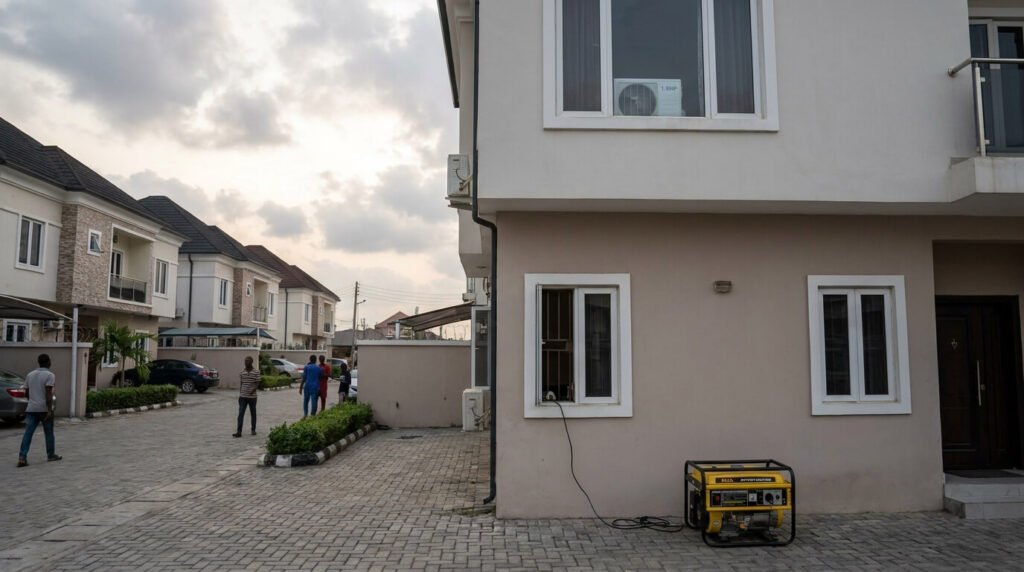
The generator sizing formula works in three clear steps: calculate the running load, account for startup surge, then convert to kVA.
Calculate Running Load
Start with your AC’s rated wattage: 746 × 1.5 = 1,119 watts. This is the continuous load the generator must sustain throughout operation.
Add any other connected appliances to get your total electrical load. For a practical sense of how this continuous draw affects your energy budget, how many units of electricity does an AC use per hour in Nigeria breaks down the numbers clearly for everyday planning.
Add Startup Surge Requirement
Next, account for surge power. Engr. Okorie confirms that compressor startup current is approximately three times the rated power: 1,119 × 3 = 3,357 watts.
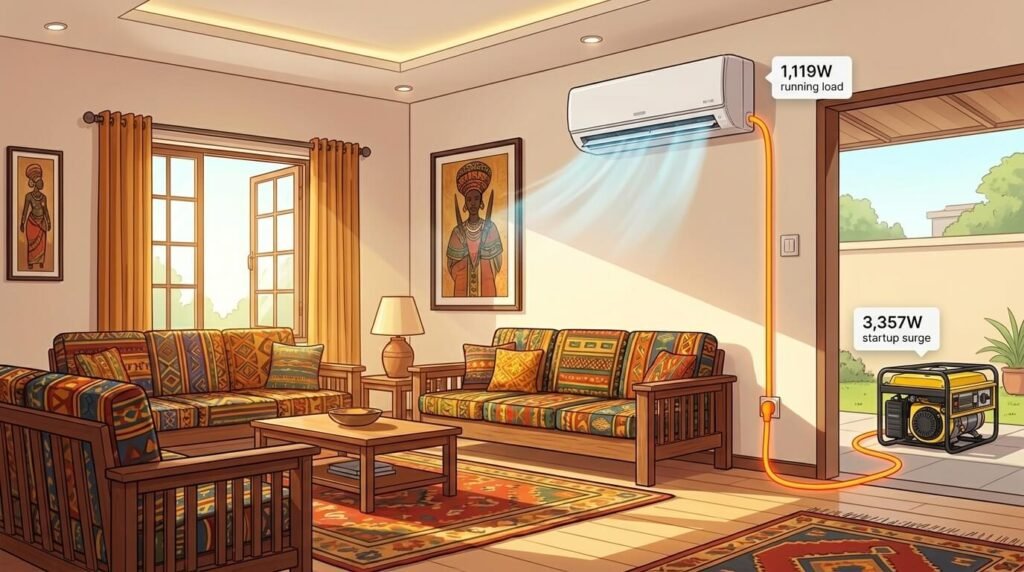
This is your peak load, the figure that actually determines your minimum generator requirement. Many buyers skip this step entirely and only discover the problem when their generator trips the moment the AC compressor starts.
Convert Watts to kVA
Generators are rated in kVA (kilovolt-amperes), not watts. To convert, divide your peak wattage by the power factor, typically 0.8.
Using Engr. Okorie’s calculation: Apparent Power = 3,357 ÷ 0.8 = 4,196.25 VA, or approximately 4.2kVA. That’s the minimum your generator needs for the AC alone.
Always round up to the next standard generator size and leave a safety margin for reliable long-term operation.
Recommended Generator Sizes for a 1.5HP Air Conditioner
Here’s how those numbers translate into practical generator choices for Nigerian homes.
Minimum Generator Size
Based on load calculation alone, the absolute minimum for a 1.5HP AC is approximately 4.2kVA. In practice, a 5kVA generator is the realistic starting point.
Engr. Okorie Udoka Ifeanyi is direct on this: “Due to other household loads, 5kVA will comfortably do the job.”
Anything below that risks tripping during compressor startup, particularly with non-inverter AC units that produce a higher startup surge than their inverter counterparts.
Recommended Generator Size for Better Performance
For reliable, consistent operation, especially during extended daily use, a 5kVA generator is the practical sweet spot. It handles the startup surge, sustains the running load, and has enough headroom for a few additional small appliances.
That buffer keeps the generator from straining at its limit, which translates directly into better fuel economy and a longer operational lifespan.
Generator Size for AC Plus Other Appliances
Once you add a TV, fridge, fans, and lighting alongside the AC, the combined appliance load changes the math entirely.
Engr. Isaac Abraham Eze, Business Development Executive at Hamisez Integrated Services in Port Harcourt, puts it plainly: “If it’s to power a building — 2 flats — including lights, ACs, fridge and more, you need to purchase a 15–20kVA generator” from brands like Jubaili Bros (MARAPCO) or Mantrac.
For a single flat, 7.5kVA to 10kVA covers the combined load comfortably.
Can a Small Generator Run a 1.5HP AC?
Here’s an honest look at how the most common generator sizes perform against a 1.5HP AC’s real demands.
2.5kVA Generator Compatibility
A 2.5kVA generator is simply too small. The startup surge of approximately 3,357 watts alone exceeds its rated capacity.
You may occasionally get the AC running under ideal conditions, but expect constant tripping, voltage instability, and premature wear on both the generator and the compressor. This is not a safe or reliable pairing for a 1.5HP air conditioner.
3.5kVA Generator Compatibility
A 3.5kVA generator sits right at the edge. It may manage a 1.5HP inverter AC with its lower startup demand, but leaves almost no headroom for any other connected appliances.
For a non-inverter AC, the startup surge will regularly push it beyond its safe limit.
If you already own a 3.5kVA generator, pair it with an inverter AC read Inverter AC and Generator compatibility to understand exactly why that pairing makes a meaningful difference in real-world performance.
5kVA Generator Compatibility
A 5kVA generator is the right match. It handles startup surge comfortably, sustains the running load without strain, and still has capacity left for other household appliances.
Reliable 5kVA options from brands like Firman Power Equipment are widely available in Nigeria and represent the practical benchmark most electrical engineers recommend for comfortable, stable 1.5HP AC operation.
Best Generator Types for Running Air Conditioners
Generator type affects power quality, fuel cost, and noise levels — all of which matter when you’re running an AC daily.
Petrol Generators
Petrol generators are the most common home backup solution in Nigeria. They’re affordable upfront, widely available, and easy to service.
Brands like Firman Power Equipment are popular choices across the country. The main drawback is fuel cost; petrol prices make extended daily runtime expensive.
They’re practical for a few hours per day but aren’t the most economical option for continuous, all-day AC operation.
Diesel Generators
Diesel generators consume less fuel per kilowatt and are built for longer operational hours.
Brands like Cummins and Mantrac — specifically recommended by Engr. Isaac Eze deliver dependable power for homes and offices running high electrical loads.
If your generator runs many hours daily to support AC cooling, the higher upfront cost of a diesel unit is recovered quickly through ongoing fuel savings.
Inverter Generators
Inverter generators produce cleaner, more stable power closer in quality to grid electricity. Honda Motor Company leads this category, and its generators are well-regarded for protecting sensitive appliances.
The stable voltage output reduces stress on the AC compressor and improves its lifespan. They’re also quieter and more fuel-efficient at partial loads, making them the best generator type for home AC use if your budget allows.
Factors That Affect Generator Size Requirements
Several real-world variables can push your generator size requirement higher than the basic calculation suggests.
Inverter vs Non-Inverter AC
The type of AC you own significantly changes how much generator capacity you need. A non-inverter AC has a fixed-speed compressor that cycles on and off, generating a startup surge repeatedly throughout the day.
An inverter AC uses variable-speed technology, starting gradually and drawing far lower surge power. For the best inverter AC for Generator use in Nigeria, choosing the right model can reduce your generator requirement by a full size category, saving on both the generator purchase and daily fuel costs.
Voltage Fluctuations
Nigeria’s power supply is prone to voltage instability, and generator output can also fluctuate under heavy load.
Undervoltage forces your AC compressor to draw more current than normal, putting extra strain on the generator.
An AVR (Automatic Voltage Regulation) system built into the generator stabilises output, while a voltage stabiliser from brands like Binatone provides additional protection for your equipment in environments with persistent voltage issues.
Additional Household Load
Every connected appliance increases your total electrical load. A fridge contributes its own startup surge. Fans, lighting, and a TV each add continuous wattage throughout the day.
The combined appliance load across your home is your real generator size requirement, not just the AC in isolation. Always calculate the total electrical load before settling on a size. This is what separates a well-planned purchase from a frustrating one.
Common Generator Sizing Mistakes
These are the errors that lead to damaged equipment, constant tripping, and wasted money.
Ignoring Startup Surge
Sizing based on running watts alone is the most common and costly mistake. The compressor startup spike — approximately three times the running power — is precisely where undersized generators fail.
A generator that manages 1,119 watts of continuous AC load may completely fail at the 3,357-watt startup surge. Always design your generator choice around peak load, not continuous load. Running watts alone tell you only half the story.
Choosing a Generator Based Only on HP
A generator’s HP rating and an AC’s HP rating don’t translate directly into wattage the way most people assume.
Different brands and models consume different amounts of power at the same HP rating.
Always check the appliance label or user manual for the actual wattage figures. Basing your generator purchase on HP labels alone — without checking real wattage is a common and easily avoidable mistake.
Forgetting Future Appliance Expansion
Many buyers size their generator for today’s load and find themselves overloaded within a year. A generator perfectly matched to current needs leaves no room for a second AC, water pump, or other additions down the line.
Build in a 20–25% safety margin above your current calculated load. Planning for expansion now avoids a costly generator upgrade later, and it costs very little to size up one step at purchase.
Tips for Running AC Efficiently on a Generator
These habits extend the life of both your generator and your air conditioner while keeping running costs down.
Use an Inverter AC
An inverter AC draws a lower startup surge and reduced running wattage, taking genuine pressure off your generator every day.
Explore the best inverter AC for Generator use in Nigeria for models specifically optimised for generator use. Some of these units can also work with solar backup.
If you want to reduce generator dependence altogether, the best solar air conditioners available in Nigeria highlight energy-saving alternatives that are now available in the market.
Turn Off Other Heavy Appliances
When the AC compressor is starting up, your generator is under maximum stress. Switch off electric irons, water heaters, or any other high-draw appliances at that moment.
Once the AC is running steadily, gradually reconnect other loads.
Smart load shedding at home protects your generator, reduces fuel consumption, and extends daily runtime a simple habit with meaningful long-term benefits for both your equipment and your budget.
Service the Generator Regularly
A poorly maintained generator can’t deliver its rated capacity reliably.
Degraded engine oil, worn spark plugs, and clogged fuel systems all reduce efficiency and output quality. Regular generator maintenance, fresh engine oil from brands like Mobil, clean spark plugs, and routine AVR checks — ensure your generator delivers stable, consistent power to the AC.
A well-serviced generator also lasts significantly longer, protecting the investment you’ve made.
Generator Buying Tips for Nigerian Homes
Beyond size, these factors determine whether your generator purchase works well for you over the long term.
Choose Reputable Generator Brands
Reliability matters far more than upfront price when the generator is your primary power source.
Brands like Honda Motor Company, Firman Power Equipment, Jubaili Bros (MARAPCO), Cummins, and Mantrac have established service networks and spare parts availability across Nigeria.
Engr. Isaac Eze specifically recommends Jubaili Bros and Mantrac for larger capacity needs.
A reputable brand means service and parts are accessible when you actually need them.
Check Fuel Consumption
Fuel economy directly affects how much you spend each month. At current petrol and diesel prices in Nigeria, even a small difference in litres per hour compounds into a significant annual cost difference.
Always compare the fuel consumption rating — typically listed in litres per hour at 75% load — before buying. A slightly more expensive generator with better fuel economy often costs less over two to three years of daily use.
Consider Noise Levels
Noise is something buyers frequently underestimate until they’re living with it daily.
Silent generators — like those from Mikano — operate at significantly lower decibel levels, making them far more comfortable for residential use, especially when running the AC overnight in bedrooms.
Check the noise rating in decibels before you purchase. The difference between a standard and a silent generator is noticeable the moment it starts.
Check After-Sales Support
Even the most reliable generator will need servicing at some point. Before buying, confirm that the brand has authorised service centres, trained technicians, and available spare parts within your city or state.
In smaller Nigerian cities, some brands have no service presence at all. Strong after-sales support can mean a quick, affordable repair versus a long, expensive wait for imported components, and that difference matters when the generator is your only power source.
Conclusion
Sizing a generator for your 1.5HP AC comes down to three things: running wattage, startup surge power, and the total load of every connected appliance.
Get those numbers right, and you protect your air conditioner, prevent generator overload, and keep your equipment running efficiently for years.
As Engr. Okorie and Engr. Isaac confirms a 5kVA generator covers a single 1.5HP AC comfortably, while larger homes with multiple appliances may need 15–20kVA.
Before you buy, calculate your full electrical load, plan for future appliance additions, and choose a generator brand with strong after-sales support in Nigeria. The right sizing decision saves you money and real frustration for years to come.
[…] the same generator, and you’ll need to size up from these baseline numbers, ideally using our full 1.5HP AC wattage and generator sizing breakdown if you’re planning to run more than one heavy appliance at […]