
Most air conditioner power consumption calculators give you a number that never matches your actual bill, because they multiply nameplate wattage by hours and stop there.
The calculator below does the same base math, but it also accounts for how a compressor actually cycles, and it works whether you’re comparing US dollars against SEER ratings or naira against generator sizing in Nigeria.
Enter your AC’s HP or BTU rating, your daily runtime, and your tariff, and you’ll get running watts, surge watts, and a real cost breakdown in under a minute.
AC Power Consumption Calculator
Enter your AC’s capacity, runtime, and tariff to get running watts, surge watts, and an estimated electricity cost.
This estimate applies a duty-cycle adjustment based on your compressor type, since most AC compressors don’t run at full nameplate power for every hour they’re switched on. Your manufacturer’s nameplate wattage, when available, should always take priority over the HP or BTU/EER estimate used here.
Example: a 1.5HP non-inverter split AC (1,119W running, 60% duty cycle) run 8 hours a day at $0.16/kWh works out to roughly $0.86/day, or about $26/month — using this AC power consumption calculator’s own formula: running watts × hours × duty cycle ÷ 1,000 × tariff.
How This AC Power Consumption Calculator Works
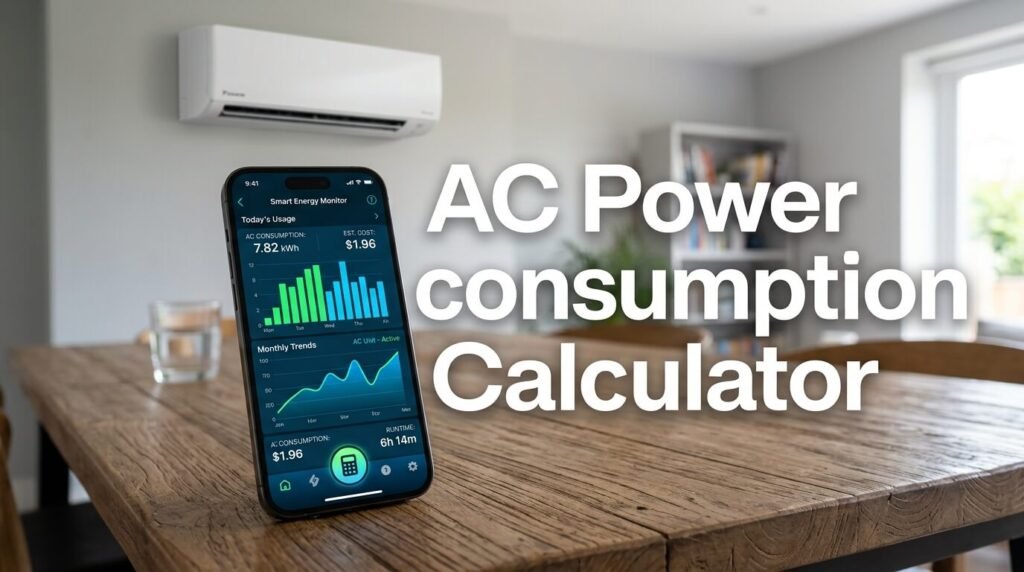
The calculator needs three things from you: your AC’s capacity, how many hours it runs per day, and your electricity tariff.
From those three inputs, it derives running watts, daily and monthly kWh, and a cost figure in your local currency.
Everything else on this page (the star rating comparisons, the generator sizing charts) builds on this same base formula.
The Formula Behind the Numbers
An air conditioner’s electricity use comes down to one relationship: how much power it draws while running, multiplied by how long it runs, multiplied by what you pay per unit of that power.
Running watts are the power the compressor and fan draw while actively cooling. For HP-rated units (common on split ACs sold in Nigeria and much of Asia), the AC unit calculation formula is:
- Take the AC’s horsepower rating.
- Multiply by 746 (the wattage equivalent of 1 HP).
- The result is your estimated running watts.
For BTU-rated units (common in the US), swap step 2: divide the BTU/hr rating by the unit’s EER (Energy Efficiency Ratio). A 12,000 BTU unit with an EER of 10 draws roughly 1,200 running watts.
Once you have running watts, the rest follows:
- Daily kWh = (running watts ÷ 1,000) × hours run per day
- Daily cost = daily kWh × your tariff (in $/kWh or ₦/kWh)
- Monthly cost = daily cost × 30
- Annual cost = daily cost × 365
What You’ll Need Before You Start
- Your AC’s capacity, in HP or BTU/hr. This is printed on the outdoor unit’s data plate, usually near the compressor.
- Your EER or SEER rating, if you know it. If you don’t, a default of EER 10 gives a reasonable estimate for a standard, non-high-efficiency unit.
- Average daily runtime, in hours. Round to the nearest half hour.
- Your electricity tariff, in $/kWh or ₦/kWh. This is on your utility bill, or you can use an estimated generator fuel cost per kWh if you run mostly on backup power.
- Your AC’s BTU rating, if you only know the room size and not the unit spec. If you’re shopping for a new unit and don’t yet know what capacity you need, our free aircon BTU calculator and AC power requirements will get you there before you run the numbers here.
AC Electricity Cost Calculator: How It Works
While power consumption tells you how much energy your AC draws, the electricity cost calculator takes it one step further, converting that consumption into the actual amount you’ll pay on your electricity bill.
The formula is simple:
Electricity Cost = Power Consumption (kWh) × Electricity Rate (per kWh) × Hours Used
To calculate your AC’s electricity cost, you need three inputs:
- Power consumption (kWh) — this comes from your AC’s wattage rating (found on the nameplate or user manual) divided by 1,000, since 1 kWh = 1,000 watts used for one hour.
- Your electricity rate — the price per kWh charged by your utility provider, usually found on your electricity bill.
- Hours of daily use — how long you run your AC per day.
This gives you the nameplate ceiling; the duty-cycle explanation below shows why your actual bill usually comes in lower than this.
Use the calculator above to skip the manual math: just enter your AC’s HP or BTU rating, your local electricity rate, and daily usage hours, and it will instantly show your estimated daily, monthly, and yearly running cost.
Feel free to swap in your actual currency symbol and adjust the example numbers to match your AC unit in your country.
How many kilowatts does a 2HP air conditioner consume in 1 hour?
A 2HP AC typically consumes about 1.5 to 2 kWh in one hour of running (1.5 to 2 kW of power draw).
| Type | Typical power draw | Energy per hour |
| Non-inverter (fixed speed) | 1.6–2.0 kW | 1.6–2.0 kWh |
| Inverter | 0.8–1.8 kW (varies with load) | 0.8–1.8 kWh |
Formula:
Energy (kWh) = Power draw (kW) × Hours used
Cost = kWh × your electricity tariff per kWh
Example: a 2HP non-inverter AC drawing 1.8 kW and running 8 hours a day uses 1.8 × 8 = 14.4 kWh per day, or about 432 kWh per month.
Check the nameplate or manual for the exact rated input (watts). Actual use depends on room size, insulation, outdoor temperature, thermostat setting, and compressor cycling.
Nameplate Watts vs. What You’re Actually Billed For
If you’ve run a proper split AC maintenance schedule and your calculated number still doesn’t match your bill, the gap usually isn’t a maintenance problem.
It’s a math problem: nameplate wattage assumes the compressor runs continuously for every hour you count, and most AC compressors don’t work that way.
Why Duty Cycle Changes the Real Number
A non-inverter (fixed-speed) compressor doesn’t run at full power the entire time your AC is switched on. It cools the room down to your set temperature, shuts off completely, then kicks back on once the room warms up a few degrees.
This on-off pattern is called the duty cycle, and it’s usually expressed as a percentage: a compressor with a 60% duty cycle is actually drawing power for 60% of the hours you count as “AC running.”
Here’s what that means for a 1.5HP split AC rated at 1,119 running watts, used for 8 hours a day:
- Nameplate math (what most calculators show): 1,119W × 8 hours = 8.95 kWh/day
- Real-world math at a 60% duty cycle: 1,119W × 8 hours × 0.60 = 5.37 kWh/day
That’s a difference of roughly 3.6 kWh every day, which compounds to about 108 kWh a month, enough to explain why your calculated cost consistently overshoots your actual bill.
Duty cycle isn’t fixed. It moves with room insulation, outdoor temperature, thermostat setting, and how well the unit has been maintained, which is exactly why two identical AC units in two different rooms can post noticeably different bills even at the same nameplate rating.
Inverter AC vs. Non-Inverter AC Power Consumption
Inverter compressors handle this differently. Instead of switching fully on and off, they throttle their speed up and down to match cooling demand, so they spend most of their runtime at partial load rather than full nameplate draw.
| Factor | Non-Inverter (Fixed-Speed) | Inverter (Variable-Speed) |
|---|---|---|
| Compressor behavior | Full power, then off, repeating | Continuously modulates speed |
| Typical duty cycle | 50-70% at moderate load | Runs near-continuously at lower average draw |
| Start-up frequency | High (repeated hard starts) | Low (one gradual ramp-up) |
| Nameplate accuracy | Overstates real consumption | Understates real consumption at full load |
| Best fit | Lower upfront cost, occasional use | Long daily runtime, stable temperature needs |
Neither number, the nameplate figure or a flat duty-cycle discount, is exactly what you’ll be billed. Treat the calculator’s output as your ceiling for a non-inverter unit and your floor for an inverter unit, and use your actual utility bill to calibrate from there.
AC Tonnage and HP to Watts Reference Table
Two different rating systems dominate two distinct markets, and that’s a real source of confusion when comparing units across them. Split ACs sold in Nigeria, India, and much of Southeast Asia are rated in horsepower (HP).
Central and window units sold in the US are rated in tons or BTU/hr. The AC unit calculation formula bridges both, but it helps to see them side by side.
Split AC Power Consumption by Capacity, 1HP-2HP
| Capacity | Running Watts (est.) | Surge Watts (2.5x) | Daily kWh at 8hrs |
|---|---|---|---|
| 1 HP | 746W | 1,865W | 5.97 kWh |
| 1.5 HP | 1,119W | 2,798W | 8.95 kWh |
| 2 HP | 1,492W | 3,730W | 11.94 kWh |
These figures assume a standard-efficiency compressor running at full nameplate load.
A brand-specific unit, a Daikin AC power consumption calculator entry, for example, may list a slightly different rated input watts on its own spec sheet, and that manufacturer figure should always take priority over the generic HP estimate above when you have it.
Window and Central AC Power Consumption Compared
| Capacity | BTU/hr | Running Watts (EER 10) | Daily kWh at 8hrs |
|---|---|---|---|
| 1 Ton | 12,000 | 1,200W | 9.6 kWh |
| 1.5 Ton | 18,000 | 1,800W | 14.4 kWh |
| 2 Ton | 24,000 | 2,400W | 19.2 kWh |
| 3 Ton (central) | 36,000 | 3,600W | 28.8 kWh |
The 1-ton AC power consumption per hour figure of 1,200W lines up closely with a 1.5HP split AC’s 1,119W, which is a useful sanity check if you’re translating between a US-market spec sheet and a Nigerian-market one.
Central AC systems draw the most in absolute terms, but they also cool more square footage per watt than running several smaller window units to cover the same space, which is worth factoring into a central AC tune-up checklist if you’re deciding between replacing a central system or splitting it into zoned mini-splits.
Star Rating and SEER — Do They Actually Lower Your Bill?
A higher star or SEER rating does lower your running watts for the same cooling output, but it doesn’t eliminate the duty-cycle and sizing factors covered above. A 5-star AC oversized for a small room can still cost more to run than a correctly sized 3-star unit.
Reading a BEE Star Label vs. a US SEER Rating
India’s Bureau of Energy Efficiency (BEE) star system and the US SEER2 system measure efficiency differently and aren’t directly interchangeable, but they roughly correspond in this order:
| BEE Star Rating | Approximate ISEER Range | Roughly Comparable SEER2 Band |
|---|---|---|
| 5 Star | 4.50 and above | 18+ SEER2 (high efficiency) |
| 4 Star | 4.30-4.49 | 15-17 SEER2 |
| 3 Star | 3.90-4.29 | 14-15 SEER2 (near US minimum) |
| 2 Star | 3.50-3.89 | Below current US minimum standard |
Treat this table as an orientation guide, not an exact conversion. ISEER and SEER2 use different test conditions and different climate assumptions, so a unit’s actual nameplate input watts is always the more reliable number when you have it.
3 star vs 5 star AC power consumption calculator
A higher star rating means a higher efficiency ratio (ISEER), so the AC uses less electricity for the same cooling.
Figures below are for a 2HP (about 18,000 BTU) AC, running 8 hours a day for 30 days.
| Feature | 3-star AC | 5-star AC |
| Efficiency (ISEER) | About 4.0–4.5 | About 5.0 and above |
| Average power draw (estimate) | About 1.5 kW | About 1.1 kW |
| Energy per hour | 1.5 kWh | 1.1 kWh |
| Energy per day (8 hrs) | 12 kWh | 8.8 kWh |
| Energy per month (8 hrs/day) | 360 kWh | 264 kWh |
| Monthly saving | Baseline | About 96 kWh (around 25–27% less) |
| Purchase price | Lower | Higher |
| Payback | Not applicable | Longer with heavy daily use, shorter with light use |
How to calculate your own:
- Find the rated input power (kW) on the AC label.
- Multiply by hours used per day, then by 30 for the monthly kWh.
- Multiply by your tariff to get the monthly cost.
- Compare the 3-star and 5-star results to see your savings.
Monthly saving formula:
Saving = (3-star kW − 5-star kW) × hours per day × 30 × tariff per kWh
Which to pick:
- 5 star: best for heavy use (8+ hours daily), because the energy savings repay the higher price faster.
- 3 star: fine for occasional use, where the cheaper purchase price matters more.
The figures above are estimates. Star thresholds and ISEER ranges differ by country and change when rating schemes are updated, so confirm against the energy label on the specific model.
Sizing Backup Power for Your AC — Generator & Inverter
If you’re running an AC power consumption calculator in Nigeria, the number you actually need isn’t just your monthly bill; it’s the generator or inverter size that will start and hold that load through a NEPA outage.
Split ACs are one of the heaviest surge loads in a typical Nigerian household, and undersizing backup power for one is the single most common reason a “big enough” generator trips the moment the compressor kicks on.
Why AC Compressors Need 2-3x Surge Capacity
A compressor’s start-up current, sometimes called locked-rotor current, is far higher than its running current because the motor has to overcome full mechanical resistance before it spins up to speed.
That surge typically lasts three to five seconds, but a generator or inverter that can’t supply it for even that brief window will trip or shut down, regardless of how comfortably it could handle the running load afterward.
This is why generator and inverter sizing has to be based on surge watts, not running watts, and it’s also why running your AC on solar instead requires an inverter rated well above the panel array’s continuous output, not just matched to it.
Generator and Inverter Size Chart by AC Capacity
| AC Capacity | Surge Watts | Recommended Generator | Recommended Inverter |
|---|---|---|---|
| 1 HP | 1,865W | 2.5 kVA | 2.5 kVA |
| 1.5 HP | 2,798W | 3.5 kVA | 3.5 kVA |
| 2 HP | 3,730W | 5 kVA | 5 kVA |
These figures cover the AC alone, running at a 0.8 power factor with no other appliances on the same circuit.
Add a refrigerator, pumping machine, or a second AC to the same generator, and you’ll need to size up from these baseline numbers, ideally using our full 1.5HP AC wattage and generator sizing breakdown if you’re planning to run more than one heavy appliance at once.
7 Ways to Cut Your AC’s Power Consumption
Most of the meaningful savings come from two places: reducing how hard the compressor has to work, and reducing how often it has to start up in the first place.
Habit Changes That Cost Nothing
- Cleaning your AC filter every four to six weeks keeps airflow unrestricted, which lets the compressor reach your set temperature faster and shut off sooner.
- Setting the thermostat a few degrees higher, especially overnight, reduces both runtime and how hard the compressor works during each cycle.
- Closing curtains or blinds during peak sun hours cuts the heat load the AC has to fight, which shortens each cooling cycle.
- Sealing obvious gaps around doors and windows in the cooled room prevents warm air from constantly re-entering and triggering the compressor to restart.
- Running the AC on a timer rather than leaving it on all day matches runtime to actual occupancy instead of an empty room.
Upgrades Worth the Investment
- Switching to an inverter unit if your daily runtime is long and consistent, since that’s the usage pattern where inverter compressors save the most over fixed-speed units.
- Adding or improving insulation in the cooled space, which reduces the total cooling load the AC has to offset regardless of the unit’s efficiency rating.
- Replacing a unit older than 10-12 years, since compressor efficiency degrades with age even when the star rating on the original label hasn’t changed.
- Install a smart thermostat that learns occupancy patterns, which reduces unnecessary runtime more consistently than manual scheduling.
Sizing your backup power correctly matters just as much as calculating your bill, especially if your AC is the single largest load your generator or inverter has to carry.
If you’re setting up backup power for a split AC specifically, our full 1.5HP AC wattage walks through sizing for a complete household load, not just the AC in isolation.
Frequently Asked Questions
How do I calculate the power consumption of my AC?
Multiply your AC’s running watts by the hours it runs per day to get daily watt-hours, then divide by 1,000 to get kWh. Find running watts by multiplying HP by 746, or by dividing BTU/hr by the EER rating if your unit is BTU-rated.
Multiply daily kWh by your electricity tariff to get daily cost, then by 30 or 365 for monthly or annual figures.
This nameplate calculation gives you an upper estimate; your actual bill will usually run lower because of duty cycling, unless you’re running an inverter unit at consistently high load.
Why is my actual electricity bill higher than what the calculator says?
The most common reason is that “higher” is relative to a nameplate estimate that already assumes continuous full-power running, which most compressors don’t do, so a mismatch in the other direction (calculator says more, bill says less) is actually the expected outcome for a healthy unit.
If your bill is genuinely higher than even the nameplate figure predicts, check for a dirty filter restricting airflow, a low refrigerant charge forcing the compressor to run longer to reach set temperature, or another appliance on the same circuit being miscounted.
A poorly maintained unit can run its duty cycle up toward 90-100%, closing the gap between nameplate and real consumption entirely.
Is an inverter AC actually cheaper to run than a non-inverter?
Yes, in most real-world usage patterns, but the savings depend heavily on how many hours a day you run it.
Inverter units modulate compressor speed instead of cycling fully on and off, so they avoid the repeated hard starts and full-power spikes that make non-inverter units less efficient over a full day of use.
For short, occasional runtime, the efficiency gap narrows enough that the higher upfront cost of an inverter unit may not pay back quickly, which is why long, consistent daily use is the usage pattern where switching makes the clearest financial sense.