
Most guides describing a split AC maintenance service, also called split system maintenance, depending on where you live, treat it as one job: clean the filters, rinse the coils, check the refrigerant, done.
That last part isn’t as casual as it sounds. Touching the refrigerant line without an EPA Section 608 certification is a federal violation, and the fine can run past $40,000 a day, which is the real reason every article tells you to “leave refrigerant work to a professional” without explaining why.
This guide draws that line clearly: what a technician actually does during a visit, what you can legally handle yourself, how often service is needed, what it costs, and how to confirm the person you hire is actually certified.
This guide focuses on keeping a split AC running well, not how the system cools a room in the first place. If you want that explanation, see our complete breakdown of how an air conditioner works.
What’s included in a Split AC (Split System) Maintenance Service
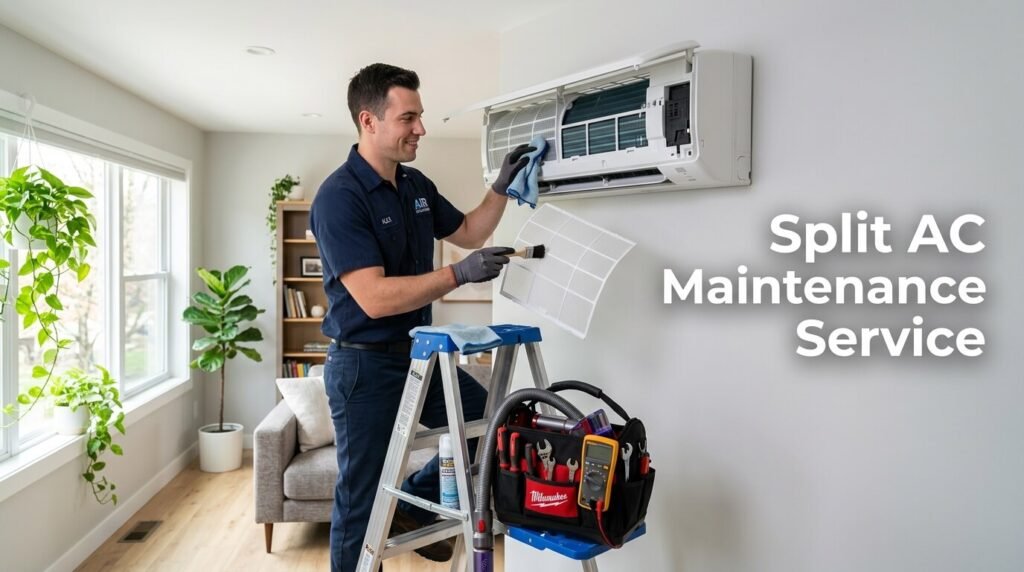
A split AC maintenance service covers four things every time: the filters, the indoor and outdoor coils, the condensate drain line, and a check of the refrigerant circuit and electrical connections.
Everything else- deep cleaning, leak repair, parts replacement- gets added on top of that baseline.
Tasks a technician performs during a standard visit
- Turn off the power at the breaker or isolator switch before opening any panel.
- Remove and inspect the air filter, then clean or replace it depending on its condition.
- Clean the indoor unit’s blower wheel and coil to clear dust, mold, and biofilm buildup.
- Clear the condensate drain line so it doesn’t back up and leak into the room.
- Wash the outdoor condenser coil and clear debris from around the unit.
- Check refrigerant pressure and look for signs of leaks, repairing any leak found rather than just adding refrigerant.
- Test electrical connections, amp draw, and thermostat response before closing up the unit.
This AC maintenance checklist covers the same steps in checklist form if you want to confirm that a technician hit every point.
Standard maintenance vs. deep cleaning service
| Factor | Standard maintenance | Deep cleaning service |
|---|---|---|
| What’s cleaned | Filters, coils, drain line, basic exterior | Same, plus full disassembly and a high-pressure or chemical coil wash inside the indoor unit housing |
| When it’s needed | Every 6 to 12 months for most homes | When you see mold, smell musty air, or haven’t had service in 2+ years |
| Typical add-on cost | Included in a standard visit | $50–$150 extra per indoor unit |
| Time required | 45 minutes to 1.5 hours | 2–3 hours |
Most homes only need standard maintenance twice a year. Deep cleaning earns its higher price when there’s visible mold or a musty smell. A quick coil rinse won’t fix paying for it at every visit is overkill for a system that’s already on a normal schedule.
What You Can Legally Do Yourself on a Split System and What You Can’t
You can legally handle anything that doesn’t touch the sealed refrigerant circuit, filters, exteriors, debris, and basic rinsing.
The moment a job involves gauges, refrigerant, or opening that circuit, it stops being a DIY task and becomes a federal certification requirement.
DIY-safe tasks
- Cleaning or replacing the air filter every 2 to 4 weeks keeps airflow where it should be, and it’s the single task with the biggest impact on performance.
- Wiping down the indoor unit’s exterior with a dry or damp cloth removes dust without touching any sealed components.
- Clearing leaves, grass clippings, and debris from around the outdoor unit takes five minutes and protects the coil from being smothered.
- Rinsing the outdoor coil gently with a garden hose, never a pressure washer, is fine as long as the power is off and the fins stay straight.
Why refrigerant work requires EPA Section 608 certification
EPA Section 608 certification is the federal credential required under the Clean Air Act for anyone who attaches gauges, adds or removes refrigerant, or otherwise opens the refrigerant circuit of an AC unit.
Cleaning a filter doesn’t require it. Touching the refrigerant line does.
| Certification type | Covers | Who typically needs it |
|---|---|---|
| Type I | Small appliances | Window unit and small-appliance technicians |
| Type II | High-pressure appliances, including most split AC and mini-split systems | Residential split AC technicians |
| Type III | Low-pressure appliances | Large chiller technicians |
| Universal | All of the above | Technicians servicing mixed equipment |
Working on a sealed refrigerant circuit without this certification is illegal, not just inadvisable, and the EPA can fine violators more than $40,000 per day per violation.
That’s the real line between a DIY task and a call-a-certified-technician task, not how confident you feel with a wrench.
Refrigerant rules have been shifting on the equipment side too; this R-410A phase-out timeline covers what changed for the refrigerant itself, separate from who’s legally allowed to touch it.
How often does a Split AC (Split System) need Maintenance?
A split AC needs professional maintenance once or twice a year for most homes, and the right number depends on how hard the system runs, not the calendar.
Recommended service frequency by use case
| Use case | Recommended frequency |
|---|---|
| Typical residential use, seasonal cooling | Once a year, before the cooling season |
| Year-round use in hot climates | Twice a year — spring and fall |
| Homes with pets, dust, or allergy sufferers | Filter checks every 2 weeks; professional visit twice a year |
| Multi-zone systems (one outdoor unit, several indoor heads) | Once per indoor unit, per visit — not once for the whole system |
Warning signs your split AC needs service now
- Reduced airflow from the indoor unit even after a filter change usually means the coil or blower wheel needs cleaning, not a new filter.
- Ice forming on the indoor coil points to a refrigerant or airflow problem that needs a technician, not just a thaw-and-wait.
- A musty smell when the unit starts up is mold growing inside the housing, and it gets worse the longer it’s ignored.
- A noticeable jump in your cooling bill with no change in habits is the clearest sign the system is working harder than it should.
What Split AC (Split System) Maintenance Costs
A standard split AC or split system maintenance visit costs $150 to $300 per indoor unit, which is a fraction of the average AC repair cost by issue you’re risking if a skipped service turns into a real breakdown.
Per-visit cost vs. annual maintenance contract
| Pricing model | Typical cost | Best fit |
|---|---|---|
| Single visit | $150–$300 per indoor unit | Homes with one or two units, occasional buyers |
| Annual maintenance contract (AMC) | $200–$600 per year, covers 1–2 visits plus priority scheduling | Homes with 3+ indoor units or year-round use |
An AMC wins once you’re past two indoor units or running the system most of the year. The bundled price usually beats paying full rate for each visit separately, and priority scheduling matters more than people expect during a heat wave when every contractor is booked solid.
What changes the price
- Each additional indoor unit on a multi-zone system adds its own per-unit labor charge, since a technician has to clean and check every head separately.
- A refrigerant leak repair or recharge gets billed on top of the maintenance visit, not folded into the base price.
- Hard-to-reach outdoor units — rooftop, behind landscaping, upper floors — add labor time that shows up on the invoice.
- A deep cleaning add-on for mold or years of neglect runs $50 to $150 more per unit than a standard visit.
What happens if you skip maintenance
Skip maintenance long enough, and the system doesn’t fail all at once. It loses efficiency first, then starts showing the signs your AC needs replacement years earlier than it should have.
Lifespan and efficiency impact
A neglected split AC doesn’t usually break down overnight. It just runs harder for the same result, month after month, until the compressor or coil gives out years ahead of schedule.
A well-maintained ductless system typically lasts 15 to 20 years; skip the twice-yearly service and that range shrinks toward the low end, sometimes well below it.
Climate plays its own role on top of maintenance habits. This central air conditioner lifespan by climate breakdown covers how much faster a unit ages under constant heavy use versus occasional seasonal cooling.
Refrigerant leak signs that need immediate attention
- Hissing or bubbling near the refrigerant lines almost always means a leak, not background unit noise.
- Ice on the indoor coil with otherwise normal airflow is one of the most common signs that refrigerant has dropped below the level the system needs.
- Cooling that gets weaker over weeks, rather than failing all at once, points to a slow leak rather than a sudden mechanical failure.
- If a technician offers to “just top off” the refrigerant more than once without finding the leak, that’s not routine maintenance. EPA rules require leak repair, not repeated recharges, and a pattern of top-offs usually means you’re paying again for a problem that was never actually fixed.
How to choose a qualified maintenance provider
Choosing a qualified maintenance provider comes down to one question most homeowners never ask: Can you prove you’re certified to touch this refrigerant line?
How to verify a technician’s EPA certification before hiring
- Ask to see the technician’s Section 608 certification card before work begins, not after.
- Check that the card lists a certifying program name and an issue date — cards issued after January 1, 2018 must include both.
- Confirm the certification type matches the job; Type II covers most residential split AC systems, so a Type I-only card isn’t enough.
- If the company can’t produce a card on request, treat that as a hard stop, not a minor inconvenience.
Questions to ask before booking
- Does the price include every indoor unit, or is it billed per head?
- Is a refrigerant leak search included, or only a refrigerant top-up if one’s needed?
- What’s covered if something goes wrong within a set period after the visit?
- Is there a contract option, and does it lock in pricing for the year or just bundle visits?
If your split AC hasn’t had a professional visit in over a year, that’s the first thing to fix before anything else on this page. A technician can tell you in one visit whether you’re looking at routine upkeep or something closer to a repair.
FAQ
What does a split AC maintenance service include?
A standard visit covers filter cleaning, coil and drain line cleaning, an outdoor unit cleanout, and a refrigerant and electrical check. Deep cleaning add-ons cost more and go further into the indoor unit housing.
How often should a split AC be serviced?
Once a year for typical seasonal use, twice a year for year-round use or hot climates. Multi-zone systems need this per indoor unit, not once for the whole setup. See our complete guide on Air Conditioner Servicing to learn more.
How much does split AC (split system) maintenance cost?
A standard visit runs $150 to $300 per indoor unit. An annual maintenance contract usually costs $200 to $600 a year and often works out cheaper for homes with three or more units.
Note: This amount depends on the state, country, or region you reside in, and issues surrounding the maintenance.
Can I clean my split AC system myself?
Yes, for filters, the exterior, and clearing debris around the outdoor unit. Anything involving the refrigerant line requires a certified technician by law.
Is it illegal to add refrigerant to my AC myself?
Yes. Adding or removing refrigerant without EPA Section 608 certification is a federal violation that can carry fines of over $40,000 per day.
What happens if I don’t maintain my split AC?
The system loses efficiency gradually rather than failing all at once, and a unit that should last 15 to 20 years can fall well short of that. Cooling bills climb first, then components start failing early.
Do I need an annual maintenance contract for my split AC system?
Not for one or two units; a single visit seasonally works fine there. For three or more indoor units or year-round use, a contract usually costs less than paying full price per visit.
How do I know if my split AC needs a refrigerant refill?
Weakening cooling over several weeks, ice on the indoor coil, or a hissing sound near the lines are the main signs. A real fix means finding and repairing the leak, not just adding refrigerant again.
Can a technician without EPA certification legally service my AC?
No, not for anything involving the refrigerant circuit. They can legally clean filters and exteriors, but touching the refrigerant lines without Section 608 certification is illegal regardless of experience.