
1.5HP AC wattage isn’t one number, and the single figure most calculators give you, 1,119 watts, is the wrong place to start.
A standard 1.5HP air conditioner actually draws 1,100 to 1,500 watts while running, not 1,119, because that textbook number is a generic horsepower-to-watts conversion, not a measurement of what a real split AC pulls from the wall.
It gets bigger once you add the startup surge: 3,000 to 4,500 watts for a standard unit, versus 900 to 1,200 watts for an inverter type.
That gap is the actual reason generators and inverters trip, and it’s where this guide starts, alongside the generator size, inverter size, and battery setup, each of which requires a number.
How many watts does a 1.5HP air conditioner use while running?
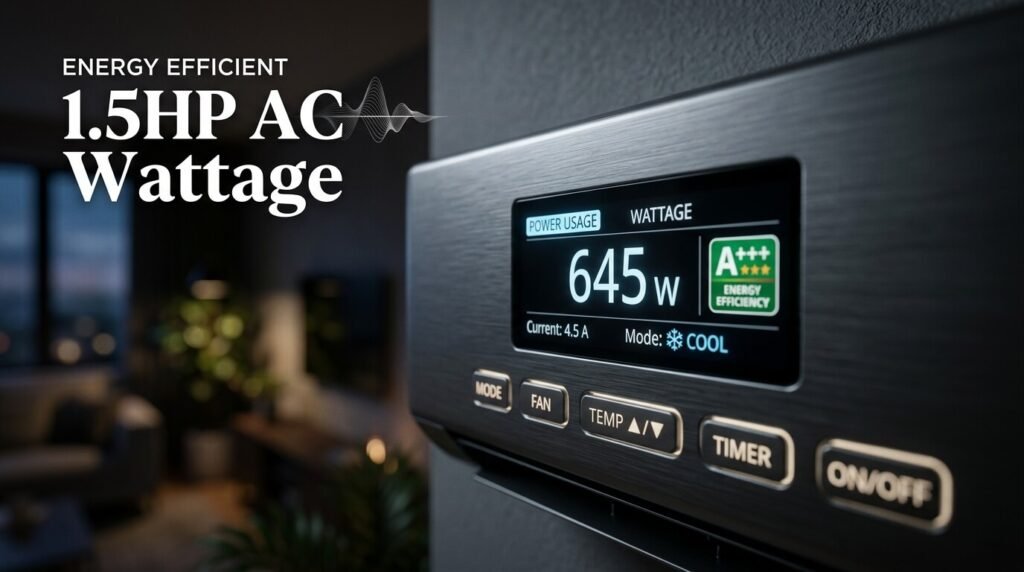
A 1.5 HP air conditioner uses 1,100 to 1,500 watts while running if it’s a standard, non-inverter unit, or 600 to 900 watts if it’s an inverter unit.
Both numbers sit on either side of the 1,119-watt figure most pages quote as the answer, and the gap exists because of where that number actually comes from.
The textbook formula, and why it’s not the full answer
The textbook formula: 746 watts × 1.5 HP = 1,119 watts. This converts horsepower to watts the way you’d size a generic motor’s mechanical output.
It says nothing about a real split AC’s electrical draw, which includes compressor inefficiency, the fan motor, and the control board on top of the compressor itself.
| Figure | Watts |
|---|---|
| Textbook formula (746W × 1.5HP) | 1,119W |
| Real-world standard 1.5HP AC, running | 1,100–1,500W |
| Real-world inverter 1.5HP AC, running | 600–900W |
The textbook number sits inside the standard range almost by coincidence, close enough that nobody questions it.
It says nothing about an inverter unit, which can run at roughly half that wattage, and nothing at all about the startup surge, which is the figure that actually decides whether your generator or inverter can handle the AC.
Real-world running wattage by AC type
| AC type | Running wattage |
|---|---|
| Standard (non-inverter) 1.5HP | 1,100–1,500W |
| Inverter-type 1.5HP | 600–900W |
Inverter wins on running watts by a wide margin once the room cools down and the compressor throttles back. That gap is the entire reason inverter units cost more upfront and less every month after.
To learn more about the relationship between wattage and AC frequency, read our guide on: Air Conditioner Frequency.
How many watts does a 1.5HP AC need to start?
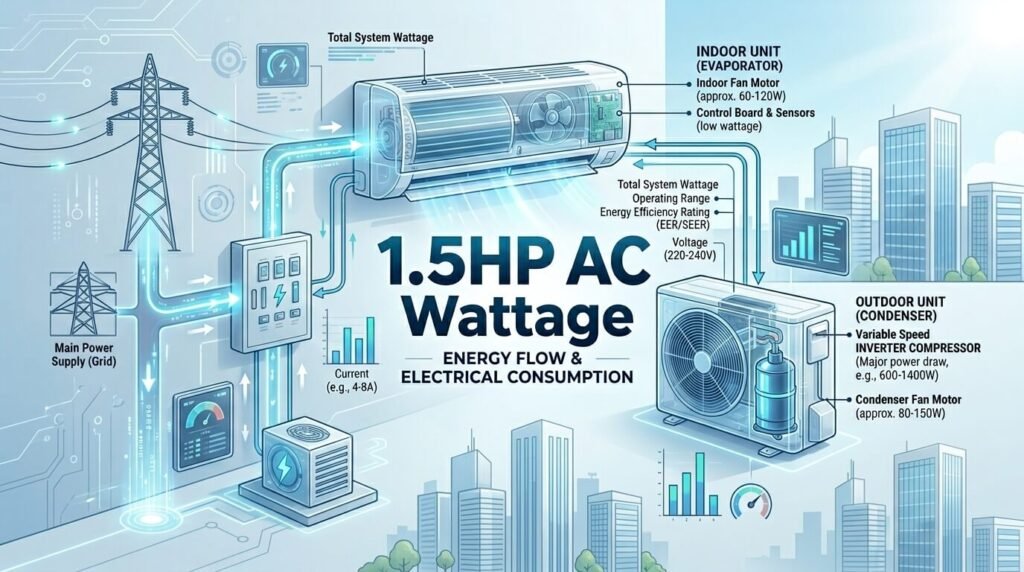
A 1.5HP air conditioner needs far more than its running wattage to start. A standard unit’s compressor can surge to 3,000 to 4,500 watts for one to three seconds at startup, while an inverter-type unit, using soft-start technology, needs only 900 to 1,200 watts to get going.
Startup surge — standard vs. inverter-type
| AC type | Startup surge | Duration |
|---|---|---|
| Standard (non-inverter) 1.5HP | 3,000–4,500W | 1–3 seconds |
| Inverter-type 1.5HP | 900–1,200W | Brief ramp-up, no hard spike |
That’s a three- to four-times gap between the two, and it’s the number that decides whether a borderline generator or inverter trips. Not the running wattage most people fixate on.
Why the surge, not the running watts, is what trips generators and inverters
Generators and inverters rarely fail because they can’t sustain the running load; that part is easy.
They fail because the compressor’s first second of operation demands three to four times that load, and if the unit supplying power can’t absorb the spike, its overload protection cuts it off immediately.
A 3.5kVA generator can run a 1.5HP AC’s steady load all day and still trip the moment the compressor cycles back on after the thermostat re-engages.
The fix isn’t more fuel or a bigger battery bank; it’s enough surge capacity to absorb that one-to-three-second spike. The same problem shows up on the battery side too, covered in more depth in this inverter AC and generator compatibility breakdown.
Generator size by AC type and household load
| Scenario | Recommended generator size |
|---|---|
| Standard 1.5HP AC alone | 5kVA minimum |
| Inverter-type 1.5HP AC alone | 3.5kVA workable, 5kVA more comfortable |
| Standard 1.5HP AC plus a deep freezer or pumping machine | 5kVA, taking care not to start both at once |
| 1.5HP AC running a manufacturer’s documented low-power mode | As low as 1.1kVA on some models, at the cost of a real drop in cooling output |
That last row isn’t a workaround. Some manufacturers, including LG, publish a separate low-power operating mode for specific models with its own generator-size rating roughly 1.1kVA for a 1.5HP unit, against about 1.7kVA in normal mode.
The unit runs on a noticeably smaller generator, and the documentation is upfront that you’re trading around 30% of cooling performance for it.
Most buyers sizing a generator never know this second rating exists, because it only shows up in that specific model’s manual, not on the box.
To learn more about Generator sizing, read our guide on: Generator Sizing for 1.5HP Air Conditioner.
What size inverter or solar backup do you need for a 1.5HP AC?
A 1.5HP AC needs at least a 3.5kVA inverter system if it’s an inverter-type unit, or 5.5kVA if it’s a standard fixed-speed unit. The gap comes from the same surge difference covered above.
Inverter size by AC type
| AC type | Minimum inverter size | Comfortable inverter size |
|---|---|---|
| Standard 1.5HP AC | 5.5kVA | 5.5kVA, with headroom for other appliances |
| Inverter-type 1.5HP AC | 3.5kVA | 3.5kVA, tight, with little room for other loads |
A 2.4kVA inverter can technically carry an inverter-type 1.5HP AC under controlled conditions, but with no freezer starting at the same time, no pumping machine, and careful load management around the clock. 3.5kVA is the realistic floor, not 2.4kVA.
Battery and solar panel sizing for realistic backup hours
| Component | Sizing guidance |
|---|---|
| Battery bank formula | Backup Hours = (Battery Voltage × Ah × Depth of Discharge × Inverter Efficiency) ÷ Load Watts |
| Example: 24V, 200Ah battery, 80% DoD, 85% efficiency | 3,264Wh usable, roughly 2.5 to 3 hours running a standard 1.5HP AC alone |
| Solar panels | 5 to 7 panels at 300W each (1,500–2,100W total) to keep pace with a 1.5HP AC’s daytime draw |
Pairing panels with the battery bank, rather than relying on either alone, is covered in more depth in this solar air conditioner breakdown.
Generator vs. inverter for a 1.5HP AC — which fits your situation?
The generator and inverter both work for a 1.5HP AC. The right one comes down to how often you lose power and whether you’d rather spend on fuel or on equipment, not on which technology performs “better” in the abstract.
Side-by-side comparison of the same wattage numbers
| Factor | Generator | Inverter/solar |
|---|---|---|
| Upfront cost | Lower, roughly ₦150,000–₦600,000 for a 5kVA petrol or diesel unit | Higher, often ₦800,000+ for a 3.5–5.5kVA system with batteries |
| Running cost | Fuel, continuous | Electricity to recharge batteries, lower per hour |
| Noise | Loud, audible outdoors | Silent |
| Handles the AC’s startup surge | Yes, if sized at 5kVA or above | Yes, if sized at 3.5–5.5kVA |
| Depends on | Fuel supply on hand | Charged batteries or grid/solar input |
| Best for | Frequent or long outages, lower upfront budget | Short-to-medium outages, cutting fuel costs over time |
Decision checklist
- Count how many hours of outage you deal with on a typical day. Under four hours favors an inverter and battery; longer or unpredictable outages favor a generator with fuel on hand.
- Add up every other appliance you need running at the same time as the AC, not the AC alone.
- Check whether your AC is standard or inverter-type, since that single fact changes the minimum size on both paths by a wide margin.
- Decide whether noise matters. An inverter system runs silently; a generator doesn’t.
1.5HP AC wattage compared to other sizes, amps, and electricity cost
HP-to-kW/kVA conversion: In kilowatts, 1.5HP works out to about 1.1 kW using the textbook conversion (746W × 1.5 ÷ 1,000), but a real 1.5HP AC’s running draw falls closer to 0.6–0.9 kW for an inverter unit or 1.1–1.5 kW for a standard unit the same running-wattage figures covered above, just expressed in kW instead of watts.
In kVA terms (used for sizing generators and inverters rather than measuring consumption), that same 1.5HP unit is typically rated for 3.5–5.5 kVA of supply capacity, covered in detail in the generator and inverter sections below.
A 1.5HP AC sits in the middle of the common Nigerian sizing range, and the wattage jump between sizes is bigger than the HP numbers alone suggest.
The watts used by AC units in Nigeria breakdown covers the full range from 1HP through 2HP side by side.
1HP vs. 1.5HP vs. 2HP wattage comparison
| AC size | Standard running watts | Standard startup surge |
|---|---|---|
| 1HP | 750–1,200W | 1,500–2,400W |
| 1.5HP | 1,100–1,500W | 3,000–4,500W |
| 2HP (scaled from confirmed 1HP/1.5HP market data) | 1,500–2,000W | 4,000–6,000W |
The 2HP row is a proportional estimate, not a separately confirmed market figure, because manufacturers don’t publish one universal number for it either.
That’s consistent with the whole point of this page: a single HP rating never maps to a single wattage figure, no matter what size you’re buying.
For a full breakdown of cooling capacity, room size, and cost differences between the two, see our complete 1HP vs. 1.5HP air conditioner comparison.
Amps, breaker size, and monthly electricity cost
| Metric | Standard 1.5HP AC | Inverter-type 1.5HP AC |
|---|---|---|
| Running amps (220–240V supply) | Roughly 5–6.5A | Roughly 2.6–4A |
| Breaker sizing | A licensed electrician typically sizes for about 125% of running current, using a breaker rated for motor or compressor loads | Same principle, lower base current |
| Electricity use | 1.1–1.5 units (kWh) per hour of running time | 0.6–0.9 units (kWh) per hour |
Multiply the units-per-hour figure by your Disco’s per-unit rate for your band to get a daily running cost.
A well-maintained unit holds closer to the low end of these ranges; a unit overdue for service runs harder for the same cooling, which this split AC maintenance service guide covers in detail.
If you already know whether your 1.5HP AC is a standard or inverter-type unit, the generator and inverter numbers above are enough to buy the first time correctly.
If you’re not sure, check the compressor: a visible single-speed unit with no electronic control board is standard, while a sealed unit with a digital inverter board is the soft-start type.
FAQ
What size inverter can power a 1.5HP AC?
A standard 1.5HP AC needs at least a 5.5kVA pure sine wave inverter. An inverter-type 1.5HP AC can run on a 3.5kVA system, or 2.4kVA with no other appliances running at the same time.
How many amps does a 1.5HP AC draw?
A standard 1.5HP AC draws roughly 5 to 6.5 amps on a 220–240V supply. An inverter-type unit draws less, around 2.6 to 4 amps.
Does an inverter-type 1.5HP AC use less power than a standard one?
Yes. An inverter-type 1.5HP AC runs on 600 to 900 watts compared to 1,100 to 1,500 watts for a standard unit, and its startup surge is roughly a third of a standard unit’s.
How many solar panels do I need for a 1.5HP AC?
Most setups need 5 to 7 panels at 300 watts each to keep pace with a 1.5HP AC’s daytime draw. Running it overnight on battery alone needs the battery bank sized separately from the panel count.
Why does my generator trip when my 1.5HP AC starts?
The generator trips because of the startup surge, not the running load. A standard 1.5HP AC’s compressor can demand 3,000 to 4,500 watts for a few seconds when it kicks on.
A generator sized only for the running wattage has no headroom for that spike and cuts out on overload protection.