
A central AC tune-up covers about a dozen tasks, and you can legally do most of them yourself: swapping the filter, rinsing the condenser coil, straightening bent fins, clearing the condensate drain, and checking the thermostat.
What you can’t do, by federal law, is open the sealed refrigerant circuit. That single distinction, more than anything else, determines how much of a tune-up you can handle without calling a technician.
This guide walks through the full process, the legal line, real cost numbers, and what to expect from a professional visit. For the complete maintenance picture across every AC type, see the complete AC maintenance guide.
What Does an AC Tune-Up Include?
A standard central AC tune-up covers roughly a dozen checks and cleaning tasks split between the indoor air handler, the outdoor condenser, and the electrical components that control both.
A technician (or a homeowner doing it themselves) works through the same general list every time, though the depth of the visit changes with the service tier.
The full task list typically includes:
- Replacing or cleaning the air filter.
- Rinsing debris and grime off the outdoor condenser coil.
- Straightening bent fins on the condenser with a fin comb.
- Clearing the condensate drain line to prevent clogs and water backup.
- Checking the thermostat’s calibration and battery condition.
- Testing electrical components, including the capacitor and contactor.
- Lubricating the blower motor if it has oil ports.
- Checking refrigerant charge and looking for signs of a leak.
- Inspecting visible ductwork for gaps or disconnected sections.
- Confirming airflow and temperature differential across the system.
Professional Tune-Up Checklist
| Task | Typical time | Frequency needed |
|---|---|---|
| Filter inspection/replacement | 5 minutes | Every 1–3 months |
| Condenser coil cleaning | 15–20 minutes | Once a year |
| Fin straightening | 10 minutes | As needed |
| Condensate drain clearing | 10 minutes | Once or twice a year |
| Thermostat check | 5 minutes | Once a year |
| Electrical component test | 10–15 minutes | Once a year |
| Refrigerant check | 15–20 minutes | Once a year |
| Full system test | 10 minutes | Once a year |
A complete professional visit runs about an hour for a straightforward system, longer if refrigerant work or a deeper diagnostic is involved.
DIY-Safe Tasks vs. Certified-Technician-Only Tasks
The list above splits cleanly into two groups, and the line between them is not a matter of skill level. It’s a matter of federal law.
| Task | Legal to DIY? | Why |
|---|---|---|
| Filter replacement | Yes | No refrigerant circuit involved |
| Condenser coil rinse | Yes | Exterior cleaning only |
| Fin straightening | Yes | Mechanical, no refrigerant access |
| Condensate drain clearing | Yes | Water line, not refrigerant line |
| Thermostat check/battery swap | Yes | Low-voltage control wiring |
| Visual electrical inspection | Yes | Looking, not opening sealed components |
| Capacitor/contactor replacement | Caution | Legal but involves stored electrical charge; many homeowners choose a pro |
| Refrigerant level check | No | Requires opening the sealed refrigerant circuit |
| Refrigerant recharge or top-off | No | Federal law, EPA Section 608 certification required |
| Refrigerant leak repair | No | Requires certified recovery and repair equipment |
Everything on the “yes” side of that table is fair game for a Saturday afternoon. For a full walkthrough of the filter step specifically, the site’s step-by-step AC filter cleaning guide covers replacement intervals and cleaning method in more detail.
How to Tune Up a Central Air Conditioner Yourself (Step-by-Step)
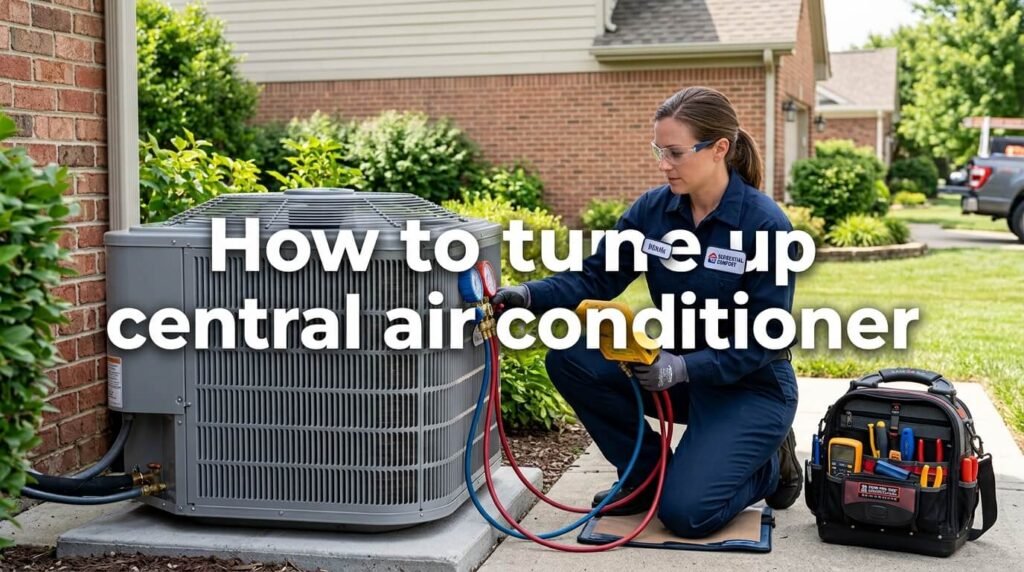
The DIY portion of a tune-up takes most homeowners 45 minutes to an hour, assuming no surprises. Work through it in order: safety shutdown first, then the cleaning and inspection steps, then a system restart to confirm everything runs correctly.
Before You Start: Safety Shutdown Steps
- Set the thermostat to “off” so the system doesn’t try to start while you’re working on it.
- Locate your home’s electrical panel and switch off the breaker labeled for the AC or condenser unit.
- Find the outdoor disconnect box near the condenser unit and switch it off as well; central AC systems have this second, separate shutoff.
- Wait at least a few minutes before touching any components. The unit contains capacitors that can hold an electrical charge even after power is cut.
Step-by-Step DIY Tune-Up Process
- Remove the air filter and hold it up to a light. If you can’t see light through it, replace it; standard filters need changing every one to three months depending on household dust levels and pets.
- Walk outside to the condenser unit and clear leaves, grass clippings, and other debris from around the base, keeping at least two feet of clearance on all sides.
- Rinse the condenser coil from the inside out with a garden hose on a gentle setting, avoiding a pressure washer, which can bend the delicate fins.
- Inspect the fins for bends. If you find any, use a fin comb (sold at most hardware stores) to straighten them and restore airflow.
- Find the condensate drain line, usually a PVC pipe near the indoor air handler, and check it for clogs. A wet-dry vacuum at the outdoor termination point can pull out algae buildup.
- Check your thermostat’s calibration by comparing its reading to a separate room thermometer, and replace batteries if it’s a battery-powered model.
- Visually inspect any exposed wiring and connections at the outdoor unit for corrosion or looseness, without touching the capacitor.
- Restore power at the breaker and outdoor disconnect, set the thermostat to “cool” a few degrees below room temperature, and confirm the system starts and produces cold air within 10 to 15 minutes.
Tools You’ll Need
- A screwdriver set for accessing panels.
- A garden hose with a spray nozzle.
- A fin comb for straightening condenser fins.
- A soft brush or shop vacuum for coil debris.
- A wet-dry vacuum for the condensate drain line.
- Replacement air filters in your system’s size.
- A basic multimeter, if you plan to check thermostat batteries or low-voltage wiring.
Why You Can’t Legally Recharge Your Own Refrigerant
Adding refrigerant to your own central AC is not legal for most homeowners, even if you buy it yourself and know exactly what you’re doing.
Federal law under EPA Section 608 of the Clean Air Act requires anyone who opens a sealed refrigerant circuit, including for a simple top-off, to hold EPA certification.
For an explanation of what a legal refrigerant recharge actually costs and involves, see the AC refrigerant recharge cost and EPA rules guide.
The rule exists because refrigerants are potent greenhouse gases, and older refrigerants also deplete the ozone layer.
Section 608 prohibits knowingly venting refrigerant into the atmosphere during service, and the certification requirement is how the EPA enforces that in practice: no certification means no legal access to refrigerant for appliance service.
This isn’t a licensing formality that only matters for large commercial systems. It applies to a homeowner topping off a 3-ton residential unit exactly the same way it applies to a commercial refrigeration contractor.
EPA Section 608 Explained
EPA Section 608 is the section of the Clean Air Act that governs refrigerant handling for stationary air conditioning and refrigeration equipment.
It requires technicians to hold a Section 608 certification before purchasing refrigerant or opening a system’s sealed circuit, and it bans intentionally venting refrigerant into the air during maintenance, service, or disposal.
The rule applies to every refrigerant currently used in residential AC, including R-410A and the newer A2L refrigerants like R-454B and R-32.
If your central AC was installed in 2025 or later, there’s a good chance it runs on R-454B or R-32 rather than R-410A, as manufacturers phase in these newer refrigerants under EPA’s ongoing phase-down schedule.
R-454B and R-32 are mildly flammable, classified as A2L refrigerants, which means any refrigerant-circuit work on these systems requires A2L-rated recovery equipment and extra caution around spark sources near the outdoor unit.
This doesn’t change anything about your DIY filter-and-coil routine, but it’s worth knowing before you assume a “quick refrigerant top-off” is a simple job, on an older or a newer system.
What Happens If Refrigerant Is Low
- A drop in cooling performance, with the system running longer to reach the set temperature.
- Ice forming on the indoor evaporator coil or the refrigerant lines.
- Hissing or bubbling sounds near the indoor or outdoor unit, which can indicate an active leak.
- Higher-than-normal energy bills as the compressor works harder for less output.
- Warm air blowing from the vents even though the thermostat is set to “cool.”
A central AC system is a sealed loop. Refrigerant doesn’t get “used up” during normal operation, so if the level is low, something is leaking, and simply adding more without finding and fixing the leak just delays the same problem.
How Much Does a Central AC Tune-Up Cost?
A professional central AC tune-up typically costs between $65 and $350, with most homeowners paying somewhere around $120 to $200 for a standard visit. The wide range isn’t random pricing; it reflects real differences in what’s included at each service tier.
Cost by Service Level (Basic vs. Comprehensive)
| Tier | Price range | What’s typically included |
|---|---|---|
| Basic inspection | $65–$150 | Filter check, visual inspection, basic system test |
| Standard tune-up | $150–$250 | Basic tasks plus coil cleaning, electrical component test, drain clearing |
| Comprehensive visit | $250–$550 | Standard tasks plus refrigerant leak test, deep coil clean, full diagnostic report |
If a quote you’ve received doesn’t match what you expected to pay, checking it against this table is a faster way to understand the gap than guessing.
Why Tune-Up Quotes Vary So Widely
Two companies quoting the same job can land $200 apart, and the difference usually comes down to what’s bundled into the visit rather than one company simply charging more for the same work.
A “splash and dash” basic inspection skips the refrigerant leak test and deep coil cleaning that a comprehensive visit includes, and it takes a technician roughly 20 minutes instead of an hour.
Seasonal demand adds another layer: rates during peak summer months run higher than the same service booked in early spring, when HVAC companies have more open slots.
System age and accessibility factor in too. An older unit that hasn’t been serviced in years typically needs more time to inspect and clean than a newer, well-maintained system, and units with tight clearance around the outdoor condenser add labor time regardless of age.
How Often Should You Tune Up a Central AC?
A central air conditioner should get a professional tune-up once a year, timed for spring before the cooling season starts. DIY tasks like filter replacement need to happen far more often, every one to three months, while the deeper cleaning and electrical checks are an annual job.
Best Time of Year to Schedule a Tune-Up
Spring, specifically March through early May in most US climates, is the ideal window. Scheduling before peak summer demand means shorter wait times, lower rates in most markets, and a system that’s already dialed in before it has to work hardest.
Waiting until the first heat wave of the season means booking against every other homeowner who had the same idea, often at a premium rate and with a multi-week wait.
Signs Your AC Needs Service Now
- The system runs longer than usual to reach the set temperature.
- You notice rattling, banging, or hissing sounds from either the indoor or outdoor unit.
- Energy bills have climbed without a corresponding change in usage habits.
- Airflow from the vents feels weaker than it used to.
- The system short-cycles, turning on and off repeatedly in quick succession.
To reset a central AC, turn the thermostat off first, then switch off the breaker for the unit at the electrical panel along with the outdoor disconnect box near the condenser.
Wait about 30 seconds, restore power at both, then set the thermostat to “cool” a few degrees below room temperature and give the system 10 to 15 minutes to restart.
This resolves most post-outage lockouts and thermostat glitches. If the breaker trips again immediately after resetting, stop; that’s a sign of a grounded compressor or short circuit that needs a technician, not another reset attempt.
For a full breakdown of what to check when a system won’t cool at all, see the signs your AC needs replacement instead of repair guide.
What You Gain From Regular AC Tune-Ups
Regular tune-ups keep a central AC running at closer to its rated efficiency, which shows up directly in lower energy bills and fewer mid-summer breakdowns.
The value isn’t abstract: it’s measurable in the utility bill and in how many years the system lasts before replacement.
- Lower monthly energy costs from a system that isn’t working harder than it has to.
- Fewer emergency repair calls, since small issues get caught during the visit instead of turning into breakdowns.
- Longer equipment lifespan, since strain from dirty coils and worn electrical components adds up over years.
- More consistent cooling and humidity control throughout the home.
- A documented service record, which some manufacturers require to keep warranty coverage valid.
The fastest way to improve a central AC’s performance is to work through the DIY task list in order: a fresh filter and a clean condenser coil alone resolve most of the sluggish-airflow complaints homeowners report, since both directly restrict how much air the system can move.
Straightened fins and a cleared condensate drain round out the rest of what’s fixable without a technician.
Beyond that, performance gains come from the annual professional visit: a correctly charged refrigerant level and a tested capacitor keep the compressor running at its rated output instead of compensating for a hidden fault.
Energy Savings and Efficiency Data
The U.S. Department of Energy has found that a well-maintained HVAC system uses 15% to 20% less energy than a neglected one. On a typical home cooling bill, that translates to real, recurring savings every summer, not a one-time gain.
A dirty filter alone forces the blower motor to work harder to move the same volume of air, and a coated condenser coil reduces the system’s ability to reject heat, both of which push the compressor to run longer cycles for the same result.
Lifespan and Breakdown Prevention
A well-maintained central AC typically lasts 15 to 20 years, while a neglected one often fails within 8 to 12.
That gap comes down to accumulated strain: a dirty coil, a low refrigerant charge, or a struggling capacitor each force other components to compensate, and that compensation wears parts out faster than normal operation would.
Catching a weak capacitor during an annual tune-up costs a fraction of what it costs to replace a compressor that failed because the capacitor gave out unnoticed.
If your central AC uses a different configuration than a full ducted system, such as a wall-mounted or ceiling cassette unit, the maintenance steps differ enough that it’s worth checking the split AC maintenance checklist instead, since coil access and drain layout work differently on those systems.
For homeowners handling their own routine maintenance, staying on the DIY side of the table above (filter, coil rinse, fins, drain, thermostat) covers the majority of what keeps a system running well between the annual professional visit.
FAQ
What is included in an AC tune-up?
A standard tune-up covers filter replacement, condenser coil cleaning, fin straightening, condensate drain clearing, a thermostat check, and testing of electrical components like the capacitor and contactor.
A more comprehensive visit adds a refrigerant leak test and a full system performance check. Most of these tasks take a technician about an hour combined, longer if the system hasn’t been serviced in a while or needs additional diagnostic work.
Is it illegal to add refrigerant to your AC yourself?
Yes, for most homeowners it is. EPA Section 608 of the Clean Air Act requires anyone who opens a sealed refrigerant circuit, including for a simple top-off, to hold federal certification.
This applies regardless of experience level or whether you own the refrigerant. The rule exists to prevent refrigerant from being vented into the atmosphere, since these chemicals are potent greenhouse gases and, in older systems, ozone-depleting substances.
How do I fix a central AC that’s not blowing cold air?
Start with the basics: check that the thermostat is set to “cool” and the temperature is below room temperature, then check the air filter, since a clogged one can restrict airflow enough to feel like warm air.
If those check out, try a reset by cycling the breaker off for 30 seconds and back on. If the system still isn’t cooling after a reset, the cause is likely low refrigerant, a failing capacitor, or a frozen coil, all of which need a technician to diagnose safely. AC blowing warm air? Schedule a tune-up.
How much does a central AC tune-up cost?
A professional tune-up typically runs $65 to $350, with most homeowners paying between $120 and $200 for a standard visit.
The price depends on what’s included: a basic inspection costs less than a comprehensive visit with a refrigerant leak test and deep coil cleaning.
Seasonal timing matters too, since booking in spring before peak summer demand generally costs less than waiting until the first heat wave.
Ready to get your system checked by a certified technician? Schedule your AC tune-up today. Call HVAC Tech Mr Oscar on +234 806 051 8393 or Mr Wokoma on +234 803 336 9201 and get the tasks off this guide’s “certified-only” list handled before the next heat wave hits.