
No single brand wins the LG vs Panasonic vs Samsung AC comparison outright.
Each one wins on a different priority. LG is the strongest overall pick for lower electricity bills and quieter operation, Samsung leads on smart-home features and Wind-Free comfort, and Panasonic stands out for air filtration, long-lasting cooling, durability, quick-maintenance design, and Matter-based smart integration.
The right choice depends on which of those priorities matters most in your home, office, or industrial site, your city’s service network, and your budget.
This guide breaks down the real numbers behind each brand instead of repeating marketing claims.
Quick Verdict: Which AC Brand Should You Buy?
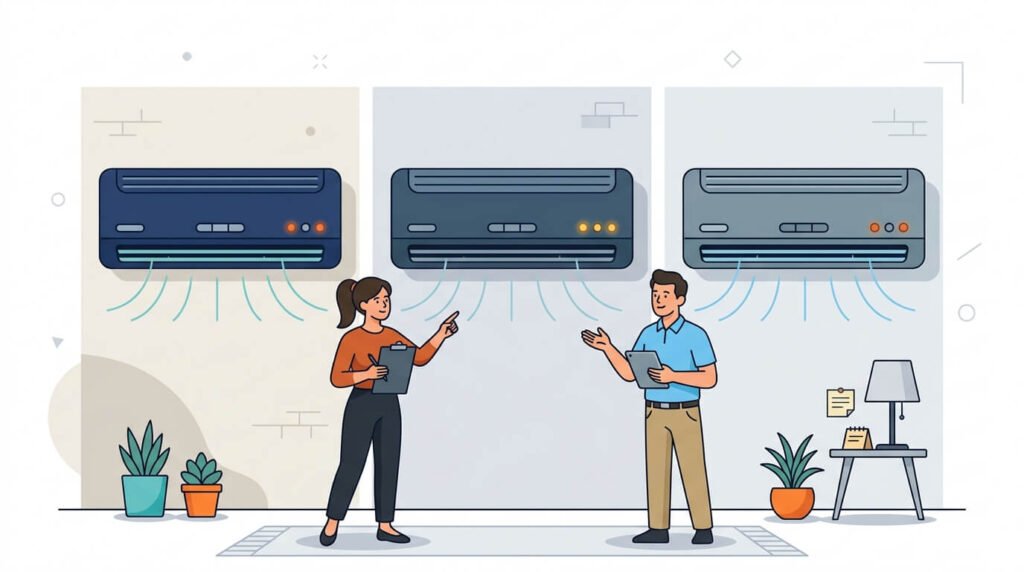
If you only read one section, read this one: LG is the safer default for most households because it combines competitive ISEER efficiency with a wide service footprint, but Samsung and Panasonic each beat it on specific priorities.
| Priority | Best Choice | Why |
| Lowest electricity bills | LG | Consistently high ISEER across its Dual Inverter range, confirmed by independent AC-testing comparisons |
| Quietest operation | LG | Lowest reported sleep-mode decibel figures among the three across independent test data |
| Smart-home integration | Samsung or Panasonic | SmartThings and MirAIe both support Matter; Panasonic’s Matter-enabled model works across Apple Home, Google Home, Alexa, and SmartThings from one unit |
| Air filtration/health | Panasonic | Nanoe-X technology targets airborne bacteria and particulate matter, a feature LG and Samsung do not match |
| Widest service network | LG | Most frequently cited as having broad service-center coverage, including smaller cities |
Best for lowest electricity bills:
- LG’s Dual Inverter range posts some of the highest ISEER values among mainstream 2026-norm models.
- LG’s average 1.5-ton price sits at or below Panasonic’s, but Panasonic ACs score comparably better on performance.
Best for smart home and premium features:
- Panasonic’s Matter-enabled model is the first room AC built to work across Apple Home, Google Home, Amazon Alexa, and Samsung SmartThings from one unit.
- Samsung’s Wind-Free technology distributes cool air through thousands of micro-holes instead of a direct blast, which many users report as more comfortable overnight.
Technical Differences Between LG vs Panasonic vs Samsung AC
As an AC technician who has worked extensively on these brands, I’ve found that Panasonic ACs have a larger compressor gas system than LG and Samsung ACs; this feature makes Panasonic cooling more effective than LG and Samsung ACs.
Panasonic ACs have this safety feature: when indoor cooling is low or inadequate, the outdoor unit (condenser) sends a signal to shut down both the indoor and outdoor units. This prevents the compressor from overheating; this design feature isn’t in Samsung and LG ACs.
When servicing Panasonic ACs ( 1HP, 1.5HP, or 2HP), especially the indoor unit or evaporator, removing the blower is very easy because the space between the blower and evaporator is large, while for LG and Samsung ACs, this space is limited, and if you are not an experienced technician, you might damage the signal electronic cables.
Panasonic AC tends to consume more electricity compared to LG and Samsung ACs because of the Large compressor gas system.
Lastly, the Panasonic AC brand can handle tough industrial environment more than LG and Samsung air conditioner units, where the air conditioner is expected to run 24 hours nonstop, like cooling an MCC control room for an FCMG company or other industries.
How the 2026 BEE Star Rating Change Affects This Comparison
Any star-rating comparison between LG, Samsung, and Panasonic ACs bought before and after January 2026 is misleading unless you check the ISEER value, not just the star count.
The Bureau of Energy Efficiency raised the efficiency bar for every star band. A model that earned 5 stars under the pre-2026 rules can now carry a 4-star label under the 2026 rules, with no change to its actual cooling performance.
LG has publicly confirmed this shift, stating that several of its previously 5-star models are now rated 4-star purely because of the tighter evaluation standard, not reduced output.
Old vs. New ISEER Thresholds by Star Band
These figures are approximate ranges compiled from BEE-linked industry reporting and should be checked against the exact label on the unit you’re buying, since BEE periodically fine-tunes the numbers.
| Star Rating | Approx. ISEER Range (Pre-2026 norms) | Approx. ISEER Range (2026 norms) |
| 1 Star | Below 3.30 | Below 3.50 |
| 2 Star | 3.30-3.79 | 3.50-3.99 |
| 3 Star | 3.80-4.49 | 4.00-4.99 |
| 4 Star | 4.50-4.99 | 5.00-5.59 |
| 5 Star | 5.00 and above | 5.60 and above |
Why Comparing Star Ratings Across Brands Can Mislead You
A 2026-labeled LG unit rated 4-star can be more efficient in raw ISEER terms than a 2022-labeled Samsung or Panasonic unit rated 5-star, simply because the two labels were issued under different rulebooks.
Before comparing any two models across brands, check the ISEER number on the BEE label and confirm its effective year. That single figure predicts your electricity bill more reliably than the star count alone.
Cooling Technology Compared: Dual Inverter vs. Digital Inverter vs. True AI
Each brand builds its efficiency claims on a different compressor and control system, and understanding the mechanism matters more than the marketing name attached to it.
| Feature | LG (Dual Inverter) | Samsung (Digital Inverter) | Panasonic (True AI) |
| Convertible cooling modes | Up to 6-in-1, 40%-110% capacity | Standard variable-capacity inverter | Up to 7-in-1 (Converti7) |
| Core differentiator | Counter-rotating dual rotor for lower vibration | Wind-Free micro-hole airflow | Adaptive Thermal Comfort Model |
| Smart adjustment | AI Convertible mode via remote | App-based mode switching | Automatic adjustment based on room and weather conditions |
LG AI Convertible 6-in-1
AI Convertible 6-in-1 is LG’s system for manually or automatically scaling compressor output from 40% up to 110% capacity, letting a single unit act like a smaller or larger AC depending on room occupancy and outside temperature.
It’s controlled through the remote rather than remotely through an app, which makes it flexible but less connected than Panasonic’s equivalent feature.
Samsung Digital Inverter and Wind-Free
Digital Inverter is Samsung’s variable-speed compressor technology, and Wind-Free is the cooling mode built on top of it that releases air through roughly 23,000 micro air holes instead of a direct stream.
The combination is designed to maintain a set temperature with minimal direct airflow on the body, which owners commonly describe as more comfortable for sleeping or long stationary periods.
Panasonic True AI and Converti 7
True AI mode runs on Panasonic’s Adaptive Thermal Comfort Model, which automatically adjusts temperature and fan speed based on room conditions, outdoor weather, and learned user preference, rather than requiring manual mode selection.
Converti7 extends the convertible-capacity concept LG popularized, offering seven capacity steps controllable from the remote.
Energy Efficiency and Running Cost Over Five Years
LG generally delivers the lowest running cost among the three brands at comparable price points, though a specific Panasonic model can edge ahead in raw ISEER if you’re comparing top-tier units directly.
ISEER Comparison by Brand: 2026 Models
| Brand / Model Type | Approx. ISEER (2026 norms) | Star Label (2026 norms) |
| LG 1.5-ton 5-star Dual Inverter | ~5.20 | 5 Star |
| Panasonic 1.5-ton 5-star Premium Wi-Fi Inverter | ~5.80 | 5 Star |
| Samsung 1.5-ton 3-star Digital Inverter | ~4.20 | 3 Star |
How to Calculate Five-Year Total Cost of Ownership
- Take the unit’s upfront price and add the estimated first-year installation cost.
- Multiply the model’s ISEER-based annual kWh figure (printed on the BEE label) by your local electricity tariff to get the yearly running cost.
- Multiply the yearly running cost by five and add it to the upfront price to get the five-year total.
- Compare that total against a competing model with a different upfront price but a different ISEER value.
- Divide the price difference between the two models by their monthly running-cost difference to find the breakeven point in months.
Noise Levels: Which AC Is Quietest?
LG’s Dual Inverter line reports the lowest sleep-mode noise figures of the three brands, largely due to its counter-rotating compressor design reducing mechanical vibration.
Sleep-Mode dB Comparison
| Brand | Approx. Sleep-Mode Noise Level |
| LG | ~19 dB |
| Samsung | ~21 dB |
| Panasonic | ~20-24 dB depending on model |
Why a Quieter AC Isn’t Always Better
A lower decibel rating only reflects how quiet the indoor unit is in its lowest fan-speed setting, not how quickly the room cools during peak afternoon heat.
If your priority is fast cooling during extreme temperatures rather than nighttime silence, prioritize the unit’s rated cooling capacity and turbo-mode performance over its sleep-mode dB figure, since some quieter units trade off peak cooling speed to achieve that lower noise level.
Smart Features and App Ecosystem: ThinQ vs. SmartThings vs. MirAIe
Samsung and Panasonic currently offer the broader smart-home reach of the three brands, largely because both support the Matter connectivity standard.
| Ecosystem | App | Matter Support | Cross-Platform Voice Control |
| LG | ThinQ | Limited | Partial |
| Samsung | SmartThings | Yes | Alexa, Google Home |
| Panasonic | MirAIe | Yes (first Matter-enabled AC in India) | Apple Home, Google Home, Alexa, SmartThings |
Matter and Cross-Platform Compatibility
Panasonic’s Matter-enabled model is currently the only one of the three that can be controlled natively through Apple Home, Google Home, Amazon Alexa, and Samsung SmartThings from a single unit, which matters if your household already has a mixed smart-home ecosystem rather than committing to one brand’s app.
Voice Assistant Support
- Samsung’s SmartThings integrates directly with Amazon Alexa and Google Home for voice-based temperature and mode control.
- Panasonic’s MirAIe-connected Matter model extends that same voice support to Apple Home as well, which neither LG nor standard Samsung models currently match.
- LG’s ThinQ app supports basic voice commands through Google Assistant and Alexa but has more limited native Matter certification across its AC lineup than Samsung or Panasonic.
Air Quality and Filtration: Nanoe-X vs. HD Filter vs. Anti-Bacteria Filter
Panasonic is the clear leader on filtration technology, since its Nanoe-X system is designed to actively neutralize airborne contaminants rather than simply trap them mechanically.
| Brand | Filtration Technology | Mechanism |
| LG | Dual/HD Filter with anti-bacterial coating | Mechanical trapping of dust and some bacteria |
| Samsung | HD Filter | Mechanical trapping of dust and particulates |
| Panasonic | Nanoe-X | Releases hydroxyl radicals that actively neutralize bacteria, viruses, and PM2.5 particles |
What Nanoe-X Technology Actually Does
Nanoe-X generates fine water particles containing hydroxyl radicals, which are released into the room to actively break down airborne bacteria, certain viruses, and fine particulate matter, rather than only filtering air that passes back through the indoor unit.
LG and Samsung’s standard filters, by comparison, rely on mechanical trapping, which is effective for dust but does not actively neutralize airborne contaminants across the whole room.
When Extra Filtration Is Worth Paying For
- Households with allergy sufferers or asthma may see a meaningful benefit from Panasonic’s active-neutralization approach over standard mechanical filtration.
- Homes in high-pollution areas benefit more from active filtration technology than from a slightly higher ISEER rating alone.
- If nobody in the household has respiratory sensitivities, the standard HD or anti-bacteria filters on LG and Samsung units are generally sufficient for everyday dust control.
Warranty and Compressor Coverage Compared
Samsung offers the longest advertised compressor coverage on paper, but LG and Panasonic are more consistently reported as honoring warranty claims without requiring a paid extended-warranty add-on.
| Brand | Standard Warranty | Compressor Warranty (Digital/Inverter) |
| LG | 12 months comprehensive | Commonly 10 years (parts) |
| Samsung | 12 months comprehensive | Up to 10 years on Digital Inverter compressors (parts only) |
| Panasonic | 12 months comprehensive | Commonly 5-10 years depending on model |
Standard vs. Extended Warranty Terms by Brand
All three brands provide a full comprehensive warranty for only the first 12 months, after which coverage narrows to parts-only protection on specific components like the compressor.
Extended coverage for PCBs, gas refills, and labor beyond year one is frequently sold as a separate paid add-on, and long-running Team-BHP owner threads repeatedly flag this distinction as something buyers miss at purchase.
Warranty Fine Print to Check Before You Buy
- Confirm whether the compressor warranty covers parts only or parts and labor, since labor costs on a compressor replacement can be substantial.
- Check whether the warranty requires a minimum number of paid annual services to remain valid.
- Ask specifically whether the PCB (control board) is covered beyond the first 12 months, since PCB failures are one of the most commonly reported issues among long-term owners across all three brands.
- Verify the warranty is registered to your specific purchase location, since some manufacturers void coverage on units purchased outside authorized channels.
Service Network and After-Sales Support
LG is the most frequently cited brand for having a wide, readily available service network across major and smaller Indian cities alike, which matters more over a five-to-ten-year ownership period than any single spec on the box.
How to Check Service-Center Availability in Your City
- Search each brand’s official service-locator page using your specific city and PIN code before purchasing.
- Call the nearest listed service center directly to confirm they handle split-AC repairs, not just other appliance categories.
- Ask neighbors or local appliance dealers which brand’s technicians they’ve seen actually show up promptly for AC service calls in your area.
What Long-Term Owners Actually Report About Service
- Long-running Team-BHP owner threads describe LG as having a more consistently available service presence, particularly outside major metro areas.
- Panasonic owners frequently report professional installation and service quality, though availability can be more limited outside larger cities.
- Samsung owners report mixed experiences, with some praising extended-warranty responsiveness and others describing recurring issues with PCB failures and gas leaks requiring repeat service visits.
Note: In Cities, where you have limited AC brand technicians, we recommend you look for an HVAC Professional for installation and maintenance.
If you are in Port Harcourt, or any of the South East States in Nigeria, contact us today!
Durability and Build Quality in Different Climates
LG and Panasonic both build outdoor units around copper condenser coils with anti-corrosion coatings designed for various climates like West African countries, Nigeria, Ghana, etc and even Indian coastal and high-humidity conditions, giving both an edge over units without equivalent protection.
For example, read about the best ACs in humid regions in Nigeria and Best Air conditioners for Northern Harmattan regions.
Copper Coils and Corrosion Resistance by Brand
| Brand | Coil Material | Corrosion Protection |
| LG | Copper | Anti-corrosion coating standard on most models |
| Samsung | Copper (varies by model) | Coating varies by model tier |
| Panasonic | Copper | Anti-corrosion coating standard on most models |
Common Failure Points Long-Term Owners Report
- PCB (control board) failures are the most commonly reported issue across all three brands, particularly in areas with unstable voltage and no stabilizer installed.
- Refrigerant gas leaks appear repeatedly in long-term owner discussions, especially on units past the three-to-five-year mark.
- Evaporator coil leaks and motor capacitor issues also show up occasionally on older units, which is why PCB and gas-leak coverage in the warranty terms matters more than the headline compressor-warranty number.
Note: We recommend that if you have used your air conditioner for, say, five to eight years on constant running, instead of spending money on frequent repairs and maintenance, it might be time to get a new one; this is more cost-effective than the latter.
Price Comparison by Tonnage and Star Rating
Panasonic’s premium models tend to carry the highest sticker price at the same star rating, while LG and Samsung compete more closely on entry-level pricing.
1 Ton AC Price Comparison
| Brand | Approx. Price Range (1 Ton, 3-5 Star) |
| LG | Check your local retailer or brand representative outlet |
| Samsung | Check your local retailer or brand representative outlet |
| Panasonic | Check your local retailer or brand representative outlet |
1.5 Ton AC Price Comparison
| Brand | Approx. Price Range (1.5 Ton, 3-5 Star) |
| LG | Check your local retailer or brand representative outlet |
| Samsung | Check your local retailer or brand representative outlet |
| Panasonic | Check your local retailer or brand representative outlet |
2 Ton AC Price Comparison
| Brand | Approx. Price Range (2 Ton, 3-5 Star) |
| LG | Check your local retailer or brand representative outlet |
| Samsung | Check your local retailer or brand representative outlet |
| Panasonic | Check your local retailer or brand representative outlet |
Note: Prices differ based on country and city location. So, consult your local retail shops.
Which Brand Should You Choose?
Rank your top priority first, then use it to pick a brand, rather than searching for one unit that wins every category at once.
- Lowest monthly electricity bill: choose LG.
- Smart-home integration across multiple platforms: choose Panasonic or Samsung.
- Active air filtration for allergy or pollution concerns: choose Panasonic.
- Service-network reliability in a smaller city or town: choose LG first, then confirm Panasonic’s local availability.
Choose LG If…
- You want the lowest realistic five-year running cost among mainstream 2026-norm models.
- You value quieter overnight operation over app-based smart controls.
- You live outside a major metro and need dependable local service access.
Choose Samsung If…
- You want Wind-Free comfort for sleeping or long stationary use.
- You’re already invested in the SmartThings ecosystem for other appliances.
- You’re comfortable paying for an extended warranty add-on for full PCB and gas-leak coverage.
Choose Panasonic If…
- Air quality and active filtration are a genuine health priority in your household.
- You want the widest cross-platform smart-home compatibility available today.
- You desire durability and effective cooling without compromise
- It is an industrial area that requires the AC unit to run 24/7
- You’re weighing Panasonic against another premium Japanese brand. See our comparison of Daikin vs Panasonic AC: which is better? for how Panasonic’s True AI and filtration technology stack up against Daikin’s Coanda airflow and build quality.
If you’ve narrowed your options down to a specific tonnage and star rating, our best AC brand comparison breakdown walks through the current 2026 norm, pricing model by model, so you can check exact ISEER values before you buy.
Note: For homes and offices, LG, Samsung, or Panasonic AC will work perfectly!
[…] know more about the cons and pros of each AC brand, see our guides on LG vs Samsung vs Panasonic AC and Panasonic vs Daikin Air […]
[…] if you want a comprehensive guide to most of the AC brands above, read our in-depth reviews on LG vs Samsung vs Panasonic air conditioners and DAIKIN vs Panasonic […]