
The Kano sun doesn’t negotiate. You’ve sealed your windows, run your AC on full blast, and still wake up drenched, wondering why your expensive unit feels like it’s losing a fight against the harmattan air. You’re not imagining it; dry heat is a different beast entirely.
Most people buy the cheapest Air Conditioner available; that’s not an energy problem, it’s a compatibility problem. What you actually need is a unit engineered to perform in low-humidity, high-temperature conditions.
This post breaks down the best AC for dry heat in Kano and Northern Nigeria, how they’re built differently, which specs actually matter, and which models deliver real relief.
Here’s the truth nobody tells you: your AC isn’t failing because it’s weak, it’s failing because it was never designed for where you live.
Understanding Dry Heat in Northern Nigeria
What Makes Dry Heat Different?
Dry heat is hot air with very low humidity, and Kano sits right in the middle of it.
Unlike the coastal south, where moisture in the air makes heat feel heavier, Northern Nigeria’s climate is characterized by scorching temperatures and bone-dry air.
During peak season, dry bulb temperatures can exceed 42°C. Add Harmattan winds carrying fine dust from the Sahara, and you have one of the most demanding climates for any cooling appliance in West Africa.
How Dry Heat Affects Indoor Comfort
Without moisture in the air, your body loses water faster through sweat. Rooms heat up quickly, especially those with poor thermal insulation or high solar heat gain from direct sunlight.
Even at night, temperatures can remain uncomfortably high. This means your AC needs to maintain temperature stability consistently — not just cool the room down once and shut off.
Why Cooling Demand Is Higher in Northern Nigeria
The extended daytime heat exposure in Northern Nigeria raises cooling demand significantly. Rooms bake under the sun for 10 to 12 hours daily during peak heat season.
High ambient temperatures make it harder for the outdoor unit’s condenser coil to expel heat efficiently, which in turn increases the compressor’s workload. In short, your AC works harder up north than it would anywhere else in Nigeria.
How Air Conditioners Perform in Dry Heat
Heat Removal Process
An air conditioner doesn’t create cold air: it removes heat from indoor air and transfers it outside.
The refrigerant inside the system absorbs heat through the evaporator coil indoors and releases it through the condenser coil in the outdoor unit.
In dry heat conditions, this cycle runs longer and more frequently because the ambient temperature keeps pushing heat back into the room.
Faster Cooling in Low-Humidity Conditions
Here’s something that works in your favour: dry air is actually easier to cool than humid air. Without moisture content, the AC doesn’t spend energy removing water vapour from the air.
This means that in a well-insulated room, a properly sized inverter split AC can lower the room temperature faster in Kano than it would in a humid city like Lagos.
It’s one of the few advantages of the Northern climate when it comes to cooling.
Increased Compressor Workload in Extreme Heat
The tradeoff is that extreme heat puts serious strain on the compressor. When outdoor temperatures are consistently above 40°C, the condenser struggles to release heat efficiently.
This increases the heat load on the entire system, drives up power consumption, and if the unit isn’t built for tropical conditions, shortens the appliance’s lifespan.
This is why compressor quality matters so much in Northern Nigeria.
Best Types of Air Conditioners for Dry Heat
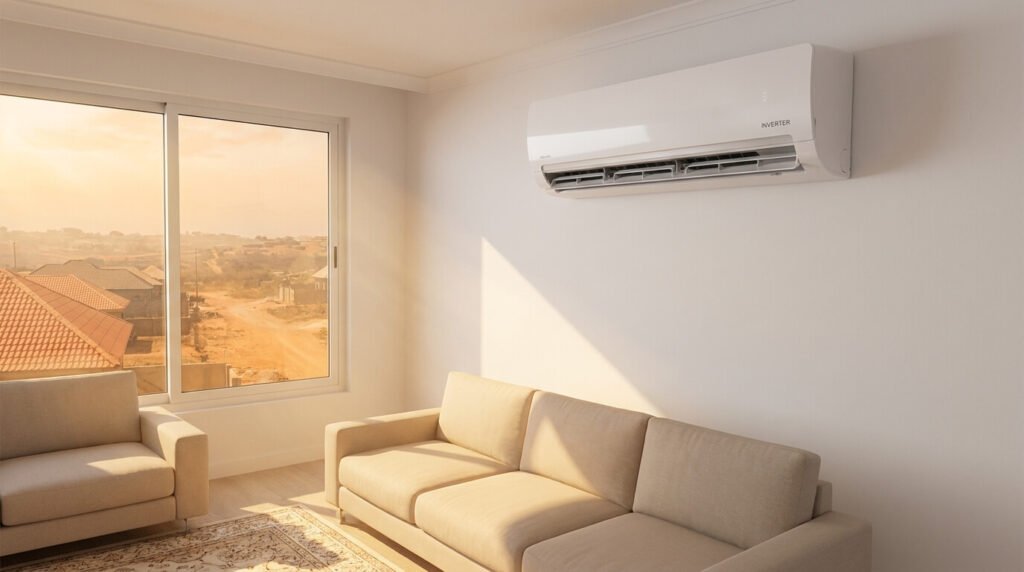
Inverter Split Air Conditioners
For most homes in Kano and across the North, an inverter split AC is the best choice for daily use.
Brands like Daikin Industries, LG Electronics, and Samsung Electronics all offer inverter models designed with variable-speed compressors that adjust their output based on the room’s cooling demand.
Instead of constantly switching on and off like a non-inverter AC, the inverter compressor slows down once the target temperature is reached and stays running at a lower speed using far less electricity while maintaining consistent comfort.
In a region where power supply is unreliable and generator costs are high, this energy saving translates directly into money saved every month.
High-Capacity Split AC Systems
For larger spaces dealing with intense heat, a high-capacity split AC — typically 2HP or 2.5HP — delivers more cooling power.
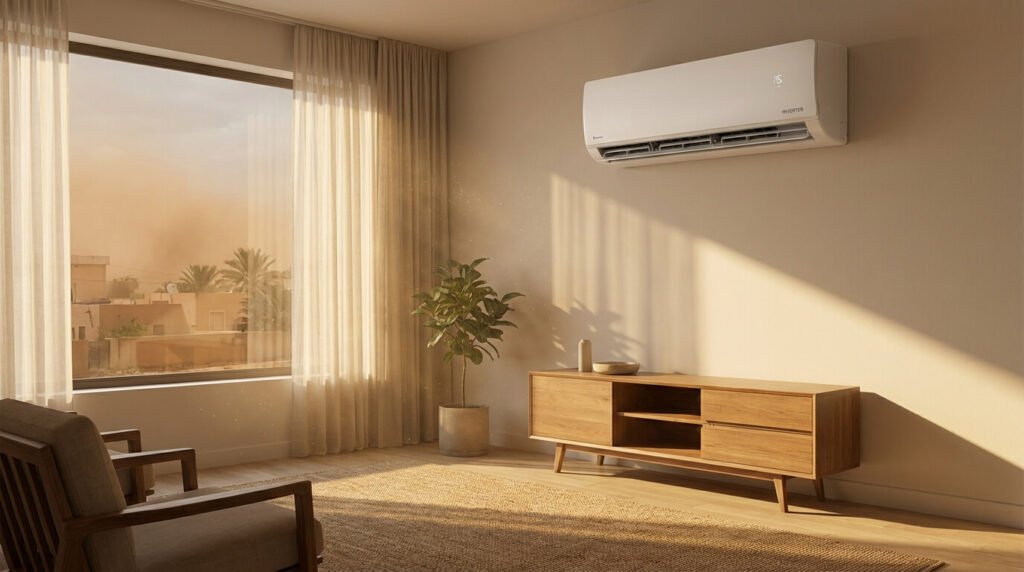
Daikin Industries’ 2.5HP units, for example, handle bigger spaces that would overwhelm a standard 1.5HP system.
In rooms with high ceilings, poor insulation, or heavy solar heat gain from west-facing windows, going a size up on capacity is the smarter move.
Floor-Standing Air Conditioners
For large living rooms, event halls, or open-plan spaces, floor-standing (also called cassette or tower) units provide strong, wide-angle airflow that a wall-mounted split AC can’t match.
They’re particularly useful when a single wall-mounted indoor unit can’t reach all corners of the room. The air throw from a floor-standing unit covers more ground and distributes cool air more evenly across the space.
Commercial Cooling Systems
For offices, shops, and commercial buildings in Northern Nigerian cities, multiple split AC systems or light commercial units are the practical solution.
Centralized systems work well for larger buildings, but individual split systems give more control over which zones are cooled and when, which matters when generator load management is a concern.
Key Features to Look for in an AC for Dry Heat
Fast Cooling Performance
In extreme heat, you want an AC that reaches your set temperature quickly. Look for units with a dedicated turbo cooling or fast cooling mode.
LG Electronics builds this into many of its split AC models. The unit blasts cold air at maximum capacity for a set period before settling into its normal operating mode.
This is especially useful when coming into a room that’s been closed and baking in the sun all afternoon.
Strong Compressor Performance
The compressor is the heart of any air conditioner, and in Northern Nigeria’s extreme heat, it needs to be tough.
Look for models with a tropical compressor or an inverter compressor rated for high ambient temperatures. Daikin Industries is well known for building compressors that handle sustained high-heat operation without breaking down.
LG’s dual inverter compressor technology is another strong performer, improving efficiency while reducing wear.
Dust Filtration System
This is non-negotiable in Northern Nigeria. Harmattan dust is extremely fine, and it will clog a standard air filter much faster than normal airborne particles.
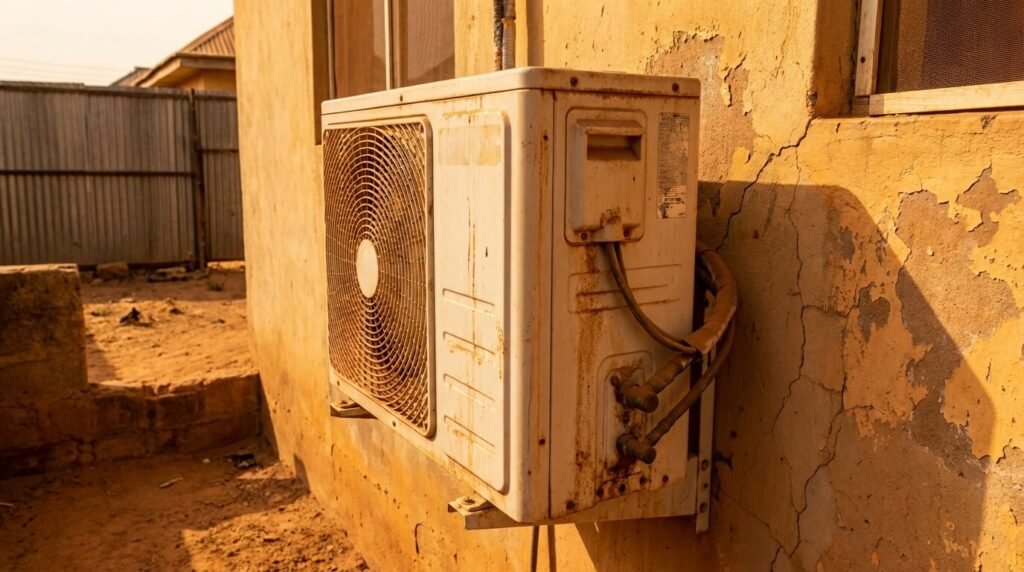
The impact of this goes beyond inconvenience, and it’s worth understanding how harmattan dust affects your Air Conditioner before you make a purchase decision.
Units with an anti-dust filter or a washable HEPA-grade dust filter are worth the extra cost. Hisense builds dedicated anti-dust protection into its Northern-market models for exactly this reason.
Energy Efficiency
With NEPA power unreliable and generator running costs high, energy efficiency is a practical necessity in Northern Nigeria, not a luxury.
Inverter ACs consistently outperform non-inverter models on long-term power consumption.
A unit with a high energy efficiency ratio (EER) or SEER rating will cost less to run over its lifetime, even if the upfront price is slightly higher. If you’re running your AC for 8 to 12 hours a day, those savings compound quickly.
Wide Voltage Protection
Nigeria’s electricity grid is known for voltage fluctuation, and Kano is no exception.
An AC with built-in low-voltage operation capability can continue running safely even when the supply drops below standard levels.
Without this feature, you’re either pairing the unit with a separate voltage stabilizer or risking compressor damage from unstable power.
Models from Samsung Electronics and LG Electronics both offer auto restart functions and voltage protection features that make them particularly well-suited for the Nigerian grid.
Best AC Capacity for Northern Nigerian Weather
1HP AC for Small Bedrooms
A 1HP AC is suitable for small bedrooms, typically rooms under 12 square metres. In Northern Nigeria’s heat, though, ceiling height and insulation quality matter just as much as floor area.
If the room has poor insulation or gets heavy afternoon sun, a 1HP unit will struggle. LG Electronics’ 1HP split AC models with fast cooling mode handle compact spaces well, but be realistic about room size and conditions.
1.5HP AC for Medium Rooms
The 1.5HP split AC is arguably the most popular size in Nigerian homes, and for good reason, because of price and size.
It is highly recommended to have a cooling capacity and energy consumption for the average bedroom or mid-sized room.
Hisense’s 1.5HP inverter models are widely available across Northern Nigeria and offer solid turbo cooling performance without placing excessive load on home generators.
2HP AC for Large Living Rooms
For living rooms and larger spaces under heavy heat load, 2HP is the minimum you should consider.
Pansonic or Samsung Electronics’ 2HP split AC range offers reliable performance in high-temperature environments, with strong airflow and wide-angle distribution that reaches all parts of the room. In rooms with very high ceilings, you may still want to size up further.
Higher Capacity Units for Commercial Use
For offices, shops, and commercial buildings, 2.5HP units and above — or multiple split systems — are the appropriate solution.
Panasonic 5HP, Skyrun 3HP and Daikin Industries lead here, with commercial-grade units designed for continuous-use environments in tropical climates.
Spare parts availability in Kano and other Northern cities is an important consideration when choosing a commercial brand. Factor in local technician support before committing.
Inverter vs Non-Inverter AC in Dry Heat
Which Cools Faster?
Honestly, at startup, a non-inverter AC and an inverter AC cool at similar speeds, and both run the compressor at full capacity when first switched on.
The real difference shows up in how they maintain temperature. A non-inverter AC cycles on and off, causing small temperature swings.
An inverter AC keeps running at reduced speed, holding the room at a more stable temperature. In extreme dry heat, that consistency makes a noticeable comfort difference.
Which Saves More Electricity?
Inverter ACs win this comparison clearly, especially for the long running hours typical in Northern Nigeria.
A non-inverter AC cycles on at full power repeatedly, while an inverter compressor adjusts its load to match exactly what the room needs.
Over a month of use in the Northern heat season, the difference in monthly energy bills can be significant enough to justify the higher upfront cost of an inverter model.
Which Handles Extreme Heat Better?
For sustained operation in 40°C+ ambient temperatures, an inverter compressor handles heat stress better. Because it modulates rather than operating at constant maximum load, it generates less heat within the compressor itself and is subject to less mechanical wear.
Non-inverter ACs work fine in Northern Nigeria; they’re used everywhere, but inverter models tend to have a longer appliance lifespan under the same demanding conditions.
Best Air Conditioner for Homes in Kano
AC for Bedrooms
For bedrooms, quiet operation matters alongside cooling performance.
Nobody wants to be woken up by a loud compressor cycling on and off at 2 am. Midea, Daikin and Panasonic all produce split AC units with notably low noise levels, combined with sleep mode to reduce energy use through the night.
A 1HP or 1.5HP inverter model from either brand is a solid choice for a standard Northern Nigerian bedroom.
AC for Living Rooms
Living rooms in Kano homes need more than just cooling capacity; they need wide-angle airflow and a strong air throw to cover the space evenly.
LG Electronics’ 2HP split ACs with wide-angle airflow distribution handle this well.
For rooms that also serve as dining areas or where multiple family members gather during peak heat hours, turbo cooling to quickly bring down the temperature before settling into steady operation is a practical feature.
AC for Family Homes
For a whole-home approach, pairing an inverter AC in each major room rather than one large unit for the entire house typically works better in Nigerian construction layouts.
This also allows generator load management; you don’t need to run all units simultaneously. Prioritize inverter models for rooms that run the AC the longest, and consider non-inverter models as a lower-cost option for rooms used less frequently.
Best Air Conditioner for Offices in Northern Nigeria
Small Office Cooling Needs
A small office of one to three people in a standard office room is well served by a 1.5HP inverter split AC.
The focus here should be on quiet operation (to avoid distracting workers) and energy efficiency (since office ACs often run 8 to 10 hours daily).
Panasonic’s quiet operation models are worth considering for this use case.
Large Office Cooling Solutions
For open-plan offices or meeting rooms in Northern Nigeria, 2HP to 2.5HP units or multiple 1.5HP units placed strategically deliver more consistent coverage.
High-capacity continuous-use systems from Daikin Industries or LG Electronics with strong air throw and wide airflow distribution are the practical choice here.
Generator compatibility is often a deciding factor for offices, so confirm the unit’s starting wattage and running wattage before purchase.
Commercial Building Cooling
For multi-room commercial buildings, the most cost-effective solution is often a combination of several split AC systems rather than a single centralized system.
This approach allows more flexible zone control, easier maintenance, and simpler repairs when one unit has a problem.
Ensure spare parts availability for your chosen brand in Kano or the nearest major Northern city before committing to a commercial installation.
Common AC Problems in Dry and Dusty Regions
Dust Blocking Filters
In Northern Nigeria, dust accumulation is the most common and easily preventable cause of reduced AC performance.
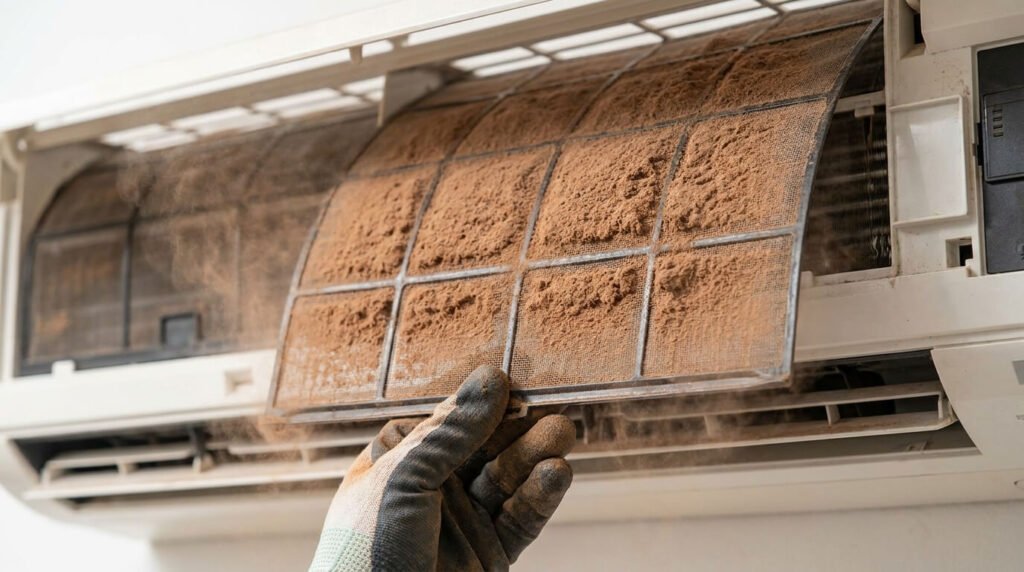
When the air filter clogs, airflow drops, the evaporator coil can’t absorb heat properly, and the entire system works harder to achieve the same cooling.
This drives up power consumption and accelerates wear. Filter cleaning every two to three weeks during the Harmattan season, not monthly, is the realistic maintenance interval up North.
Overheating Outdoor Units
When the outdoor unit sits in direct afternoon sunlight and ambient temperatures are already above 40°C, condenser efficiency drops significantly.
The compressor works harder, overheat protection may trip the unit off, and over time, this strain shortens compressor life.
This is a common and often overlooked problem in Northern Nigerian installations. Where possible, shade the outdoor unit without blocking airflow to reduce this stress.
Increased Power Consumption
During peak heat season, don’t be surprised if your electricity bill or generator fuel cost rises noticeably. Your AC is simply working harder.
An inverter AC manages this better than a non-inverter because it adjusts its load rather than running full blast.
Still, setting the thermostat to 24°C–26°C rather than 18°C makes a meaningful difference to power consumption without giving up comfort.
Maintenance Tips for ACs in Northern Nigeria
Clean Filters Frequently
Given how harmattan dust affects your Air Conditioner, clogging filters, coating evaporator coils, and reducing airflow, filter cleaning needs to happen more often in the North than in other parts of Nigeria.
Washable anti-dust filters make this easier. Remove, rinse under clean water, dry, and reinstall. It takes ten minutes and can meaningfully extend your AC’s lifespan and keep cooling performance sharp.
Protect Outdoor Units From Direct Sunlight
Install a simple shade structure over the outdoor unit, a small roof or awning that blocks direct sunlight while allowing free airflow around all sides.
This one step can reduce condenser heat stress significantly, improve efficiency during peak afternoon hours, and reduce the risk of overheat protection tripping.
Service the AC Regularly
Beyond filter cleaning, professional servicing of your AC at least twice a year in Northern Nigeria is strongly recommended once before the hot season starts, and once after Harmattan ends.
A professional service includes coil cleaning, refrigerant level checks, electrical connection inspection, and compressor health assessment.
This routine maintenance is what separates an AC that lasts eight years from one that fails in three.
Check Refrigerant Levels
Low refrigerant is a common and often misdiagnosed problem. If your AC runs constantly but the room doesn’t get cool enough, refrigerant loss could be the cause.
R-32 refrigerant is becoming more common in newer models and offers better efficiency than older R-410A systems. Only a qualified HVAC technician should handle refrigerant checks and recharging.
Common Buying Mistakes to Avoid
Choosing Low Capacity for Large Hot Rooms
This is the most common mistake in Northern Nigeria. Buyers go for a 1HP unit to save money, install it in a 20-square-metre room with high ceilings and poor insulation, then wonder why it never gets cool enough.
The AC runs non-stop at maximum load, the compressor wears out prematurely, and the electricity bill is higher than it would have been with a properly sized unit.
Match the capacity to the actual heat load, not just the floor area.
Ignoring Dust Protection Features
Buying an AC without anti-dust filtration for use in Kano or any Northern city is a false economy. Standard filters clog within weeks during Harmattan, reducing airflow and forcing the compressor to work harder.
Dust resistance is not a premium feature up North; it’s a basic requirement. Hisense’s anti-dust filter models and similar offerings from other brands are worth the extra cost.
Buying Based Only on Price
A cheaper non-inverter AC may seem like a bargain until you factor in higher monthly energy bills, more frequent maintenance, and a shorter lifespan.
When also considering that the best AC brands for humidity in Lagos and Port Harcourt are often different from what works best in the dry North, it becomes clear that climate-specific performance — not just price — should drive the purchase decision.
Spend a little more upfront on a quality inverter model from a trusted brand, and it will almost always pay back the difference within two to three years of use.
Conclusion
The best air conditioner for dry heat in Kano and Northern Nigeria needs to combine strong cooling power, effective dust filtration, energy efficiency, and a durable compressor that can handle sustained operation in extreme heat.
Inverter models from trusted brands like LG Electronics, Daikin Industries, Samsung Electronics, and Hisense consistently deliver the combination of performance and long-term value that Northern Nigeria’s climate demands.
Match your unit’s horsepower to the actual heat load of the space, prioritize anti-dust features, and commit to regularly servicing your AC. Do those three things, and your investment will serve you well for years.