
You invested in solar to escape the grid, and yet your AC still drains your batteries by midday, leaving you sweaty and frustrated by afternoon.
You’ve done the panels, bought the inverter, and still can’t cool your home without NEPA showing up to save you. The problem isn’t your solar setup; it’s that your AC was never built to work with it.
Adding more batteries won’t solve this; pairing your system with the right solar-compatible AC will.
This post breaks down the best solar air conditioners in Nigeria, units specifically engineered for low power draw, DC compatibility, and maximum cooling output on limited solar capacity.
Here’s the truth the market won’t tell you: most ACs in Nigerian stores were designed for stable grid power, not solar, and that difference is costing you every single day.
Expert Contribution
Name: Engr. Chibueze Iwuala
MSc IT & Cybersecurity expert
Co-founder of Iwu Chi Technologies, Founder of Kowatek Solar LTD
IT Consulting & Certified in various domains.
What Is a Solar Air Conditioner?
Definition of Solar AC
A solar air conditioner is a cooling system powered partially or fully by solar energy. Instead of drawing all its electricity from the national grid or a generator, it taps into energy generated by photovoltaic panels installed on your roof or compound.
The result is a system that cools your space while significantly reducing your dependence on grid electricity.
How Solar Air Conditioners Work
Solar panels convert sunlight into electricity using photovoltaic technology. That electricity is then used to power the AC compressor, fan, and control systems.
Most residential solar AC setups route this power through a solar inverter, which converts the DC electricity generated by the panels into AC electricity that standard air conditioners can use.
Some systems also store excess energy in a battery bank for use during low-sunlight periods or at night.
As Engr. Chibueze Iwuala, Founder of Kowatek Solar LTD and co-founder of Iwu Chi Technologies, explains: “Most of the air conditioners recommended nowadays are inverter ACs because they are more energy-efficient and work better with solar systems. However, there are true solar ACs that use DC power directly, without inverting the DC to AC — these bypass the inverter entirely and are even more efficient in direct solar use.”
Types of Solar AC Systems
There are three main types to know about. The hybrid solar AC runs on a combination of solar, grid, and battery power. It automatically switches between sources based on availability, making it very practical for Nigerian conditions.
The DC solar AC operates directly on DC power from the panels, without conversion, making it highly efficient and ideal for off-grid situations.
There’s the off-grid solar AC system, which is a fully independent setup that runs entirely on solar and battery storage, with no connection to the national grid at all.
For a deeper review on this, read our guide on: Understanding Solar Air Conditioners Inverters.
Why Solar Air Conditioners Are Popular in Nigeria
Unstable Electricity Supply
Nigeria’s power supply challenges are well documented. Voltage fluctuation, extended outages, and regional supply gaps have pushed millions of households and businesses to look for alternatives.
Solar AC systems address this directly when the grid goes down, a properly sized solar setup keeps the cooling running without switching to a generator.
Rising Fuel Costs
Generator fuel costs have climbed consistently over recent years. For anyone running an AC on a generator for several hours a day, the monthly fuel expense is significant.
A solar system dramatically cuts this. During daylight hours, the AC runs on free solar energy. Engr. Iwuala puts it plainly: the goal is reducing generator dependence, not just lowering electricity bills, and a well-designed solar system achieves both.
Long-Term Energy Savings
The upfront cost of a solar system is real, but so is the long-term return. Once the panels, inverter, and batteries are installed, electricity bill reduction becomes a monthly reality.
The payback period varies based on system size, usage, and local electricity costs, but most residential solar AC systems in Nigeria recover their installation cost within three to five years and then continue delivering savings for another decade or more.
Environmental Benefits
Solar energy is renewable and produces zero emissions during operation. Every kilowatt-hour generated from solar panels is a kilowatt-hour not generated from burning fossil fuels.
For Nigeria, which is also dealing with significant urban air quality challenges, this shift toward sustainable cooling and green energy use has real environmental value not just for individual households, but at scale.
Best Types of Solar Air Conditioners
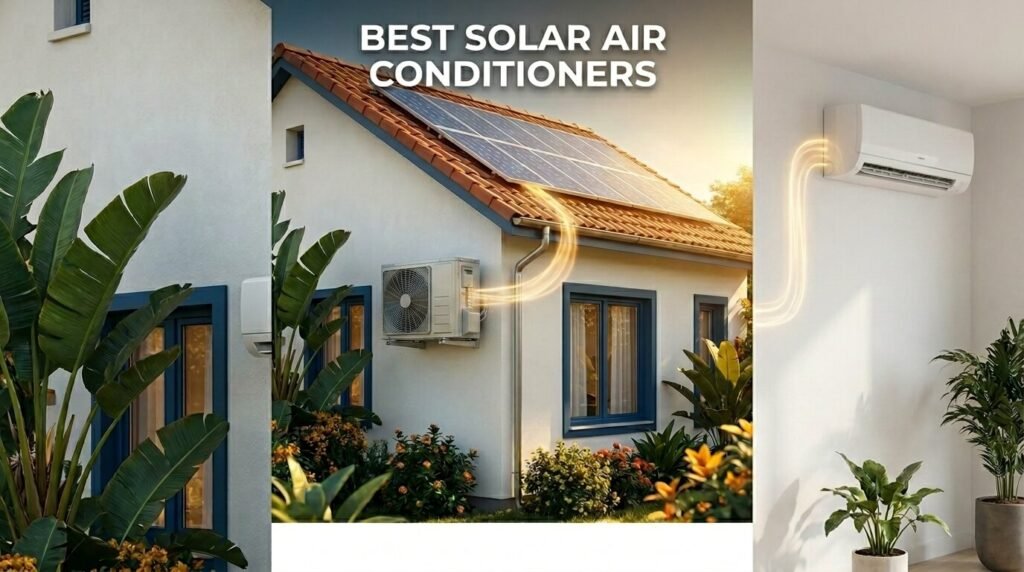
Hybrid Solar Inverter AC
This is the most practical option for most Nigerian homes and businesses.
A hybrid solar AC, such as units from Gree Electric, automatically draws from solar panels first, then switches to battery backup, and finally falls back to grid or generator power when needed.
You’re always using the cheapest available source first. This type works well in urban areas where there’s occasional grid power but frequent outages.
DC Solar Air Conditioners
DC solar ACs run directly on the DC electricity produced by solar panels, without needing a solar inverter to convert the power. This makes them highly efficient. There’s no conversion loss.
They’re a strong option for locations where grid power is either unavailable or completely unreliable. The trade-off is that they typically require a purpose-built solar DC system and may have fewer local service options compared to standard inverter ACs.
Off-Grid Solar AC Systems
An off-grid solar AC system operates with complete energy independence, no connection to the national grid at all. This makes it ideal for rural areas, remote communities, and sites where grid extension isn’t realistic.
The system relies entirely on solar panels and a battery bank for power. Sizing the battery bank correctly is critical here, since it needs to cover both daytime cooling and any nighttime or cloudy-period demand.
Key Features to Look for in a Solar Air Conditioner
High Energy Efficiency
The lower the power consumption, the more efficiently your solar system runs. Look for AC units with strong Energy Efficiency Ratio (EER) or SEER ratings.
A more efficient unit means fewer solar panels and less battery capacity needed to run it, which directly reduces your installation cost.
Inverter Technology
Inverter ACs use a variable speed compressor that adjusts cooling output based on the room’s current needs, rather than switching fully on and off like non-inverter units.
This makes them significantly more solar-friendly. Daikin Industries’ inverter ACs are a good example of the smooth, consistent power draw, which is much easier for a solar system to supply than the sudden high-demand spikes of a non-inverter unit starting up.
Low Startup Power Requirement
Standard non-inverter ACs have a high startup surge; the moment the compressor kicks on, it draws several times its running wattage.
This spike is hard on solar systems and inverters. Inverter ACs start gradually and avoid this problem entirely, making them the right choice for any solar-powered setup.
Smart Power Management
The best solar AC systems include intelligent power management that automatically switches between solar, battery, and grid power based on availability and load.
This ensures the AC runs without interruption and that solar energy is always prioritised. Some smart AC models from brands like LG Electronics also offer mobile app control and remote monitoring for additional management flexibility.
Battery Compatibility
For night cooling or use during overcast periods, battery backup is essential.
Make sure the solar AC system you choose is compatible with lithium batteries, specifically lithium iron phosphate (LiFePO4) batteries, which offer long cycle life and better performance in Nigeria’s heat.
A properly sized battery bank ensures the AC can run through low-sunlight periods without interruption.
Choosing the Right Solar AC Capacity
1HP Solar AC for Small Rooms
A 1HP solar AC is suitable for bedrooms and small offices, typically rooms up to about 12 square metres. It’s the most economical to run on solar, requiring fewer panels and less battery storage.
LG Electronics and similar brands offer reliable 1HP inverter options that pair well with modest solar setups.
1.5HP Solar AC for Medium Rooms
The 1.5HP capacity is the most popular choice for Nigerian homes; it handles living rooms, medium-sized bedrooms, and standard office spaces comfortably.
Hisense and similar brands offer 1.5HP inverter ACs that balance cooling performance with power efficiency. This is the capacity, Engr. Iwuala most frequently helps clients size solar systems at Kowatek Solar LTD.
See our guide to Solar-Powered Air Conditioners for home use.
2HP Solar AC for Large Spaces
For larger living rooms, open-plan offices, and commercial spaces, a 2HP solar AC delivers the cooling capacity needed.
Samsung Electronics makes well-regarded 2HP inverter units suitable for solar integration. The trade-off is that larger capacity means higher power demand, which translates to a bigger solar array and more battery storage, both worth factoring into your budget from the start.
Solar Panel Requirements for Air Conditioners
How Many Solar Panels Are Needed?
This is one of the most important questions in solar AC planning, and Engr. Iwuala is direct about it: “A reliable solar energy system can comfortably power an air conditioner, depending on the AC capacity (HP) and how many hours you want it to run. The solar system size should be determined by the AC horsepower, number of AC units, desired backup runtime hours, and other appliances connected to the system.”
As a general guide, a 1HP inverter AC running during peak sun hours typically needs around 1,000–1,200 watts of monocrystalline solar panels.
A 1.5HP unit needs roughly 1,500–2,000 watts, and a 2HP unit may require 2,500 watts or more.
Nigeria has strong solar irradiation across most regions, with the north averaging more peak sun hours than the south, which means northern installations often need slightly fewer panels to achieve the same output.
Battery Storage Requirements
Daytime cooling is relatively straightforward; the panels generate power, and the AC uses it directly. Night cooling is the bigger planning challenge.
To run a 1.5HP inverter AC overnight, you need a battery bank sized to supply 8–10 hours of continuous load.
Lithium batteries are strongly preferred over lead-acid for this purpose; they handle deep discharge better, last significantly longer, and perform more reliably in high-temperature environments like Nigeria.
Solar Inverter Sizing
The solar inverter must be sized to handle the AC’s peak load, not just its running wattage. Engr. Iwuala specifically recommends transformer-based hybrid inverters for solar AC setups.
They’re more robust than transformerless models and handle the kind of voltage fluctuation common on the Nigerian grid.
An MPPT charge controller should also be part of the setup, as it maximises the electricity harvested from the panels regardless of cloud cover or panel temperature.
Solar AC vs Regular Inverter AC
Electricity Consumption Comparison
A regular inverter AC connected to the national grid draws all its power from the utility. A solar-integrated inverter AC draws from panels first, reducing grid dependence significantly.
During peak sun hours, a well-sized solar system can run the AC entirely on solar power, with zero grid consumption and zero generator fuel. The difference shows up clearly on monthly utility bills and fuel receipts.
Installation Cost Comparison
A regular inverter AC installation costs far less upfront, just the unit and fitting. A solar AC system includes the panels, inverter, charge controller, battery bank, wiring, and installation labour, which adds significantly to the initial outlay.
But the comparison needs to account for ongoing costs: fuel, electricity bills, and generator maintenance all factor into the true cost of running a regular AC in Nigeria.
Long-Term Savings Comparison
Over five years, the math typically favours solar. The installation cost is a one-time expense; fuel savings and electricity bill reduction are recurring monthly benefits.
For a household running an AC 8 hours a day, the fuel and electricity savings from a properly sized solar system can be substantial enough to fully recover the installation cost and then generate ongoing savings.
Best Solar AC Solutions for Nigerian Homes
Solar AC for Apartments
For apartments, a 1HP or 1.5HP hybrid solar inverter AC is the most practical choice.
Space constraints on most apartment buildings limit rooftop panel installation, so a compact, efficient system that uses a modest solar array and a lithium battery bank for backup is ideal.
The goal is to reduce the electricity bill and cut generator hours, not necessarily going fully off-grid.
Solar AC for Family Homes
Family homes typically need 1.5HP or 2HP units for the main living areas. A well-designed system for a family home might include multiple solar panels on the roof, a transformer-based hybrid inverter, and a lithium battery bank sized for 4–6 hours of night cooling.
The best AC brands for high humidity in Port Harcourt and Lagos are worth researching specifically for coastal family homes, where humidity control and corrosion resistance matter as much as energy efficiency.
Solar AC for Off-Grid Areas
For homes and communities without grid access, a DC solar AC or a fully off-grid solar AC system is the right solution.
These setups are more common in rural areas across northern and central Nigeria, where grid extension is limited.
A properly sized off-grid system with monocrystalline panels and a quality lithium battery bank can deliver reliable cooling around the clock, supporting energy independence without any reliance on the national grid or generator fuel.
Best Solar AC Solutions for Offices and Businesses
Small Office Cooling
A small office running one or two 1HP to 1.5HP inverter ACs can be comfortably served by a moderate solar system.
Daytime cooling — when staff are present, and the sun is generating power- is where solar delivers the most value.
Fuel savings during working hours alone can justify the investment for many small businesses within two to three years.
Commercial Solar Cooling
Larger commercial spaces, such as supermarkets, showrooms, churches, and schools, often run multiple AC units for extended hours.
Engr. Iwuala notes that Kowatek Solar LTD regularly designs solar solutions for estates, churches, and businesses where multiple AC units need to run simultaneously.
These setups require careful load calculation, properly sized solar arrays, and high-capacity battery banks to ensure consistent cooling across all units.
Reducing Generator Fuel Costs
For businesses currently running ACs entirely on generators, a solar-assisted daytime cooling setup offers the fastest return on investment.
The solar system handles cooling during business hours, and the generator only kicks in when the sun isn’t generating enough. This hybrid approach can cut generator fuel costs by 50–70% for businesses operating primarily during daylight hours.
Common Challenges of Solar Air Conditioners in Nigeria
High Initial Installation Cost
The panels, inverter, battery bank, charge controller, and installation all add up to a significant upfront investment.
This is the biggest barrier for most buyers. Solar financing options are becoming more available in Nigeria, including Bank of Industry-backed schemes, but the market is still developing.
The key is to see the installation cost as a capital investment with a measurable return, not just an expense.
Limited Battery Runtime
Battery storage has real limits. Running a 1.5HP AC overnight requires a substantial lithium battery bank, and adding more battery capacity adds cost.
Many solar AC users in Nigeria opt for a hybrid approach, solar and battery for daytime and early evening, then switching to grid or generator for late-night hours.
This keeps the system affordable while still delivering significant savings.
Weather Dependence
Solar panels generate less electricity on overcast or rainy days. Nigeria’s rainy season, which brings extended cloud cover to southern regions, can reduce solar output significantly.
This is why battery backup and hybrid inverter systems that can also draw from the grid or generator are important; they ensure the AC keeps running even when sunlight is limited.
The effects of Harmattan dust on AC systems are also relevant here, as dust accumulation on panels during the dry season reduces their output and needs to be cleaned regularly.
Installation Complexity
A solar AC system is not a plug-and-play installation. It requires proper system sizing, correct panel tilt angle for maximum sunlight exposure, appropriate wiring, and a qualified solar installation technician who understands both the solar and HVAC components.
Poor installation is one of the most common reasons solar AC systems underperform. Using experienced, certified installers like the team at Kowatek Solar LTD is not optional; it’s essential.
Tips for Maximising Solar AC Performance
Use Energy-Efficient Inverter ACs
The more efficient the AC, the less power it demands, and the more effectively your solar system serves it. Always choose an inverter AC over a non-inverter model for any solar setup.
The lower, more consistent power draw of an inverter compressor is far easier for a solar system to supply, and it extends your battery runtime significantly.
Improve Room Insulation
A well-insulated room retains cool air longer, which means the AC runs less and draws less power.
Simple steps — sealing gaps around windows and doors, using thick curtains, and minimising heat-generating appliances in cooled rooms all reduce the cooling load and help your solar system go further.
Position Solar Panels Correctly
Panel placement and tilt angle directly affect how much electricity your solar array generates.
In Nigeria, panels should generally face south and be tilted at an angle close to the local latitude for optimal year-round output.
Shade from trees, buildings, or rooftop structures significantly reduces panel performance and should be avoided entirely.
Service both the AC and the Solar System Regularly
Both the AC unit and the solar components need regular maintenance. For the AC, this means filter cleaning, coil cleaning, and drain inspections.
The standard servicing schedule applies regardless of whether the unit is solar-powered. For the solar system, panels need periodic cleaning (especially during Harmattan), connections should be inspected, and the battery bank should be checked regularly.
The top AC brands that can work under dry heat and in Northern Nigeria tend to have better dust resistance, which matters for both the AC unit and its interaction with the solar setup in northern locations.
Common Buying Mistakes to Avoid
Undersizing the Solar System
This is the most common mistake, Engr. Iwuala sees at Kowatek Solar LTD. Buyers choose panels and a battery bank that are too small for their actual cooling needs, then wonder why the system struggles.
The fix is proper load calculation before purchase, accounting for AC capacity, daily runtime hours, and other appliances on the same system.
Undersizing costs more in the long run because it leads to poor performance and early battery degradation.
Ignoring Battery Backup Needs
Some buyers focus entirely on the solar panels and overlook battery storage. Without adequate battery runtime, the AC stops cooling the moment the sun goes down or cloud cover reduces solar output.
A lithium battery bank sized for your actual evening and night cooling needs is not an optional extra; it’s a core part of the system design.
Buying Based Only on Price
The cheapest solar panels, inverters, and batteries are rarely the best value. Low-quality components fail faster, deliver less output, and often aren’t compatible with each other in ways that become apparent only after installation.
Engr. Iwuala specifically recommends monocrystalline solar panels and lithium iron phosphate batteries, not the cheapest options available, but the ones that deliver reliable long-term performance in Nigerian conditions.
Using Poor Installers
A correctly specified system can still underperform badly if it’s installed incorrectly. Wrong panel angles, undersized wiring, improper inverter configuration, and poor battery connections all reduce efficiency and can damage components over time.
Choosing a certified, experienced solar installation technician, one who understands how to size and integrate all components properly, is as important as choosing the right equipment.
Conclusion
Solar air conditioners are no longer a niche product in Nigeria; they’re a practical, increasingly affordable solution to the country’s power challenges.
The best solar AC for your needs should deliver genuine energy efficiency, reliable cooling, solar compatibility, and long-term savings that justify the upfront investment.
Before buying, take the time to evaluate your room size, required cooling capacity, solar panel requirements, battery backup needs, and total budget.
And as Engr. Chibueze Iwuala of Kowatek Solar LTD rightly points out always ask how many hours you need the AC to run on solar. That single question shapes every other decision in your system design.