
An AC tune-up is a preventive service where a technician cleans, tests, adjusts, and measures your air conditioner while it’s still working to keep it efficient and catch small problems before they become summer breakdowns.
A proper central AC tune-up takes 60–90 minutes and costs about $75–$150.
Many homeowners schedule one every year and assume it was done right. A 20-minute visit with no measurements taken, no capacitor tested, and no temperature split recorded isn’t a tune-up; it’s a walk-around with a marketing label on it.
This guide covers what a real tune-up includes, what it costs in 2026, the measurements that prove the work was done, and the low-demand months when prices run 30–50% below the summer peak.
What Is an AC Tune-Up? (And How It Differs from a Repair)
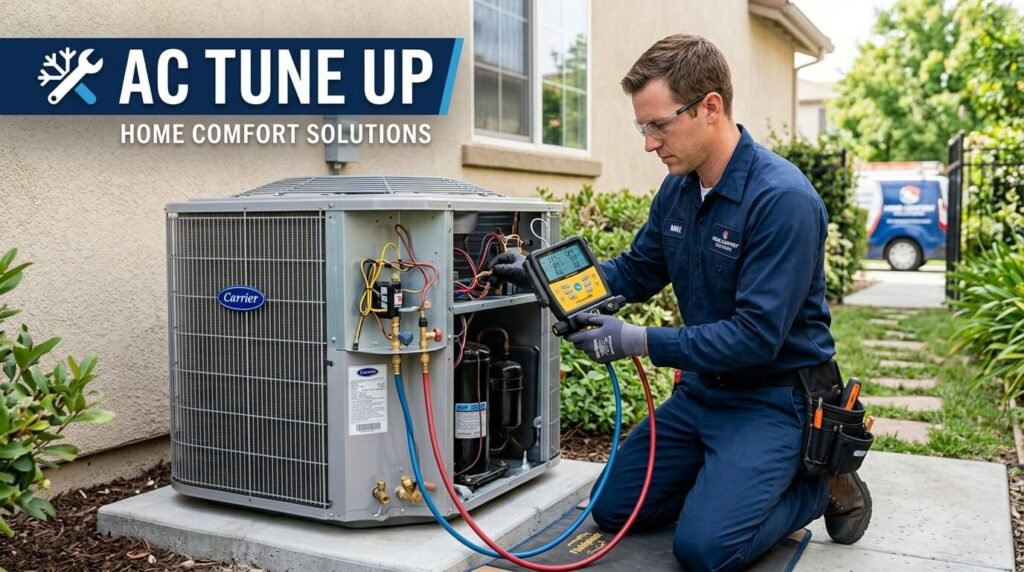
An air conditioning unit tune-up is a preventive service performed on a functioning system to maintain efficiency, catch early-stage problems, and extend equipment life. It’s not a repair; repairs fix something already broken.
Standard AC tune-up: For a central air conditioner, a standard tune-up is the full service in the checklist below: electrical testing, refrigerant measurements, coil cleaning, drain flushing, and a written report. It applies to home systems, including central air, mini-splits, and window units, though the tasks vary by system type.
AC tune-up vs. HVAC tune-up: An AC tune-up services only the cooling side of your system. An HVAC tune-up covers heating and cooling, usually the air conditioner or heat pump plus the furnace. If you have both, see AC and furnace tune-up below.
In addition, it’s not an inspection; an inspection documents what’s there without correcting it. The distinction matters because homeowners often receive one when they paid for another.
The Difference Between a Tune-Up, an Inspection, and a Repair
AC Tune-Up: Preventive service on a working system, cleaning, testing, adjusting, and measuring. The system runs the same way it did before, but more efficiently and with documented condition data.
AC Inspection: A visual and functional review that identifies problems and documents the system’s current state. No cleaning, no adjustments, no measurements taken.
AC Repair: Corrective work performed after a component has failed or is failing. A repair is triggered by a symptom; a tune-up is scheduled on a calendar.
Some contractors use these terms interchangeably. A $49 “tune-up special” that takes 15 minutes is almost certainly an inspection dressed up as a tune-up — and telling the difference requires knowing what measurements a real tune-up produces.
Why Skipping a Tune-Up Costs More Than Scheduling One
AC systems lose approximately 5% efficiency per year without professional maintenance, per field data cited by multiple HVAC operators.
“The U.S. Department of Energy has been cited as saying a dirty condenser coil can increase compressor energy consumption by 30%, which is a component-specific impact rather than a whole-system efficiency loss”.
For the full maintenance picture beyond the annual professional visit, see our complete AC maintenance guide covering monthly and annual tasks.
- A system that hasn’t been serviced in 3 years runs roughly 15% less efficiently than when new, which means that when paying for electricity, the system isn’t converting it into cooling.
- A failed capacitor — one of the most common tune-up findings — costs $150–$400 to replace when it fails mid-summer, versus $0 when caught during a tune-up before it fails.
- Documented annual service is required by most HVAC manufacturers to keep the warranty valid — skipping a year can give the manufacturer grounds to deny a parts claim.
Does an AC Tune-Up Include Refrigerant (Freon) Recharge?
No. A standard tune-up checks your refrigerant level and measures the charge, but it doesn’t add refrigerant or Freon.
That distinction trips up many homeowners comparing quotes, and it’s also the answer to “which HVAC service includes refrigerant recharging”: a separate repair visit does, after a leak is found and sealed.
A tune-up’s refrigerant task is a level check. The technician confirms the system has the correct charge for its rated capacity and flags any low reading.
Topping off refrigerant that has gone missing is billed separately.
Why recharge isn’t a routine tune-up item
Refrigerant is a closed-loop system. It doesn’t get “used up” through normal operation. If a system is low, refrigerant escaped somewhere — a leak.
Recharging a leaking system without finding and sealing the leak first means the new refrigerant leaks out too, and you’re paying for the same recharge again in a few months.
A tune-up isn’t the appointment where a technician has the time or scope to trace a leak; that’s a diagnostic repair visit.
What actually happens if your tune-up technician finds low refrigerant
- They’ll flag it as a finding, not fix it on the spot
- They should recommend a leak detection service before any recharge — dye testing, electronic leak detectors, or nitrogen pressure testing
- Recharge cost gets quoted separately once the leak is found and sealed, priced per pound and by refrigerant type (R-410A recharge runs meaningfully cheaper than R-22, which is being phased out and priced accordingly).
If a company recharges without mentioning a leak check first, that’s worth being cautious about it either means they’re skipping a step that saves you money long-term, or the “tune-up” you booked was priced to include upsells that weren’t disclosed upfront.
What Does an AC Tune-Up Include? The Full 20-Point Checklist
AC system tune-up covers the electrical system, the refrigerant circuit, the coils and air handling components, and the condensate drainage.
A technician who does all of this properly should be on-site for 60–90 minutes minimum. Anything under 45 minutes for a central AC system is a red flag.
Electrical System: Capacitors, Contactors, and Connections
- The technician tests the start and run capacitors with a multimeter, measuring actual microfarad output against the rated value stamped on the capacitor — a reading 10% or more below rated capacity means the capacitor is failing and should be replaced before it causes a no-start failure.
- Contactors (the electrical switches that engage the compressor and condenser fan) are inspected for pitting and carbon buildup, which increases resistance and accelerates motor wear.
- All electrical connections at the disconnect, capacitor terminals, and control board are checked for corrosion and tightened — loose connections generate heat that degrades wiring insulation over time.
- The thermostat is tested for calibration accuracy and correct signal delivery to the air handler and outdoor unit.
Refrigerant System: Levels, Leaks, and the Superheat/Subcooling Check
Refrigerant is not a fuel that gets used up; a properly sealed system should never need recharging. If a technician recommends adding refrigerant, there’s a leak somewhere that needs to be found and repaired, not just topped off.
For more details, see our guide on AC Refrigerant check and recharge.
- Refrigerant line pressure is measured with a digital manifold gauge set at both the high-side (liquid line) and low-side (suction line).
- Superheat and subcooling calculations are performed to confirm the refrigerant charge is correct for current ambient conditions — pressure readings alone are insufficient because they don’t account for temperature and humidity variables on the day of service.
- Refrigerant lines are inspected for oily residue, which indicates a leak site, and for insulation condition on the suction line.
- The evaporator coil (indoor) is checked for icing or frost, which indicates either a low charge or an airflow restriction.
Coils, Airflow, and the Condensate Drain
- The condenser coil (outdoor unit) is cleaned with a coil cleaner and rinsed — a dirty condenser coil is the single component the DOE links to a 30% compressor energy increase, making this the highest-value cleaning task in the tune-up.
- The evaporator coil (indoor unit) is inspected for dust and mold buildup; heavy buildup requires chemical cleaning that takes additional time and is often billed separately.
- Airflow through the return and supply is verified — the technician checks for blocked vents, collapsed ductwork at the air handler, and blower wheel condition.
- The condensate drain line is flushed to clear algae buildup; a blocked condensate drain can cause water backup and ceiling damage within days during peak humidity season.
- The air filter is inspected and replaced (homeowner-supplied) or noted as requiring replacement.
Full 20-Point AC Tune-Up Checklist at a Glance
| Task | What the Technician Does | Tools Required | Pro Only? |
|---|---|---|---|
| Capacitor test | Measures microfarad output | Multimeter | Yes |
| Contactor inspection | Checks for pitting and resistance | Visual + multimeter | Yes |
| Electrical connection tightening | Torques all terminals | Screwdriver set | Yes |
| Thermostat calibration | Test the accuracy and signal | Thermometer + meter | Yes |
| Refrigerant pressure measurement | High-side and low-side readings | Digital manifold | Yes |
| Superheat calculation | Temperature + pressure at suction line | Manifold + thermometer | Yes |
| Subcooling calculation | Temperature + pressure at liquid line | Manifold + thermometer | Yes |
| Leak check | Visual + electronic detector sweep | Leak detector | Yes |
| Condenser coil cleaning | Chemical wash and rinse | Coil cleaner + hose | Yes |
| Evaporator coil inspection | Visual check for buildup or icing | Flashlight | Yes |
| Blower wheel inspection | Check for dust and balance | Visual | Yes |
| Condensate drain flush | Flush with water or dilute bleach | Wet-dry vac/hose | No (homeowner can maintain) |
| Air filter check | Inspect condition, note MERV rating | Visual | No |
| Temperature split measurement | Return air vs supply air delta | Digital thermometer | Yes |
| Refrigerant line insulation check | Inspect suction line insulation | Visual | No |
| Disconnect box inspection | Check fuses and connections | Multimeter | Yes |
| Contactor voltage test | Verify proper voltage drop across contacts | Multimeter | Yes |
| Fan blade inspection | Check for cracks, balance | Visual + spin test | Yes |
| Motor amperage draw | Verify within nameplate rating | Clamp meter | Yes |
| Written service report | Document all readings and findings | Service software | Yes |
How to Tell If You Got a Real AC Tune-Up (The Measurements That Prove It)
Aside from focusing on what a technician should do, it is recommended that you verify that it happened.
A real tune-up produces specific numbers. If your technician can’t tell you the temperature split and capacitor reading before leaving, those measurements weren’t taken.
The Three Numbers Every Completed Tune-Up Should Produce
| Measurement | What the Technician Does | Acceptable Range | What It Means If Out of Range |
|---|---|---|---|
| Temperature split (Delta T) | Measures return air temp and supply air temp at the air handler | 15–20°F difference | Below 15°F = possible low refrigerant or dirty evaporator coil; above 20°F = possible restricted airflow or oversized system |
| Capacitor microfarad | Test the actual capacitance with a multimeter | Within 5–10% of value stamped on capacitor | 10%+ below rated = failing capacitor; replace before it causes a no-start or compressor damage |
| Superheat (TXV systems) | Digital manifold reading at suction line vs saturation temp | 5–15°F above saturation temperature | Low superheat = overcharged or metering issue; high superheat = undercharged or restricted |
| Subcooling | Digital manifold reading at liquid line vs condensing temp | 10–20°F below condensing temperature | Confirms correct charge and proper condenser coil operation |
What to Ask Your Technician Before They Leave
- “Can you show me the temperature split reading?” — The digital thermometer reading should be in their service report.
- “What was the capacitor microfarad reading, and is it within spec?” — This should be a specific number, not “it looked fine.”
- “What were the superheat and subcooling readings?” — If the technician can’t answer this, refrigerant measurements weren’t taken.
- “Did anything come up that I should monitor or address before next season?”
- “Can I get a written copy of today’s service report with all readings?”
A technician who can answer questions 1–3 with specific numbers performed a real tune-up. One who responds with “everything looked good” almost certainly didn’t.
How Much Does an AC Tune-Up Cost in 2026?
The average cost of a Home AC tune-up falls between $75 and $150 for a central AC system. A premium tune-up with documented superheat and subcooling readings runs $120–$200, and a combined AC and furnace visit costs $150–$300.
Window units run $60–$90 and single-zone mini-splits $85–$160.
The biggest swing factor is timing: peak-season prices (June–August) run 50–100% above spring or fall, which means booking off-peak saves roughly 30–50%.
What raises the price of a tune-up visit
- Booking in June–August, when demand is highest
- Heavy evaporator coil buildup that needs chemical cleaning (often billed separately)
- Servicing two systems (AC and furnace) in one visit
- A mini-split with multiple zones
Not included in the tune-up price
- Refrigerant recharge and leak repair
- Replacement parts, such as a capacitor (150–400 when it fails mid-summer)
- Chemical evaporator coil cleaning
- Duct cleaning or repair.
Cost by Service Level and System Type
| Service Level | System Type | Price Range | What’s Included |
|---|---|---|---|
| Basic tune-up | Window/wall unit | $60–$90 | Filter, coil clean, electrical check |
| Standard tune-up | Central AC (single system) | $75–$150 | Full 20-point service |
| Standard tune-up | Mini-split (1 zone) | $85–$160 | Head unit cleaning, electrical, and refrigerant check |
| Premium / diagnostic tune-up | Central AC with full digital manifold readings | $120–$200 | All of the above + documented superheat/subcooling |
| Dual system (AC + furnace) | Central AC + gas furnace | $150–$300 | Both systems serviced in one visit |
The Seasonal Price Premium: Why Booking in Winter Saves You 30–50%
AC tune-up prices don’t stay flat across the year. Demand drives a 50–100% premium during peak season (June–August) vs. the shoulder months, and during the first major heat wave of the summer, same-day availability disappears entirely in most markets.
| Month | Demand Level | Typical Price Range | Technician Availability | Best Action |
|---|---|---|---|---|
| January–February | Very low | $58–$100 | Excellent | Lowest prices; book if system needs service |
| March–April | Low-medium | $75–$130 | Good | Optimal window — best balance of price, availability, and lead time before summer |
| May | Medium-high | $100–$150 | Moderate | Last chance before the surge; book early in the month |
| June–August | Peak | $150–$200+ | Limited | Avoid if possible; emergency service only |
| September–October | Low | $80–$140 | Good | Second optimal window; ideal for heat pump biannual service |
| November–December | Very low | $60–$100 | Excellent | Good second window; some contractors offer end-of-year specials |
“In San Antonio, HVAC companies commonly recommend scheduling tune-ups in early spring, especially March or April, to get better availability and avoid the summer rush; fall is another low-demand window for maintenance”.
Annual Maintenance Plan vs One-Time Service: Which Is Worth It?
For a full breakdown of what plan contracts should include, see the table below:
| Dimension | Annual Maintenance Plan | One-Time Service |
|---|---|---|
| Typical cost | $150–$350/yr (covers 2 visits) | $75–$200 per visit |
| Scheduling | Automatic reminders; contractor calls you | You remember to book |
| Repair discounts | Usually 10–20% off parts and labor | Full price |
| Priority scheduling | Yes — plan members typically get priority during peak season | No |
| Best for | Homeowners who want to set it and forget it; systems under 12 years old | Homeowners who are comfortable managing their own schedule; older systems are approaching replacement |
The plan costs less per visit in most markets and eliminates the risk of forgetting to book during the shoulder season window.
But it only makes financial sense if the contractor’s plan includes real, documented service, not a 20-minute inspection with a tune-up label. Ask to see a sample service report before signing.
AC and Furnace Tune-Up: Should You Service Both Together?
If your home has both an air conditioner and a gas furnace, you can book them as a single HVAC tune-up, sometimes called a heating and cooling tune-up.
One technician services both systems in one visit, and the combined price typically runs $150–$300, which is usually less than paying for two separate calls.
What a furnace tune-up adds to an AC tune-up
The AC portion is the same 20-point service described above. The furnace portion typically adds:
- Burner and igniter inspection and cleaning
- Heat exchanger inspection for cracks or corrosion
- Flue and venting check for proper exhaust
- Blower motor and belt inspection
- Carbon monoxide and gas-connection safety checks
- Thermostat and safety-control testing
Should you book them together?
Booking both in one visit makes sense when your furnace and AC are on the same air handler, or you want a single service report for warranty records.
But cooling and heating peak in opposite seasons, so many homeowners split them: AC in March or April, furnace in September or October, when each is in its low-demand window.
If you’d rather book once, choose a shoulder month such as April or October, when technicians have the most availability and both systems can be checked before either season starts.
Heat pump owners should note that a heat pump replaces both the AC and the furnace, so it already gets a twice-a-year service (see How Often below).
How Often Should You Get an AC Tune-Up?
Once per year is the standard for central Air conditioner tune-up systems. Twice per year — fall and spring — is correct for heat pumps, because heat pumps run year-round in both heating and cooling mode and accumulate wear on a different schedule than seasonal-only AC systems.
Once a Year for Most Systems; Twice a Year for Heat Pumps
For central air conditioners used seasonally (cooling only), one annual tune-up in spring covers the equipment’s needs.
Systems in hot-humid climates that run 9–10 months per year are the exception.
If your system runs nearly year-round, a fall check-up makes financial sense even if you don’t have a heat pump, because the usage hours are comparable to a heat pump’s annual cycle.
The Compounding Efficiency Loss From Skipping Years
The 5% annual efficiency loss isn’t a scare figure; it’s what happens to coils, capacitors, and refrigerant charge accuracy without annual correction.
Here’s what that compounding looks like in dollars for a homeowner with a $100/month cooling bill.
| Years Without Professional Service | System Efficiency vs New | Monthly Wasted Cost ($100 cooling bill) | Annual Wasted Cost | Cumulative Waste |
|---|---|---|---|---|
| 0 (annual service maintained) | 100% | $0 | $0 | $0 (+ $120–150/yr service cost) |
| 1 year skipped | ~95% | ~$5 | ~$60 | ~$60 |
| 2 years skipped | ~90% | ~$10 | ~$120 | ~$180 |
| 3 years skipped | ~85% | ~$15 | ~$180 | ~$420 |
| 4 years skipped | ~80% | ~$20 | ~$240 | ~$660 |
“DOE-cited material says a dirty condenser coil can increase compressor energy consumption by about 30%, so a single coil cleaning can recover some of that lost performance”.
“For many homeowners, an annual tune-up can reduce wasted energy and may pay back quickly in hot climates, but the exact savings vary by system condition, usage, and local electricity prices”.
Signs Your AC Needs a Tune-Up (or Already Needs One)
A cooling system tune-up that needs service usually signals it before it fails. These symptoms are the system’s way of asking for maintenance, not always for a repair.
Warning Signs That Mean Service Is Overdue
| Symptom | Likely Cause | Urgency |
|---|---|---|
| Higher electricity bills with no change in usage | Dirty coils or a failing capacitor are reducing efficiency | Schedule within 14 days |
| Weak airflow from vents | Dirty filter, clogged evaporator coil, or blower issue | Schedule within 7 days |
| System runs longer cycles than before | Low refrigerant charge or dirty condenser coil | Schedule within 7 days |
| Warm or lukewarm air from supply vents | Low refrigerant, failing capacitor, or refrigerant leak | Call within 48 hours |
| Water pooling near the air handler | Clogged condensate drain | DIY flush; monitor; schedule if persists |
| Rattling or unusual noise from outdoor unit | Loose fan blade or debris in housing | Check visually; schedule if noise continues |
| System short-cycling (turns on and off rapidly) | Oversized system, dirty coil, or failing capacitor | Schedule within 7 days |
If multiple symptoms are present and the system is over 10 years old, see our signs your AC needs repair or replacement rather than a tune-up.
AC Blowing Warm Air? When a Tune-Up Helps and When You Need a Repair
If your AC is blowing warm air, check the simple causes first: the thermostat is set to “cool” and below room temperature, the air filter isn’t clogged, the breaker hasn’t tripped, and the outdoor unit is running.
If you see ice on the indoor coil or refrigerant line, turn the system off and let it thaw before calling.
If those check out, the cause is usually one of three things, and only some of them are tune-up territory.
| Cause | Fixed by a tune-up? | What to book |
| Dirty condenser or evaporator coil | Yes | Standard tune-up |
| Weak or failing capacitor | Yes, if caught before failure | Tune-up, or a repair if it has already failed |
| Slightly low refrigerant | Partly. It’s measured, not fixed | Leak detection, then repair |
| Refrigerant leak | No | Repair |
| Failed compressor or control board | No | Repair |
Rule of thumb: if the system is still cooling, just not as well as before, a tune-up is the right first call. If it’s blowing warm air continuously or not cooling at all, book a diagnostic repair visit within 48 hours instead.
A tune-up appointment isn’t scoped to trace a leak or replace a failed part, so you’d pay for one visit and still need another.
How to Tune Up Your AC Unit Yourself (What’s Safe to DIY)
You can’t do a full professional tune-up yourself, since refrigerant measurement and capacitor testing require certification and tools.
But a handful of basic maintenance steps are safe for any homeowner and keep your system running between professional visits. Follow them in this order:
- Turn off power. Switch off the thermostat and the outdoor disconnect box before touching the outdoor unit.
- Replace or clean the air filter. Every 30–90 days, depending on filter type, pets, and allergies.
- Clear the area around the condenser. Keep a 2-foot perimeter free of plants, debris, and stored items.
- Rinse the condenser fins. Use a garden hose on a soft setting, from the inside out if possible. Never use a pressure washer.
- Flush the condensate drain. Pour one cup of distilled white vinegar into the drain access port quarterly to prevent algae.
- Check the vents. Make sure all supply and return vents are open and not blocked by furniture.
- Restore power and confirm the system starts and cools normally.
Then book a professional visit for the rest of the job: refrigerant measurement, capacitor testing, electrical connections, and chemical coil cleaning. That’s the part that can’t be done safely at home.
Tasks that require a licensed technician and should never be attempted by homeowners:
- Refrigerant measurement, addition, or recovery — EPA Section 608 certification is legally required.
- Capacitor testing and replacement — capacitors store lethal voltage even when the system is off.
- Electrical connection work at the disconnect box or control board.
- Coil cleaning with chemical agents — wrong concentration or product damages fins permanently.
AC Tune-Up and Your Warranty: What the Fine Print Actually Requires
Most HVAC manufacturer warranties require documented annual professional service as a condition of coverage. For the full warranty picture, including registration deadlines and your rights, see what HVAC manufacturers require to keep your warranty valid.
Why Most Manufacturers Require Documented Annual Service
Manufacturer warranties from Trane, Carrier, Lennox, Goodman, and Daikin contain language requiring annual professional maintenance as a condition of parts warranty coverage.
“Annual professional maintenance” means a licensed HVAC technician, not a filter change. And it means documented: a signed, dated service invoice listing what was inspected and serviced.
- A parts warranty claim on a compressor ($1,500–$2,500 in parts alone) can be denied if you can’t produce service records for the year before the failure.
- The manufacturer doesn’t need to prove that the lack of maintenance caused the failure; they only need to show that no maintenance records exist.
- Service records from a maintenance plan are the cleanest documentation because the contractor generates them automatically.
What Counts as Proof: Keeping the Right Records
- After every professional tune-up, request a written invoice or service report listing every task performed, every measurement recorded, and the technician’s license number.
- Photograph the invoice and store the image in cloud storage — paper receipts fade and get lost; a timestamped photo doesn’t.
- Keep the physical invoice with the original installation paperwork and warranty registration confirmation.
- Note the model number and serial number of your system somewhere separate from the unit itself — you’ll need both to file any warranty claim.
- If your tune-up was performed under a maintenance plan, confirm the contractor’s records match what was actually done — ask for a copy of the service report at each visit, not just at the end of the plan year.
If your last tune-up didn’t include documented measurements, now is the right time to schedule one that does. Book in March or April for the best price and a choice of appointment windows before summer demand peaks.
Frequently Asked Questions About AC Tune-Ups
How long does an AC tune-up take?
A real tune-up on a standard central AC system takes 60–90 minutes. Mini-splits take slightly longer per zone due to the head unit cleaning process.
Any visit under 45 minutes for a central system almost certainly didn’t include refrigerant measurements or a thorough coil cleaning.
What does an AC tune-up include and consist of?
A standard AC tune-up consists of four parts: electrical testing, a refrigerant check, coil and airflow cleaning, and condensate drain service.
The technician tests the capacitors and contactors, tightens electrical connections, and calibrates the thermostat.
They measure refrigerant pressure and calculate superheat and subcooling, then clean the condenser coil, inspect the evaporator coil and blower, flush the drain line, and check the air filter.
They also record the temperature split and motor amperage draw.
A full central AC tune-up takes 60-90 minutes and should end with a written service report listing every reading.
It does not include refrigerant recharging, replacement parts, or chemical evaporator coil cleaning, which are billed separately. For the complete task-by-task list, see the 20 point AC tune up checklist above.
Does an AC tune-up include refrigerant?
No, a tune-up includes checking refrigerant levels and measuring the charge, but not adding refrigerant. Refrigerant should never need adding in a sealed system; if a technician recommends a recharge, there’s a leak that needs to be located and repaired first.
What is the best time of year to get an AC tune-up?
March or April: for most homeowners, prices are $75–$130 in most markets, technician availability is good, and you have adequate lead time before summer.
January and February offer the absolute lowest prices ($58–$100 in many markets) if you’re willing to book five months early.
Can I do my own AC tune-up?
You can handle filter changes, condenser exterior rinsing, condensate drain flushing, and perimeter clearing around the outdoor unit.
You cannot safely handle capacitor testing, refrigerant measurements, electrical connection work, or chemical coil cleaning, which require certification, calibrated tools, or both.
What is the difference between an AC tune-up and an AC inspection?
A tune-up includes cleaning, adjusting, and measuring the system, which comes out of the visit better than it went in. An inspection documents what’s there without correcting it.
Some contractors use the terms interchangeably; the service report tells you which one you actually received.
Does a tune-up fix my AC if it’s not cooling properly?
A tune-up can fix performance problems caused by a dirty coil, a failing capacitor, or a slightly low refrigerant charge, all of which are within tune-up scope.
It won’t fix a failed compressor, a refrigerant leak, or a failed control board. If the system isn’t cooling at all, that’s a repair call, not a tune-up.
How do I know if an HVAC technician is qualified to perform a tune-up?
Verify that the technician holds an EPA Section 608 certification (required to handle refrigerants) and a state HVAC contractor license for your state.
Both are public records; you can ask to see the license number and verify it on your state’s contractor licensing board website. A technician without Section 608 certification cannot legally perform or verify refrigerant measurements.
Do mini-split systems need the same tune-up as central air?
Mini-splits need professional service on the same annual schedule, but the tasks differ. The indoor head unit’s blower wheel accumulates mold and debris that homeowners can’t safely reach.
Professional cleaning of that component is the highest-priority mini-split maintenance task. Refrigerant checks and electrical testing are the same as central air; ductwork inspection isn’t applicable.