
You searched “solar Inverter AC ” and landed on three different types of products across the first page of results.
That’s not a coincidence; it’s a terminology problem. A solar AC inverter can mean a standard solar inverter wired to an existing AC unit, a DC inverter air conditioner that runs on solar power directly, or an all-in-one hybrid unit managing solar, battery, and cooling in a single box.
Buying the wrong one doesn’t just waste money. It means your inverter trips every time the compressor starts.
This guide separates all three, shows you how to size correctly, and explains what most buyers miss before they purchase.
‘Solar AC Inverter’ Means Three Different Things — Here’s Which One You’re Looking For
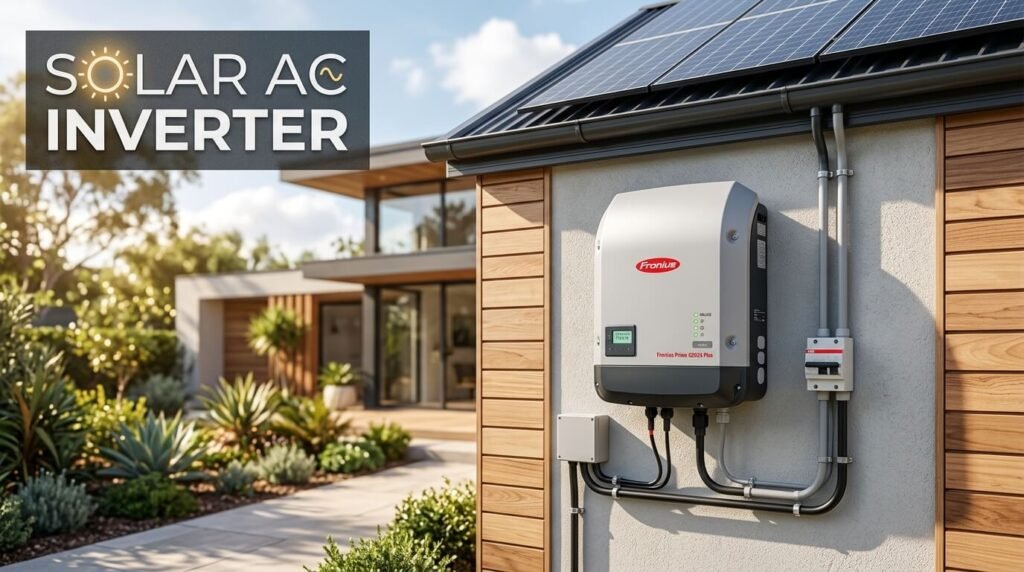
Most articles treat this as one product. It isn’t. The three types work differently, cost differently, and suit completely different situations. Getting this wrong at the research stage is how people end up with mismatched systems.
Type 1 — A Solar Inverter Used to Power a Standard AC Unit
Type 1 (Solar Inverter for AC) — A standard solar inverter (string or hybrid) that converts DC electricity from solar panels into AC electricity, which then powers a conventional air conditioner.
The AC unit itself is unchanged. The inverter is the solar component; the AC is a separate appliance.
This is what most homeowners already have or are shopping for when they want to “run their AC on solar.”
The AC plugs into the home’s electrical system; solar panels feed the inverter; the inverter feeds the grid or the home loads. Simple setup, but the startup surge from the compressor is where most systems fail, and that’s covered in the sizing section below.
Type 2 — A DC Inverter Air Conditioner (Runs on Solar DC Directly)
Type 2 (DC Inverter AC) — An air conditioner with a variable-speed compressor that runs on DC power directly from solar panels, bypassing the need for a separate solar inverter.
The “inverter” in the name refers to the compressor’s speed control technology, not a solar power inverter. These are often marketed as solar mini splits.
The naming is what confuses buyers. A DC inverter AC doesn’t need a solar inverter box on the wall; the DC conversion happens inside the unit.
These are more efficient than Type 1 setups because they cut out one conversion stage (DC from panels → AC through inverter → back to DC for the compressor motor). That efficiency gap runs 8–12% in real-world conditions.
Type 3 — A Hybrid Solar AC Inverter (All-in-One System)
Type 3 (Hybrid Solar AC Inverter) — An all-in-one unit that integrates a solar inverter, battery management system, grid connection, and dedicated AC load controller into a single box.
It manages solar input, battery charging and discharging, grid import and export, and AC load priority simultaneously.
| Feature | Type 1 | Type 2 | Type 3 |
|---|---|---|---|
| What it is | Solar inverter powering a standard AC | DC inverter AC running on solar DC | All-in-one solar + battery + AC controller |
| Battery needed? | Optional (grid-tied works without) | Optional (daytime-only systems exist) | Usually yes — that’s the point |
| Setup complexity | Low — existing AC, add solar | Medium — purpose-built unit required | High — full system design needed |
| Best for | Grid-connected homeowners who already own an AC | Buyers in high-heat markets want maximum efficiency | Off-grid homes or those wanting 24hr solar cooling |
| Rough cost range | $800–$2,500 (inverter only) | $1,500–$4,000 (unit + installation) | $4,000–$12,000+ (full system) |
For the full technical breakdown, see how a hybrid inverter manages solar, battery, and grid simultaneously.
How to Size a Solar Inverter for an Air Conditioner
The sizing rule most guides give you, “match the inverter kW to the AC kW, is wrong. It ignores the startup surge, which is the single most common reason solar inverters trip when AC units turn on.
Why Running Wattage Is Not Enough — The Startup Surge Problem
A 1.5-ton AC draws about 1,600W while running. But in the first half-second when the compressor starts, it can pull 4,000–5,000W. That spike is called the startup surge or Locked Rotor Amps (LRA).
If your inverter can’t supply that surge for at least one second, it trips. This isn’t a fault or a defect. AC compressors pull 3–8× their running current at startup for 100–800 milliseconds. Physics.
Here’s how to size correctly:
- Find your AC’s running wattage on the nameplate or spec sheet — it’s listed as “rated input power” in watts or kW.
- Find the LRA rating on the same nameplate in amps. Multiply by voltage to get surge watts. If it isn’t listed, assume 3× running wattage as a conservative minimum.
- Choose an inverter whose surge/peak watt rating covers the LRA figure — not just the running wattage. Quality inverters list both a continuous rating and a 5-second surge rating.
- Add a 20% buffer above the surge figure. Inverters running at their surge ceiling wear faster and trip more often under real load.
Solar Inverter Size Guide by AC Tonnage
| AC Size | Running Watts | Startup Surge Watts | Minimum Inverter Size | Soft Starter Needed? |
|---|---|---|---|---|
| 1 ton (12,000 BTU) | ~900W | 2,500–3,200W | 3.5 kW surge-rated | Optional |
| 1.5 ton (18,000 BTU) | ~1,600W | 4,000–5,000W | 5 kW surge-rated | Recommended |
| 2 ton (24,000 BTU) | ~2,200W | 5,500–7,000W | 7.5 kW surge-rated | Recommended |
| 3 ton (36,000 BTU) | ~3,200W | 8,000–10,000W | 10 kW surge-rated | Required |
How Many Solar Panels Do You Need to Run an AC?
The panel count depends on three things: your AC’s running wattage, how many hours per day you run it, and how many peak sun hours your location receives.
A 1.5-ton AC running 8 hours daily in a location with 5 peak sun hours needs roughly 2,560Wh from panels per hour of operation — about 9–10 panels at 400W each, before accounting for inverter losses.
See our guide on how many solar panels your system needs for the full calculation method.
Panel Count by AC Size and Daily Use Hours
| AC Size | Daily Use | Energy Needed | Peak Sun Hours | Panels Required (400W) |
|---|---|---|---|---|
| 1 ton | 6 hrs/day | ~5.4 kWh | 5 hrs | 3–4 panels |
| 1 ton | 10 hrs/day | ~9.0 kWh | 5 hrs | 5–6 panels |
| 1.5 ton | 6 hrs/day | ~9.6 kWh | 5 hrs | 5–6 panels |
| 1.5 ton | 10 hrs/day | ~16 kWh | 5 hrs | 9–10 panels |
| 2 ton | 6 hrs/day | ~13.2 kWh | 5 hrs | 7–8 panels |
| 2 ton | 10 hrs/day | ~22 kWh | 5 hrs | 12–13 panels |
All figures assume 90% inverter efficiency and 10% system losses. Locations with fewer than 5 peak sun hours need proportionally more panels.
Do You Need a Battery to Run AC on Solar?
No — if you only need cooling during daylight hours. A grid-tied or daytime-only off-grid system runs your AC directly from panels without a battery, as long as solar generation meets demand.
The AC runs when the sun is up and either shuts off or pulls from the grid when it isn’t. For most households in hot climates, that covers 80–90% of the actual cooling needs.
But if you need cooling after dark or during cloudy stretches, a battery is necessary. That changes the system cost significantly.
- Skip the battery if your peak cooling demand falls between 9 am and 5 pm and you have grid backup or can tolerate gaps.
- Add a battery if you need 24-hour cooling, live off-grid, or experience frequent grid outages that interrupt cooling.
- Size the battery at a minimum of 2× your AC’s hourly consumption per hour of non-solar operation needed — a 1.5-ton AC running 4 hours overnight needs at least 6.4 kWh of usable battery capacity.
For nighttime or cloudy-day cooling requirements, start with our solar battery storage options and sizing guide.
On-Grid vs Off-Grid Solar Inverter for Air Conditioning
The grid connection decision affects far more than just the AC — here is on-grid vs off-grid solar — which system suits your situation. For AC specifically, the tradeoffs break down like this:
| Feature | On-Grid (Grid-Tied) | Off-Grid | Hybrid |
|---|---|---|---|
| Grid connection | Required | None | Optional backup |
| Battery required | No | Yes | Yes (usually) |
| Startup surge handled by | Grid supplements solar | Battery bank | Battery bank |
| At night | Grid powers AC | Battery powers AC | Battery powers AC |
| When solar + battery run out | Grid takes over automatically | AC shuts off | Grid takes over (if connected) |
| System cost (1.5T AC) | $3,000–$6,000 | $6,000–$14,000 | $8,000–$18,000 |
| Best for | Urban homes with a reliable grid | Remote or off-grid locations | Frequent outages or energy independence |
When On-Grid Makes More Sense
- Your grid is reliable, and outages are rare — the grid handles surge and nighttime load without extra hardware.
- Your cooling demand peaks during daylight hours, so solar covers most actual use.
- Your budget is limited — on-grid systems cost 40–60% less than equivalent off-grid setups.
- You want to export surplus solar electricity and reduce your bill rather than store it in batteries.
When Off-Grid or Hybrid Is the Right Call
- Grid power is unreliable, expensive, or unavailable — battery backup means cooling continues regardless.
- You need 24-hour cooling and can’t depend on the grid supply after sunset.
- Your electricity tariff is high enough that storing solar and self-consuming beats exporting to the grid.
- You’re in a tropical climate where cooling demand doesn’t neatly follow daylight hours.
DC Inverter AC vs. Running a Standard AC on a Solar Inverter — What’s Actually Better?
For most buyers in a hot climate running AC six or more hours daily, the DC inverter AC pays back its efficiency premium within 2–3 years. The numbers support that position clearly.
Efficiency Difference: DC Inverter AC vs AC-Powered Compressor
| Feature | Standard AC on String Inverter | DC Inverter AC on Solar | Hybrid Solar AC System |
|---|---|---|---|
| Conversion stages | DC → AC (inverter) → AC motor | DC → DC compressor (direct) | DC → managed DC → compressor |
| Round-trip efficiency | 85–90% | 92–97% | 90–95% |
| Typical SEER rating | 14–18 | 20–28 | 20–26 |
| Compressor speed control | Fixed speed (on/off cycling) | Variable (matches cooling demand) | Variable |
| Annual electricity cost (1.5T, 8hr/day est.) | ~$520–$680 | ~$380–$480 | ~$400–$510 |
The efficiency gap comes from one thing: a standard AC on a solar string inverter converts DC to AC, then the compressor motor converts back to rotational energy.
A DC inverter AC runs the compressor motor directly on DC — one fewer conversion step, which accounts for the 8–12% efficiency gain (SurgePV hybrid inverter testing, 2024).
The SEER difference (14–18 vs 20–28) compounds this over a decade of use.
Which One Costs Less to Set Up?
| System Type | Equipment Cost | Installation | Total Setup (1.5T equivalent) |
|---|---|---|---|
| Standard AC + string solar inverter | $800–$1,800 (inverter) + existing AC | $500–$1,200 | $3,500–$7,000 |
| DC Inverter AC (solar mini split) | $1,500–$3,500 (unit) | $800–$1,500 | $4,500–$9,000 |
| Hybrid solar AC all-in-one | $4,000–$8,000 (system) | $1,500–$3,000 | $8,000–$18,000 |
The upfront gap between Type 1 and Type 2 is roughly $1,000–$2,000 more for the DC inverter AC system. At $100–$200 less per year in electricity costs, that gap closes in 5–10 years.
In markets with expensive electricity or high solar irradiance, such as most of sub-Saharan Africa, Southeast Asia, and South Asia, the payback is closer to 3 years.
For West African countries, we have researched the best solar Air Conditioners in Nigeria and solar-powered AC for the home. Kindly read through to select the best brand.
What Is a Soft Starter and When Do You Need One?
A soft starter is a small device, typically $50–$200, that limits the inrush current when an AC compressor starts.
Instead of pulling its full Locked Rotor Amps in one spike, the compressor ramps up over 0.5–2 seconds. The inverter sees a gradual load increase rather than a wall of current, and it doesn’t trip.
A soft starter protects the inverter; keeping the compressor itself healthy long-term requires a regular AC servicing schedule to protect your compressor.
How a Soft Starter Reduces the AC Startup Surge
- Power reaches the soft starter before it reaches the compressor motor.
- The soft starter uses SCR (Silicon Controlled Rectifier) technology to limit current during the first 0.5–2 seconds of startup.
- The compressor motor accelerates gradually — torque builds over time rather than in a single instant.
- The inverter sees current draw rise smoothly from zero to running load, staying within its surge rating.
- Once the compressor reaches operating speed, the soft starter bypasses itself, and the AC runs normally.
When a Soft Starter Is Non-Negotiable
- Your inverter’s surge watt rating is less than 3× your AC’s running wattage — the startup surge will exceed the inverter’s capacity without intervention.
- You’re running a 2-ton or larger AC on a solar system — the LRA figures at this size reliably exceed what most residential inverters can supply unaided.
- Your inverter trips occasionally when the AC starts, but runs fine once it’s on — that’s a classic LRA problem, and a soft starter fixes it without replacing the inverter.
- You’re running off-grid on battery — batteries handle surge differently than grid power, and a soft starter reduces the current spike that can stress battery management systems.
How Much Does a Solar Inverter System for AC Cost?
For the full picture beyond just the inverter, see our full solar system cost breakdown for homeowners. For the inverter and AC-specific components, here’s what most buyers actually spend.
Cost by System Type
| System Configuration | Inverter / Unit Cost | Panels (6–10 × 400W) | Battery (if needed) | Total Installed |
|---|---|---|---|---|
| On-grid: standard AC + string inverter | $800–$1,800 | $1,200–$2,500 | None | $3,000–$6,000 |
| On-grid: DC inverter AC (solar mini split) | $1,500–$3,500 | $1,200–$2,500 | None | $4,500–$9,000 |
| Off-grid: standard AC + hybrid inverter + battery | $1,500–$3,500 | $1,200–$2,500 | $2,000–$6,000 | $8,000–$16,000 |
| Off-grid: DC inverter, AC + hybrid inverter + battery | $2,500–$5,000 | $1,200–$2,500 | $2,000–$6,000 | $9,000–$18,000 |
Labour costs vary by market. In the US, expect $500–$2,000 for installation, depending on system complexity. In Nigeria, the Philippines, and Pakistan, three of the fastest-growing markets for solar AC adoption, labour costs $150–$600.
The 30% Federal Tax Credit and What It Covers
In the US, the Inflation Reduction Act’s Investment Tax Credit (ITC) covers 30% of solar system costs through 2032. For solar AC systems, eligible components include:
- Solar panels and racking hardware.
- The solar inverter (string, hybrid, or microinverter).
- Battery storage systems are charged primarily by solar.
- Installation labour and wiring.
It does not cover the AC unit itself, even a DC inverter AC purpose-built for solar use. The AC is a cooling appliance, not a solar component.
A $7,000 solar system paired with a $2,000 DC inverter AC installation gets the 30% credit on $7,000, saving $2,100. Not on the AC hardware.
If your inverter trips when the AC starts, the fix is rarely a bigger inverter.
A $100–$200 soft starter solves the LRA problem in most cases. If you’re sizing from scratch, use the surge watt figures in the table above; running wattage alone will undersize your system.
And if you’re choosing between system types, the SEER 20–28 of a DC inverter AC versus SEER 14–18 on a standard unit is a gap that compounds every year the system runs.
Frequently Asked Questions About Solar AC Inverters
What size inverter do I need to run an air conditioner?
Size to the startup surge, not the running wattage. A 1.5-ton AC runs at ~1,600W but surges to 4,000–5,000W at startup. You need an inverter with a surge rating of at least 5 kW — or a 3.5 kW inverter paired with a soft starter that limits the inrush current.
Can a solar inverter run an air conditioner at night?
Not without a battery or grid connection. A grid-tied system hands off to the grid at night. An off-grid system needs enough battery capacity to cover nighttime hours — size at a minimum of 2× your AC’s hourly watt draw for each hour of overnight cooling needed.
What is the difference between a DC inverter AC and a solar inverter?
A solar inverter converts DC from panels to AC for your home’s electrical system.
A DC inverter AC is an air conditioner whose variable-speed compressor runs on DC power directly — the word “inverter” describes the compressor control technology, not a solar component.
They’re different devices, but DC inverter ACs are built to work efficiently with solar DC power.
Why does my inverter trip when my AC starts?
The compressor’s Locked Rotor Amps (LRA) at startup exceed your inverter’s surge capacity. The fix is either a soft starter ($50–$200) that ramps current gradually, or an inverter with a higher surge watt rating.
The soft starter solves the same problem at a fraction of the cost in most cases.
Is a hybrid solar AC inverter better than a standard solar inverter?
For off-grid use or homes with frequent outages, yes. For grid-connected homes mainly looking to cut electricity bills, a standard on-grid inverter costs 40–60% less and handles most situations well.
The hybrid earns its price when you need battery management, time-of-use control, or reliable backup power.
How much does a solar inverter system for AC cost?
A grid-tied setup for a 1.5-ton AC runs $3,000–$6,000 installed. Add battery storage for off-grid capability, and the range is $8,000–$16,000.
A DC inverter AC system (solar mini split) sits between those at $4,500–$9,000. The US ITC covers 30% of solar components through 2032, but not the AC unit itself.