
A solar AC and an inverter AC solve different problems. An inverter AC cools your home efficiently on grid power.
A solar AC (or an inverter AC paired with solar panels) cuts what that cooling costs you over time, at a much higher upfront price. If your electricity bill is the main pain point and you have roof space to spare, solar is worth the math below.
If you just want reliable, efficient cooling without a bigger project, a standard inverter AC is usually the better fit.
What Is a Solar AC vs an Inverter AC?
The two terms describe different things: one is about the compressor technology inside the unit, the other is about where the power comes from. Mixing them up is where most of the confusion starts.
What Is a Solar AC?
A solar AC is an air conditioner designed to run partly or fully on power from solar panels rather than the grid.
Most solar ACs on the market today are “hybrid” units: they use solar power when the sun is available and automatically switch to grid power (or battery) when it isn’t.
Fully off-grid solar ACs exist too, but they need a battery bank sized to cover nighttime and cloudy-day cooling, which adds significant cost.
What Is an Inverter AC?
An inverter AC is a standard air conditioner with a variable-speed compressor. Instead of switching fully on and off like older fixed-speed units, it adjusts its speed to match the cooling load, which cuts electricity use and reduces temperature swings.
The “inverter” in inverter AC has nothing to do with converting solar power. It refers to the compressor’s motor control, and the unit runs on grid power like any other appliance.
The Question You Might Actually Be Asking: Can an Inverter AC Run on Solar Panels?
If you already own an inverter AC, or you’re planning to buy one, here’s the short answer: yes. A standard inverter AC can run on solar power without being replaced by a dedicated “solar AC” unit.
You do this by adding rooftop solar panels and, typically, a hybrid inverter or grid-tie system that feeds the AC (and the rest of your home) from solar during the day and from the grid the rest of the time.
This matters because a lot of people searching “solar AC vs inverter AC” aren’t actually choosing between two appliances.
They’re trying to figure out whether they need to buy a new, more expensive “solar AC” at all, or whether they can just add panels to the inverter AC they already have.
In most cases, the second option is cheaper and simpler, and we walk through the numbers for it later in this article. If that’s your situation, skip ahead to Or Do This Instead. If you’re deciding which appliance to buy from scratch, keep reading.
Solar AC vs Inverter AC: Key Differences at a Glance
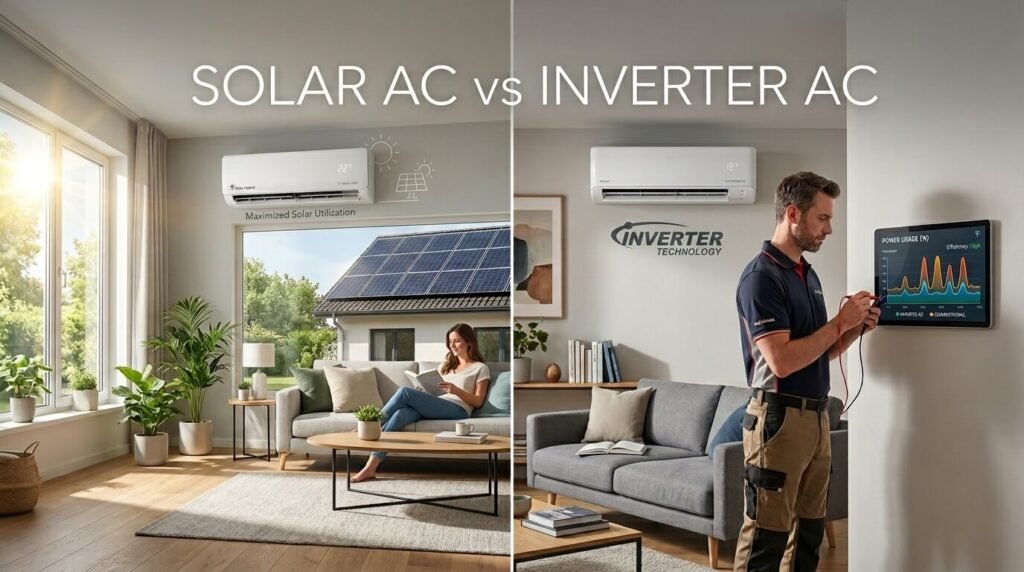
Before comparing price and running cost, it helps to see how the two options actually differ on paper.
Power Source & How Each One Works
| Feature | Solar AC | Inverter AC |
|---|---|---|
| Power source | Solar panels, with grid or battery backup | Grid electricity only |
| Compressor type | Usually variable-speed (inverter-driven), some fixed-speed | Variable-speed |
| Works without sun | Yes, if grid-tied or battery-backed; no, if purely off-grid | Yes, always |
| Extra hardware needed | Solar panels, charge controller or hybrid inverter, optional battery | None beyond the unit and standard wiring |
| Typical setup complexity | Moderate to high (panel mounting, wiring, permitting in some areas) | Low (standard electrician installation) |
Technology & Types (Hybrid, Off-Grid, DC Solar AC)
- Hybrid solar AC: Runs on solar power when available and switches to grid power automatically when the sun isn’t sufficient. This is the most common and most practical type for home use.
- Off-grid (battery-backed) solar AC: Runs entirely on solar and stored battery power, with no grid connection. This costs more because the battery bank has to be large enough to run the compressor overnight or through several cloudy days.
- DC solar AC: Runs the compressor directly on DC power from the panels, skipping the inverter step. This can be more efficient but limits your options to specific compatible panel and unit combinations, and it’s less common than AC-coupled hybrid systems.
Most homeowners end up choosing a hybrid setup because it keeps cooling reliable even when solar output drops, which is also the setup covered in the solar air conditioning market overview if you want a broader look at where the technology is heading.
Price Comparison: Solar AC vs Inverter AC
Exact prices depend heavily on your region, local installer rates, and the brand you choose, so instead of quoting fixed figures, it’s more useful to compare relative cost. Use the multiples below as a starting point and get local quotes for real numbers.
Upfront Purchase Price by Tonnage (Relative Cost, Not a Fixed Price)
| AC type | Typical cost relative to a standard inverter AC | What drives the difference |
|---|---|---|
| Standard inverter AC | 1x (baseline) | Unit and standard installation only |
| Hybrid solar AC | Roughly 3x to 5x | Adds panels, charge controller or hybrid inverter, mounting hardware |
| Off-grid solar AC with battery | Roughly 5x to 8x | Adds a battery bank sized for nighttime and low-sun operation |
What’s Included in the Price (Panels, Battery, Inverter, Installation)
- The AC unit itself, which is often similar in price to a comparable standard inverter AC.
- Solar panels sized to the unit’s power draw, usually the single largest line item in the total cost.
- A hybrid inverter or charge controller to manage the switch between solar and grid power.
- A battery bank, only if you’re going for an off-grid or extended-backup setup.
- Mounting hardware, wiring, and installation labor, which varies more by region and roof type than any other cost component.
If you want a plain-language walk-through of these components before comparing prices, our guide to understanding solar air conditioners covers each part in more depth.
Running Cost & Electricity Bill Savings
Once installed, the ongoing cost comparison flips: solar setups become cheaper to run because sunlight is free, while inverter ACs keep drawing metered electricity every time they’re used.
Monthly Running Cost Comparison
| Scenario | Relative monthly running cost |
|---|---|
| Inverter AC on grid power, moderate daily use | 100% (baseline, at your local electricity rate) |
| Hybrid solar AC, daytime-heavy use | Roughly 20% to 50% of the baseline, since grid power still covers evenings and low-sun days |
| Off-grid solar AC | Close to 0% ongoing electricity cost, since there’s no grid draw at all |
How Much You Can Actually Save Per Year
The savings depend on three things: how many daylight hours you actually run the AC, your local electricity rate, and how much of the unit’s draw the solar system can cover.
A household that runs the AC mostly in the afternoon and evening, when solar output is highest, will see savings closer to the top of the hybrid range above.
A household that runs the AC mainly at night will see much smaller savings from a hybrid system, because the panels aren’t generating power when the load is highest.
This is the single biggest factor competitors leave out of their savings estimates, and it’s worth checking your own usage pattern before assuming you’ll hit the higher end of the range.
Payback Period & Long-Term ROI
The extra upfront cost of solar only makes sense if you’ll own the property and the system long enough to recover it.
How Long It Takes to Recover the Extra Cost
- Take the extra upfront cost of the solar setup compared to a standard inverter AC (from the price comparison above).
- Estimate your annual electricity savings using your local electricity rate and the running-cost range above.
- Divide the extra upfront cost by the annual savings to get a rough payback period in years.
- Adjust for any subsidy or incentive you qualify for, which shortens the payback period (see below).
- Compare that payback period to how long you plan to stay in the property. If it’s shorter, solar pays for itself before you’d likely move; if it’s longer, you may not recoup the investment.
Local Subsidies & Incentives: How They Change the Math
Many regions offer subsidies, tax credits, or rebates for residential solar installations, and these can shift the payback calculation substantially.
Because programs vary so much by country and even by state or municipality, the table below uses a generic subsidy percentage rather than a specific scheme.
Check your local energy department or utility for the actual program available where you live.
| Subsidy level | Effect on payback period |
|---|---|
| No subsidy | Full payback period as calculated above |
| 20% subsidy on system cost | Payback period shortens by roughly 15% to 20% |
| 40% subsidy on system cost | Payback period shortens by roughly 30% to 40% |
A meaningful subsidy can turn a marginal payback period into a genuinely good one, which is why it’s worth checking before ruling out solar based on sticker price alone.
Performance: Cooling, Reliability & Cloudy-Day Behavior
Price aside, the systems also perform differently day to day.
What Happens on Cloudy Days or at Night
A hybrid solar AC keeps cooling normally on cloudy days and at night; it simply draws more from the grid when solar output drops, so comfort isn’t affected.
An off-grid solar AC depends entirely on stored battery capacity once the sun goes down or output drops during overcast weather, and if the battery runs low, cooling can be interrupted.
A standard inverter AC on grid power is unaffected by weather in either case, since it never depends on sunlight to begin with.
Battery Backup — Do You Need One?
Do I need a battery with a solar AC? Only if you want the system to run without grid power at night or during extended cloudy periods.
A hybrid system that’s allowed to draw from the grid when solar isn’t available doesn’t need one, and skipping the battery is usually the single biggest cost reduction you can make on a solar AC setup.
A battery becomes worthwhile mainly in areas with frequent grid outages, where backup cooling matters on its own, separate from the solar savings case.
Installation, Space & Maintenance Requirements
Beyond price and performance, physical space and upkeep are practical factors that affect which option fits your home.
Space & Panel Requirements by AC Tonnage
| AC size | Approximate panel count needed | Approximate solar array size |
|---|---|---|
| 1 ton | 3 to 4 panels | 1.0 to 1.3 kW |
| 1.5 ton | 5 to 6 panels | 1.6 to 2.0 kW |
| 2 ton | 7 to 8 panels | 2.3 to 2.7 kW |
These figures assume standard 300 to 350-watt residential panels and typical sun hours; actual panel count depends on your local solar irradiance and the specific AC’s power draw, so treat this as a starting estimate rather than a final spec.
Maintenance Comparison
- A standard inverter AC needs periodic filter cleaning, coil checks, and refrigerant servicing, the same as any AC unit.
- A solar AC needs all of that plus periodic panel cleaning, since dust and debris buildup reduces output over time.
- A battery-backed system adds battery health monitoring and, eventually, battery replacement, which is a real long-term cost that’s easy to overlook when comparing upfront prices.
- Panels themselves are largely maintenance-free beyond cleaning; the components more likely to need service are the inverter and, if present, the battery.
Which One Should You Buy? Decision Framework
Put the price, running cost, and performance factors together, and the choice usually comes down to how you use the AC and how long you’ll stay in the property.
Choose Inverter AC If…
- You want lower upfront cost and a simpler, faster installation.
- Your roof doesn’t get consistent sun exposure, or you don’t have roof space to spare.
- You’re renting or don’t plan to stay in the property long enough to recoup a larger investment.
- Grid power in your area is reliable and reasonably priced.
Choose Solar AC If…
- You run the AC heavily during daylight hours, when solar output is highest.
- Your local electricity rates are high enough that the running-cost savings add up quickly.
- You have good roof exposure and qualify for a meaningful local subsidy.
- You’re planning to stay in the property long enough for the payback period to make sense, as covered specifically in solar-powered AC for home setups.
Or Do This Instead — Add Solar Panels to Your Existing Inverter AC
For a lot of homeowners, the real answer isn’t “solar AC” or “inverter AC” at all. It’s keeping the inverter AC you already own (or planned to buy anyway) and adding solar panels sized to cover its power draw, using a hybrid inverter to manage the switch between solar and grid.
This retrofit path is usually cheaper than buying a purpose-built solar AC, because you’re not paying a premium for a specialized appliance, and it avoids the biggest downside of off-grid systems: it never leaves you without cooling on a bad-weather day.
Using the panel sizing from the table above, a 1.5-ton inverter AC needs roughly 5 to 6 standard panels to offset most of its daytime draw.
Pair that with a hybrid inverter that can feed both the AC and the rest of the home’s circuits, and you get most of the running-cost savings of a dedicated solar AC without the higher purchase price.
This is worth asking a local solar installer about directly, since not every home’s electrical setup supports a retrofit without some rewiring.
For a broader look at how solar AC and inverter AC options are evolving, including how a solar AC inverter is different from the hybrid retrofit setup described above, and what a standard inverter air conditioning unit looks like on a spec sheet, our related guides break down each component in more detail.
If you’d rather skip the DIY math and compare real products, a look at best solar AC brands in Nigeria shows how the price and included components actually vary between manufacturers, which is a useful sanity check on the relative cost ranges above before you request quotes.
FAQs — Solar AC vs Inverter AC
Is solar AC better than inverter AC?
Neither is better across the board; they solve different problems. A solar AC (or an inverter AC paired with solar panels) cuts electricity costs over time but costs several times more upfront.
A standard inverter AC costs less to buy and install but keeps drawing grid electricity for as long as you own it. If you run the AC mostly during daylight hours and plan to stay in the property for years, solar tends to win on total cost.
If you want the lowest upfront cost and simplest installation, a standard inverter AC is the better choice.
What is the price difference between solar AC and inverter AC?
A hybrid solar AC setup typically costs roughly 3 to 5 times more than a comparable standard inverter AC, mainly because of the added solar panels and hybrid inverter or charge controller.
An off-grid solar AC with battery backup can cost 5 to 8 times more, since the battery bank is the most expensive single component.
Exact prices vary by region, brand, and installer, so these are relative multiples rather than fixed figures; get local quotes for both options before deciding.
Can a normal inverter AC run on solar power?
Yes. You don’t need to buy a dedicated “solar AC” to run an inverter AC on solar power.
Adding rooftop solar panels sized to the unit’s draw, along with a hybrid inverter to manage switching between solar and grid, lets a standard inverter AC run on solar during the day and grid power at night.
For many homeowners, this retrofit path is cheaper than buying a purpose-built solar AC unit, since it avoids paying a premium for specialized hardware.
What is the typical payback period of a solar AC?
The payback period depends on your extra upfront cost, your local electricity rate, and how much of your AC use happens during daylight hours, so there’s no single global figure.
As a rough approach, divide the extra cost of the solar setup by your estimated annual electricity savings to get a payback period in years, then shorten that estimate if you qualify for a local subsidy or incentive, which can cut payback time by 15% to 40% depending on the program.
Comparing that number to how long you plan to stay in the property tells you whether the investment is likely to pay off.
[…] If you’re further along and comparing a purpose-built solar AC against adding solar panels to a standard unit you already own or plan to buy, the practical, unit-level version of that decision, including price ranges and payback math, is covered in solar AC vs inverter AC. […]