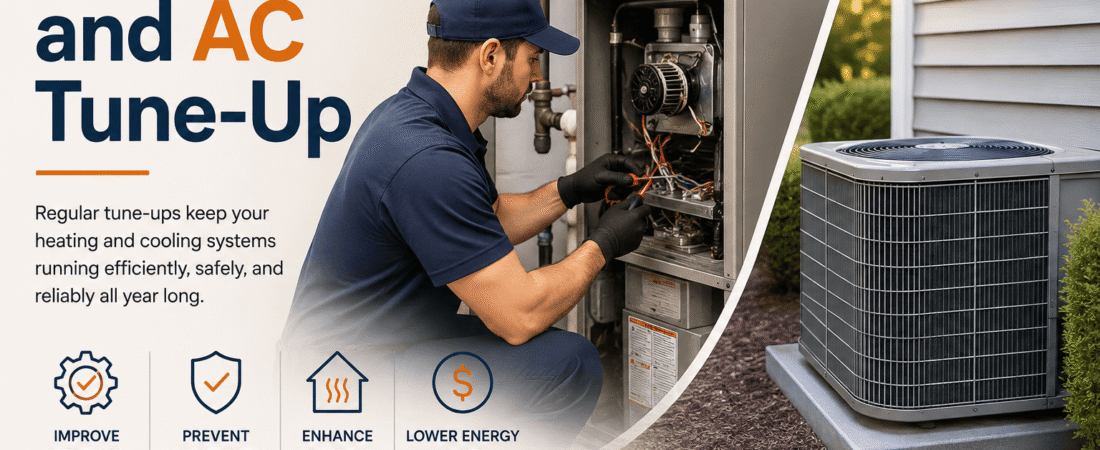
A furnace and AC tune up is a scheduled inspection and cleaning of your heating and cooling equipment, done by a licensed technician before each system’s busiest season.
Most homeowners pay between $75 and $250 per system, and a single visit typically runs 45 minutes to two hours depending on the equipment’s age and condition.
The confusing part isn’t the price. It’s whether “furnace and AC tune-up” means one combined appointment or two separate seasonal visits, since furnaces and air conditioners are almost always serviced at different times of year.
This guide breaks down what’s included in each type of tune-up, what it costs, when to schedule it, and whether bundling both systems into one visit actually saves money.
What Is a Furnace and AC Tune Up?
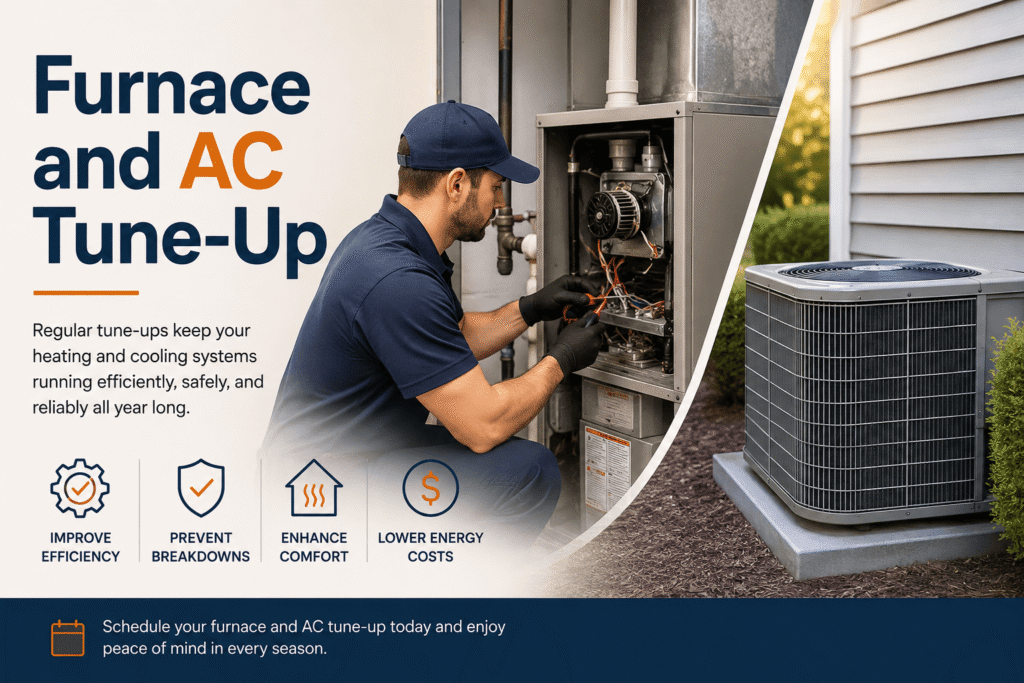
A furnace and AC tune-up, sometimes called a heating and cooling tune-up, is preventive maintenance performed on your heating and cooling systems before they take on their heaviest workload of the year.
A technician inspects, cleans, and adjusts the equipment so it runs efficiently and safely, and catches small problems (a worn belt, a cracked heat exchanger, a low refrigerant charge) before they turn into breakdowns or repair bills.
The two services aren’t interchangeable. A furnace tune-up focuses on combustion, heat exchange, and airflow through the heating side of your system.
An AC tune-up focuses on refrigerant, condenser coils, and the electrical components that keep the cooling side running. Some technicians can perform both during one appointment; others treat them as two separate seasonal jobs.
The rest of this guide explains both, plus how to decide which approach fits your home.
Furnace Tune-Up vs. AC Tune-Up: Key Differences
| Feature | Furnace Tune-Up | AC Tune-Up |
|---|---|---|
| Primary focus | Burners, heat exchanger, ignition system, ductwork | Condenser coils, refrigerant charge, compressor, electrical connections |
| Typical season | Fall, before heating season | Spring, before cooling season |
| Safety check | Carbon monoxide and gas leak inspection | Electrical short and refrigerant leak inspection |
| Typical cost | $70-$200, depending on fuel type | $75-$250, depending on unit size |
| Time required | 45-90 minutes | 45-90 minutes |
Can You Get Both Done in One Visit?
Yes, many HVAC companies offer a combined furnace and AC tune-up, especially if both systems share the same air handler or ductwork. Whether that’s the right call for your home depends on the age of your equipment and how extreme your local seasons are.
| System age & climate | Recommendation |
|---|---|
| Both systems under 5 years old, mild climate | Bundle into one combined visit; less to monitor closely |
| Either system 10+ years old, or extreme seasonal swings | Keep AC (spring) and furnace (fall) as separate visits for closer, more frequent monitoring |
| One new system, one aging system | Service the older system on its own seasonal schedule; bundle the newer one in if convenient |
Older equipment and harsh climates put more stress on individual components, so spacing the visits out gives a technician two chances a year to catch developing issues rather than one.
Newer, well-matched systems in moderate climates have less that can go wrong between spring and fall, which is why bundling makes more sense for them.
Furnace and AC Tune Up Requirements
Before a technician can perform a thorough tune-up, a few conditions need to be met on both sides: what the homeowner prepares, and who’s qualified to do the work.
What You Need to Do Before the Technician Arrives
- Clear a path to the furnace, air handler, and outdoor condenser unit so the technician has room to work.
- Make sure the thermostat has working batteries and the system is set to a mode that lets the technician test both heating and cooling functions.
- Keep pets away from the work area during the visit for their safety and the technician’s.
- Have your most recent service records or maintenance plan number on hand if you have one.
- Replace an obviously dirty filter yourself beforehand if you know how, though most technicians will check and replace it as part of the visit anyway.
Technician Licensing and Certification Requirements
- The technician should hold a valid HVAC contractor license in your state, which you can usually verify through your state’s licensing board website.
- NATE certification (North American Technician Excellence) is a strong signal of training quality, though it isn’t legally required everywhere.
- EPA Section 608 certification is legally required for any technician who handles refrigerant, since it’s a federal requirement under the Clean Air Act.
- The company should carry liability insurance and be willing to provide proof of it on request.
- Ask for a written, itemized service report at the end of the visit. This becomes your documentation for warranty and resale purposes, which matters more than it sounds like it should (more on that later).
Furnace Tune-Up Checklist: What’s Included
A furnace tune-up covers the heating-specific components that don’t get touched during an AC visit. Here’s what a thorough one includes, step by step.
Step-by-Step Furnace Tune-Up Process
- The technician shuts off power to the furnace at the breaker before beginning any inspection.
- They inspect and clean the burners, removing dust and debris that can affect the flame pattern.
- They check the heat exchanger for cracks or corrosion, since a damaged exchanger can leak carbon monoxide into the home.
- They test the ignition system, whether that’s a pilot light, hot surface igniter, or electronic ignition.
- They inspect and, if needed, replace the air filter.
- They check the blower motor and belt for wear, and lubricate moving parts as needed.
- They test the thermostat’s connection to the furnace to confirm accurate temperature response.
- They inspect the flue and venting system for blockages or corrosion.
- They check gas line connections (on gas furnaces) for leaks using a combustible gas detector.
- They test the furnace through a full heating cycle and confirm it reaches the correct temperature rise.
Furnace Safety Checks (Carbon Monoxide & Heat Exchanger)
- The technician tests carbon monoxide levels near the furnace and in the surrounding ductwork, since a malfunctioning furnace is one of the more common sources of CO buildup in a home.
- They inspect the heat exchanger closely for hairline cracks, which can be invisible to the eye but still allow gas to escape.
- They check that the flue pipe has proper slope and no obstructions, since a blocked flue can force exhaust gases back into the house instead of outside.
- They test the limit switch, which is designed to shut the furnace down if it overheats.
- They verify the carbon monoxide detector in your home (if you have one) is working, and recommend installing one if you don’t.
How Long Does a Furnace Tune-Up Take?
A standard furnace tune-up takes 45 minutes to 90 minutes for most residential systems.
Older furnaces, units in hard-to-reach locations like tight crawlspaces or attics, or systems that haven’t been serviced in several years tend to run closer to two hours, since the technician has more buildup to clean and more components to test carefully.
If the technician finds a problem during the inspection, such as a cracked heat exchanger or a failing blower motor, the visit can run longer or require a follow-up appointment for repairs, which is billed separately from the tune-up itself.
AC Tune-Up Checklist: What’s Included
An AC tune-up covers the cooling-specific components: refrigerant, coils, and the electrical parts that keep the compressor running safely.
Step-by-Step AC Tune-Up Process
- The technician shuts off power to the outdoor unit before beginning work.
- They clean the outdoor condenser coil, which loses efficiency quickly once it’s coated in dust, pollen, or grass clippings.
- They check the refrigerant charge by measuring superheat and subcooling, since an incorrect charge is one of the leading causes of compressor damage.
- They inspect and tighten electrical connections, since loose connections are a common cause of intermittent failures.
- They test the run and start capacitors, which wear out gradually and are a frequent cause of AC units that hum but won’t start.
- They inspect the indoor evaporator coil and clean it if needed.
- They check the condensate drain line for clogs, since a blocked drain can cause water damage or trigger a safety shutoff.
- They replace or clean the air filter if this wasn’t already done during a furnace visit.
- They test the thermostat’s connection to the cooling system.
- They run the system through a full cooling cycle and confirm the temperature drop across the coil is within the normal range.
AC Components a Technician Inspects
| Component | What’s Checked |
|---|---|
| Condenser coil | Dirt buildup, physical damage, airflow restriction |
| Refrigerant charge | Superheat and subcooling measurements against manufacturer spec |
| Compressor | Electrical draw, unusual noise, oil leaks |
| Capacitors | Run and start capacitor voltage and capacitance |
| Evaporator coil | Dirt buildup, frost or ice formation |
| Condensate drain | Clogs, proper slope, standing water |
| Electrical connections | Corrosion, looseness, wire insulation condition |
Furnace and AC Tune-Up Cost
Cost depends on which system you’re servicing, its fuel type or size, and whether you’re booking one visit or two.
Furnace Tune-Up Cost by Fuel Type
| Fuel Type | Typical Cost Range |
|---|---|
| Gas furnace | $80-$170 |
| Oil furnace | $100-$250 |
| Electric furnace | $70-$130 |
Gas and oil furnaces cost more to service because they involve fuel line and combustion inspections that electric furnaces don’t need.
AC Tune-Up Cost
The average AC tune-up cost by unit size generally falls between $75 and $250, with most homeowners paying closer to $100 to $150 for a standard residential system.
Larger homes with bigger tonnage units, or systems that haven’t been serviced in a year or more, tend to land at the higher end of that range because there’s more cleaning involved and a greater chance the technician finds a component that needs adjustment.
How Much You Save by Bundling Both
Paying for two separate service calls costs more than most homeowners expect, mostly because each visit carries its own trip and labor charge. Here’s the actual math using typical pricing.
| Approach | Typical Annual Cost |
|---|---|
| Two separate visits (AC in spring, furnace in fall) | $150-$300 |
| One bundled combo visit for both systems | $220-$260 |
| Annual maintenance plan covering both systems | $150-$350/year |
Bundling into one combo visit typically saves somewhere between $40 and $80 a year compared to booking two separate service calls, mostly because the technician isn’t charging a second trip fee.
A maintenance plan can land in a similar range or slightly higher, but it usually adds perks like priority scheduling and discounted repairs, which is worth factoring in beyond the sticker price alone.
When to Schedule Your Furnace and AC Tune-Up
Timing matters because a tune-up is meant to catch problems before the system is under heavy demand, not after.
Best Time for an AC Tune-Up (Spring)
Schedule your AC tune-up in March or April, before outdoor temperatures climb and before HVAC companies get booked solid with emergency repair calls.
A technician who services your system in spring has time to order replacement parts if something needs attention, instead of leaving you without cooling during a July heat wave while parts are on backorder.
Best Time for a Furnace Tune-Up (Fall)
Schedule your furnace tune-up in October or November, ahead of the first cold snap. This timing matters even more for furnaces than for AC units, since a furnace that fails on the first genuinely cold night of the year is a safety and comfort problem, not just an inconvenience.
Fall scheduling also gives you time to address carbon monoxide or heat exchanger issues before the furnace runs continuously for months.
Signs You Need a Tune-Up Now
Some warning signs mean you shouldn’t wait for the next seasonal appointment.
Furnace Warning Signs
- The burner flame is yellow or flickering instead of a steady blue, which can indicate incomplete combustion and possible carbon monoxide production.
- The furnace short-cycles, turning on and off repeatedly instead of running a full heating cycle.
- You notice a persistent burning smell that doesn’t fade after the first few minutes of the heating season.
- Your energy bills have climbed noticeably without a corresponding increase in usage.
- The furnace makes new banging, rattling, or screeching noises during operation.
If any of these apply and a tune-up doesn’t resolve them, it may point to a bigger issue worth checking against these signs your furnace needs repair, not just a tune-up.
AC Warning Signs
- The system blows warm or lukewarm air instead of cold air.
- You hear unusual clicking, buzzing, or grinding sounds from the outdoor unit.
- The AC cycles on and off more frequently than it used to, without a change in the thermostat setting.
- Airflow from the vents feels noticeably weaker than in past seasons.
- Humidity in the house feels higher than normal even with the AC running.
For a deeper walkthrough of these symptoms, see this AC not cooling troubleshooting guide.
DIY vs. Professional Maintenance
Some maintenance tasks are safe and simple enough to handle yourself. Others involve refrigerant, high voltage, or gas lines and should be left to a licensed technician.
Tasks You Can Safely Do Yourself
- You can replace or clean the air filter every one to three months, depending on the filter type and household conditions.
- You can keep the outdoor condenser unit clear of leaves, grass clippings, and debris within a two-foot radius.
- You can visually check that vents and registers throughout the house are open and unobstructed.
- You can gently rinse the outdoor condenser coil with a garden hose (power off first) to remove surface dirt between professional visits.
- You can check that the condensate drain line isn’t visibly clogged or leaking near the indoor unit.
Tasks That Require a Licensed Technician
- Refrigerant charging or recovery must be handled by an EPA Section 608 certified technician, since it’s a federal legal requirement.
- Heat exchanger inspection requires specialized tools and training to detect cracks that aren’t visible to the naked eye.
- Electrical component testing, including capacitors and control boards, involves working with high voltage that can be dangerous without proper training.
- Gas line and combustion inspections require equipment most homeowners don’t have, like combustible gas detectors and combustion analyzers.
- Full system diagnostics that involve measuring temperature differentials, refrigerant pressures, or airflow rates require calibrated professional equipment.
Is an HVAC Maintenance Plan Worth It?
A maintenance plan bundles your seasonal tune-ups into one annual or biannual agreement, usually with a company you’ve already used.
Whether it’s worth it depends mostly on the age of your system and whether you’re disciplined about scheduling service on your own.
What Maintenance Plans Typically Include
- Two scheduled visits per year, one for the furnace in fall and one for the AC in spring.
- Priority scheduling during peak season, which matters most during the first heat wave or cold snap when service companies get backed up.
- Discounted rates on repairs, often 10 to 15 percent off standard pricing.
- A locked-in HVAC maintenance plan pricing structure that doesn’t fluctuate with seasonal demand.
- Documented service history, which matters for the warranty reasons covered below.
If you’re confident you’ll remember to book two seasonal visits on your own, a plan mostly buys you convenience and priority scheduling rather than dramatic savings.
If you tend to let maintenance slip, a plan functions as a built-in reminder that protects both your equipment and your warranty.
Maintenance Plans and Your Manufacturer Warranty
Most HVAC manufacturers require documented proof of annual professional maintenance to keep a parts warranty valid, and skipping tune-ups can void that coverage even if the failure itself isn’t related to a missed maintenance step.
The problem is that most guidance stops at the warning without saying what to actually keep. Here’s what you need:
- A dated, itemized invoice from each service visit, listing the specific tasks performed, not just “furnace tune-up” as a single line item.
- The technician’s license or certification number, which some manufacturers ask for directly when processing a warranty claim.
- A record matching the tasks performed against your manufacturer’s stated maintenance requirements, since some manufacturers specify particular checks (like annual filter changes or coil cleaning) that need to appear on the record.
- A storage system that survives the full warranty period, which often runs 5 to 10 years on parts. A single folder, whether physical or a photo album on your phone, is enough as long as you keep adding to it after every visit.
Keeping this kind of documentation takes a few minutes after each appointment and can be the difference between a covered repair and a full out-of-pocket replacement years down the line.
Whichever route you choose, the biggest factor in cost and system lifespan is consistency, not which company you use for a single visit.
If you’re ready to get both systems on a reliable schedule, you can schedule a furnace and AC tune-up with a licensed technician in your area today or call our Licensed HAVC Technicians in Onitsha ( Mr Oscar +234 806 051 8393) and Port Harcourt (Mr Wokoma +234 803 336 9201, respectively.
– Glacvent
FAQ
How much does a furnace and AC tune-up cost?
A furnace tune-up typically costs between $70 and $250 depending on fuel type, while an AC tune-up runs $75 to $250 depending on unit size.
Booking both as a combined visit usually costs $220 to $260 total, which is generally less than paying for two separate service calls.
Costs increase if the technician finds a part that needs replacing during the inspection, since repairs are billed separately from the maintenance visit itself.
How often should you get a furnace and AC tune-up?
Most manufacturers and HVAC professionals recommend servicing each system once a year: the AC in spring before cooling season and the furnace in fall before heating season.
Systems that are older than 10 years, run in extreme climates, or haven’t been serviced recently benefit from staying on this twice-a-year schedule rather than bundling both into a single combined visit, since more frequent checks catch developing issues earlier.
Can I tune up my own furnace or AC?
You can safely handle a few basic tasks yourself, including replacing the air filter, clearing debris from around the outdoor condenser unit, and rinsing the condenser coil with a garden hose.
Anything involving refrigerant, gas lines, high-voltage electrical components, or heat exchanger inspection requires a licensed technician, both for safety and because refrigerant handling is federally regulated under EPA Section 608.
What happens if you don’t get your furnace serviced?
Skipping furnace maintenance increases the risk of a mid-winter breakdown, since small issues like a dirty flame sensor or worn belt tend to worsen without attention and eventually cause the system to fail.
It also raises safety risks, since a cracked heat exchanger or blocked flue can allow carbon monoxide to enter the home undetected.
On top of that, most manufacturers require documented annual maintenance to keep the warranty valid, so a missed tune-up can leave you paying full price for a repair that should have been covered.