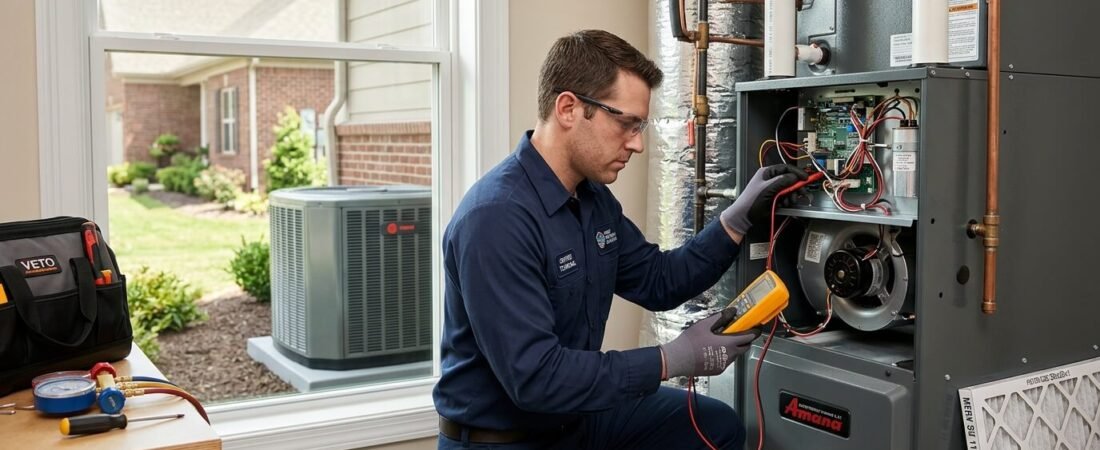
A heating and cooling tune up is a scheduled inspection and service visit for your HVAC equipment, but what it actually includes depends heavily on what kind of system you have.
A furnace and central AC split system needs different tasks than a heat pump, which needs different tasks than a ductless mini-split or a boiler.
Costs range from roughly $65 for a basic AC visit to $550 for a full mini-split service, and that spread mostly reflects how much equipment the technician has to touch, not how thorough the visit is.
This guide breaks down what a proper tune-up includes for each system type, how much it should cost, how often you need one, and how to tell whether a quote you’ve received actually covers what your equipment needs.
What Is a Heating and Cooling Tune Up?
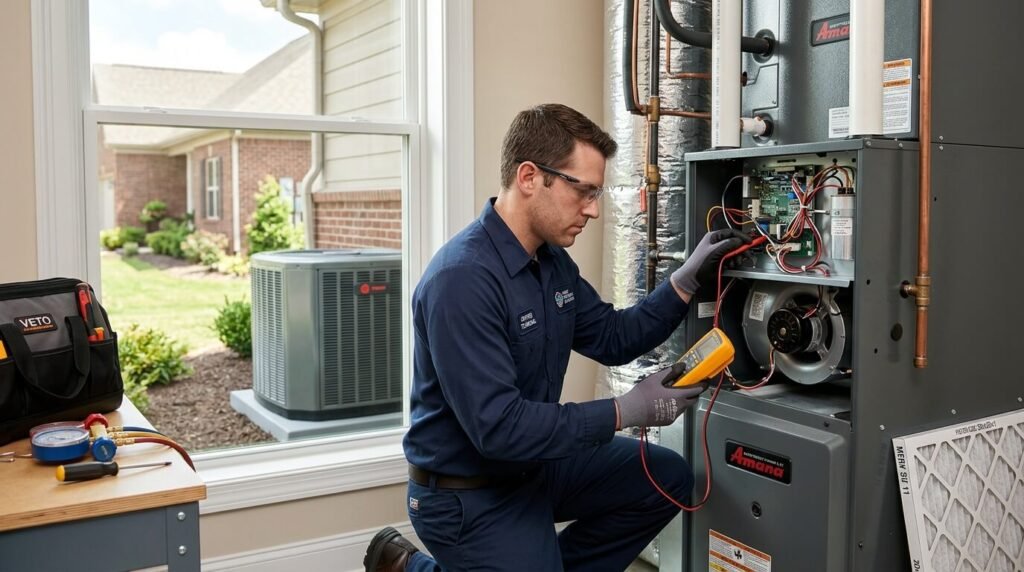
A heating and cooling tune up is a preventive maintenance visit where a technician inspects, cleans, and adjusts your equipment before its busiest season of use.
The specific tasks depend entirely on what type of system you have. A furnace-and-AC split system, a heat pump, a ductless mini-split, and a boiler each rely on different components, so a checklist built for one doesn’t automatically cover another.
The underlying mechanics explain why. A furnace and a boiler both burn fuel or use resistance heat, so their tune-ups revolve around combustion safety and heat exchange.
A central AC and a heat pump both move refrigerant through a closed loop, so their tune-ups revolve around refrigerant charge and coil condition.
A mini-split does the same refrigerant work as a heat pump, just split across multiple indoor heads instead of one central air handler.
Knowing which category your equipment falls into is the fastest way to tell whether a generic “HVAC tune-up” quote actually covers what your system needs.
What a Tune-Up Includes by System Type
| System Type | Primary Components Serviced | Typical Season |
| Furnace + Central AC | Burners, heat exchanger, blower motor (furnace); condenser coil, refrigerant charge, capacitors (AC) | Furnace: fall. AC: spring |
| Heat Pump | Outdoor and indoor coils, refrigerant charge, reversing valve, electrical components | Spring and fall (runs both seasons) |
| Ductless Mini-Split | Indoor unit filters and coils, outdoor unit coil, refrigerant lines, condensate drain per zone | Spring and fall |
| Boiler | Heat exchanger, combustion chamber, water flow and pressure, expansion tank, circulator pump | Fall |
For the full breakdown of tasks specific to that pairing, see this furnace and AC tune-up checklist.
How to Tell If a Tune-Up Was Actually Thorough
The most reliable way to judge a tune-up’s thoroughness is to check it against ANSI/ACCA 4 QM, officially titled “Maintenance of Residential HVAC Systems.”
It’s a nationally recognized, manufacturer-endorsed standard that spells out the minimum inspection tasks a tune-up should include for each equipment type, from furnaces and central AC to heat pumps, boilers, and mini-splits.
The standard exists because HVAC contractors historically used wildly different definitions of a “seasonal tune-up,” a “clean and check,” or a “maintenance service,” with no consistent way for a homeowner to compare one company’s visit against another’s. ACCA, working with contractors and manufacturers, built the standard to set a common floor.
Most homeowners have no way to tell whether a $90 visit is a genuine inspection or a fifteen-minute filter swap, and asking whether a contractor’s checklist meets or exceeds ACCA 4 QM minimums gives you an objective way to check before you book.
You don’t need to read the full standard to use it. Ask the company directly, or ask to see a copy of the checklist they’ll be working from, and compare it against the task categories below for your system type.
| System Type | Minimum Task Categories Under ACCA 4 QM | What a Complete Quote Should Include |
| Furnace | Combustion analysis, heat exchanger inspection, venting check, electrical connections | A line item for burner cleaning and heat exchanger inspection, not just “furnace check” |
| Central AC | Refrigerant charge verification, coil condition, condensate drain, electrical components | A refrigerant measurement noted with actual numbers, not just “checked” |
| Heat Pump | All AC tasks plus reversing valve operation and defrost cycle test | Confirmation that both heating mode and cooling mode were tested |
| Mini-Split | Indoor filter and coil per zone, outdoor coil, refrigerant lines, condensate drain per head | Separate line items for each indoor head, not one flat “mini-split service” charge |
| Boiler | Combustion efficiency test, water flow and pressure check, expansion tank, circulator pump | Water-side and combustion-side items listed separately |
If a quote you’re comparing skips these categories for your system type, ask the contractor directly what’s included before you book. A vague one-line description like “seasonal maintenance” doesn’t tell you whether the visit will actually catch a developing problem.
Heating and Cooling Tune-Up Cost by System Type
Cost depends primarily on which system you’re servicing, since each equipment type requires different components, tools, and time to service properly.
Fuel type, the number of indoor units, and how much cleaning the equipment needs all move the price within these ranges, so treat them as a starting point for comparing quotes rather than a fixed rate.
Furnace and AC Tune-Up Cost
| System | Typical Cost Range |
| Gas furnace | $80-$170 |
| Oil furnace | $100-$250 |
| Electric furnace | $70-$130 |
| Central AC | $65-$200 |
| Combined furnace + AC visit | $180-$260 |
Gas and oil furnaces cost more to service than electric furnaces because they require a combustion analysis and fuel line inspection that an electric furnace doesn’t need.
Oil furnaces run higher still, since oil-fired combustion produces more soot buildup that has to be cleaned out each visit.
Heat Pump and Mini-Split Tune-Up Cost
This mini-split maintenance checklist explains why ductless systems tend to cost more per visit than a single furnace or AC unit: each indoor head needs its own filter, coil, and drain check, and the technician has to service every zone in the home instead of one central unit.
| System | Typical Cost Range |
| Heat pump | $80-$350 |
| Ductless mini-split (whole system) | $300-$550 |
| Mini-split (per additional head) | roughly $100-$180 |
A heat pump costs more than a standalone furnace or AC visit because the technician has to test both heating and cooling function in the same appointment, plus check the reversing valve that switches the system between modes.
A mini-split’s higher price reflects labor, not complexity of any single component: a three-zone system means three indoor units to open, clean, and test, even though the refrigerant work itself is similar to servicing one central AC unit.
How Often You Need a Heating and Cooling Tune Up
How often you need a tune-up depends on what type of system you have. A furnace and a central AC split the year between them, so each one only needs a single annual visit.
A heat pump runs both heating and cooling on the same hardware for most of the year, which is why it benefits from two visits instead of one.
Furnace and AC: Once a Year Each
A standard furnace-and-AC setup needs one tune-up per system per year: the furnace in fall before heating season begins, and the AC in spring before cooling season begins.
Because each appliance only operates for roughly half the year, this single annual visit is generally enough to catch developing issues before they cause a breakdown.
Heat Pumps: Why They Need More Frequent Attention
A furnace typically runs for about five to six months a year, and a central AC runs for a similar stretch during the opposite season, so each appliance spends roughly half the year resting between tune-ups.
A heat pump doesn’t get that rest. It uses the same compressor, coils, and refrigerant system to heat the home in winter and cool it in summer, which means it can operate close to ten or eleven months out of twelve depending on the climate.
That difference in run time is the real reason heat pumps benefit from two tune-ups a year instead of one. The equipment accumulates wear and dirt faster because it rarely gets an off-season.
For the full task list specific to this equipment, see this heat pump tune-up checklist.
Signs You Need a Tune-Up Now
Some warning signs mean you shouldn’t wait for the next scheduled visit, regardless of system type.
Heating System Warning Signs
- The system takes noticeably longer to reach the temperature set on the thermostat than it used to.
- You notice a burning smell that doesn’t fade within the first few minutes of a heating cycle.
- The heat exchanger or burner area shows visible rust or discoloration.
- The system short-cycles, turning on and off repeatedly instead of completing a full heating cycle.
- Energy bills have climbed noticeably without a matching increase in usage.
Cooling System Warning Signs
- The system blows warm or lukewarm air instead of cold air during cooling mode.
- You hear new clicking, buzzing, or grinding sounds from the indoor or outdoor unit.
- Humidity in the house feels higher than normal even with the system running.
- Ice or frost has formed on the indoor coil or refrigerant lines.
- Airflow from the vents or mini-split heads feels weaker than in past seasons.
If any of these signs persist after a tune-up, the issue may go beyond routine maintenance. This guide to signs you need HVAC repair, not just a tune-up, walks through what typically separates the two.
DIY vs. Professional Maintenance by System Type
Some maintenance tasks are safe to handle yourself across every system type. Others involve refrigerant, combustion, or high voltage and should be left to a licensed technician.
Tasks You Can Handle Yourself
- You can replace or clean air filters every one to three months for furnace, AC, and heat pump systems, or every two to four weeks for washable mini-split filters.
- You can keep the outdoor condenser or heat pump unit clear of leaves, grass clippings, and debris within a two-foot radius.
- You can rinse an outdoor coil gently with a garden hose, with the power off first, to remove surface dirt between professional visits.
- You can check that the condensate drain near an indoor unit isn’t visibly clogged or leaking.
- You can visually confirm that vents, registers, and mini-split heads aren’t blocked by furniture or curtains.
Tasks That Require a Licensed Technician
- Refrigerant charging, recovery, or leak repair must be handled by an EPA Section 608 certified technician, since it’s a federal legal requirement for every system that uses refrigerant.
- Combustion analysis and heat exchanger inspection on a furnace or boiler require specialized tools most homeowners don’t own.
- Electrical component testing, including capacitors, control boards, and reversing valves, involves high voltage that requires proper training to test safely.
- Water flow, pressure, and expansion tank checks on a boiler require plumbing and combustion knowledge beyond basic homeowner maintenance.
- Full diagnostic testing that measures temperature differentials or airflow rates requires calibrated professional equipment.
Is a Heating and Cooling Maintenance Plan Worth It?
A maintenance plan bundles your seasonal tune-ups into a single annual agreement, and whether it’s worth it depends mostly on how many systems you have and how disciplined you are about scheduling service on your own.
What a Maintenance Plan Typically Includes
An HVAC maintenance plan cost typically runs $150 to $500 a year depending on how many systems and visits are included, and most plans bundle in the following:
- Two scheduled visits per year for split systems, or two visits for a heat pump’s single set of equipment.
- Priority scheduling during peak season, which matters most during the first heat wave or cold snap when service companies get backed up.
- Discounted rates on repairs, typically 10 to 20 percent off standard pricing.
- Waived diagnostic fees for plan members when a problem is found during a scheduled visit.
- Documented service history, which matters for the warranty reasons covered next.
Maintenance Plans and Your Manufacturer Warranty
Most manufacturers require documented proof of annual professional maintenance to keep a parts warranty valid, and this applies across system types, not just furnaces.
A heat pump or mini-split warranty can be voided by the same missed-maintenance clause that applies to a furnace, even though the equipment and failure modes are different.
Keep a dated, itemized invoice from every visit that lists the specific tasks performed rather than a single line like “seasonal service,” since some manufacturers ask for proof that particular components, like a heat exchanger or reversing valve, were actually inspected.
Whichever system you have, the biggest factor in cost and equipment lifespan is staying on schedule, not which company handles a single visit.
If you’re ready to get your equipment on a reliable maintenance schedule, you can schedule a heating and cooling tune-up with our licensed technician on these numbers: 1) Mr Wokoma, Port Harcourt – +234 803 336 9201 or +234 806 051 8393; Mr Oscar, Onitsha, Anambra State, Nigeria. who can service your specific system type.
– Glacvent
FAQ
How much does a heating and cooling tune-up cost?
A heating and cooling tune-up typically costs between $65 and $550, depending on your system type.
A furnace or central AC visit generally runs $70 to $200, a heat pump tune-up runs $80 to $350, and a ductless mini-split service runs $300 to $550 because each indoor head needs separate attention.
A combined furnace-and-AC visit usually costs $180 to $260. Costs increase if the technician finds a component that needs repair or replacement during the inspection, since that work is billed separately from the maintenance visit itself.
Please note that this cost is dependent on your country of origin and your AC system brand and scope of work to be done.
How often should you get a heating and cooling tune-up?
Most systems need one tune-up per year, though heat pumps benefit from two. A furnace and central AC split system should be serviced once each: the furnace in fall and the AC in spring, since each appliance only runs for about half the year.
A heat pump, mini-split, or any system that both heats and cools on the same hardware runs closer to ten or eleven months a year, so scheduling a visit before both heating and cooling season, roughly every six months, catches wear before it turns into a breakdown.
Do heat pumps need more maintenance than a furnace and AC?
Yes, heat pumps generally need more frequent maintenance because a single set of hardware handles both heating and cooling instead of splitting the workload between two separate appliances.
A furnace rests for roughly six months while the AC handles summer, and vice versa, but a heat pump’s compressor, coils, and refrigerant system stay in near-continuous use across both seasons.
That extra run time means dirt, wear, and refrigerant issues develop faster, which is why most manufacturers and technicians recommend two tune-ups a year for heat pumps instead of one.
Does skipping a tune-up void my HVAC warranty?
It can, since most manufacturers require documented proof of annual professional maintenance to keep a parts warranty valid, regardless of whether your system is a furnace, heat pump, or mini-split.
If a covered component fails and you can’t produce service records showing regular maintenance, the manufacturer may deny the claim even if the failure itself wasn’t caused by lack of maintenance.
Keep an itemized, dated invoice from every visit that lists the specific tasks performed, since a generic receipt that just says “seasonal service” may not satisfy the manufacturer’s documentation requirement.