
Fix airflow first, then have a technician verify your refrigerant charge with measurements.
Those two services restore the most cooling efficiency, while condenser coil washing and blind refrigerant top-ups are oversold.
I have spent more than five years installing, repairing, and maintaining air conditioners, and I hold a degree in electrical and electronics engineering.
My work covered homes, offices, and a large FMCG plant. For every task beyond the ones here, use the complete AC maintenance checklist.
What Does Cooling Efficiency Mean for an Air Conditioner?
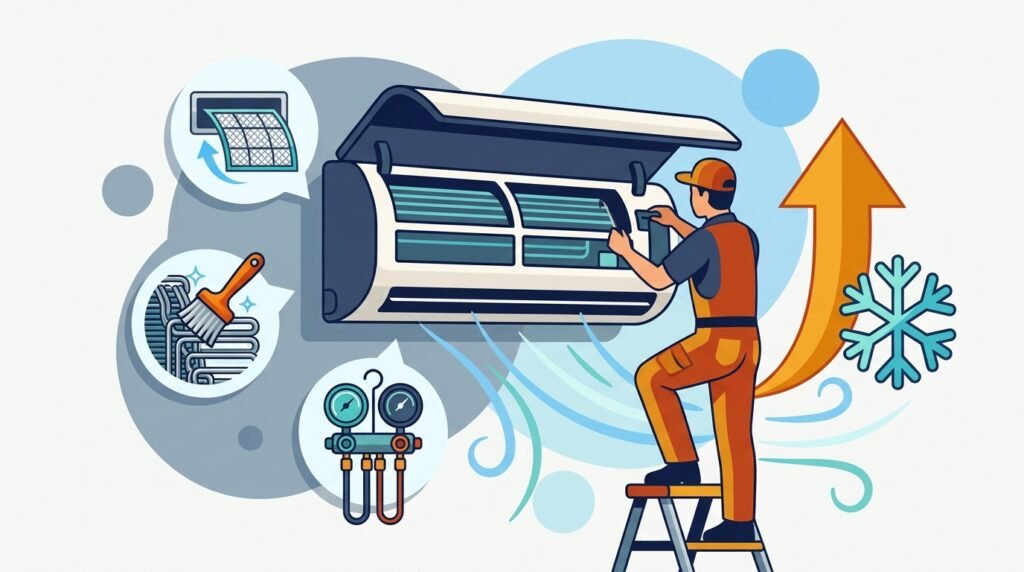
Cooling efficiency is how much cooling your air conditioner delivers for each unit of electricity it uses.
A neglected unit needs more power to deliver the same cooling, and the loss is often invisible: rooms stay cool while the compressor runs longer and the bill climbs.
The U.S. Department of Energy (DOE) notes that neglected maintenance reduces performance and increases energy use.
ENERGY STAR states that airflow problems alone can reduce system efficiency by up to 15 percent.
Efficiency vs cooling capacity
Cooling capacity is how much heat the unit can remove, measured in tons or British thermal units (BTU) per hour. A 5-ton unit and a 2 horsepower (HP) split unit differ mainly in capacity.
Cooling efficiency is how much electricity the unit uses to deliver that capacity. A unit can reach its set temperature and still waste power doing it.
Signs your AC has lost efficiency
- Run times grow longer on days with the same outdoor temperature, which points to restricted airflow or a charge problem.
- Your bill rises while weather and habits stay the same, which can mean a fouled coil or a failing component.
- Airflow at the vents feels weak, which usually means a clogged filter, dirty evaporator coil, or blower problem.
- Ice forms on the refrigerant lines or indoor coil, which signals low airflow or a charge fault.
What Types of Maintenance Does an HVAC System Need?
An HVAC system needs preventive maintenance, meaning scheduled work done before something fails, in two layers: routine care you do yourself and scheduled checks by a technician.
Waiting for a breakdown costs more and hides the slow efficiency loss described above.
The 5 types of preventive maintenance
Below are the 5 types of AC Preventive maintenance:
- Time-based maintenance renews or services an item at a fixed interval, whatever its condition. Example: replacing the air filter monthly in the cooling season.
- Failure-finding maintenance checks protective functions that only matter when something else fails. Example: testing a compressor’s overload protection.
- Condition-based maintenance acts on evidence that a failure is developing. Example: cleaning a coil when the fins are visibly clogged.
- Predictive maintenance uses sensor data to spot equipment drifting toward failure. Example: trending run-time and temperature readings on a large plant system.
- Risk-based maintenance puts effort where failure costs the most. Example: servicing units that protect a production line more often than those in a storeroom.
HVAC System Preventive Maintenance Explanation
A home system needs mainly time-based and condition-based maintenance, and a plant adds the other three as the cost of downtime rises.
| Maintenance type | HVAC example | Who does it | Best fit |
|---|---|---|---|
| Time-based | Monthly filter swap, yearly pre-season check | Owner and technician | Homes and plants |
| Condition-based | Washing a visibly clogged condenser coil | Owner or technician | Homes and plants |
| Failure-finding | Testing safety controls and overload protection | Technician | Plants and large buildings |
| Predictive | Logging current draw and temperatures over months | Facilities team | Plants and commercial sites |
| Risk-based | More frequent service on critical-area units | Facilities manager | Plants and commercial sites |
At the plant where I worked, units were serviced monthly, and each visit was recorded. When a unit developed a fault, the earlier records showed what had changed.
Which AC Maintenance Services Improve Efficiency the Most?
Filter replacement and airflow service (evaporator coil and blower cleaning) improve efficiency the most, followed by a measured refrigerant charge check.
Condenser coil cleaning and duct sealing help in specific cases. The table ranks each service by the strength of its evidence.
| Service | What it fixes | Evidence strength | Who does it | Frequency |
|---|---|---|---|---|
| Air filter replacement | Restricted airflow | Strong: DOE reports 5% to 15% lower energy use with a clean filter | Owner | Every 1 to 2 months in season |
| Evaporator coil and blower cleaning | Low airflow, the most common fault | Strong: ENERGY STAR cites up to 15% loss; a Proctor Engineering field study found airflow up 16% after fixes | Technician | Check yearly |
| Refrigerant charge check (measured) | Overcharge or undercharge | Mixed: charge errors were common in the field study; no savings figure found | Certified technician | At the yearly tune-up |
| Condenser coil cleaning | Heat rejection from a fouled coil | Mixed: a small test found an average change near zero | Owner or technician | When fins are visibly clogged |
| Duct inspection and sealing | Leaking ducts | Mixed: leakage raised cooling load about 25% in the field study | Technician | When symptoms point to it |
The ranking logic: services that restore airflow come first because they address the most common fault, and evidence strength sets the order within each tier.
Does AC service actually improve cooling?
Yes, when the service fixes a real fault. A visit that corrects low airflow or a wrong refrigerant charge improves both cooling and efficiency, while a visit that only inspects the unit changes little.
Air filter replacement
A clean filter is the cheapest efficiency gain available. The DOE states that replacing a dirty, clogged filter with a clean one can lower an air conditioner’s energy consumption by 5% to 15%.
The gain depends on how clogged the old filter was, so a filter changed on schedule saves less than one neglected for a season. Here is how to choose, clean, and change an AC air filter.
Evaporator coil and blower cleaning (airflow service)
Low airflow is the most common air conditioner fault, and fixing it is the service I would book first.
In the Proctor Engineering field study, two-thirds of units had low airflow, averaging 350 cubic feet per minute (cfm) per ton against a 400 target.
Cleaning the coil, opening registers, and adjusting drive pulleys raised airflow 16% in the ten deficient units. A technician doing this work will:
- Clean the evaporator coil, including any hidden row behind the front row.
- Clean and adjust the blower so it moves the right volume of air.
- Check that the filter, registers, and return paths are open.
My biggest improvement came from a clogged evaporator on a 5-ton floor-standing (cabinet) unit.
Cold air came out, but airflow was restricted. We disassembled the unit and removed the double-row evaporator coil, whose second row sits behind the front row.
A slime-like brown deposit of biofilm and dirt covered it. After we pressure-washed the coil and reinstalled it, cooling improved greatly.
Many HVAC technicians avoid this job because it is slow and demands care.
Refrigerant charge check
A charge check measures whether the system holds the correct amount of refrigerant, and a top-up adds refrigerant without that proof.
Adding blindly can make things worse: in the Proctor Engineering study, 8 of 15 units had an improper charge, split evenly between overcharge and undercharge, with errors averaging about 10% over and 20% under.
A sealed system should not lose refrigerant, so a unit needing a top-up leaks. Learn the signs of an AC refrigerant leak.
Condenser coil cleaning
Clean the condenser coil when the fins are visibly clogged, not by calendar. The evidence is mixed.
In a small test by Yuill and Mehrabi, washing condenser coils changed heat transfer by between +7% and -7%, averaging near zero.
A coil with about 7 grams of dirt per square foot improved about 7%, while one with about 17 grams got about 7% worse.
A separate fouling study that readers cited reported 7% to 12% lower heat transfer on fouled single-row coils.
The test was small, so treat it as a caution against washing on autopilot, not proof that cleaning is useless.
My experience supports cleaning when a coil is heavily fouled. In the hot, dusty season, rinsing the outdoor unit with water to remove dust and debris improved cooling noticeably, because the compressor no longer struggles to reject heat.
Switch the power off at the breaker first and rinse gently so you do not bend the fins.
Duct inspection and sealing
Duct sealing is a repair, not a routine tune-up item. In the Proctor Engineering study, duct leakage raised the average cooling load about 25%, and a supply leak to the outside cuts capacity by the same percentage as the leak.
Technicians eliminated almost 60% of measured leakage, and about four hours of sealing work with feedback allowed an average 65% reduction.
Ask for a duct inspection when rooms stay warm although the unit runs.
What Does an AC Tune-Up Include, and Is It Worth It?
A tune-up is worth paying for only if the technician measures things and fixes what the measurements show. A visit that ends with a visual check leaves your efficiency where it was.
A real tune-up checklist
The list below outlines the work a contractor should do in a pre-season cooling check:
- Check thermostat settings for comfort at home and savings when away.
- Tighten electrical connections and measure motor voltage and current.
- Lubricate all moving parts.
- Inspect the condensate drain.
- Check system controls and the starting cycle.
- Clean the evaporator and condenser coils.
- Check the refrigerant level and adjust it if needed.
- Clean and adjust the blower components to maintain airflow.
Tune-up vs coil cleaning vs recharge visit
| Visit type | What is done | Can improve | Cannot fix | Choose it when |
|---|---|---|---|---|
| Full tune-up | Electrical checks, coil cleaning, charge check, blower service | Airflow, charge errors, early electrical faults | Leaking ducts, an undersized unit | Once a year before cooling season |
| Coil cleaning visit | Evaporator and condenser coil cleaning | Heat transfer on fouled coils | Charge or electrical faults | The coils are visibly dirty |
| Recharge visit | Refrigerant added after testing | Cooling, if the charge was low | The leak itself | A technician has measured a low charge and found the leak |
Upsells to question
- A refrigerant top-up with no leak check is a red flag, because a low charge points to a leak that will return.
- Coil washing sold on a fixed calendar, with no look at the fins, may not change your efficiency.
- Efficiency claims with no before-and-after numbers cannot be checked.
Prices vary by region and provider, so see what an AC tune-up costs before you book.
Which Service Should You Book for Your Symptom?
Match the service to the symptom, not the other way round.
Symptom-to-service guide
If your unit is not cooling at all, start with the AC not cooling troubleshooting guide. If it cools poorly or expensively, use this table.
| Symptom | Likely cause | Service to request | DIY first step |
|---|---|---|---|
| Weak airflow at the vents | Clogged filter, dirty evaporator coil or blower fault | Airflow service | Replace the filter; check registers |
| Runs constantly but barely cools | Restricted airflow, charge fault, or fouled condenser | Measured diagnostic visit | Check the filter and outdoor unit |
| Ice on the coil or lines | Low airflow or low charge | Airflow service, then charge check | Switch off; replace the filter |
| Warm air with normal airflow | Charge fault, failed compressor or electrical fault | Measured diagnostic visit | Confirm the outdoor unit runs |
| High bills with normal cooling | Coil fouling, duct leaks or charge drift | Full tune-up with readings | Compare run time and daily kWh with last season |
| Fan runs, compressor trips, no cooling | Electrical fault at the compressor | Electrical inspection | Leave it off at the breaker |
The last row comes from a 2 HP Panasonic split unit I serviced. The compressor kept tripping on thermal overload whenever it was due to start, while the indoor fan ran with no cooling.
We first isolated the unit at the electrical breaker for safety. The air filters, the indoor control board, and the refrigerant level were all fine.
At the outdoor unit, the compressor was hot, and the cable lug connected to the capacitor was burnt at the tip.
The capacitor itself tested fine, so we fitted a new connector and rewired it. We then let the compressor cool for over two hours so the overload could reset.
What surprised me was that such a small electrical fault stopped the whole cooling cycle.
What to do first: a decision order
Work from the cheapest step to the most expensive.
- Check the air filter and replace it if it is dirty.
- Check that supply vents and return grilles are open.
- Look at the outdoor unit for clogged fins, debris, or foliage, and keep 2 feet of clearance around it.
- If cooling is still weak, book a measured diagnostic visit.
DIY or Professional AC Maintenance for Efficiency?
Do the airflow tasks yourself, and leave refrigerant and live electrical work to a certified technician. The line is safety and law, not only skill.
What you can safely do yourself
- Replace or clean the air filter on schedule.
- Keep at least 2 feet of clearance around the outdoor unit, as the DOE advises.
- Rinse the outdoor coil gently with the power off at the breaker.
What needs a licensed technician
- Refrigerant checks, recovery, and leak repair, which in the United States require EPA Section 608 certification (confirm current rules before relying on this).
- Electrical measurements and repairs at the compressor and capacitor.
- Blower and evaporator coil access for deep cleaning.
How Often Should You Service Your AC?
Check filters every month or two in cooling season, and book one professional tune-up a year before the season starts, per the DOE and ENERGY STAR.
Service interval by task
| Task | Interval | Who |
|---|---|---|
| Air filter check or replacement | Every 1 to 2 months in cooling season (DOE) | Owner |
| Evaporator coil check | Once a year (DOE) | Technician |
| Condenser coil cleaning | When the area is dusty, or foliage is nearby (DOE) | Owner or technician |
| Professional tune-up | Once a year, in spring (ENERGY STAR) | Technician |
| Basic service: filters, condenser, refrigerant level check | Every 3 months for a home; monthly for an industrial site (my field practice in hot, dusty conditions) | Technician |
The last row is my practice, not a published standard. I recommend the shorter interval in hot, dusty conditions because units work harder there, and monthly at an industrial site so a developing fault is easier to trace.
What shortens the interval
- Pets add hair and dander that clog filters faster.
- Construction dust loads filters and coils quickly.
- Heavy daily use means more run hours between services.
- Foliage or windblown debris near the outdoor unit clogs the condenser coil.
How Can You Make Your AC Cooling More Effective?
Do the free actions before you pay anyone, because most weak-cooling problems start with airflow.
Practical ways to get more cooling from your AC
- Complete the first three steps of the decision order above.
- Put filters, condenser cleaning, and a refrigerant level check on the interval schedule.
- Shorten that schedule if you have pets, dust, or constant heavy use.
- If the unit still underperforms, request the measured readings listed below.
What is the most efficient method of cooling?
The most efficient method depends on climate and system type.
In dry climates, evaporative cooling is a common low-power option, while in humid climates a well-maintained compressor-based system or heat pump is the practical choice.
Whichever you use, the maintenance steps on this page keep it close to its rated efficiency.
How to Tell Whether a Service Actually Improved Efficiency
Most maintenance advice stops at “schedule a tune-up” and never says how to check that it worked. You can verify a service by asking the technician for readings and by running your own before-and-after test.
Numbers to ask the technician for
Ask for these readings before and after the work, written on the invoice.
- Airflow. Ask for cfm per ton. The Proctor Engineering study used 400 as its target and found 350 on average in low-airflow homes.
- Refrigerant charge. Ask for a measured charge test, not a top-up. The study recommended superheat-based testing over guesswork because charge errors run in both directions.
- Temperature drop across the evaporator coil. This is return-air temperature minus supply-air temperature. Ask what range is normal for your system.
- Motor voltage and current. Include these in the contractor checklist, and a reading outside the nameplate range points to an electrical fault.
Before-and-after checks you can run yourself
You do not need instruments to test whether a service helped.
- Before the service, pick two or three days with similar outdoor temperature and record daily kWh from your smart meter or bill.
- On a hot day, note how many minutes per hour the compressor runs.
- Measure air temperature at a supply vent and at the return, with the thermostat at the same setting.
- After the service, repeat all three on days with similar weather.
- Compare the results. Lower kWh and shorter run time on similar days mean the service worked.
Weather is the main source of error, so compare days with similar outdoor temperature and humidity.
How Refrigerant Rules Affect AC Recharge in 2026
In the United States, refrigerant rules are changing how recharge decisions are made. This section applies to U.S. readers, and readers elsewhere should check local regulations.
R-410A servicing and the phase-down
The U.S. is phasing down production of hydrofluorocarbon (HFC) refrigerants, including R-410A, under the AIM Act.
According to an industry summary from OxMaint, existing R-410A systems can still be serviced, but supply is shrinking, and newer equipment uses mildly flammable A2L refrigerants such as R-454B and R-32.
Confirm current dates on the EPA’s HFC phasedown page. A recharge is a repair decision, not a routine cost.
When low refrigerant means “fix the leak”
- A sealed system should not lose refrigerant, so low refrigerant means there is a leak.
- Ask for a leak test before any top-up, because refrigerant added to a leaking system escapes again.
- Weigh repair against replacement on the unit’s age, the leak’s location, and refrigerant availability.
Book a Tune-Up That Measures Airflow and Charge
One question that stands out is this: will the technician measure airflow and refrigerant charge and write the readings on my invoice?
A tune-up that does is a diagnostic, and one that does not is a visual check. If your unit is due, request a measured tune-up.
FAQ: Cooling Efficiency and AC Maintenance
Does AC maintenance really lower my electric bill?
Yes, when the maintenance fixes a fault that was wasting power.
The DOE reports that swapping a dirty filter for a clean one can cut an air conditioner’s energy use by 5% to 15%, and ENERGY STAR says airflow problems can reduce efficiency by up to 15%.
A unit that was already clean and correctly charged will save little, so the size of the saving follows the size of the fault you fix.
Is cleaning AC coils worth it?
Cleaning is worth it when the coil is visibly clogged, and it is not worth doing on a fixed calendar when the fins are clean.
A small published test of washed condenser coils found an average heat-transfer change near zero, with individual coils ranging from +7% to -7%.
In dusty conditions, I have seen heavily fouled coils improve cooling noticeably after cleaning, so inspect the fins first and then decide.
Can I add refrigerant to my AC myself?
No. In the United States, handling and buying most refrigerants requires EPA Section 608 certification, so refrigerant work belongs to a certified technician.
Adding refrigerant without measuring the charge can also make efficiency worse: in a Proctor Engineering field study, 8 of 15 units had a wrong charge, split evenly between overcharge and undercharge.
Outside the U.S., check local licensing rules, and find leaks before any top-up.
Is an AC maintenance plan worth it?
A maintenance plan is worth it only if it lists the measurements the technician will take and schedules visits to match your conditions.
A plan that promises “a tune-up” without airflow, charge, and electrical readings gives you little to check.
Plans suit homes with pets, dust, or heavy use, and sites where faults must be traced over time.
Compare terms using the HVAC maintenance plan comparison.
[…] two. This one adds the two pieces homeowners actually get burned by: what skipping a task costs in real cooling efficiency and energy-bill terms, and what a manufacturer requires you to document to keep your warranty […]
[…] too late. Good AC maintenance is a year-round habit that provides improved cooling efficiency, and the line between what you can do yourself and what requires a licensed technician matters more […]
[…] tune-up vs. HVAC tune-up: An AC tune-up services only the cooling side of your system. An HVAC tune-up covers heating and cooling, usually the air conditioner or heat pump plus the furnace. If you have both, see AC and furnace […]