
If you are evaluating a VRF system in Port Harcourt for your office, hotel, hospital, or home, this guide answers the questions that matter most in this city: what the system costs in Naira, whether it will run reliably on generator power, and how to find a qualified installer.
Port Harcourt’s combination of extreme humidity, year-round temperatures of 30–35°C, and fewer than 12 hours of daily grid supply makes HVAC decisions here more consequential than almost anywhere else in Nigeria.
The wrong system or the wrong installation costs you for years.
What Is a VRF System?
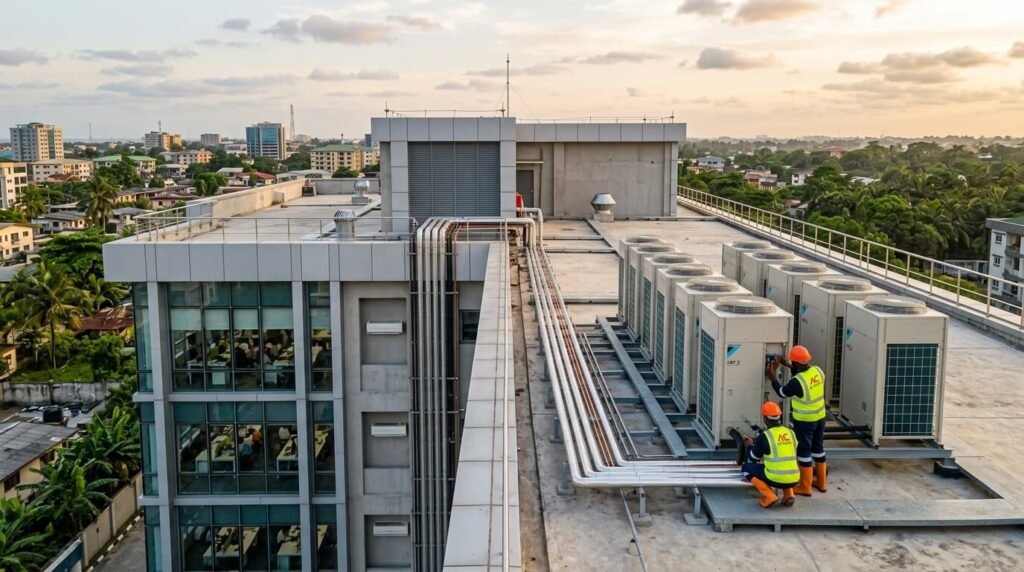
A Variable Refrigerant Flow (VRF) system is a multi-zone air-conditioning technology that connects one outdoor unit to multiple indoor units via a shared refrigerant piping network.
Unlike a conventional split AC, one compressor per room, a VRF system can serve an entire floor or building from a single outdoor unit while giving each room independent temperature control.
How VRF technology works — compressor, refrigerant flow, indoor/outdoor units
The outdoor unit houses an inverter-driven compressor that modulates speed continuously, sending precisely the refrigerant volume each indoor unit needs at any moment.
When one room hits its set temperature, the compressor reduces output to that zone rather than cycling off. Studies from the US Department of Energy show this variable operation delivers 15–42% energy savings compared to standard constant-volume systems in mid-size buildings.
Indoor units can be wall-mounted, cassette-type (ceiling), ducted, or floor-standing, often mixed across different rooms in the same system.
VRF vs VRV: what’s the actual difference?
| Feature | VRF | VRV |
|---|---|---|
| Full name | Variable Refrigerant Flow | Variable Refrigerant Volume |
| Who uses the term | All manufacturers except Daikin | Daikin only (registered trademark) |
| Technology | Identical | Identical |
| Performance difference | None | None |
VRF and VRV are the same technology. Daikin invented the system in 1982 and trademarked “VRV.” Every other manufacturer — LG, Mitsubishi, Gree, Midea — calls their version VRF. When an installer quotes you a “VRV system,” they mean VRF.
Types of VRF Systems: Which One Do You Actually Need?
For Port Harcourt buyers, the choice is simple: cooling-only VRF is the right specification for virtually every building in Rivers State.
Cooling-only VRF: the right choice for Port Harcourt’s tropical climate
- Cooling-only VRF removes heat from spaces and nothing else, the correct configuration for a city where ambient temperatures rarely fall below 22°C, even at night.
- These systems are less expensive than heat pump or heat recovery variants, use simpler two-pipe refrigerant circuits, and carry lower maintenance overhead.
- Look for units with a rated outdoor operating range that includes 43–52°C, which covers Port Harcourt’s worst-case roof-level temperatures during the dry season.
Heat pump VRF and heat recovery VRF: what they are and when they’re irrelevant
A heat pump VRF can cool and heat, but not simultaneously in different zones. A heat recovery VRF (three-pipe system) can cool some zones while heating others at the same time.
Both cost significantly more and are engineered for climates with genuine heating seasons. In Port Harcourt, specifying either type for a standard commercial or residential building adds capital cost with no practical return.
How Much Does a VRF System Cost in Nigeria?
VRF pricing in Nigeria is poorly documented publicly, which causes buyers to overpay or reject legitimate quotes as inflated.
The estimates below reflect Port Harcourt market conditions as of mid-2025 and should be verified with at least two suppliers, as forex movements affect CIF pricing significantly.
VRF system cost by building size (₦ estimates)
| Building type | Approx. capacity | Supply only (₦) | Supply + install (₦) |
|---|---|---|---|
| Large residential (duplex / 3-bed flat) | 3–6 tons | ₦4.5M – ₦9M | ₦6.5M – ₦13M |
| SME office (300–700 sqm) | 8–15 tons | ₦12M – ₦22M | ₦17M – ₦30M |
| Mid-size commercial (hotel floor, clinic) | 20–40 tons | ₦28M – ₦58M | ₦40M – ₦80M |
| Large commercial (multi-floor building) | 50+ tons | ₦70M+ | ₦100M+ |
Prices for Daikin and Mitsubishi Electric run 20–35% higher than Gree or Midea equivalents of the same capacity. Customs duty plus port clearing fees add 15–25% to imported equipment cost.
What drives up installation costs in Port Harcourt
- Customs duty and port clearing: VRF outdoor units are imported; clearing fees at Apapa or Tincan add 15–25% to CIF cost, sometimes hidden in quotes.
- Long refrigerant pipe runs: Multi-storey buildings may require 30–60 metres of insulated copper pipe per riser — a significant materials cost.
- Building finishing works: Ceiling-cassette units require false ceiling framing and plastering after installation — costs outside the HVAC quote that affect the total budget.
Payback period: how long before energy savings cover the investment?
A VRF system costs roughly 2–3× more upfront than equivalent split ACs.
In Port Harcourt, where generators run about 6+ to 12+ hours daily (depending on the area your office or business is situated) at ₦1250–₦1300 per litre (late 2026 pricing and depending on the state you reside in), energy efficiency translates directly to diesel savings.
At part-load, VRF systems consume 10–40% less electricity than split-AC banks. For a 20-ton commercial installation, this represents ₦800,000–₦2M in annual diesel savings, putting payback at 3–5 years, after which the system continues delivering savings for its remaining 12–18 year lifespan.
VRF Systems and Nigeria’s Power Problem: What You Must Know Before Buying
A VRF system can absolutely run on generator power, but only if the generator is correctly sized and the supply is stable enough for the inverter electronics. For example, see our guide on generator size for powering a 1.5HP Air conditioner.
Can a VRF system run on a diesel generator? Startup current, sizing the gen
VRF units with inverter-driven compressors draw startup current gradually rather than in a single large inrush, placing less stress on a generator at startup than a conventional compressor of the same capacity.
However, the generator must be sized for the VRF’s running load plus headroom, and must deliver stable voltage; most VRF control boards tolerate no more than ±10% voltage variation before triggering a fault shutdown.
Unstable generator voltage is the leading cause of VRF PCB (control board) failures in Nigeria.
How to size your generator correctly for a VRF system
- Find your VRF system’s rated input power — the kW figure on the outdoor unit nameplate, not the cooling capacity in tons.
- Convert to kVA by dividing kW by the power factor (0.8 for most VRF equipment): kVA = kW ÷ 0.8.
- Add 25–30% headroom to account for startup transients and shared electrical loads.
- Add all other generator loads (lighting, computers, lifts) to reach the total required generator kVA.
- Specify a generator with Automatic Voltage Regulation (AVR) — non-negotiable for VRF equipment.
- Confirm generator compatibility with the VRF manufacturer’s local distributor before purchasing.
Quick reference: a 10-ton VRF system (10–12 kW input) needs a minimum 45 kVA dedicated generator. A 20-ton system typically requires 80–90 kVA.
Voltage fluctuation and VRF: what protections you need in Nigeria
- Automatic Voltage Regulator (AVR): Install a quality AVR on the generator output or VRF supply circuit — budget ₦300,000–₦600,000 for a properly rated unit.
- Surge Protection Device (SPD): A Type 2 SPD on the distribution board guards VRF control electronics from spikes during generator start and stop cycles.
- Dedicated circuit: The VRF outdoor unit should be on its own breaker, not sharing a circuit with welding equipment or other heavy inductive loads.
- Phase monitoring relay: For three-phase VRF systems, this protects against single-phasing — a common generator fault that can destroy a compressor within minutes.
VRF System vs Split AC in Nigeria: Is It Worth the Extra Cost?
For a single room or small apartment, split ACs are almost always the right answer. For any building with five or more rooms cooled simultaneously, VRF warrants serious consideration. For a broader overview, see our guide to central air conditioning options in Nigeria.
Head-to-head: VRF vs multiple split ACs across 6 dimensions
| Dimension | VRF system | Multiple split ACs |
|---|---|---|
| Upfront cost (10-room building) | Higher — ₦17M–₦30M installed | Lower — ₦4M–₦8M installed |
| Energy consumption | 15–40% lower at part-load | Higher — compressors cycle on/off at full capacity |
| Generator load | One starting event: predictable, sustained draw | Multiple compressors cycling independently; harder to plan gen load |
| Aesthetics | One outdoor unit; clean building exterior | 10+ outdoor units on walls or roof |
| Zone control | Independent per room with central management possible | Independent per room; no central control |
| Maintenance cost | Single system; annual service | 10 systems to service; higher cumulative spend |
For a detailed breakdown by Nigerian building type, read our full comparison of VRF and split AC systems for Nigerian buildings.
VRF vs chiller: When does a chiller make more sense for a large building?
A chiller system suits buildings above approximately 200 tons of cooling load, such as large hospitals, convention centres, or high-rise towers.
Below that threshold, VRF is more cost-effective because it eliminates chilled-water pipework, pump systems, and cooling towers.
For Port Harcourt’s typical four to eight-storey commercial buildings, VRF is almost always the correct specification.
Best VRF Brands Available in Port Harcourt
Top VRF brands: EER rating, efficiency, tropical operating range, Nigeria availability
| Brand | EER (cooling) | kW/ton (lowest) | Max outdoor temp | Available in PHC |
|---|---|---|---|---|
| LG Multi V | 5.20 | 0.673 | 43°C | Yes |
| Daikin VRV IV | 4.40 | 0.756 | 49°C | Yes — Panaserv, Trans-Amadi |
| Gree GMV IV | 4.06 | 0.863 | 48°C | Yes |
| Mitsubishi City Multi | 3.64 | 0.916 | 43°C | Via Lagos order |
| Midea V4 Plus | 4.29 | 0.820 | 48°C | Yes |
Source: manufacturer’s published data. Higher EER = better efficiency. Lower kW/ton = less power consumed per ton of cooling.
Daikin VRV IV’s 49°C outdoor operating limit is a genuine advantage for Port Harcourt — outdoor units on exposed rooftops regularly reach 45°C+ in the dry season. See our guide to Daikin VRV systems available in Nigeria for model specifics.
How to verify a brand’s authorised distributor and warranty support in Nigeria
- Check the manufacturer’s website directly for their Nigeria dealer locator — Daikin Africa lists authorised dealers at daikinafrica.com; LG Nigeria lists commercial HVAC partners on their business site.
- Request the authorisation certificate before purchasing — a legitimate distributor produces this without hesitation.
- Confirm local warranty registration — grey-market importers sometimes sell genuine equipment without registering a warranty, leaving you to absorb factory defect costs.
How to Choose a VRF Installer in Port Harcourt
The installation quality matters more than the equipment brand. A poorly installed premium VRF system underperforms and fails early. For vetted contractors, see our directory of professional HVAC installation in Port Harcourt.
10 questions to ask any VRF installer before signing a contract
- Do you carry out a heat load calculation before quoting? Good: “Yes — we need your floor plans.” Red flag: “We go by number of rooms.”
- Are you certified by the VRF brand you are installing? Good: manufacturer training certificate. Red flag: “We install all brands” with no specific documentation.
- Who commissions the system after installation? Good: “Our engineer, with a commissioning report.” Red flag: “We switch it on and check it cools.”
- What refrigerant do you use, and where do you source it? Good: manufacturer-specified R410A or R32 from an authorised supplier with proof. Red flag: vague or undocumented sourcing.
- Do you provide a refrigerant charge log after installation? Good: Yes — signed record of weight charged. Red flag: unfamiliarity with this requirement.
- How do you protect the system from voltage fluctuation? Good: specifies AVR and SPD as standard. Red flag: no mention of power quality.
- Do you nitrogen pressure-test the pipe circuit before charging? Good: 40+ bar for 24 hours minimum. Red flag: “We use standard practice” without specifics.
- What is your defect liability period? Good: 12 months minimum on workmanship. Red flag: “The manufacturer’s warranty covers everything.”
- Can you provide references from two commercial VRF installations in Port Harcourt in the last 24 months? Good: immediate verifiable references. Red flag: unavailable or unverifiable.
- Who handles post-installation service, and what is your response time? Good: named engineer, 24–48 hours. Red flag: “Call the manufacturer hotline.”
The VRF Installation Process: What to Expect
Step-by-step: site survey → design → procurement → installation → commissioning
- Site survey: Installer visits, takes measurements, and identifies outdoor unit locations and refrigerant pipe routes.
- Heat load calculation: Cooling load per zone is determined using ASHRAE or equivalent methodology.
- System design: Outdoor unit capacity, indoor unit types, and pipe layout are specified and shared before procurement.
- Equipment procurement: Allow 3–6 weeks for imported units to clear port.
- Civil and electrical prep: Pipe penetrations and power cabling are prepared; false ceiling works begin if applicable.
- Refrigerant pipe installation: Copper pipes are installed, insulated, and brazed under dry nitrogen to prevent moisture contamination.
- Indoor unit installation: Units are mounted and connected to pipework, drainage, and control cabling.
- Pressure testing: The full refrigerant circuit is pressurised with dry nitrogen to 40+ bar for 24 hours minimum.
- Refrigerant charging: Manufacturer-specified refrigerant is charged to the exact weight for the pipe run length.
- Commissioning: All units are tested, sensors verified, and a commissioning log is handed over.
Timeline: How long does a VRF installation take for different building sizes?
A residential duplex (4–6 indoor units) takes 3–5 working days plus 1 day commissioning. A full office floor (10–20 units) takes 2–3 weeks, including civil prep. A multi-floor commercial building (50+ units) typically runs 6–12 weeks from survey to handover.
VRF System Maintenance in Port Harcourt: Schedule and Costs
For ongoing support, our directory covers HVAC service and maintenance in Port Harcourt in full.
Recommended maintenance schedule
| Task | Monthly | Quarterly | Annually |
|---|---|---|---|
| Clean indoor unit filters | ✓ | ||
| Check drain pans and drainage lines | ✓ | ||
| Inspect indoor fan coils | ✓ | ||
| Clean the outdoor unit coil and fins | ✓ | ||
| Verify refrigerant pressure | ✓ | ||
| Full refrigerant leak detection | ✓ | ||
| Check and tighten electrical connections | ✓ | ||
| Full system performance report | ✓ |
Common VRF faults in Nigeria and what causes them
- PCB (control board) failure: The most common VRF fault in Nigeria is caused by voltage spikes or sustained overvoltage from unregulated generators. Prevention: AVR plus SPD on the supply circuit.
- Refrigerant loss: Results from poor pipe joint brazing during installation. A system losing refrigerant in year one has a workmanship defect, not a manufacturer’s issue.
- Dirty coil and reduced capacity: Port Harcourt’s harmattan air and proximity to Trans-Amadi industrial areas accelerate outdoor coil fouling — quarterly cleaning is not optional.
- EEV (electronic expansion valve) fault: Caused by refrigerant contamination from incorrect charging or moisture introduced during installation.
Get a VRF system quote for your building in Port Harcourt. Contact a certified HVAC contractor for a free site assessment, heat load calculation, and equipment recommendation specific to your property. Use the 10 installer questions above before you sign anything or send us an email.
Frequently Asked Questions About the VRF System in Port Harcourt
Can a VRF system work on generator power in Nigeria?
Yes — VRF systems with inverter-driven compressors can run on generator power provided the generator is correctly sized (allow 25–30% headroom above the VRF’s rated kVA demand) and fitted with an AVR for stable voltage.
Is VRF better than multiple split ACs for my home?
For a home with five or more rooms cooled simultaneously, VRF delivers lower running costs, a cleaner exterior, and central control — at a significantly higher upfront cost. For three rooms or fewer, split ACs are almost always the more economical choice.
Which VRF brand is best in Nigeria?
LG Multi V has the highest published EER (5.20) and lowest power draw per ton (0.673 kW/ton). Daikin VRV IV has the widest high-ambient operating range (up to 49°C), a genuine advantage for Port Harcourt rooftop installations.
Both are strong choices depending on whether efficiency or ambient tolerance is the priority.
How many indoor units can one VRF outdoor unit handle?
Most commercial VRF outdoor units support 8 to 64 indoor units, depending on the unit’s rated capacity.
Total connected indoor unit capacity should not exceed 130% of the outdoor unit’s rated capacity, the standard design rule for diversity of simultaneous use.
How long does a VRF system last?
A well-maintained VRF system from a reputable brand has a design life of 15–20 years.
Compressor longevity depends on correct refrigerant charge, clean coils, and stable voltage supply, all within the owner’s control through proper maintenance and power protection.
What generator size do I need for a 10-ton VRF system?
A 10-ton VRF typically draws 10–12 kW input power. Dividing by a 0.8 power factor gives 12.5–15 kVA; adding 25–30% headroom brings the minimum dedicated generator requirement to approximately 40–45 kVA. Add any other loads sharing the generator before final sizing.