
R410A vs R32 refrigerant comes down to a trade-off: R32 has about one-third the global warming potential of R410A (675 versus 2,088) and usually delivers slightly better efficiency, but it is mildly flammable and cannot be added to a system built for R410A.
Since January 1, 2025, new U.S. residential systems have been built with R32 or R454B instead of R410A.
In May 2026, the EPA also removed the federal installation deadline for older R410A equipment, which makes many 2026 articles out of date.
This guide compares the two refrigerants on specifications, safety, cost, and current rules so you can decide what to buy, service, or avoid.
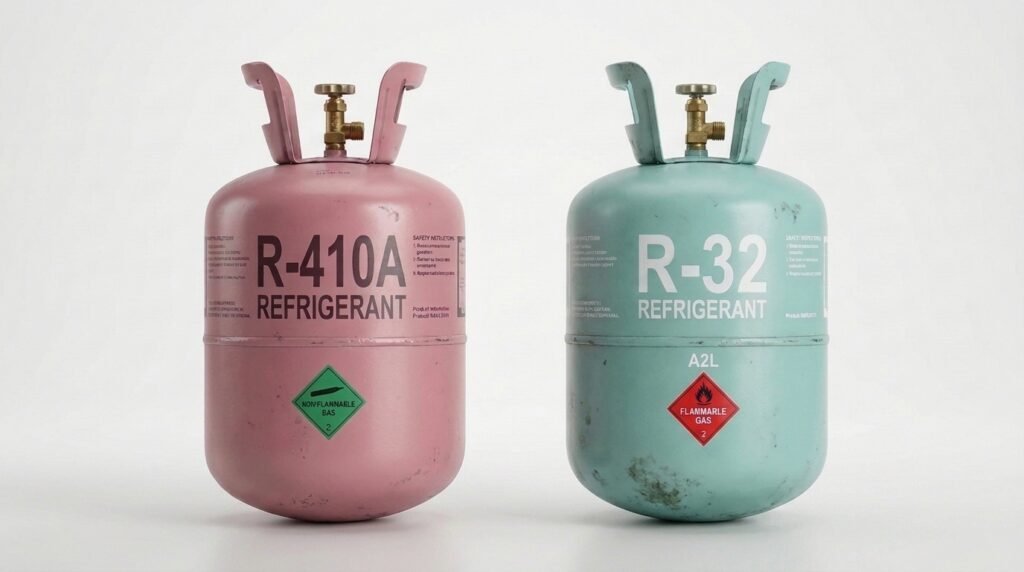
| Factor | R410A | R32 |
| Global warming potential (GWP) | 2,088 | 675 |
| Flammability | Non-flammable (A1) | Mildly flammable (A2L) |
| Efficiency | Baseline | Typically slightly higher; varies by system |
| Can one replace the other in an existing system? | No | No |
| 2026 status | Existing systems stay serviceable; pre-2025 equipment can still be installed federally | Standard for new equipment, alongside R454B |
Last verified: October 2026.
What Is the Difference Between R410A and R32?
R410A is a blend of two refrigerants, while R32 is a single refrigerant, and that composition drives nearly every other difference: operating pressure, flammability, charge size, and global warming potential.
R410A Is a Blend That Contains R32
R410A is a 50/50 blend of difluoromethane (R32) and pentafluoroethane (R125). It is a hydrofluorocarbon (HFC) and a zeotropic blend, which means its two components can separate at different rates if the system leaks.
R32 is a single-component HFC made of difluoromethane alone. Because it is not a blend, its composition cannot drift during a leak.
R32 is half of R410A, which is why the two are so often confused. The R125 in the blend suppresses flammability, so the blend is non-flammable while pure R32 is not.
R410A itself arrived as the replacement for ozone-depleting R22, and the R22 refrigerant guide covers that earlier transition.
Which Is Newer: R410A or R32?
R32 is the newer choice for residential air conditioning. R410A was introduced to replace R22 and became the dominant refrigerant in U.S. residential systems for years.
R32 is now replacing R410A, even though the R32 molecule was always one of R410A’s two components. “Newer” here describes adoption as a standalone refrigerant, not discovery of the chemical.
R410A vs R32 Refrigerant Specifications at a Glance
| Specification | R410A | R32 |
| Composition | 50% R32 + 50% R125 (zeotropic blend) | 100% R32 (single component) |
| GWP | 2,088 | 675 |
| ASHRAE safety class | A1 (non-flammable) | A2L (mildly flammable) |
| Ozone depletion potential | Zero | Zero |
| Typical charge by mass | Baseline | Roughly 20% to 30% less, per retailer comparisons |
| Charging behavior | Blend; fractionation is a concern | Single component; no fractionation |
| Compressor oil | Polyolester (POE) | Polyolester (POE) |
| Compressor discharge temperature | Baseline | Higher |
Operating Pressure, Pressure Chart and Discharge Temperature
R32 runs at slightly higher pressure than R410A at the same temperature, and its compressor discharge temperature is noticeably higher.
Exact pressure-temperature values belong to the equipment, so use the chart in the manufacturer’s service manual or on the unit itself, never a generic R410A chart.
| Parameter | R410A | R32 |
| Operating pressure | High (baseline) | Slightly higher at the same temperature |
| Pressure ratio | Baseline | Higher |
| Compressor discharge temperature | Baseline | Higher (about 20 to 30 °C in one lab study) |
| Test pressure | Per R410A specification | Per R32 manufacturer specification |
| Source of exact values | Manufacturer pressure-temperature chart, R410A column | Manufacturer pressure-temperature chart, R32 column |
- R410A test pressures should never be applied to an R32 system, because R32 requires pressures set by the manufacturer’s specification.
- Manifold gauge sets need an R32 scale and a pressure rating suitable for R32.
- The higher discharge temperature is the main reason R32 compressors are designed specifically for the refrigerant.
Is R32 Better Than R410A?
R32 is better than R410A on global warming potential and usually on efficiency, while R410A is better on flammability and on compatibility with existing equipment.
For new equipment, R32 is the stronger choice; for an existing R410A system, R410A remains the only correct refrigerant.
GWP and Environmental Impact
R32’s GWP of 675 is roughly 68% lower than R410A’s 2,088, and both have zero ozone depletion potential.
The shift matters because the American Innovation and Manufacturing (AIM) Act directs the EPA to phase down HFC production and consumption by 85% by 2036.
| Refrigerant | GWP | ASHRAE class |
| R410A | 2,088 | A1 |
| R32 | 675 | A2L |
| R454B | 466 | A2L |
Which Cools Better: R410A or R32?
R32 generally delivers slightly more cooling capacity than R410A in a system designed for it.
- R32 has a higher refrigerating effect per kilogram, so a system can move the same heat with less refrigerant.
- A Brazilian laboratory study found cooling capacity roughly 3% to 7% higher with R32.
- A vapor-injection heat pump study found capacity gains of up to about 10%.
- These gains depend on system design, and a compressor built for R410A would not capture them.
Electricity Consumption: R410A vs R32
R32 systems typically use slightly less electricity for the same cooling, but the published gains range from a few percent to about 10%, and some tests show higher compressor power.
The table below summarizes what peer-reviewed and laboratory studies measured, with their test conditions.
| Study | Test condition | Capacity and efficiency result | Trade-off observed |
| Hwang, Radermacher and Xu (2013) | Vapor-injected heat pump | R32 capacity up to about 10% higher; coefficient of performance (COP) up to about 9% higher | Not reported in the abstract |
| Federal University of Uberlândia (Brazil) | Standard cooling system | R32 capacity about 3% to 7% higher; COP about 2% to 8% higher | Compressor power 3% to 5% higher; discharge temperature about 20 to 30 °C higher |
| University of Malta | Inverter air conditioner, full and partial charge | R410A performed better at full charge | R32 slightly better at reduced charge, relevant to slow leaks |
| Literature review of R32 in air conditioners (IIR) | Review of published work | R32 has larger cooling capacity | Slightly higher energy use and discharge temperature; A2L charge limits are the main constraint |
Manufacturer and utility figures tend to be more optimistic. Daikin has stated that R32 air conditioners can lower electricity use by about 10%, and French utility EDF is cited by Thermor as seeing 6% to 7% better heat pump performance.
Those figures come from interested parties, so treat them as upper-range claims. The research supports a more careful reading: R32 gains are real but modest, and the higher discharge temperature is the cost, which is why R32 needs a system designed for it.
Refrigerant Charge Size
- R32 systems typically need a lower charge by weight, and one retailer comparison puts the reduction at about 20% to 30% against comparable R410A systems.
- The higher refrigerating effect per kilogram is the physical reason for the smaller charge.
- Pipe-run correction factors differ between the two refrigerants, so installers cannot reuse R410A charging tables.
- A smaller charge also helps R32 systems stay within the charge limits that apply to mildly flammable refrigerants.
Equipment and Refrigerant Price: R410A vs R32
R32 equipment generally costs more than older R410A equipment, and R410A refrigerant faces upward price pressure as supply shrinks under the AIM Act.
Exact per-pound and per-system prices vary by market and supplier, so get local quotes before deciding.
| Cost factor | R410A | R32 | Direction |
| New equipment price | Lower on legacy stock | Higher on new systems, according to contractor guidance | R32 and R454B systems cost more up front |
| Refrigerant price per pound | Supply declining; ACCA warns prices could rise | Newer, with demand growing | R410A pressure upward |
| Service parts availability | Strong for now | Expanding with new equipment | Converging over time |
| Lifetime outlook | Rising service costs as supply falls | More stable as the standard refrigerant | Favors R32 over a long horizon |
All rows are directional, based on industry commentary, not published price lists.
Disadvantages of R32 Refrigerant
- R32 is mildly flammable, so systems face charge-size limits and extra safety requirements that R410A systems do not.
- R32 runs a higher compressor discharge temperature, which can reduce compressor life in equipment not designed for it.
- R32 cannot be retrofitted into R410A systems, so owners of older equipment cannot switch refrigerants.
- Technicians need A2L-rated leak detectors, R32-rated gauges, and updated training, which raises the cost of service.
- New systems designed for A2L refrigerants typically cost more than the older R410A systems they replace.
Is R32 Flammable?
Yes, R32 is mildly flammable, while R410A is not. R32 is hard to ignite and burns slowly, which is why it sits in a low-hazard flammability class, but it still requires design and installation precautions that R410A does not.
What A2L Means
A2L is an ASHRAE safety classification. The “A” means lower toxicity. The “2L” means lower flammability: the refrigerant is difficult to ignite and has a burning velocity of 10 centimeters per second or less.
R32 and R454B are both A2L refrigerants, while R410A is class A1, meaning no flame propagation.
Which Is Safer: R410A or R32?
R410A is safer in terms of flammability, and R32 is safe in practice when it is installed and serviced as designed.
| Safety factor | R410A | R32 |
| ASHRAE class | A1 | A2L |
| Flammability | None | Mild; low burning velocity |
| Toxicity class | Lower toxicity (A) | Lower toxicity (A) |
| Operating pressure | High | Slightly higher |
| Handling requirements | Standard | A2L-rated tools, detectors, and training |
| Charge limits | Not flammability-limited | Limited by room size |
Safety Features Built Into R32 Systems
- Charge limits are set according to room size, so a leak cannot create a flammable concentration in the space.
- Systems include leak sensors where the design or code calls for them.
- ASHRAE Standard 15 sets safety requirements for systems using A2L and A3 refrigerants.
- Updated installation standards now cover ventilation and installation practices for mildly flammable refrigerants.
Tools and Training for Technicians
- Leak detectors must be certified for A2L refrigerants, typically heated-diode, infrared, or ultrasonic types.
- Manifold gauges must carry an R32 scale and a rating for R32 operating pressures.
- Recovery cylinders should be dedicated to each refrigerant type, with hoses purged between systems.
- Technicians should avoid spark and ignition sources when working on a system with a suspected leak.
Can You Use R32 in an R410A System?
No. Replacing R410A with R32, or filling an R410A system with R32, is not safe, even though R32 is half of R410A.
Why R32 Is Not a Drop-In Replacement for R410A
The confusion starts with composition: R410A is 50% R32, so it seems logical that pure R32 should work. It does not, because the system around the refrigerant was designed, rated, and certified for R410A’s properties.
Some HVAC technicians call R32 a drop-in replacement, but the UK trade body FETA and the refrigerant handling register Refcom have explicitly warned against the practice.
FETA stated that a system designed for non-flammable R410A has not accounted for the safety factors an A2L refrigerant requires.
Refcom added that unsafe retrofits became more common as refrigerant prices rose during the F-gas phase-down.
- The system was not designed for a flammable refrigerant, so it lacks the safety factors A2L refrigerants require.
- R32’s higher discharge temperature increases compressor wear and can shorten compressor life.
- Component pressure ratings and test pressures are specified per refrigerant, so R410A specifications do not carry over.
- Retrofitting with a flammable refrigerant may invalidate insurance coverage and the equipment warranty.
- Unapproved retrofits can expose the installer and owner to legal liability.
| Retrofit risk | Why it matters |
| Flammability | System was certified for a non-flammable refrigerant |
| Discharge temperature | Higher temperature accelerates compressor wear |
| Pressure ratings | Components, gauges, and test pressures are refrigerant-specific |
| Insurance and warranty | Cover may be invalidated |
| Contamination | Mixing forces full recovery and cleanup |
Can You Mix R32 and R410A?
No, R32 and R410A should never be mixed in the same system. A mixed charge cannot be separated on site, so the entire charge must be recovered and the system cleaned before it can run again.
Dedicated recovery cylinders for each refrigerant prevent cross-contamination during service.
Is There an R410A to R32 Conversion Kit?
No conversion kit makes an R410A system safe for R32. The sources reviewed for this guide document no manufacturer-endorsed kit, and FETA and Refcom warn against retrofitting an R410A system with R32.
If a vendor offers a kit, ask for written manufacturer approval and confirmation that the equipment is certified for A2L refrigerants before accepting any work.
What to Do Instead When an R410A System Leaks or Fails
If your R410A system is leaking or underperforming, refrigerant leak repair comes before any recharge decision, and the steps below show the order.
- Confirm the refrigerant by reading the nameplate on the outdoor unit.
- Locate and repair the leak, because adding refrigerant to a leaking system only delays the failure.
- Recharge with R410A while it is still legal and available for servicing existing equipment.
- If the system is near the end of its life or repairs are expensive, replace the whole system with a complete R32 or R454B system.
- Have the old refrigerant recovered properly instead of vented.
Is R410A Being Phased Out?
R410A is being phased out for new equipment, not for existing systems. Three separate things get blurred together: the production phase-down of HFCs, the ban on manufacturing new equipment, and the deadline for installing existing stock.
Timeline of the US Rules (AIM Act and EPA, as of October 2026)
The federal installation deadline that many still describe as in force was removed in 2026, while the manufacturing ban stands.
The EPA announced the change on May 21, 2026, published it in the Federal Register on May 26, and the rule took effect July 27, 2026.
Before that, the EPA had signaled in 2025 that it would give the January 2026 deadline low enforcement priority.
| Date | Event | Status | Common misstatement |
| Dec 27, 2020 | AIM Act enacted; HFC production and consumption phase down 85% by 2036 | In force | “R410A is banned” |
| Jan 1, 2025 | Manufacture and import of new residential and light commercial systems above 700 GWP ends | In force | “You can still buy new R410A systems” (only pre-2025 stock) |
| Jan 1, 2026 | Original federal installation deadline for pre-2025 R410A equipment | Removed federally by the EPA final rule, effective July 27, 2026 | “R410A installs became illegal on January 1, 2026” |
| Jan 1, 2026 | New York Part 494 installation deadline | Still in force in New York | “The federal change applies everywhere” |
| Ongoing | Servicing existing R410A systems | Allowed | “Your system must be replaced now” |
The federal relief applies only to residential and light commercial systems whose specified components were manufactured or imported before January 1, 2025.
Everything coming off residential production lines is still A2L.
Industry groups have also warned that the extended R410A demand could prompt tighter restrictions later. For dates beyond this table, see the R410A phase-out timeline.
State and Country Differences
- New York keeps the January 1, 2026 installation deadline under its Part 494 regulation, according to ACCA, so federal relief does not apply there.
- A group of states, including California and New York, run their own HFC programs, so contractors should check the state rules for the job location.
- The UK and EU phase R410A down under the F-gas regulation, and UK trade bodies reported refrigerant price spikes as a result.
- France has progressively restricted R410A on its market since January 1, 2025, according to heat pump maker Thermor.
Can You Still Buy, Install and Service R410A?
- Existing R410A systems are unaffected because the AIM Act does not restrict HFC use in installed equipment.
- Qualifying pre-2025 R410A equipment can be installed at the federal level until stock runs out, except in states such as New York.
- Servicing continues, and manufacturers and importers may still supply properly labeled R410A components for repairs, with limitations.
- R410A refrigerant prices may rise as supply falls under the AIM Act, according to ACCA.
The same pattern played out with R22: existing systems kept running while service costs climbed as supply shrank, which the R22 phase-out guide explains in detail.
R32 vs R454B: Which Replaces R410A?
Several new refrigerant options now replace R410A, and in the United States the two that matter for residential equipment are R32 and R454B.
Both are A2L, both are lower in GWP than R410A, and which one your new system uses depends on the manufacturer.
R410A vs R32 vs R454B Compared
| Factor | R410A | R32 | R454B |
| GWP | 2,088 | 675 | 466 |
| ASHRAE class | A1 | A2L | A2L |
| Composition | Blend | Single component | Blend |
| New U.S. equipment | Pre-2025 stock only | Current standard (for example, Daikin and Goodman) | Current standard (for example, Carrier and Trane) |
| Charging consideration | Charge as liquid | No fractionation | Charge in liquid phase to prevent fractionation |
| Retrofit into R410A system | Not applicable | No | No |
Which One Will Your New System Use?
Start by learning how to identify your AC refrigerant type, then confirm the new system’s refrigerant before signing a quote.
- Check the model number and data plate of the proposed outdoor unit for the refrigerant name.
- Ask the installer to state the refrigerant in writing on the quote.
- Confirm that the indoor and outdoor units are rated for the same refrigerant.
- Verify that local or state rules allow the equipment.
How to Choose Between an R410A and R32 System
Choose R32 or R454B for a new installation, and keep R410A only for servicing existing equipment or installing eligible pre-2025 stock.
The checklists below split the decision by who is making it.
Checklist for Homeowners
- Decide whether the unit is new construction or legacy stock, because pre-2025 R410A units remain on shelves but represent the older refrigerant.
- Compare warranty terms, since a warranty typically covers only the refrigerant the system was built for.
- Confirm the installer is trained and equipped for A2L refrigerants.
- Ask how easily the system can be serviced in your area over the next 10 to 15 years.
- Compare total cost of ownership, including electricity use and expected refrigerant service costs, not just purchase price.
Checklist for Contractors and Facility Managers
- Audit the installed base by refrigerant type and system age.
- Plan recovery capacity and cylinder inventory for a longer R410A service tail.
- Stock A2L-rated leak detectors, R32-rated gauges, and dedicated recovery cylinders.
- Update technician training for A2L handling and installation standards.
- Verify state rules, such as New York Part 494, before quoting any R410A installation.
Need Help Choosing or Replacing Your AC System?
Choosing between an R410A system and an R32 system affects safety, running costs, and how easily the equipment can be serviced for years.
Our trained and certified HVAC technician can confirm what refrigerant your current unit uses, check the rules in your area, and price a replacement; request a quote for R32 air conditioner installation.
R410A vs R32 FAQs
Can I still install an R410A system in 2026?
Yes, in most of the United States, if all the system’s components were manufactured or imported before January 1, 2025.
An EPA final rule that took effect on July 27, 2026, removed the federal installation deadline for that equipment.
New York is the notable exception, because its Part 494 regulation keeps the January 1, 2026 deadline.
The ban on manufacturing new R410A residential systems still stands, so only existing stock qualifies.
Is R32 safe to have in my home?
Yes, R32 is safe in a home when the system is designed for it and installed and serviced to current standards.
R32 is classified A2L, meaning it is mildly flammable but hard to ignite and slow to burn.
Systems designed for it include charge limits based on room size, leak detection where required, and installation rules under standards such as ASHRAE 15.
The risk comes mainly from improper retrofits and poor installation, not from a correctly installed unit.
How do I know whether my AC uses R410A or R32?
Check the data plate on the outdoor unit, which lists the refrigerant name and the factory charge. The owner’s manual and the manufacturer’s model documentation state the same information.
Units built for R32 also carry flammability warning labels, because it is an A2L refrigerant.
If the plate is unreadable or missing, ask a licensed technician to identify the refrigerant before adding anything to the system.
[…] and R32 are the two alternatives most buyers compare, and the R410A vs R32 refrigerant guide sets them side by […]
[…] have written a detailed comparison in figures for R-410A and R-32; confirm the R-454B value against the manufacturer’s data […]