
R-22 is not banned to own or use. What’s actually banned is narrower than most headlines suggest: manufacturing new R-22 equipment has been prohibited since 2010, and producing or importing virgin R-22 refrigerant has been prohibited since 2020.
If you have an existing R-22 air conditioner, you can run it, repair it, and recharge it with reclaimed refrigerant today, and there’s no federal deadline forcing you to replace it.
What has changed is the price and the supply, both of which keep tightening as reclaimed R-22 becomes the only legal source left.
This guide separates what’s actually illegal from what’s just expensive, covers current 2026 pricing, and walks through your real options: keep recharging, retrofit to a different refrigerant, or replace the system.
Is R-22 illegal to use?
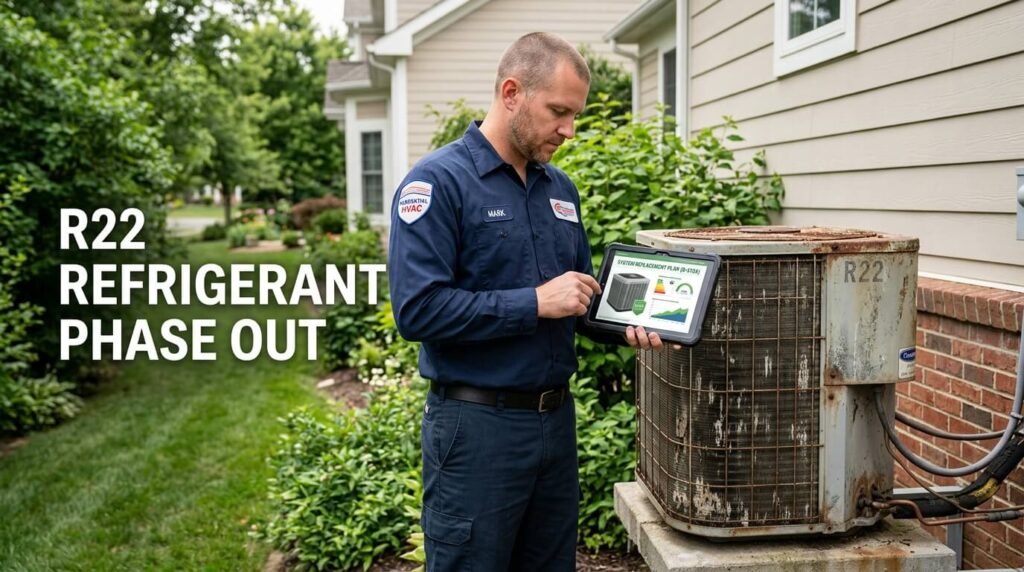
No, using an existing R-22 air conditioner is not illegal, and there’s no law requiring you to stop using one or replace it by a certain date.
The confusion comes from conflating a manufacturing and production ban with a usage ban, which are very different things under the Clean Air Act.
What Is R22 Refrigerant?
Chemical Composition and Properties
R22 refrigerant, also sold under the brand name Freon, is chlorodifluoromethane, a hydrochlorofluorocarbon (HCFC) made of hydrogen, chlorine, fluorine, and carbon.
It boils at -41°F at standard pressure, which lets it absorb and release heat efficiently as it cycles between liquid and gas inside an AC or heat pump.
The chlorine in its molecule is the problem: once released into the atmosphere, it breaks down ozone. That’s the entire reason R22 is being phased out.
How R22 Was Used in HVAC Systems
For most of the 1970s through the 2000s, R22 was the default refrigerant in residential and light commercial air conditioners and heat pumps.
It was cheap, stable, and handled a wide range of climates well, so manufacturers built entire product lines around it.
If your AC or heat pump was installed before 2010, there’s a good chance it runs on R22. Anything installed from 2010 on almost certainly doesn’t, since the EPA stopped allowing new R-22 equipment that year.
What’s actually banned vs. what’s still legal
| Legal | Illegal |
| Owning and using an existing R-22 system | Manufacturing new R-22 equipment |
| Servicing or repairing an R-22 system | Producing or importing virgin R-22 refrigerant |
| Recharging with reclaimed or recycled R-22 | Installing new R-22 equipment |
| Retrofitting a system to a different refrigerant | Knowingly venting refrigerant into the atmosphere |
| Buying R-22 in containers of 2 lbs or less | Buying more than 2 lbs without EPA Section 608 certification |
Can I still buy R-22 refrigerant?
Yes, R-22 is still available in 2026, but only from reclaimed and recycled supply, since new production and imports stopped in 2020.
Licensed HVAC technicians can purchase and use reclaimed R-22 to service existing systems, and small containers of 2 lbs or less remain available to consumers without certification, though larger purchases require EPA Section 608 certification.
Supply is finite and shrinking every year, which is the main reason prices keep climbing rather than any new legal restriction on use.
Are there no retrofit refrigerants for R22?
There are. This is one of the most common points of confusion, mostly because people assume “retrofit” means R410A, and it doesn’t.
R410A runs at much higher pressure than R22 and needs different compressors, metering devices, and line sets, so it’s a new-equipment refrigerant, not something you drop into an old system.
The actual retrofit options are HFC blends built to work in existing R22 hardware with minimal changes: R407C, R438A (MO99), R422B, R422D, and R427A.
Some, like R438A and R422B, are compatible with the mineral oil already in an R22 system, so no oil change is needed.
Others, like R407C, require switching to POE oil first. None of them perform identically to R22; capacity and pressure shift a little with each, so a technician still needs to check compatibility before charging one in.
Is R22 refrigerant flammable or not?
No. R22 is non-flammable. It’s classified by ASHRAE as an A1 refrigerant, the lowest toxicity and flammability category there is.
That’s actually one reason it stuck around in HVAC for so long; it was easy and safe to work with compared to some of the newer low-GWP refrigerants (like R32 or R454B) that carry a mild flammability rating.
R22 refrigerant pressure chart
R22 pressure varies with temperature. Here’s a reference for common points along a standard pressure-temperature chart, given in PSIG (gauge pressure):
| Temperature (°F) | R22 Pressure (PSIG) |
| 0°F | 24.0 |
| 20°F | 43.0 |
| 40°F | 68.5 |
| 60°F | 101.6 |
| 70°F | 121.4 |
| 80°F | 143.6 |
| 90°F | 168.4 |
| 100°F | 195.9 |
| 110°F | 226.4 |
| 120°F | 260.1 |
| 130°F | 297.1 |
At a typical 78-82°F outdoor condensing temperature, an R22 system usually runs around 130-160 PSIG on the high side and 60-70 PSIG on the low side, though exact numbers depend on the specific unit, load, and indoor conditions.
A technician uses this chart during charging and diagnostics, since pressure readings well outside these ranges usually point to a leak, overcharge, or a failing component.
R22 Gas Price in Nigeria
R22 gas price per Kg in Nigeria is between 8,000 and 10,000 Naira, depending on your state and retailer. If we go with 10,000, the full Gas Cylinder should be about 130,000 Naira because the Cylinder is 13kg.
R-22 phase-out timeline
The R-22 phase-out happened in stages rather than all at once, and knowing the actual dates clears up most of the confusion around what’s currently allowed.
| Year | What changed |
| 2010 | Manufacturing new R-22 equipment became illegal |
| 2015 | Production and import allowances began stepping down sharply under the phase-out schedule |
| 2020 | Production and import of virgin R-22 became fully illegal |
| 2026 (today) | Only reclaimed and recycled R-22 is legally available |
2010: new equipment manufacturing ban
Starting in 2010, manufacturers were no longer allowed to produce new air conditioning or heat pump equipment designed to use R-22.
This is why any R-22 system in a home today is generally at least 15 years old. It didn’t affect the legality of running existing systems, only the production of new ones.
2020: production and import ban
By 2020, the EPA’s phase-out schedule reached zero for R-22 production and import, meaning no new virgin R-22 has legally entered the US market since.
This is the milestone most people mean when they say R-22 was “banned,” but it applies to production and import, not to owning or servicing existing systems.
R-22 belongs to the broader HCFC category, and while R-22 itself hit zero production in 2020, the full phase-out of all remaining HCFCs under the Montreal Protocol’s US implementation is scheduled to complete by 2030, which is a separate, later deadline that doesn’t change anything about R-22 specifically since it already reached zero production a decade earlier.
R-22 refrigerant price in 2026
For a full breakdown of how refrigerant type affects total repair costs, see our full AC repair cost guide by repair type.
R-22 costs an estimated $150 to $300 per pound in 2026, a price that has climbed steadily every year since the 2020 production cutoff and shows no sign of leveling off.
Why R-22 keeps getting more expensive
The only legal source of R-22 left is reclaimed refrigerant, meaning it has to be recovered from decommissioned systems, cleaned, and recertified before it can be resold.
That supply is fixed and shrinking, while demand from the millions of R-22 systems still in service hasn’t dropped nearly as fast.
Basic supply and demand accounts for most of the price increase, and unless a large volume of reclaimed refrigerant enters the market, prices are expected to keep climbing rather than stabilize.
What a full R-22 recharge costs today
| Recharge amount | Estimated cost |
| 2 to 3 lbs (small top-up) | $300 to $900 |
| 4 to 6 lbs (moderate leak) | $600 to $1,800 |
| 8 to 12 lbs (full system recharge) | $1,200 to $3,600 |
| Full recharge including labor and detection | $750 to $4,500 |
For repair costs broken down by leak location and severity, see our refrigerant leak repair costs by leak size guide.
Beware the “R-22a” scam
Watch out for any refrigerant marketed as “R-22a” or “22a,” since it’s not an approved refrigerant and using it in a system not designed for it creates a real safety hazard.
As R-22 prices climb, some sellers have started offering this substitute as a cheap alternative, but it’s actually a blend built around propane or other flammable hydrocarbons.
Why some sellers offer suspiciously cheap recharges
Legitimate R-22 recharges are expensive because reclaimed refrigerant is scarce, so a quote that comes in dramatically below the ranges above is a signal to ask exactly what’s being used.
The EPA has issued specific consumer warnings about unapproved refrigerant blends being sold under names like “R-22a,” and has taken enforcement action against sellers, because these products are not listed under the EPA’s Significant New Alternatives Policy (SNAP) program for use in R-22 equipment.
Home AC systems are not built with the safety features needed to handle a flammable refrigerant, and using one can lead to fire or explosion risk in the compressor or refrigerant lines.
How to confirm you’re getting real, legal refrigerant
- Ask the technician to name the exact refrigerant by its full designation, not a shortened or unfamiliar brand name.
- Confirm the refrigerant is EPA SNAP-listed as approved for use in your specific system type before any recharge happens.
- Request documentation showing the refrigerant was reclaimed and recertified, since legitimate suppliers can provide this.
- Be skeptical of any recharge quote that comes in far below current market pricing, since that’s the clearest red flag for a counterfeit product.
- If you’re unsure who you’re working with, our guide on how to vet a licensed HVAC technician covers the certifications and licensing to check before any refrigerant work begins.
What’s replacing R-22?
R-22 is being replaced by a mix of retrofit refrigerants for existing systems and newer refrigerants built into new equipment, with R-410A remaining the most common full-replacement option, though it’s worth noting that R-22 and R-410A are chemically different, and R-22 is not the same substance, just often called by the same “Freon” nickname informally.
Retrofit refrigerants (R-407C, R-422D, R-438A)
- R-407C is one of the most common drop-in retrofit options, designed to work in many existing R-22 systems with modifications to the lubricant and some components.
- R-422D is another retrofit blend marketed as a closer performance match to R-22 in certain compressor types.
- R-438A, sold under the brand name Freon MO99, is designed as a retrofit option that minimizes the changes needed to existing R-22 equipment.
- None of these retrofit refrigerants perform identically to R-22, and a technician needs to evaluate your specific system before recommending one.
Full replacement with R-410A or newer refrigerants
For a detailed cost comparison of converting an R-22 system, see our R22 to R410A conversion cost breakdown.
R-410A cannot simply be added to an R-22 system, since the two refrigerants operate at different pressures and require different components, which means a true conversion to R-410A means replacing the compressor, coils, and lines rather than just switching refrigerants.
This is effectively a full system replacement rather than a retrofit, and it’s why most homeowners comparing R-22 to R-410A are really comparing “keep servicing my old system” against “install a new one.”
Should you repair, retrofit, or replace your R-22 system?
The right move depends on how much a repair or recharge currently costs relative to retrofitting or replacing, so it helps to see all three paths priced side by side rather than evaluating them one at a time.
| Path | Typical cost | Best fit |
| Continue recharging R-22 as needed | $750 to $4,500 per recharge | Newer R-22 system, minor or infrequent leaks |
| Retrofit to R-407C | $500 to $3,800 | System in good mechanical condition, wants to avoid full replacement |
| Full replacement | $3,000 to $7,500 | System 15+ years old, recurring leaks, or repair costs approaching replacement cost |
- Get a written repair or recharge quote and confirm exactly what it includes.
- Ask whether the leak is a one-time issue or a sign of broader wear, since a system with recurring leaks is a poor candidate for continued recharging.
- Get a retrofit quote for comparison if the system is otherwise in good condition, since R-407C conversion can be meaningfully cheaper than full replacement.
- Apply the 50% rule: if a repair or retrofit quote reaches 50% or more of full replacement cost, replacement is usually the better long-term value.
- Age factor: an R-22 system is already at least 15 years old, which means it’s also running well below the efficiency of new equipment regardless of refrigerant cost.
R-22 to R-407C retrofit cost
| System size | Typical retrofit cost |
| Small (2 to 2.5 ton) | $500 to $1,800 |
| Medium (3 to 3.5 ton) | $1,200 to $2,800 |
| Large (4 to 5 ton) | $2,000 to $3,800 |
When full replacement makes more sense
Retrofitting only makes sense when the rest of the system- the compressor, coils, and lines- is in good mechanical condition, since a retrofit doesn’t fix wear that’s unrelated to the refrigerant itself.
If a system is already 15 to 20 years old, has needed more than one refrigerant-related repair in the past two years, or the retrofit quote is climbing close to half of what a full replacement would cost, replacement is usually the better financial move.
A new system also comes with a fresh warranty and significantly better efficiency than a 15-year-old unit, retrofit or not. For a full breakdown of what a new system costs by size and efficiency tier, see our full AC replacement cost breakdown.
Whichever path you choose, staying ahead of future refrigerant issues is easier with regular service.
Our guide to annual HVAC maintenance plan cost covers what a maintenance plan typically includes and what it costs, and routine visits are one of the best ways to catch a small leak before it turns into an expensive recharge or a retrofit decision made under pressure.
Frequently asked questions
Is R-22 refrigerant illegal?
No, R-22 refrigerant itself is not illegal to own, use, or have serviced in an existing air conditioning system.
What’s illegal is manufacturing new R-22 equipment, which has been banned since 2010, and producing or importing virgin R-22 refrigerant, which has been banned since 2020.
Homeowners with existing R-22 systems can continue running, repairing, and recharging them legally using reclaimed refrigerant, and there’s no federal deadline requiring replacement.
What is R-22a and is it safe?
R-22a is not a safe or approved substitute for R-22, despite being marketed by some sellers as a cheap drop-in alternative.
It’s typically a flammable blend built around propane or similar hydrocarbons, and it is not listed under the EPA’s Significant New Alternatives Policy program for use in standard residential AC equipment, which is not built to handle a combustible refrigerant safely.
The EPA has issued consumer warnings and taken enforcement action related to this product, so any recharge quote using a refrigerant name you don’t recognize is worth questioning before work begins.
Is it worth repairing an R-22 air conditioner or should I replace it?
Whether to repair or replace depends on the size of the repair relative to full replacement cost and how old the system already is.
A small recharge on a system with no history of recurring leaks is usually worth repairing, but once a repair or recharge quote reaches 50% or more of what a full replacement would cost, or the system has needed more than one refrigerant-related repair in the past two years, replacement typically becomes the better financial choice, especially since R-22 systems are already at least 15 years old and run well below the efficiency of new equipment.
Can I convert my R-22 system to R-410A?
Not directly. R-22 and R-410A operate at different pressures and are not interchangeable in the same equipment, so converting to R-410A means replacing the compressor, coils, and refrigerant lines rather than simply switching refrigerants, which makes it effectively a full system replacement rather than a conversion.
If you want to keep more of your existing equipment, a retrofit to a compatible refrigerant like R-407C is a separate, less expensive option, typically costing $500 to $3,800 depending on system size, though it still requires a technician to confirm your specific system is a good candidate.
[…] How long this supply lasts depends on each country’s schedule, set out in the R22 phase-out timeline. […]