
MCA vs MOCP for AC Calculator comes down to two jobs.
MCA (minimum circuit ampacity) is the smallest wire ampacity an AC unit needs. MOCP (maximum overcurrent protection) is the largest breaker or fuse the manufacturer allows.
Size the wire to MCA, then pick a breaker at or below MOCP. Both numbers are printed on the nameplate, and the nameplate always wins over a calculation.
What Is MCA (Minimum Circuit Ampacity) on an AC Unit?
MCA (Minimum Circuit Ampacity): the smallest current rating the supply wires to an air conditioner may have. The manufacturer calculates it, prints it on the nameplate, and states it in amps.
That is the MCA electrical meaning in one line. When you ask what MCA means on an AC unit, the answer is a wire-sizing number. It is not a measure of how much power the unit draws while running.
Where to Find MCA on the Nameplate
MCA is usually printed on the outdoor unit under one of these labels:
| Label on the plate | Where you see it | Meaning |
| MCA or Min Circuit Amps | Most split systems and heat pumps | Minimum wire ampacity |
| Min Supply Circuit Ampacity | Older plates and some rooftop units | Same value |
| WSA (Wire Sizing Amps) | Some chillers and commercial equipment | Same value |
If the plate is faint, decode your AC model number and pull the exact spec sheet for the unit.
What MCA Is Not (It Is Not Running Current)
- Not running amps. MCA amps sit above normal running current because the formula adds 25% to the largest motor.
- Not the breaker size. The breaker is limited by MOCP, covered next.
- Not the compressor rating. The compressor’s RLA is one input to MCA, not the same figure.
- Not for load monitoring. Do not compare clamp-meter readings to MCA to judge a unit’s health.
Run Your Own Numbers With the Free MCA/MOCP Calculator

Enter your compressor RLA and fan FLA to check a nameplate or size a circuit in seconds. Open the MCA/MOCP calculator.
MCA and MOCP Calculator for AC Units
Enter your compressor RLA, fan FLA, and other loads to get the minimum circuit ampacity (MCA), maximum overcurrent protection (MOCP), and a suggested wire and breaker size.
Example: a compressor with an RLA of 18.5 A and a fan motor with an FLA of 0.7 A gives an MCA of 23.83 A (1.25 × 18.5 + 0.7). The MOCP starting limit is 35 A (1.75 × 18.5 + 0.7 = 33.075 A, rounded to the next standard size), and the ceiling is 40 A (2.25 × 18.5 + 0.7 = 42.325 A, rounded down). This MCA and MOCP calculator would suggest wire rated for at least 23.83 A, 10 AWG copper on 60°C terminals, and a breaker between 25 A and 35 A.
What Is MOCP (Maximum Overcurrent Protection)?
MOCP (Maximum Overcurrent Protection): the largest breaker or fuse the manufacturer permits on the circuit feeding the unit. It protects the branch circuit against short circuits and ground faults. It is a ceiling, not a target.
The manufacturer sets the MOCP electrical rating based on the compressor’s rated load current, and it is printed on the same nameplate as the MCA.
MOCP vs MOP vs “Max Fuse or Circuit Breaker”: Same Number?
Is MOCP the same as max fuse size? Yes. Manufacturers use different labels for one value, so the number you read under any of these is your breaker limit:
| Label | Where you see it | Meaning |
| MOCP | Spec sheets, calculators | Maximum overcurrent protection |
| MOP | Mitsubishi and other manufacturers | Same value |
| Max Fuse or Ckt Bkr | Nameplates on many residential units | Same value |
| Max Overcurrent Protective Device | Code language | Same value |
Fuse-Only Marking vs Breaker Allowed (HACR)
- If the plate says “maximum fuse” with no mention of a breaker, you must use a fuse. A breaker alone does not satisfy it unless a footnote allows one.
- If it says “Max Fuse or Circuit Breaker,” either device works up to that rating.
- HACR-rated breakers have been tested for HVAC and refrigeration equipment, which is why many plates specify them.
- Whatever the device, never exceed the printed number.
MCA vs MOCP: Key Differences
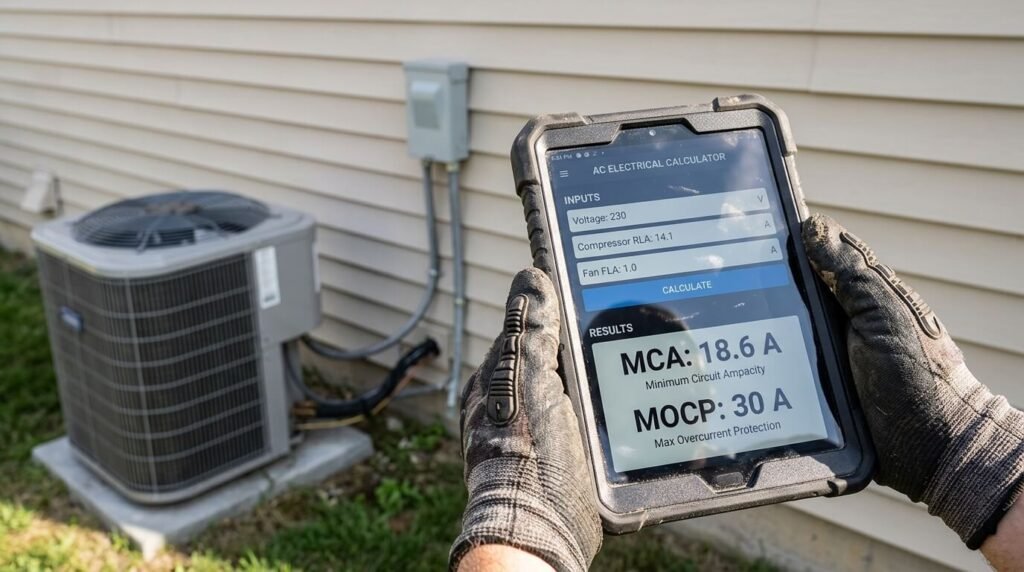
MOCP vs MCA is a question of direction. MCA is a floor for the wire. MOCP is a ceiling for the breaker.
| Features | MCA | MOCP |
| Full name | Minimum Circuit Ampacity | Maximum Overcurrent Protection |
| What it sizes | The supply wire | The breaker or fuse |
| Direction | Minimum: go at or above | Maximum: go at or below |
| Protects against | Wire overheating at full load | Short circuits and ground faults |
| Typical basis | 125% of the largest motor, plus all other loads | 175% to 225% of the largest compressor, plus all other loads |
| Who sets it | The manufacturer, printed on the plate | The manufacturer, printed on the plate |
Which One Sizes the Wire and Which Sizes the Breaker?
MCA sizes the wire, and MOCP sizes the breaker. Choose wire with an ampacity at or above MCA, then choose a breaker or fuse at or below MOCP.
Most guides stop there, but several common mistakes still happen:
| Wrong move | What it causes | Correct move |
| Sizing the wire to the breaker or MOCP | Oversized, costly wire that may not fit the unit’s terminals | Size the wire to MCA, then check the terminal temperature rating |
| Multiplying MCA by 125% again | A breaker above MOCP: a 74 A MCA becomes 92.5 A, rounds to 100 A, against a 90 A MOCP | MCA already contains the 125% factor, so use it as printed |
| Rounding the breaker up past MOCP | Fails inspection and breaks the unit’s listing | Round down to the next standard size at or below MOCP |
| Sizing by tonnage | Wrong wire for units with unusual compressors | Use the nameplate, not a tonnage rule of thumb |
Why MOCP Is Usually Larger Than MCA
A compressor draws a large surge when it starts, so the breaker needs headroom to let that surge pass without tripping.
The motor is protected against running overloads by a thermal device built into the unit, so the branch breaker only has to handle short circuits and ground faults.
That is why MOCP typically lands well above MCA. There is no fixed multiplier from MCA to MOCP, because each comes from a different formula.
FLA vs MCA vs MOCP
Three terms get mixed up, and LRA and RLA join them. Here is how they differ:
| Term | Stands for | What it describes | Role in sizing |
| RLA | Rated Load Amps | Compressor current at rated conditions | Main input to both MCA and MOCP |
| FLA | Full Load Amps | Running current of a fan or other motor | Added to MCA and MOCP at 100% |
| LRA | Locked Rotor Amps | Starting surge current | Not used in these formulas |
| MCA | Minimum Circuit Ampacity | Wire-sizing current | Sets minimum wire size |
| MOCP | Maximum Overcurrent Protection | Breaker or fuse limit | Sets maximum breaker size |
How to Calculate MCA for an AC Unit
The manufacturer has already done this math and printed the result, so you rarely calculate MCA yourself. Doing it anyway lets you check a nameplate or size a circuit when the plate is unreadable.
MCA Formula (NEC 440.33)
Only the largest motor gets the 125% factor. Everything else counts at 100%.
MCA = (1.25 × largest compressor RLA) + (FLA of all other motors) + (other loads)
Step-by-Step MCA Calculation
- Find the compressor RLA on the compressor label or the spec sheet.
- Multiply that RLA by 1.25.
- Add the FLA of each fan motor at 100%.
- Add any other loads, such as the crankcase heater and controls, at 100%.
- Round up and compare the result with the MCA printed on the nameplate. The printed value governs.
MCA With Heat Strips or Combination Loads
Electric heat strips change the math. A unit with electric heat is a combination load under NEC 440.34, and manufacturers typically count resistive heat at 125% as well.
A 20 A heater counted that way adds 25 A to the heating-side total. Do not stack heater amps on top of cooling amps by hand. Use the MCA listed on the plate of the heater kit you installed.
How to Calculate MOCP for an AC Unit
The MOCP electrical calculation uses the same inputs as MCA but applies a larger multiplier to the compressor because breakers must tolerate starting surge.
MOCP Formula (175% and 225%, NEC 440.22)
The code starts at 175% of the largest compressor’s RLA. If that breaker would trip on startup, it allows up to 225%.
MOCP (starting limit) = (1.75 × largest compressor RLA) + (FLA of all other motors) + (other loads)
MOCP (ceiling) = (2.25 × largest compressor RLA) + (FLA of all other motors) + (other loads)
Step-by-Step MOCP Calculation
- Take the largest compressor RLA.
- Multiply by 1.75, then add the other motor FLAs and other loads at 100%.
- Round to a standard breaker or fuse size. The 175% figure may round up to the next standard size.
- If that size is too small for starting, repeat with 2.25. Round down so you do not exceed the result.
- If the result is lower than MCA, raise MOCP to MCA and round up to the next standard size.
- If the result is under 15 A, use 15 A.
How Do I Calculate the MOCP From the MCA?
You cannot get MOCP from MCA with a single multiplier, because MCA hides the compressor RLA inside the sum. You can work backward if you know the other loads:
- Subtract the fan and other loads from MCA.
- Divide the remainder by 1.25 to recover the compressor RLA.
- Apply the MOCP formula above.
Example: an MCA of 23.83 A with 0.7 A of other loads gives (23.83 − 0.7) ÷ 1.25 = 18.5 A of compressor RLA. Then 1.75 × 18.5 + 0.7 = 33.1 A, which rounds to a 35 A breaker.
MCA and MOCP can end up equal. When the calculated MOCP falls below MCA, the standard sets MOCP equal to MCA and rounds up.
So the answer to “can MCA and MOCP be the same” is yes, and the FAQ below covers it.
MCA and MOCP Calculator for AC Units
See Calculator above. Enter the compressor RLA, fan FLA, and other loads, and it returns MCA, MOCP, and a suggested wire size.
Read the output as a check against the nameplate, never as a replacement for it.
Calculator Inputs: Compressor RLA, Fan FLA, Other Loads, Voltage, Phase
| Input | Where to find it | Unit |
| Compressor RLA | Compressor label or spec sheet | Amps |
| Fan motor FLA | Fan motor label or spec sheet | Amps |
| Other loads | Spec sheet: crankcase heater, controls | Amps |
| Voltage | Nameplate, for example 208/230 V | Volts |
| Phase | Nameplate: single-phase or three-phase | 1 or 3 |
Worked Example: 18.5 A Compressor and 0.7 A Fan
- Inputs: compressor RLA 18.5 A, fan FLA 0.7 A, no other loads.
- MCA: 1.25 × 18.5 = 23.125, plus 0.7 = 23.825, so MCA is 23.83 A.
- MOCP at 175%: 1.75 × 18.5 = 32.375, plus 0.7 = 33.075, which rounds to 35 A.
- MOCP ceiling at 225%: 2.25 × 18.5 = 41.625, plus 0.7 = 42.325, which rounds down to 40 A at most.
- Result: wire rated at least 23.83 A, and a breaker between 25 A and 35 A. If the plate lists a different MOCP, the plate wins.
MCA to FLA Calculator: Working Backward From the Nameplate
To get the compressor’s running current from MCA, reverse the formula:
Compressor RLA = (MCA − other loads) ÷ 1.25
| Nameplate MCA | Other loads | Compressor RLA |
| 20.0 A | 0.9 A | 15.28 A |
| 23.83 A | 0.7 A | 18.50 A |
| 30.0 A | 1.2 A | 23.04 A |
This works only when the compressor is the largest motor and the plate follows the standard formula. Inverter units can print values that do not reconcile, covered under edge cases below.
What Size Wire and Breaker Do You Need From MCA and MOCP?
Two steps decide the circuit: pick wire from MCA, then pick a breaker between MCA and MOCP.
Wire Size From MCA
The right wire size for air conditioners depends on MCA and on the temperature rating of the unit’s terminals. This table uses copper conductors from NEC Table 310.16:
| Copper wire | Largest MCA it can serve, 60°C terminals | Largest MCA it can serve, 75°C terminals |
| 14 AWG | 15 A | 20 A |
| 12 AWG | 20 A | 25 A |
| 10 AWG | 30 A | 35 A |
| 8 AWG | 40 A | 50 A |
| 6 AWG | 55 A | 65 A |
A nameplate MCA of 24.5 A on 60°C terminals needs 10 AWG. Long runs and hot locations may need larger wire, so confirm with a licensed electrician.
Breaker Size Between MCA and MOCP
- Read the MOCP on the plate. This is your ceiling.
- Check whether the plate says fuse only or fuse or breaker.
- List the standard sizes at or below MOCP: 15, 20, 25, 30, 35, 40, 45, 50, 60 A and so on.
- Choose a size at or above MCA and at or below MOCP. With an MCA of 23.83 A and an MOCP of 35 A, that means 25, 30, or 35 A.
- If the plate lists a recommended breaker, use that size.
The air conditioner breaker size chart lists the common sizes by MCA so you can check your pick quickly.
Typical MCA, MOCP, and Wire by AC Tonnage
Tonnage is a rough guide only. Never size a circuit from it in place of the nameplate. These are example values:
| Unit | Example MCA | Example MOCP | Copper wire |
| Mini split, 1 ton | 12.0 A | 15 A | 14 AWG |
| Mini split, 1.5 ton | 14.5 A | 20 A | 12 AWG |
| Mini split, 2 ton | 17.0 A | 25 A | 10 AWG |
| Central AC, 2 to 3 ton | Varies by model | 30 to 35 A typical | 10 AWG typical |
| Central AC, 4 to 5 ton | Varies by model | Varies by model | 8 AWG may be needed |
Efficiency also shifts the numbers.
Higher-efficiency units often use inverter compressors with different electrical profiles, so check the SEER rating for air conditioners alongside the plate when comparing models.
When MCA and MOCP Look Wrong: Edge Cases
Some nameplates break the simple rules. These are the cases that cause the most confusion.
MCA Higher Than the Recommended Breaker on Mini Splits
Newer inverter-driven and ECM-fan units are certified to different test methods, and their plates can show an MCA above the recommended breaker size.
This is simply a recommendation, not a code requirement. For example, a 3-ton mini-split lists 19.8 A MCA with a 20 A MOCP, while the standard formula on its listed loads gives about 24 A.
Follow the plate, and make sure the breaker’s lugs accept the wire sized to MCA.
The refrigerant does not change the electrical rule, so when comparing R410A vs R32 refrigerant models, read each unit’s own plate.
Can the Breaker Be Smaller or Larger Than MOCP?
- Smaller: allowed, because MOCP is a maximum. The breaker still has to carry the unit’s load, so it normally stays at or above MCA, unless the plate lists a smaller recommended size.
- Larger: never. Going above MOCP breaks the equipment listing and fails inspection.
- Different type: if the plate says fuse only, a breaker does not satisfy it.
What to Do If the Nameplate Is Missing
- Look up the model number in the installation manual or spec sheet. The listed value governs.
- If none exists, read the compressor and fan motor labels for RLA and FLA.
- Calculate MCA and MOCP with the formulas above.
- Have a licensed electrician verify the result before wiring the unit.
MCA vs MOCP FAQ
Is the breaker sized to MCA or MOCP?
Neither alone. The wire is sized to MCA. The breaker must be at or below MOCP and normally at or above MCA. For an MCA of 23.83 A and an MOCP of 35 A, a 25, 30, or 35 A breaker fits.
Can MCA be higher than MOCP?
On a standard plate, no. If the calculated MOCP comes out below MCA, the method raises MOCP to MCA.
A few units, such as certain chilled-water air conditioners, print an MCA above MOP, and some inverter units list a recommended breaker below MCA. Follow the plate.
Can the MCA and MOCP be the same?
Yes. When the calculated MOCP falls below MCA, the method sets MOCP equal to MCA and rounds up to a standard size. You will often see values like 19 A MCA and 20 A MOCP on small inverter units.
Can I use a bigger breaker than the MOCP?
No. MOCP is a hard ceiling set by the manufacturer. A larger breaker voids the unit’s listing and fails inspection, even if the wire could carry more.
What wire size does an MCA of 20, 25, or 30 amps need?
For copper wire: 20 A needs 12 AWG, 25 A needs 12 AWG on 75°C terminals (10 AWG on 60°C terminals), and 30 A needs 10 AWG. Long runs may need larger wire, so confirm with a licensed electrician.
Does MCA already include the 125% factor?
Yes. MCA is 125% of the largest motor plus the other loads. Do not multiply it by 125% again, or you will pick a breaker above MOCP.
Is MOP the same as MOCP?
Yes. MOP, MOCP, and “Max Fuse or Circuit Breaker” all name the same limit on the plate. Some manufacturers prefer one label over another.
Can I calculate MCA myself instead of using the nameplate?
You can, with 1.25 × the largest compressor RLA plus the other loads. Use it only when the plate is missing. When the manufacturer’s value exists, it governs under NEC 110.3(B).
Do mini splits and heat pumps use the same MCA and MOCP rules?
Yes. NEC Article 440 covers them all, and the plate carries the values. Inverter models are more likely to list a recommended breaker lower than MCA, so read the plate rather than assuming.
Does the nameplate require a fuse instead of a breaker?
Read the wording. “Max Fuse” alone means a fuse. “Max Fuse or Circuit Breaker” allows either, up to the printed rating. Many plates specify HACR-rated breakers for HVAC equipment.
[…] correctly, and they’re worth understanding on their own before touching a calculator or an MCA and MOCP calculator: minimum circuit ampacity and maximum overcurrent […]