
The right wire size for an AC unit comes from the minimum circuit ampacity (MCA) printed on its nameplate, not from its tonnage.
A wire size chart for AC units gets you close: most residential central units land between 14 and 8 AWG copper, or about 2.5 to 10 mm².
The nameplate settles the exact gauge, and the run length from your panel can push it up one more size.
This guide gives you the charts in AWG and mm², a four-step method to calculate your own, and the code rules that explain why a 30-amp breaker can sit on a 12 AWG wire.
What Size Wire Should I Use for My AC Unit?

Use the wire size that matches the MCA on your AC unit’s nameplate.
For most residential central units, that is 14 to 8 AWG copper, about 2 to 8 mm² in cross-section. Tonnage gives a rough guess, but two units of the same tonnage can need different wire, so the label wins.
Two nameplate numbers drive every decision on what you will read here.
Minimum circuit ampacity (MCA): the smallest current rating the supply wire must carry for that unit. Manufacturers build the 125 percent factor for the largest motor into this number, so you do not add it again.
Maximum overcurrent protection (MOP): the largest breaker or fuse the manufacturer allows. It leaves room for the compressor’s startup surge, while the unit’s built-in overloads guard the running load.
Wire follows the MCA and the breaker follows the MOP, which is why a 12 AWG wire can sit on a 30-amp breaker when the nameplate allows it.
Some labels say MOCP instead of MOP, and they mean the same thing. The MCA vs MOCP calculator for AC units runs both lookups from your nameplate.
Here is one tonnage with two nameplates. A 3-ton unit can list an MCA of 19A or 25A depending on its efficiency, according to the Voltflow wire guide for central air conditioners.
| 3-ton unit | MCA | Smallest copper wire, 60°C column |
| Lower-draw model | 19A | 12 AWG (20A rating) |
| Higher-draw model | 25A | 10 AWG (30A rating) |
Efficiency is what separates those two nameplates, and the SEER rating for air conditioning systems explains how.
Some published charts disagree mostly because they start from tonnage instead of the MCA.
| Unit | Wire shown | What sits behind it |
| 2-ton | 14 gauge | Tonnage chart, no MCA range |
| 2-ton | 12 to 10 AWG | MCA range of 13 to 17A |
| 5-ton | 14 gauge (2.5 mm²) | 480V three-phase table, about 15A maximum current |
Air Conditioner Wire Size Chart
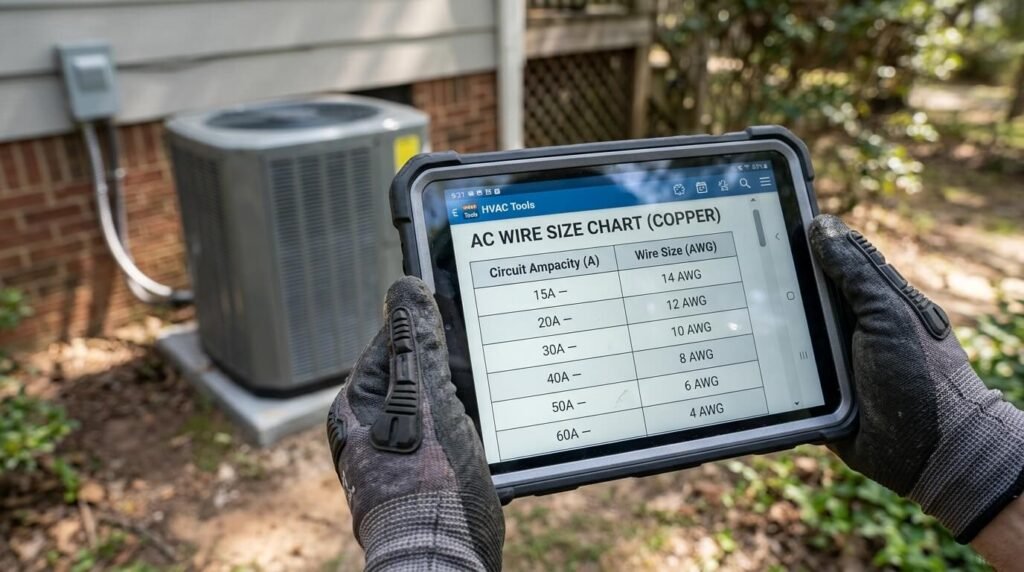
The chart below lists the usual copper wire for single-phase 240V central AC units from 1.5 to 5 tons.
The wire column is worked out from the NEC ampacity table in the 60°C column.
Use it to plan, then let the nameplate overrule it.
| Tonnage | Typical MCA | Smallest copper wire (60°C column) |
| 1.5 | 10 to 14A | 14 AWG |
| 2 | 13 to 17A | 14 to 12 AWG |
| 2.5 | 15 to 19A | 14 to 12 AWG |
| 3 | 17 to 22A | 12 to 10 AWG |
| 3.5 | 20 to 25A | 12 to 10 AWG |
| 4 | 22 to 28A | 10 AWG |
| 5 | 28 to 35A | 10 to 8 AWG |
Once you have the wire, match the breaker with the AC unit’s breaker size chart.
The lookup table behind that chart is NEC Table 310.16 for copper wire. Every wire carries two ratings, one for 60°C terminals and one for 75°C terminals.
| Wire (copper) | 60°C ampacity | 75°C ampacity |
| 14 AWG | 15A | 20A |
| 12 AWG | 20A | 25A |
| 10 AWG | 30A | 35A |
| 8 AWG | 40A | 50A |
| 6 AWG | 55A | 65A |
The lowest-rated part in your circuit decides which column you use, and the choice matters most near the edges.
An MCA of 33A needs 8 AWG in the 60°C column (40A) but only 10 AWG in the 75°C column (35A). The 8 AWG choice is the safer default.
Glacvent recommends the 60°C column for most residential work unless every termination is rated 75°C, and most certified electricians note that inexpensive pull-out disconnects can cap a circuit at 60°C no matter which wire you pull.
Read the temperature rating on the breaker, the disconnect, and the unit’s terminal block. If all three show 75°C, the 75°C column is open to you. If any one shows 60°C or no rating, use the 60°C column.
Three-phase units at 208, 230, or 480V draw less current per ton, so their charts show smaller wire.
Wire Size Chart for AC Units in mm
To read a wire size chart for AC units in mm, convert the AWG size to its cross-section, round up to the next standard metric size, then confirm the current rating in your local code table.
| AWG | Cross-section | Closest standard metric size at or above |
| 14 AWG | 2.08 mm² | 2.5 mm² |
| 12 AWG | 3.31 mm² | 4 mm² |
| 10 AWG | 5.26 mm² | 6 mm² |
| 8 AWG | 8.37 mm² | 10 mm² |
| 6 AWG | 13.3 mm² | 16 mm² |
If you are wiring in the Philippines or another metric country, size the cable from your local electrical code’s ampacity table and confirm the unit’s voltage on the nameplate.
Those tables rate each cable size by installation method, which the AWG numbers above cannot show. Do not use US ampacities on mm² sizes.
3 Ton AC Wire Size in mm
A 3-ton AC unit needs 4 mm² copper for an MCA up to about 20A and 6 mm² above that, as a starting point from AWG matching. Confirm the final size against your local code.
| MCA | AWG match | Metric size |
| 17 to 20A | 12 AWG | 4 mm² |
| 21 to 25A | 10 AWG | 6 mm² |
4 Ton AC Wire Size in mm
A 4-ton AC unit needs 6 mm² copper for most nameplates, since its MCA runs about 22 to 28A, and a long run can push it to 10 mm². Confirm the size against your local code.
| MCA | Condition | AWG match | Metric size |
| 22 to 28A | Run under about 95 ft | 10 AWG | 6 mm² |
| 28 to 30A | Run over about 95 ft | 8 AWG | 10 mm² |
4 mm wire for AC
4 mm² wire suits an AC unit with an MCA up to about 20A on a short run. It sits above 12 AWG (3.31 mm²) and below 10 AWG (5.26 mm²), so units near 25A should move up to 6 mm².
Three limits decide the final answer:
- The unit’s MCA must stay below the cable’s rating in your local ampacity table.
- The run from the panel to the unit must keep voltage drop near 3 percent or less.
- The installation method, such as surface-mounted or buried in conduit, changes the cable’s allowed current in most local tables.
Can an AC Run on 2.5mm Wire?
Yes, but only a small unit on a short run. A 2.5 mm² cable sits just above 14 AWG (2.08 mm²), so it matches units with an MCA of about 15A or less, such as many 1.5-ton models.
| MCA | Run length | Verdict |
| Up to 15A | Under about 75 ft | Fits by AWG match |
| 16 to 20A | Any | Too small by AWG match, use 4 mm² |
| Up to 15A | Over about 75 ft | Voltage drop passes 3 percent, use 4 mm² |
Fill in the final ratings from your local code table before you rely on this row.
How Many AC Can Run on 10mm Wire?
Two 3-ton units, not three. A 10 mm² cable sits near 8 AWG (8.37 mm²), which carries 50A in the 75°C column, so two units with MCAs of 22A and 25A (47A combined) land close to its limit.
Run the same check on your own units:
- Find the cable’s ampacity in your local code table for your installation method.
- Add the MCA from every unit on the cable. This gives a safe upper bound, and the code’s rule for several motor loads on one circuit may allow a slightly lower total.
- Compare the total with the cable’s ampacity, and stay at or below it.
- Check voltage drop over the full run.
- Confirm the breaker rating against each unit’s MOP and the cable’s rating.
Treat the two-unit example as an illustration and confirm it with your local code.
Air Conditioner Wire Size Calculator
Air Conditioner Wire Size Calculator
Enter the MCA from your AC nameplate and the one-way run from the panel to get a copper wire size in AWG and mm², checked for voltage drop.
Example: a unit with an MCA of 18.7 A on a 240 V single-phase circuit, using the 60°C column, needs 12 AWG copper (20 A rating) for a run up to about 97 feet. At 120 feet, the voltage drop on 12 AWG reaches 3.7%, so this air conditioner wire size calculator moves up to 10 AWG, about 6 mm² in metric terms, which holds the drop to 2.3%.
To calculate AC wire size, read the MCA from the nameplate (here is how to find your AC unit’s model number when the label is hard to read), match it to the ampacity table, then check voltage drop over your run. Four steps cover it:
- Read the MCA and MOP from the nameplate.
- Pick the temperature column from the lowest-rated part in the circuit.
- Choose the smallest wire whose ampacity is at or above the MCA.
- Check run length for voltage drop, and move up one wire size if the run is too long.
Voltage drop in volts equals 2 × one-way length in feet × MCA × wire resistance in ohms per 1000 ft, divided by 1000.
Most designers keep that drop at or under 3 percent of 240V, which is 7.2 volts.
That is a design guideline, not a code requirement for this circuit.
| Nameplate | Wire from the 60°C column | Final choice |
| MCA 17.8A, MOP 30A | 12 AWG (20A) | 12 AWG, with a 30A breaker allowed |
| MCA 18.7A, MOP 30A | 12 AWG (20A) | 12 AWG up to about 97 ft, 10 AWG beyond |
| MCA 33.9A, 135 ft run | 8 AWG (40A) | 8 AWG sits right at the 3 percent limit, so 6 AWG gives margin |
The run-length table below turns that voltage drop math into a lookup. It shows the longest one-way run for each copper wire size on a 240V single-phase circuit at 3 percent drop.
| Load (MCA) | 12 AWG | 10 AWG | 8 AWG | 6 AWG |
| 15A | 121 ft | 193 ft | 308 ft | 488 ft |
| 20A | 90 ft | 145 ft | 231 ft | 366 ft |
| 25A | 72 ft | 116 ft | 185 ft | 293 ft |
| 30A | 60 ft | 96 ft | 154 ft | 244 ft |
| 35A | 51 ft | 82 ft | 132 ft | 209 ft |
Find your MCA row, then move right until the length is longer than your run. That column is your minimum wire.
The 33.9A example shows how tight this gets: a thread on the Mike Holt forum puts a 5-ton unit at that MCA on 8 AWG up to about 135 ft and 6 AWG beyond, which matches the math here.
Move up one wire size when any of these is true:
- The run is longer than about 50 ft, because the chart’s minimum wire starts to exceed the 3 percent guideline.
- The cable crosses a hot attic, because high ambient temperature lowers a wire’s allowed current.
- Several conductors share one conduit, because the code reduces each wire’s rating when they bundle.
- The MCA sits within a few amps of the wire’s rating, because there is no room for error.
- You may add a larger unit later because a heavier gauge now costs less than pulling wire again.
One code change is worth knowing. The 2026 NEC added section 440.15, which requires marking the exterior disconnect of a split-system HVAC with the location of the indoor unit it serves in buildings other than one- and two-family dwellings.
We recommend you also read changes to 440.2, 440.4(A), and 440.14. Read the code text before applying any of them, and ask your local inspector which edition your area has adopted.
10/2 or 10/3 Wire for Air Conditioner
Use 10/2 wire for most central AC condensers. A 10/2 cable carries two hot conductors plus a ground, which is all a 240V condenser needs.
| Cable | Conductors | When it applies | Neutral |
| 10/2 | 2 hot + ground | Standard 240V condenser | No |
| 10/3 | 2 hot + neutral + ground | A 120V part shares the circuit, such as an air handler blower | Yes |
| THHN in conduit | Individual wires | Larger units, exposed runs, or 8 AWG and up | As needed |
Please also note that if the AC and its furnace or air handler share a circuit, the combined load sets the wire size.
NM-B cable (Romex) is rated in the 60°C column, so 10/2 NM-B carries 30A. Units above that move to 8 AWG and THHN wire in conduit, as the chart shows for 4-ton and larger systems.
Air Conditioner Wiring Diagram
An AC wiring diagram shows one power path and one control path. The power path runs from a double-pole breaker in the panel to an outdoor disconnect, then to the condenser’s line terminals, and the thermostat’s low-voltage wiring stays separate from it.
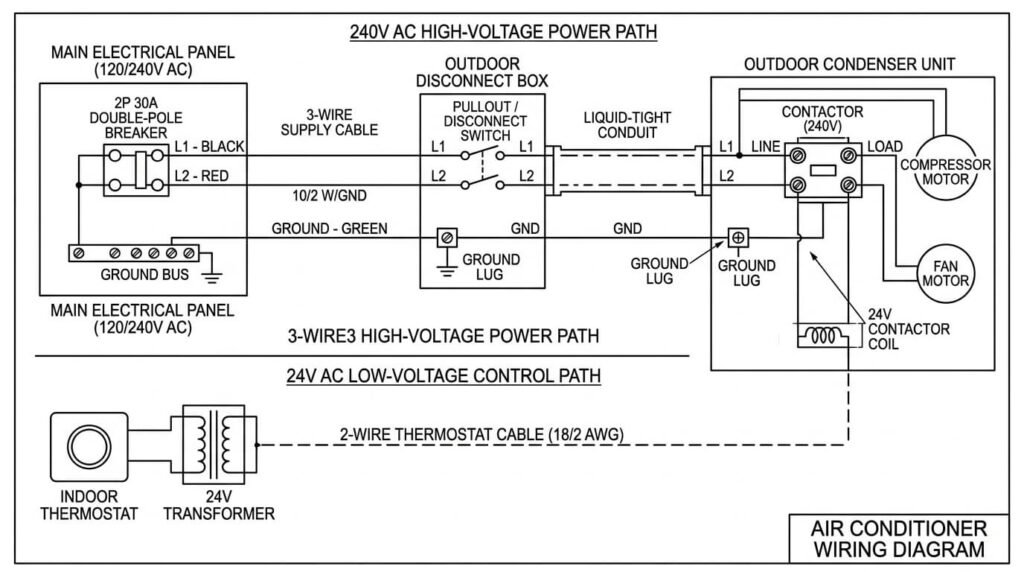
Connection order:
- Install a double-pole breaker in the panel, sized at or below the unit’s MOP.
- Run the supply cable from the breaker to the outdoor disconnect.
- Run wire from the disconnect to the condenser’s line terminals, connecting the two hot conductors.
- Connect the ground wire to the unit’s ground lug.
- Run the low-voltage thermostat wire on its own path, away from the 240V conductors.
AC Wire Connection Colour
In the US, an AC supply uses black and red for the two hot wires, green or bare for ground, and white for neutral when a neutral is used.
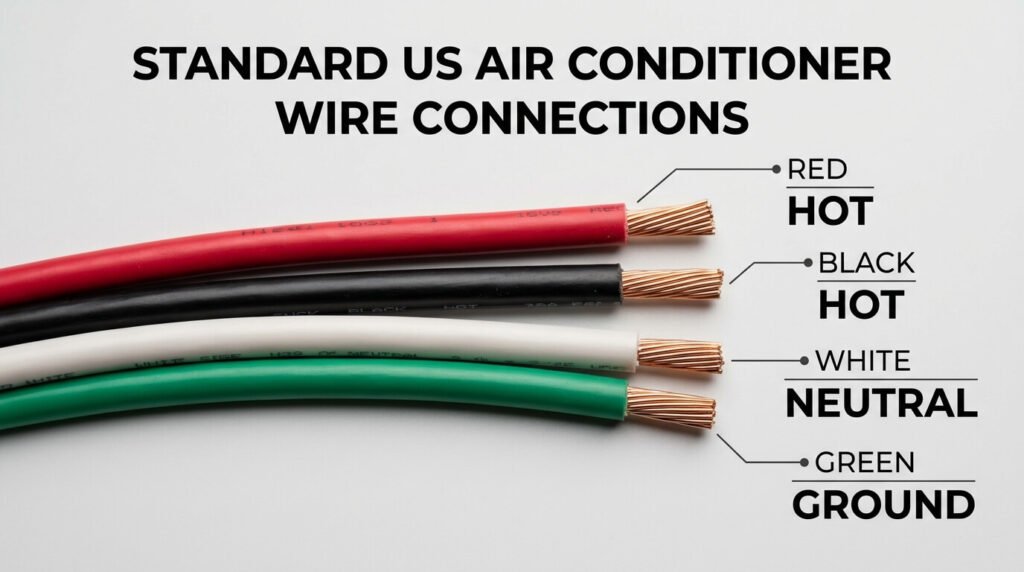
Colors follow your country’s code, so confirm them before you wire anything.
| Conductor role | US color | IEC-style color (single-phase) | Note |
| Hot, line 1 | Black | Brown | Connects to a breaker pole |
| Hot, line 2 | Red | Brown or black | In a /2 cable, the white wire is used as a hot and should be re-marked |
| Neutral | White | Blue | Only in a /3 cable or a 120V circuit |
| Ground | Green or bare | Green and yellow | Connects to the unit’s ground lug |
A white wire carrying a hot in a /2 cable should be re-marked with tape at both ends. That tells the next person the wire is live.
With the MCA, wire gauge, and run length written down, you have what an electrician needs to confirm your circuit or quote the job.
Check the AC nameplate checklist to collect the MCA, MOP, voltage, and run length in one place before you compare installer quotes or order wire.
Frequently Asked Questions
Can I use 12-gauge wire with a 30-amp AC breaker?
Yes, when the nameplate shows an MCA of 20A or less and a MOP of 30A or more.
Article 440 lets the breaker rise to the manufacturer’s MOP because the breaker only protects against short circuits and ground faults, while the unit’s built-in overloads protect the running load.
In ordinary household circuits, a 12 AWG wire stops at 20A, so this rule applies only to AC equipment and only up to the marked MOP.
Can I put a bigger AC on my existing wire?
Yes, if the new unit’s MCA is at or below your wire’s rating and the run still passes the voltage drop check.
Read the new nameplate before you buy, since two units of the same tonnage can list 19A and 25A.
On 12 AWG wire, anything above 20A MCA means pulling new wire.
A replacement is also the moment to compare refrigerants, which the R410A vs R32 refrigerant guide covers.
What happens if the AC wire is too small?
The wire runs hot under load, and the heat ages the insulation over months or years.
When I was serving as an electrical technician for AB InBev, I noticed that a small, undersized AC wire (used for a 2HP Panasonic AC) resulted in overworking and overheating of the compressor, and this can further lead to damage to the AC unit and arc faults.
Too much voltage drop on a long run also starves the compressor of voltage, which makes starting harder and adds wear.
The fix we carried out on the 2HP Panasonic AC was to size the wire from the nameplate MCA and check the run length before the work started on the AC unit.
[…] the final wire size against a wire size chart for AC units before pulling conductor, since conductor ampacity tables vary by insulation […]