
An inverter air conditioner saves electricity by running its compressor at a variable speed instead of switching it fully on and off, and in most homes that cuts the cooling bill by 25 to 45 percent compared with a fixed-speed unit of the same size.
That’s the part every buying guide covers. What gets left out is what happens after year three: repairs on an inverter unit can cost as much as buying a whole new non-inverter AC, and the payback math falls apart if your power supply isn’t stable.
This guide covers how inverter technology works, what it saves month to month, when the extra cost pays for itself, and the repair and voltage risks that actually decide whether it’s the right buy for your home.
What Is an Inverter Air Conditioner?
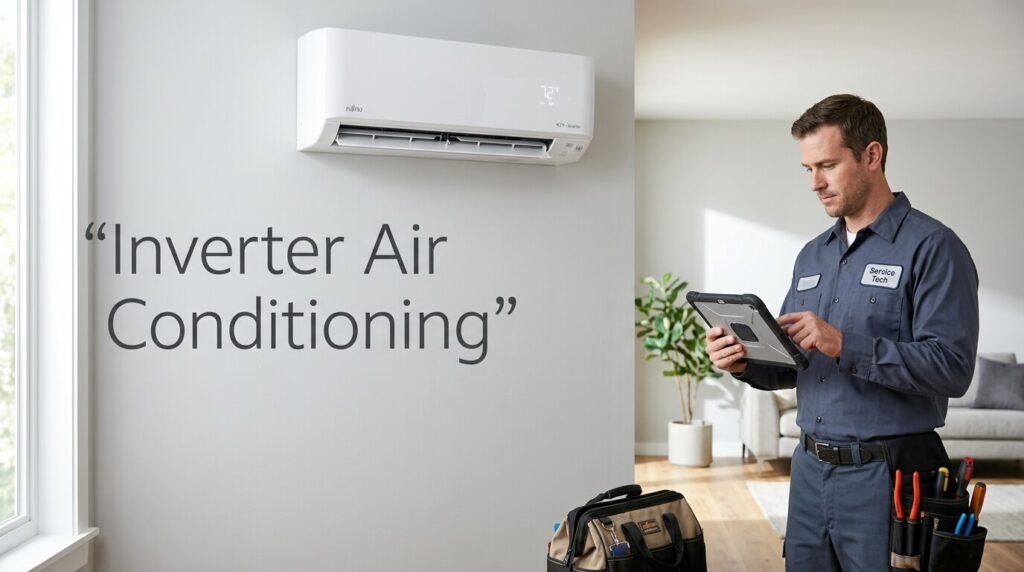
An inverter air conditioner is a cooling unit whose compressor speed is controlled by an inverter circuit, letting it speed up or slow down based on how much cooling the room needs right now instead of switching fully on or fully off.
The name refers to that circuit. It has nothing to do with airflow direction, despite what the word suggests to a lot of first-time buyers.
A non-inverter (fixed-speed) air conditioner works differently. Its compressor runs at full power until the room hits the target temperature, then cuts off entirely.
When the room warms up again, it restarts at full power. An inverter compressor instead throttles down as the room nears the setpoint and holds a lower, steady output rather than stopping.
How the Variable-Speed Compressor Works
The inverter sits between the AC’s power supply and the compressor motor. It converts incoming AC power to DC, then back to AC at whatever frequency the compressor needs at that moment.
A motor spinning slower draws less current, so as the room cools and demand drops, so does the electricity draw.
On a hot afternoon, the compressor might run close to full speed to bring the temperature down quickly, then settle to a fraction of that once the room is near the setpoint, similar to how a car uses more fuel accelerating than cruising.
Because the compressor isn’t restarting from zero every few minutes, it avoids the current spike a fixed-speed unit pulls each time it switches back on.
That’s the main reason inverter units use less power overall, and it’s also why they put less mechanical stress on their internal parts over time.
For homes that also run on solar power, this steadier draw matters even more, since a solar AC inverter has to size its battery and panel output around peak demand, not average demand, and a variable-speed compressor is far kinder to that math than a unit that spikes every few minutes.
Inverter AC vs. Non-Inverter AC: The Core Mechanical Difference
| Feature | Inverter AC | Non-Inverter AC |
|---|---|---|
| Compressor type | Variable speed | Fixed (single) speed |
| Operating pattern | Runs continuously at adjusted output | Cycles fully on, then fully off |
| Startup current draw | Low, no repeated restarts | High, every restart pulls peak current |
| Temperature swing | Narrow, usually within 1°F of setpoint | Wider, several degrees between cycles |
| Typical lifespan | 10-15 years with regular maintenance | 12-18 years, simpler parts wear more slowly |
| Repair complexity | Higher, needs electronics diagnosis | Lower, mostly mechanical or electrical faults |
If you’re weighing whether to go further and run cooling off solar entirely, it’s worth reading up on solar AC vs. inverter AC before you buy, since the two decisions affect each other more than most guides admit.
Inverter vs. Non-Inverter AC: Full Comparison
The difference between inverter and non-inverter air conditioners comes down to three things: how much electricity they use, how steady and quiet they run, and how much they cost to buy.
Inverter units win the first two by a wide margin. Non-inverter units still win on sticker price.
| Factor | Inverter AC | Non-Inverter AC |
|---|---|---|
| Electricity use | 25-45% less for the same cooling output | Higher, especially with long daily use |
| Noise | Quieter, rarely runs at full speed once cooled | Louder at startup and during full cycles |
| Temperature stability | Holds within about 1°F of setpoint | Fluctuates several degrees between cycles |
| Upfront price | 20-30% more expensive | Lower purchase price |
| Best suited for | Rooms used 6+ hours a day | Rooms used occasionally, guest rooms |
Energy Efficiency and Running Cost
A 1.5-ton non-inverter AC typically pulls around 1,500 watts, while a 5-star inverter of the same tonnage runs closer to 950 watts for the same cooling output, roughly 37 percent less.
Independent testing of inverter units also shows real-world savings in the 25 to 45 percent range compared with a non-inverter unit of the same tonnage and star rating, though the exact figure depends on room insulation, outdoor temperature, and how many hours a day the unit runs.
| Metric | Non-Inverter AC (1.5T, 3-star) | Inverter AC (1.5T, 5-star) |
|---|---|---|
| Approximate wattage | ~1,500W | ~950W |
| Units used per 8-hour day | ~10-12 units | ~7-9 units |
| Estimated electricity savings | Baseline | 25-45% lower |
Noise and Temperature Stability
- Inverter compressors rarely hit full speed once a room reaches its setpoint, so the loud startup surge a non-inverter unit produces every few minutes is mostly absent.
- Because the compressor doesn’t fully stop and restart, indoor temperature typically holds within about 1°F of the target instead of swinging several degrees between cycles.
- Non-inverter units tend to get noticeably louder the moment they kick back on, which is usually when people notice the difference most in a quiet bedroom or home office.
- Less compressor cycling also means less mechanical wear over time, which is part of why inverter units are marketed as gentler on components, even though repairs, when they’re needed, tend to cost more.
Upfront Price Difference
Inverter units generally cost 20 to 30 percent more than a non-inverter AC of the same tonnage and cooling capacity.
Part of that premium comes from the inverter circuit itself, and part comes from installation, since inverter systems are heavier, larger, and often need a technician familiar with the electronics rather than a general handyman.
Buyers on a tight upfront budget sometimes assume the price gap will close quickly through electricity savings. It usually does, but not as fast as sales materials suggest, which is why the payback math further down matters more than the sticker price alone.
How Much Electricity Does an Inverter AC Actually Save?
The honest answer is a range, not a single number, because savings depend on tonnage, star rating, usage hours, and local climate.
A well-sized 5-star inverter AC running 8 hours a day in a typical bedroom will usually save 25 to 45 percent on electricity compared with a same-size non-inverter unit, which for a 1.5-ton AC running through a 5-month cooling season can add up to real money rather than a rounding error on the bill.
Real-World Monthly Bill Comparison
Using a 2-ton unit running 8 hours a day for 30 days as an example: a 3-star non-inverter AC uses around 480 kWh a month, which at a certain amount per unit comes to roughly x amount of dollars.
A 5-star inverter AC of the same tonnage on the same schedule uses closer to 307 kWh, or about a certain amount, saving around x amount a month.
Scaled down to a 1.5-ton unit on the same routine, a 3-star non-inverter model runs about $$$ to $$$$ a month, while a comparable inverter model brings that closer to $$$ amount.
| Unit Size | Type | Monthly Electricity Cost (8 hrs/day) |
|---|---|---|
| 2 Ton | 3-Star Non-Inverter | $$ depends on country or region |
| 2 Ton | 5-Star Inverter | $$ depends on country or region |
| 1.5 Ton | 3-Star Non-Inverter | $$ depends on country or region |
| 1.5 Ton | 5-Star Inverter | $$ depends on country or region |
How Star Rating Affects the Number
This is where most people quietly contradict each other, and it’s worth untangling instead of picking whichever number sounds best.
One person believes that a 5-star 1.5-ton AC saves 10 to 20 percent more electricity than a 3-star model.
Another, citing figures from the Bureau of Energy Efficiency, puts that same comparison at 28 percent. A third estimates the gap between a 3-star and 5-star 1.5-ton inverter at around 60 to 90 units a month.
None of these numbers are wrong. They’re measuring different things.
Star rating reflects a unit’s SEER (Seasonal Energy Efficiency Ratio) or SEER score, which is calculated under standardized lab conditions at a fixed temperature and humidity.
Real-world savings depend on how many hours a day the unit runs, how well the room is insulated, and how hot the local climate gets during peak season.
A 5-star AC in a poorly insulated room that runs 12 hours a day in extreme heat will show a smaller percentage gain over a 3-star model than the lab rating implies, because both units are working harder than the test conditions assume.
The same 5-star unit in a well-insulated room running 6 hours a day in moderate heat will often outperform its rated savings.
Rather than treating any single savings percentage as gospel, use the 10 to 30 percent range as a starting point and adjust it against your own usage hours and insulation before comparing models.
| Comparison | Reported Savings | Source Basis |
|---|---|---|
| 5-star vs. 3-star (same tonnage) | 10-20% | Real-world estimate |
| 5-star vs. 3-star (BEE-based) | ~28% | Lab SEER rating |
| 5-star vs. 3-star (monthly units) | 60-90 units/month | Usage-based estimate |
| Inverter vs. non-inverter (same star) | 25-45% | Combined field data |
Once you know roughly what you’d save, an AC electricity bill calculator is a faster way to plug in your own tariff and usage hours than doing the math by hand.
Payback Period: When Do the Savings Actually Break Even?
The extra 20 to 30 percent you pay upfront for an inverter AC typically pays for itself in 2 to 4 years through lower electricity bills, though that number shifts a lot depending on daily usage hours and, just as importantly, whether the unit needs a costly repair before it gets there.
Most buying guides stop at the first half of that sentence. The second half is what actually determines whether the purchase makes sense.
- Start with the price difference. If an inverter AC costs about $$ to $$$ (depending on country of origin) more than a comparable non-inverter unit, that’s the amount the electricity savings need to recover.
- Estimate monthly savings using your actual usage hours, not the 8-hour example most calculators default to. A unit that only runs 3 hours a day saves far less in absolute terms than one running 10 hours a day, even at the same efficiency gap.
- Divide the price difference by the monthly savings to get a rough payback period in months, then convert to years.
- Subtract expected repair risk. Inverter units carry a higher chance of an expensive electronics repair (a failed PCB or compressor module) somewhere in years 3 to 7, and that repair can cost as much as an entire new non-inverter unit. A payback period of 2 years looks very different if there’s a real chance of a $$$$$ repair bill in year 4.
- Compare the risk-adjusted payback against how long you plan to keep the unit or stay in the home. If you’re likely to move or replace the AC before the break-even point, the inverter premium may never pay off.
Payback Calculation by Daily Usage Hours
- 2-4 hours/day (occasional use, guest room): Savings are small in absolute terms, often $$$ a month, pushing payback past 4-5 years. A non-inverter unit is usually the better financial choice here.
- 6-8 hours/day (bedroom, home office): This is the range most manufacturers use in their marketing, and it’s realistic. Payback typically lands in the 2-4 year window, assuming no major repairs.
- 10+ hours/day (living room, 24-hour cooling, shared workspace): Savings scale up fastest here, sometimes pushing payback under 2 years, which makes the inverter premium easiest to justify for heavy daily users.
When a Non-Inverter AC Is Still the Smarter Buy
- A guest room or spare room used a few weeks a year won’t run enough hours to recover the inverter price gap within any reasonable timeframe.
- Homes with frequent voltage fluctuations or an unreliable power grid face a higher chance of inverter electronics failing early, which can erase years of savings in one repair bill.
- Budget-constrained buyers who need to replace a broken AC immediately may be better served by the lower upfront cost of a non-inverter unit, especially if a stabilizer or backup power system isn’t already in place.
- Areas where inverter spare parts are hard to source locally can mean weeks without cooling if something breaks during peak season, which is a real cost even if it doesn’t show up in a payback spreadsheet.
The Disadvantages Nobody Mentions Upfront
Inverter ACs save on electricity, but they carry three real downsides that rarely get equal billing in buying guides: repair costs, voltage sensitivity, and parts availability, all of which matter more in regions with less reliable power grids.
Anyone weighing inverter AC and generator compatibility as part of a backup power plan should read this section before the electricity-savings pitch, not after.
- Repairs on inverter units require specialized diagnostic equipment and technicians trained in electronics, which most general appliance repair shops don’t have.
- A failed PCB (printed circuit board) or compressor module can cost as much as, or more than, buying an entirely new non-inverter AC.
- Spare parts for inverter models are often imported rather than stocked locally, which can mean weeks without cooling during the hottest part of the year if a part needs to be ordered.
- Inverter electronics are more sensitive to voltage spikes and unstable power than the simpler relays and thermostats in a non-inverter unit.
- Inverter units are typically heavier and larger than non-inverter models of the same tonnage, which can complicate installation or require modifying an existing window or wall opening.
Why Inverter AC Repairs Cost More
The complexity that makes inverter ACs efficient is the same complexity that makes them expensive to fix. A non-inverter AC uses simple mechanical relays and a fixed-speed motor, parts that most local technicians already know how to diagnose and replace cheaply.
An inverter AC replaces that mechanical simplicity with a control board, sensor array, and a proprietary compressor driver, and when one of those fails, diagnosis alone can take longer because it requires manufacturer-specific tools.
In markets where spare parts are largely imported, that repair can stretch from an afternoon fix into a multi-week wait, and the price of the part plus labor can rival the cost of buying a new budget non-inverter unit outright.
This is a bigger factor in the total cost of ownership than most buyers realize when they’re standing in a showroom comparing sticker prices, so it’s worth budgeting for before you buy rather than after something breaks.
For a detailed breakdown of what those repairs typically run, see this guide to average inverter AC repair costs.
Voltage Sensitivity and Stabilizer Requirements
A voltage stabilizer is a device that regulates incoming electrical current to a safe, steady range before it reaches the AC, protecting the inverter’s sensitive circuit board from damage during power surges or drops.
Inverter ACs run on DC power internally, converted from the AC supply, and that conversion process is more vulnerable to voltage swings than the simpler wiring in a non-inverter unit.
For buyers researching the best inverter AC for generator use in Nigeria, this is the single most important spec to check before purchase, since generator power is rarely as clean as grid power and an unprotected inverter AC can suffer electronics damage within its first year of use.
Use this checklist to figure out whether your home needs a stabilizer:
- Does your area experience frequent brownouts, voltage drops, or unannounced power cuts? If yes, a stabilizer is close to mandatory.
- Is your home’s wiring older or does it lack dedicated circuit protection for large appliances? Older wiring is more prone to voltage inconsistency.
- Will the AC run partly or fully on a generator rather than grid power? Generators, especially smaller or older models, tend to produce less stable voltage than the national grid, which raises the risk of electronics damage.
- Does the specific AC model include built-in voltage protection? Some higher-end inverter units ship with internal surge protection, which reduces but doesn’t eliminate the need for an external stabilizer.
- Have you experienced appliance failures from power issues before? Past damage to other electronics in your home is a strong signal that a stabilizer is worth the added cost.
If two or more of these apply, budget for a stabilizer as part of the total purchase cost, not as an optional add-on. Skipping it to save money upfront is one of the most common reasons inverter ACs fail early in regions with unstable power.
Lifespan vs. Non-Inverter Units
| Metric | Inverter AC | Non-Inverter AC |
|---|---|---|
| Typical lifespan | 10-15 years | 12-18 years |
| Main failure point | Control board, sensors, compressor driver | Compressor motor, relays |
| Maintenance sensitivity | High, needs regular checkups and clean power | Lower, more tolerant of inconsistent maintenance |
| Effect of voltage instability | Significant risk of early electronics failure | Lower risk, simpler components |
How to Choose the Right Inverter AC for Your Room
Picking the right inverter AC comes down to matching tonnage to room size, matching star rating to how many hours you’ll actually run it, and confirming your power supply can support the unit safely. Getting any one of these wrong undercuts the savings the rest of this guide has walked through.
- Measure your room’s square footage and match it against a tonnage chart rather than guessing based on the room “feeling big” or “feeling small.”
- Decide how many hours a day the AC will realistically run, since that number drives whether the 5-star premium is worth paying.
- Check your area’s power stability and factor in a voltage stabilizer if needed, using the checklist above.
- Confirm installation requirements, since inverter units are heavier and may need a larger opening or reinforced mounting than the non-inverter unit they’re replacing.
- Compare at least two models’ warranty terms specifically for the compressor and PCB, since these are the components most likely to need an expensive repair.
Sizing by Room Area (Tonnage Chart)
For an AC tonnage calculator for your room that accounts for ceiling height and sun exposure, the chart below is a reasonable starting point for a standard room with average insulation.
| Room Size (sq. ft.) | Recommended Tonnage |
|---|---|
| Up to 120 | 1.0 Ton |
| 120-180 | 1.5 Ton |
| 180-250 | 2.0 Ton |
| 250-400 | 2.5-3.0 Ton |
Best Use Cases by Room Type
- A bedroom used 6-8 hours a night is one of the strongest cases for an inverter AC, since consistent overnight use is exactly the usage pattern that recovers the higher upfront cost fastest.
- A home office running most of the workday benefits from the temperature stability of an inverter unit as much as the electricity savings, since fewer temperature swings mean fewer distractions.
- A living room used for a few hours in the evening sits in a middle ground where either type works, and the decision often comes down to noise preference and budget rather than pure efficiency math.
- A guest room or rarely used space is usually better served by a non-inverter AC, since low usage hours mean the inverter premium may never fully pay back.
Once you’ve settled on a tonnage and star rating, the next practical step is checking whether your power situation, especially if you rely on a generator for backup, calls for extra protection before you install anything.
Getting that part right upfront avoids the single most common and most expensive mistake buyers make with inverter ACs.
If you’re not sure where your home or office falls, compare running-cost and repair-risk estimates for your top two or three shortlisted models before you commit to a purchase.
Frequently Asked Questions
What does “inverter” mean in an air conditioner?
The “inverter” in inverter AC refers to the electronic circuit that controls the compressor’s motor speed, not to any change in airflow direction.
It converts incoming AC power to DC, then back to AC at a variable frequency, which lets the compressor speed up or slow down based on real-time cooling demand instead of switching fully on and off.
This is the same underlying technology used in some refrigerators and washing machines to reduce power spikes and wear. The result is lower electricity use, quieter operation, and steadier room temperature compared with older fixed-speed compressor designs.
What are the biggest disadvantages of an inverter AC?
The three biggest disadvantages are higher repair costs, sensitivity to unstable voltage, and slower access to spare parts in some regions.
A failed control board or compressor driver can cost as much as buying a new non-inverter unit, and diagnosing the problem often requires a technician with specialized training and equipment that isn’t always available locally.
Inverter electronics are also more vulnerable to power surges and voltage drops than the simpler components in a non-inverter AC, which raises the stakes in areas with an unreliable grid.
None of these issues cancel out the electricity savings, but they do mean the total cost of ownership isn’t as one-sided as the upfront pitch suggests.
Do inverter ACs need a voltage stabilizer, and can they run on a generator?
Most inverter ACs benefit from a voltage stabilizer, and it becomes close to essential if you experience frequent power fluctuations or plan to run the unit on a generator.
Inverter compressors rely on sensitive electronics to convert and regulate power, and generator output is typically less stable than grid electricity, especially from smaller or older units.
Running an unprotected inverter AC on unstable power raises the risk of early electronics failure, sometimes within the first year.
Checking a model’s built-in surge protection and pairing it with an external stabilizer where needed is a small upfront cost that protects a much larger investment.
How much can I actually save on electricity with an inverter AC?
A well-sized inverter AC typically saves 25 to 45 percent on electricity compared with a non-inverter unit of the same tonnage and star rating, though the exact number depends on your usage hours, room insulation, and local climate.
For a 1.5-ton unit running 8 hours a day, that can mean the difference between a monthly bill of roughly $$$ ( certain amount depending on country of origin) and one closer to $$$ ( certain amount depending on country of origin).
Savings tend to be larger for units that run long hours daily and smaller for occasional use, since fixed installation and standby costs matter less as usage hours climb.
Using your own electricity rate and daily runtime gives a far more accurate estimate than any single advertised percentage.