
A complete AC maintenance checklist covers four things: monthly tasks you can do yourself, tasks that require a licensed technician, how often each one needs to happen, and what happens if you skip them.
Most guides stop at the first two. This one adds the two pieces homeowners actually get burned by: what skipping a task costs in real efficiency and energy-bill terms, and what a manufacturer requires you to document to keep your warranty valid.
Whether you own a central air conditioner, a mini-split, or a heat pump, the same core checklist applies, with adjustments noted for climate and usage along the way.
What’s Included in a Complete AC Maintenance Checklist
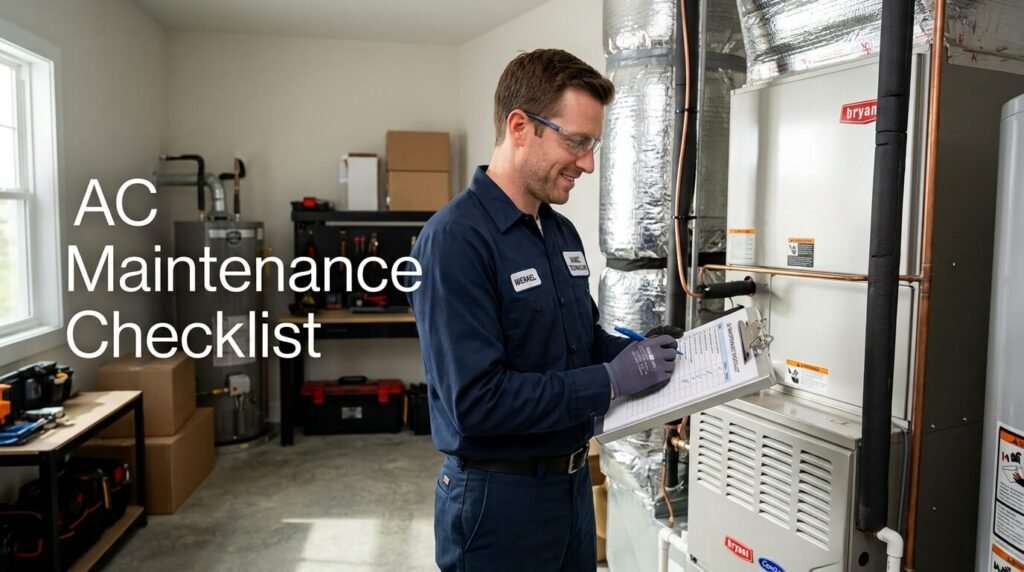
A complete AC maintenance checklist covers five categories of work: airflow (filters, vents, ductwork), the outdoor condenser (coils, fan, refrigerant), electrical components (capacitors, connections, contactors), drainage (the condensate line and pan), and controls (thermostat calibration and settings).
Most tasks within these categories fall into one of two buckets: things a homeowner can safely handle without tools or training, and things that legally or practically require a licensed technician.
The table below outlines what each category includes before this article gets into who should do what.
The Systems and Components a Full Checklist Covers
| Category | What It Includes | Typical Frequency |
| Airflow | Air filter, supply and return vents, ductwork | Monthly (filter), annually (ducts) |
| Outdoor condenser | Evaporator and condenser coils, fan blades and motor, refrigerant lines | Twice yearly |
| Electrical | Capacitors, contactors, wiring connections, disconnect box | Twice yearly, professional |
| Drainage | Condensate drain line, drain pan, overflow switch | Monthly homeowner check, twice-yearly professional flush |
| Controls | Thermostat calibration, programmed schedules, sensor accuracy | Twice yearly |
Several of the values a technician checks against, like rated amperage and refrigerant type, come straight off the equipment’s data plate, so it helps to know how to read your AC’s nameplate rating before a service visit.
DIY vs. Professional, at a Glance
| Features | DIY Tasks | Professional Tasks |
| Examples | Filter changes, clearing debris, checking the thermostat, visual inspection | Refrigerant handling, electrical testing, coil deep-cleaning, capacitor replacement |
| Tools required | Basic household tools, no specialized equipment | Refrigerant recovery equipment, multimeters, capacitor testers |
| Legal restriction | None | Refrigerant handling requires EPA Section 608 certification |
| Typical frequency | Monthly to seasonal | Twice yearly |
DIY AC Maintenance Tasks You Can Safely Do Yourself
The tasks a homeowner can safely handle without tools or training fall into two timeframes: things to check every month, and things to do once before each cooling season starts.
None of these involve opening the refrigerant circuit or touching electrical components inside the unit, which is where the DIY line ends.
Monthly Tasks
- Check the air filter and replace it if it looks gray or clogged, since a dirty filter can raise energy consumption by 5 to 15 percent according to Department of Energy guidance.
- Look at the outdoor unit for leaves, grass clippings, or debris piled against the condenser cabinet, and clear anything blocking airflow.
- Confirm the condensate drain line isn’t backed up by checking for standing water in the drain pan.
- Listen for unusual noises when the system cycles on, since a new rattle or squeal often signals a loose panel or failing part before it turns into a bigger problem.
- Check that supply and return vents throughout the house are open and not blocked by furniture or rugs.
Tasks to Do Before Each Cooling Season
- Trim back any vegetation growing within two feet of the outdoor condenser to keep airflow clear around the coil.
- Straighten bent fins on the condenser coil gently with a fin comb, since bent fins restrict airflow just like debris.
- Test the thermostat by lowering the setting a few degrees and confirming the system responds within a few minutes.
- Wash the outdoor unit’s exterior coil gently with a garden hose from the inside out, avoiding high-pressure spray that can bend fins.
- Wipe down and inspect indoor vents and grilles for dust buildup that can restrict airflow into the room.
Professional-Only AC Maintenance Tasks
Several tasks on any AC maintenance checklist require a licensed technician, not because of complexity but because of legal restrictions and the risk of damaging expensive components. These are the jobs a professional tune-up visit is built around.
Why These Tasks Require a Licensed Technician
Refrigerant handling falls under EPA Section 608 certification requirements, and technicians who add, recover, or evacuate refrigerant without that certification face real enforcement risk, not just a theoretical rule.
Beyond the legal restriction, several tasks carry equipment risk that makes them impractical for a homeowner: testing a capacitor involves working near a component that can hold an electrical charge after the system is powered off, and deep-cleaning an evaporator coil usually means partially disassembling the indoor unit.
A professional tune-up bundles these tasks together because the technician is already on-site with the tools and certification to handle all of them safely in one visit.
What a Standard Tune-Up Visit Includes
- Measure refrigerant charge and pressure, and add or recover refrigerant if levels fall outside the manufacturer’s specification.
- Test capacitors and contactors under load, and replace any component reading outside its rated tolerance.
- Clean the evaporator coil and condenser coil thoroughly, removing buildup a garden hose can’t reach.
- Check electrical connections for corrosion or looseness, and tighten or replace wiring as needed.
- Verify airflow across the coil with a static pressure test, confirming the blower moves the volume of air the system was designed for.
- Flush the condensate drain line and test the safety float switch that shuts the system down if drainage backs up.
An HVAC tune-up cost guide breaks down what a visit like this typically costs by region and system size.
How Often You Should Schedule AC Maintenance
Most manufacturers and technicians recommend professional AC service twice a year: once in spring before cooling season starts, and once in fall to check the system before it sits idle.
That baseline holds for most of the country, but it isn’t universal, and the right frequency depends on your climate and how hard the system runs.
The Standard Twice-a-Year Schedule
The spring visit focuses on getting the system ready for peak cooling demand: refrigerant levels, coil cleaning, and electrical testing before the compressor runs continuously for months.
The fall visit is lighter, typically a filter check, a drain line flush, and a general inspection before the unit sits mostly idle through cooler months.
A seasonal HVAC maintenance checklist breaks each visit down task by task if you want the full seasonal split.
Adjusting Frequency for Your Climate and Usage
The twice-yearly default assumes a system that runs seasonally, which isn’t true everywhere.
| Climate or Usage Pattern | Recommended Professional Visits per Year | Filter-Change Frequency | Additional Consideration |
| Four-season moderate climate | 2, spring and fall | Every 60-90 days | Standard schedule applies |
| Humid or year-round cooling climate | 2-3, spaced roughly every 4 months | Every 30-45 days | Higher humidity accelerates coil and drain-line buildup |
| Coastal or salt-air environment | 2, plus an annual corrosion check | Every 60 days | Salt exposure corrodes coil fins and electrical contacts faster than inland units |
| Seasonal or vacation-home use | 1, timed before arrival | Before each occupied season | A system sitting idle for months needs a pre-arrival inspection, not just a seasonal one |
What Skipping Maintenance Actually Costs You
Skipping AC maintenance doesn’t just risk a breakdown. It has a measurable cost you’re already paying in higher energy bills, even while the system still seems to run fine.
Each commonly skipped task has a documented efficiency or capacity cost attached to it.
The Efficiency and Energy-Bill Cost of Each Skipped Task
| Task | What Happens If Skipped | Documented Impact | Source |
| Filter replacement | Airflow restriction forces the system to work harder | 5-15% increase in energy consumption | U.S. Department of Energy |
| Coil cleaning | Reduced heat transfer at the evaporator or condenser coil | 20-40% loss of cooling capacity | Industry HVAC efficiency data |
| Refrigerant charge check | An undercharged system runs longer to reach the same temperature | Roughly 20% efficiency loss from a charge just 10% low | Industry HVAC efficiency data |
| Blower and fan cleaning | Dust buildup on the blower wheel restricts air volume | Around 10% efficiency loss | Industry HVAC efficiency data |
| Full annual tune-up | Small issues go unnoticed and compound over time | Regular maintenance is associated with preventing the majority of common HVAC service calls | ACCA (Air Conditioning Contractors of America) |
The Breakdown Risk of Deferred Maintenance
Beyond energy costs, deferred maintenance compounds mechanically: a slightly low refrigerant charge makes the compressor work harder, which shortens its life, and a dirty coil forces longer run times that add wear to every component in the system, not just the dirty one.
A well-maintained system typically lasts 15 to 25 years, while a neglected one commonly fails well before that range, often with a compressor failure that costs more to replace than several years of professional tune-ups combined.
If your system develops icing on the coil or a hissing sound near the refrigerant lines, that’s usually further along than routine wear, and it’s worth understanding the signs of a refrigerant leak before the compressor is affected.
AC Maintenance and Your Warranty
Most manufacturer warranties on AC systems require documented professional maintenance to stay valid, and this is the part of a maintenance checklist that gets skipped most often, not because homeowners neglect the tasks, but because they don’t keep proof the tasks were done.
What Documentation Manufacturers Actually Require
Manufacturers typically don’t accept a homeowner’s word that maintenance happened. They want a paper trail tied to a licensed technician.
| Task | Who Performs It | What to Keep as Proof | Why It Matters for Your Warranty |
| Filter changes | Homeowner | Purchase receipts and a simple date log | Rarely required on its own, but useful if a claim is disputed |
| Seasonal tune-up | Licensed technician | Dated, itemized invoice listing the specific work performed | Typically the primary document a manufacturer requests during a claim |
| Refrigerant service | EPA-certified technician | Invoice showing certification number and refrigerant amount added | Confirms the work was performed by someone legally authorized to handle refrigerant |
| Major component replacement | Licensed technician | Itemized invoice and the replaced part’s serial number | Ties the specific part to your system’s warranty record |
A Simple Maintenance Log You Can Keep Yourself
A printable HVAC maintenance log template makes this easier to keep consistent, but the format matters less than what you record.
- Write down the date and a short description of every task performed, whether you did it yourself or a technician did.
- Keep every professional invoice in one folder, physical or digital, rather than scattered across email and paper receipts.
- Note the technician’s name and company on each visit, since some manufacturers ask for this during a warranty claim.
- Record filter changes separately from professional visits, since the two serve different purposes in a claim review.
- Store your system’s model and serial numbers with the log, since a claim typically starts with that information before anything else.
Not sure if a task on this list needs a pro? If a job involves refrigerant, electrical testing, or opening the indoor coil cabinet, it’s professional-only territory. Everything else on the monthly and seasonal DIY lists above is safe to handle yourself with basic tools.
FAQ — AC Maintenance Checklist
What is included in a basic AC maintenance checklist?
A basic AC maintenance checklist covers five areas: airflow (filter and vents), the outdoor condenser (coils, fan, refrigerant), electrical components (capacitors and connections), drainage (the condensate line), and controls (thermostat accuracy).
Homeowners typically handle the airflow and basic inspection tasks monthly, while refrigerant, electrical work, and deep coil cleaning require a licensed technician on a twice-yearly schedule.
A checklist that lists tasks without separating who should perform each one is missing the most practical piece of information a reader needs.
How often should I get my AC serviced?
Most homes should schedule professional AC service twice a year, once in spring before cooling season and once in fall.
Homes in humid or year-round cooling climates often benefit from a third visit or shorter intervals between services, since the system runs nearly continuously and accumulates buildup faster than a seasonal unit does.
Seasonal or vacation homes need a different approach entirely: one thorough inspection timed just before the home becomes occupied again, rather than a fixed spring and fall calendar.
Is it illegal to add refrigerant to my own AC?
Yes, in most cases. Handling refrigerant, including adding it to a system, recovering it, or evacuating a line, requires EPA Section 608 certification under federal law, and performing this work without certification carries real enforcement risk for whoever does it.
This rule exists because refrigerants can harm the environment if released improperly and require specific handling equipment to manage safely. If your system is low on refrigerant, that job belongs on a licensed technician’s list, not a weekend project.
Does skipping AC maintenance void the warranty?
It can, and this is one of the most common ways homeowners lose warranty coverage without realizing it.
Most manufacturers require documented, professional maintenance, not just maintenance that happened, to honor a warranty claim, which means a dated invoice from a licensed technician matters as much as the work itself.
Filter changes and casual DIY upkeep typically don’t satisfy this requirement on their own. Keeping invoices from every professional visit is the simplest way to protect a claim before you ever need to file one.
How much does professional AC maintenance cost?
Professional AC maintenance typically costs less over a year than the higher energy bills caused by a neglected filter or dirty coil, though the exact price varies by region, system size, and what the visit includes.
A standard tune-up visit covers refrigerant checks, electrical testing, and coil cleaning in one appointment, usually for less than paying for each service separately.
Cost also depends on whether you’re enrolled in a maintenance plan with a contractor or paying for a one-off visit, since plans typically offer a lower per-visit rate.
Can dirty AC coils really increase my energy bill?
Yes, and the impact is larger than most homeowners expect.
A clogged evaporator or condenser coil can reduce a system’s cooling capacity by 20 to 40 percent, based on industry HVAC efficiency data, which forces the system to run longer to reach the same indoor temperature.
That extended runtime shows up directly on your energy bill, and it adds wear to the compressor and other components that aren’t built for constant operation.
Coil cleaning during a professional visit addresses this directly.
What’s the difference between AC maintenance and AC repair?
Maintenance is scheduled, preventive work performed on a system that’s still running, while repair is reactive work performed after something has already failed.
A maintenance visit checks refrigerant levels, tests electrical components, and cleans coils before any of those things cause a breakdown.
A repair visit happens because the system has already stopped cooling, is making an unusual noise, or has tripped a breaker.
Consistent maintenance reduces how often repair visits happen, but it doesn’t eliminate the need for repairs.
Should I get maintenance once a year or twice a year?
Twice a year is the standard recommendation for most homes, spaced roughly six months apart to cover both the spring startup and the fall wind-down.
Once-a-year maintenance is sometimes acceptable for systems in mild climates that run for a shorter season, but it leaves more room for small issues to go unnoticed between visits.
If your system runs nearly year-round, twice yearly is the minimum, and a third check may be worth the added cost in a climate with heavy, continuous use.