
Replace your AC when it is past 10–15 years old and repairs keep adding up, but confirm the cause first, because a struggling air conditioner is not always a worn-out one.
In five years of installing and servicing air conditioners in homes, offices, and industrial sites in Nigeria, I have seen units written off that only needed their outdoor unit moved or their power supply fixed.
This guide gives you the repair-or-replace rules, air conditioner replacement cost 2026 prices in dollars and naira, what the R-410A refrigerant change means for you, and a checklist for judging any quote.
| Quick fact | Answer |
| Typical US cost for a central AC replacement | About $3,000–$12,000, depending on the system size |
| Typical lifespan | 10–15 years for central AC; 8–10 years for window units |
| Must you replace a working R-410A system? | No; existing R-410A systems can still be run and repaired |
| Typical install time | About 2–4 hours for a single split unit; a full central system takes a day or more |
| Nigeria: floor-level split installation labor | ₦35,000–₦50,000 at my current rates, with the unit price extra |
What Does AC Replacement Include?
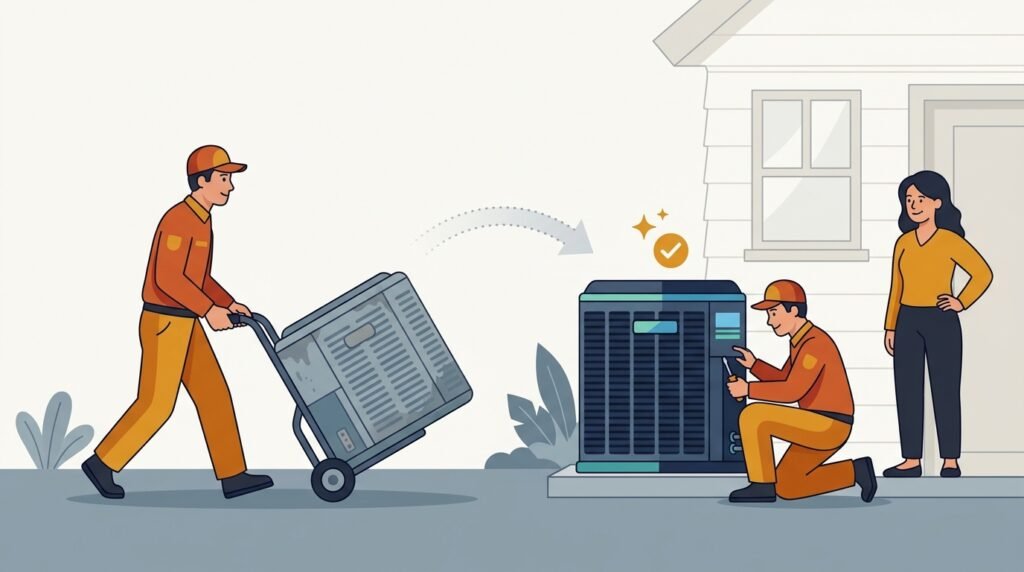
AC replacement covers the outdoor unit, the matching indoor coil or air handler, the refrigerant lines, and the commissioning work, not just a new box outside.
The scope is what separates a $1,200 quote from a $12,000 one, so confirm it before you compare prices.
What a Central AC Replacement Involves
Central AC replacement is the removal of a home’s old outdoor condenser and indoor cooling coil (or air handler) and the installation of a new, matching pair, joined by a refrigerant line set and controlled by a thermostat.
A typical quote covers the new equipment, labor, refrigerant, and removal of the old system. Ductwork repairs, electrical upgrades, and permits are often extra, so ask for each to be listed separately.
Outdoor Unit, Matched System, or Full HVAC Replacement
Three scopes are common, and the right one depends on the age and compatibility of what you already own.
| Scope | What you replace | Typical installed cost | When it fits | Main risk |
| Outdoor unit only | Condenser, plus lines if needed | About $1,200–$5,000 | Indoor coil is under 10 years old, compatible, and leak-free | A mismatched coil lowers efficiency and can affect the warranty |
| Matched system | Condenser plus indoor coil or air handler | About $3,000–$8,500 for 2–3 ton systems | Older system, or the coil cannot work with the new outdoor unit | Higher upfront cost |
| Full HVAC | AC plus furnace | About 10,000–20,000 | Both units are old, and you want one matched set | Largest single expense |
Can You Replace the AC Without Replacing the Furnace?
Yes, you can replace only the AC when the furnace and indoor coil are in good condition and compatible with the new outdoor unit, although replacing a central AC often means replacing the furnace too, so the two parts match.
A coil or air handler swap becomes necessary in these cases:
- The new outdoor unit uses a different refrigerant, such as R-454B, and cannot work with an old R-410A coil.
- The indoor coil is leaking, corroded, or otherwise incompatible with the new unit.
- The furnace is near the end of its life, and replacing both together saves a second labor charge.
- The manufacturer’s warranty expects a matched indoor and outdoor set.
Signs Your Air Conditioner Needs Replacing
There are different reasons to replace an AC; for example, to replace a central air conditioner when it’s over 10–15 years old and breaks down repeatedly, costs more to run each year, or cannot hold temperature on hot days.
ENERGY STAR also advises considering replacement once a unit passes 10 years.
How Long Does an Air Conditioner Last?
| System type | Typical lifespan |
| Central AC | 10–15 years, up to 20 with good care |
| Heat pump | 15–20 years |
| Split AC | 8-12 years |
| Window AC | 8–10 years |
Warning Signs It Is Time
- The unit is past 10–15 years old and a major component has failed.
- Repairs are frequent, and systems needing three or more repairs a year usually cost more to keep than to replace.
- Your electricity bills rise while cooling gets worse.
- Some rooms stay warm or humid even with the unit running.
- If the unit is noisy, short-cycles, or blows warm air during the hottest hours, that can point to poor airflow or low voltage, so check those first.
- The system uses a refrigerant that is now scarce or expensive, such as R-22.
Repair or Replace Your AC?
Use the $5,000 rule as a first filter: replace when your system’s age multiplied by the repair estimate is more than $5,000.
Then check three things the rule ignores: the real cause of the failure, the refrigerant type, and how often the unit has needed repairs.
The $5,000 Rule Explained
- Find the system’s age in years.
- Get a written repair estimate.
- Multiply the age by the estimate.
- If the result is under $5,000, repair the unit; if it is over, replacement is usually the better value.
The 50% Rule and the $1,200-a-Year Threshold
The three common rules measure different things, so they can disagree on the same unit. The 50% rule says replace when one repair costs more than half the price of a new system.
Service Experts’ threshold says replace when annual repair spending approaches $1,200. The table assumes a $7,000 replacement, and the scenarios are illustrations.
| Scenario | $5,000 rule | 50% rule | $1,200-a-year rule | Best call |
| A: 14-year-old unit, one $600 repair | 14 × $600 = $8,400, replace | 9% of $7,000, repair | $600 this year, repair | Repair once and start budgeting |
| B: 9-year-old unit, $1,800 coil repair | 9 × $1,800 = $16,200, replace | 26% of $7,000, repair | $1,800 this year, replace | Replace unless the coil is under warranty |
| C: 12-year-old unit, $1,500 repair after $800 earlier this year | 12 × $1,500 = $18,000, replace | 21% of $7,000, repair | $2,300 this year, replace | Replace |
Use the age-and-cost rule first, then let repair frequency and refrigerant type settle close calls. The 50% rule is the weakest signal on old units because it ignores age.
None of these rules would have helped on one job of mine, because the failing part was not the cause.
A 2HP LG split in an industrial complex had run 24 hours a day for more than seven years, and its compressor had already been changed twice.
The customer said it cooled well in the morning but blew warm air in the hot afternoons. The filter, evaporator coil, and condenser coil were clean, and the gas charge was correct.
The outdoor unit had been installed so close to the rooftop that it could not get enough air, so the compressor labored every afternoon.
I priced two options, relocating the unit or replacing it, and the service manager chose replacement because of the unit’s age and repair history.
We fitted a Panasonic 2HP, bought in March 2025 for about ₦450,000, and I recommended it because it holds up under heavy load.
The new outdoor unit went at floor level, where air moves freely, and the relocation work was included in the installation price.
The next hot afternoon, the office stayed cool. A new AC in the old spot would likely have failed the same way.
When Refrigerant Type Changes the Answer
- An R-22 system with a leak usually points to replacement, since R-22 production and import ended on January 1, 2020, and recharging has become very expensive.
- An R-410A system with a leak calls for a quote on the leak repair.
- An R-410A system in good working order does not need replacing because of its refrigerant alone.
A Five-Question Repair-or-Replace Check
Work through these in order and stop at the first clear answer.
- How old is the system? Past 10–15 years favors replacement, and under 8–10 years usually favors repair.
- Does the repair estimate pass the $5,000 rule or the 50% rule? If both say replace, replace.
- Has a major part, such as the compressor, already been replaced? A repeat failure in a short time suggests an outside cause or the end of the unit’s life.
- Is the cause outside the unit? Check airflow around the outdoor unit and the supply voltage before blaming the AC. Nigerian supply is nominally 230V, and when I measure 180–190V on arrival, I tell the customer the power is the problem. On an inverter unit, surges can damage the electronic board that acts as its sensors, and on a standard unit, low voltage overheats the compressor, so it blows hot air and fails over time. A stabilizer or surge protector protects either type, and customers often blame the brand when the electricity is at fault.
- Is the refrigerant R-22, or are parts hard to find? If so, replacement is usually the cheaper path.
AC Replacement Cost in 2026
US prices for a central AC replacement run from about $3,000 to $12,000, and the gap comes mainly from system size, efficiency, ductwork, and what the quote includes depending on the HVAC company.
Average Cost by System Type
| System type | Typical installed cost in $ |
| Window AC | 150–750 |
| Ductless mini-split | 1,500–8,000 |
| Central AC only | 3,000–12,000 |
| Central AC plus furnace | 10,000–20,000 |
Cost by Home Size and Tonnage
Installed price rises with tonnage, but the ranges below are estimates; prices differ based on country or locality.
| Approximate home size | Tonnage | Installed range |
| 900–1,400 sq ft | 2 ton | 2,550–5,500 |
| 1,200–1,800 sq ft | 3 ton | 3,000–6,500 |
| 1,600–2,400 sq ft | 4 ton | 3,500–7,500 |
| 2,000+ sq ft | 5 ton | 4,000–8,250 |
Replacing Just the Outdoor AC Unit: Cost
Replacing only the outdoor condenser costs less than a full system, but it pays off only when the indoor coil is a factory match and does not leak.
| Item | Typical cost |
| Full condenser swap with installation | 1,200–5,000 |
| Condenser unit only, 2–3 ton | 700–3,500 |
| Line set replacement, per 25 ft | 200–900 |
| Adding a matched indoor coil | Moves the total from about $2,400 to $4,000 or more |
Don’t forget that a condenser under 10 years old or still under warranty may only need a coil repair, while an older out-of-warranty unit is usually better replaced whole.
Split AC Unit Replacement Cost
In the US, “split” usually means a two-part central system, while in Nigeria and much of the world it means a ductless wall unit with an outdoor unit.
| Split type | Where it is common | Cost reference |
| Single-zone ductless split | Nigerian homes and offices; US mini-splits | US mini-splits run $1,500– $8,000 in total; Nigerian prices appear in the next section |
| Multi-zone ductless split | Homes and offices with several rooms | It could be more affordable than several single splits, with a more complex installation |
| Central split system | US ducted homes | About $3,000– $8,500 for a 2–3 ton system |
Window AC Replacement Cost
Replace a window AC when its compressor fails, or it is past 8–10 years old, and repair it only for cheap faults such as a capacitor or fan motor.
| Situation | Repair cost | Replacement cost | Better call |
| Capacitor or fan motor fails | 75–250 | 120–700 | Repair |
| Compressor fails | 400–1,500 | 120–700 | Replace |
| Unit is 8–10+ years old with a major fault | Rarely worth it | 120–700 | Replace |
Repair figures and replacement prices are estimates for the window AC.
In Nigeria, replacing window units costs about ₦90,000–₦200,000 and above, depending on the technician and brand of Window unit.
Are you buying a brand-new AC unit or a fairly used ( Tokunbo) Window Unit?
What Drives Your Quote Up or Down
- Tonnage matters, because moving from a 2–2.5 ton system to a 3.5–5 ton system adds about 1,200–3,500 to equipment cost.
- Efficiency matters, because stepping from SEER 14 to SEER 18 on a 3-ton unit typically adds 1,000–3,000.
- Ductwork adds 8–35 per linear foot, and replacing more than 50 feet can add 900–3,500.
- Long line sets over 50 feet commonly add 200–800.
- Timing changes the price; the price for spring differs from fall and summer.
- Access changes labor, which is why a unit installed at height costs more than one at floor level.
Where the Money Goes: Equipment, Labor, Fees
| Cost component | Typical share or range |
| Equipment (outdoor unit and matched coil) | 50–70% of installed cost for midrange systems |
| Labor, condenser swap | 200–800 |
| Line set | 200–900 |
| Permit and fees | 50–250 |
| Ductwork repair or replacement | 8–35 per linear foot |
| Haul-away of the old unit | 0–150 |
AC Replacement Cost in Nigeria
Our air conditioner prices in Nigeria guide has the full list; for planning, a mainstream 1HP–2HP split costs roughly ₦348,000 to ₦1,020,000, and floor-level installation adds ₦35,000–₦50,000 at my rates.
Naira prices move with the exchange rate, so each figure below is liable to change:
AC Unit Prices in Nigeria by Type and HP
| Type | Example | Price |
| Window unit | Generic | ₦65,000–₦200,000+ |
| 1HP split | Skyrun with installation kit | ₦348,000 |
| 1.5HP split | Skyrun with installation kit | ₦382,000 |
| 1.5HP inverter split | Syinix to Daikin | ₦430,000–₦863,500 |
| 2HP split | Kenstar | ₦586,000 |
| 2HP inverter split | Samsung with kit | ₦1,020,000 |
| 2HP split | Panasonic | About ₦450,000 |
The 2HP Panasonic air conditioner price above was when we installed a new AC for a customer in March 2025.
Installation and Replacement Labor Costs in Nigeria
| Job | Cost | What it covers |
| Floor-level split installation or replacement | ₦35,000–₦50,000 | My current rates; installation only, with new copper pipes |
| Installation at height | From ₦100,000 | Ladders or scaffolding, longer pipes, and added safety risk; scaffolding comes from a separate company, so its price varies |
I always use new copper pipes instead of reusing the old ones, because old pipes can leak refrigerant or carry dirt that blocks the new unit.
R-410A Phase-Out and What It Means for Your Replacement
You do not have to replace a working R-410A air conditioner, and the R-410A phase-out explained for homeowners covers the background; the short version is that the rules changed which equipment is made and installed, not what you may keep running.
What Changed and When
| Date | Rule | What it affects |
| January 1, 2025 | EPA’s Technology Transitions Rule stops manufacture and import of new residential and light-commercial AC and heat pump systems using refrigerants above 700 GWP | New equipment only |
| January 1, 2026 | Original deadline to install remaining R-410A inventory | Replaced by the July 2026 rule below |
| July 27, 2026 | EPA’s final rule removes that installation deadline for equipment made or imported before January 1, 2025, as reported by ACCA and HVAC trade media | Pre-2025 R-410A equipment can still be installed |
| Any date | Servicing existing R-410A systems | Never restricted; New York’s Part 494 keeps the January 1, 2026 install deadline as a state rule |
Do You Have to Replace an R-410A AC?
No. Existing R-410A systems can still be operated, serviced, and repaired, and reclaimed and recycled R-410A will be available for many years.
You also cannot add R-454B or R-32 to an R-410A system, because those refrigerants are not drop-in replacements.
When an R-410A system finally fails, most new systems you buy will use R-454B or R-32, so plan for that when you budget.
R-454B vs R-32 and the A2L Safety Question
| Feature | R-410A | R-454B | R-32 |
| Global warming potential | 2,088 | About 466 | 675 |
| Safety class | A1, non-flammable | A2L, mildly flammable | A2L, mildly flammable |
| Typical use | Existing systems | Mostly ducted whole-home systems | Mostly ductless systems |
| Compatibility with old R-410A systems | Not applicable | Not drop-in | Not drop-in |
We have written a detailed comparison in figures for R-410A and R-32; confirm the R-454B value against the manufacturer’s data sheet.
A2L systems add safety features, and the installed cost is estimated at $800–$1,500 more than comparable R-410A systems.
What It Does to Repair Costs on Older Systems
- Servicing R-410A systems stays legal and possible, but refrigerant pricing can rise as new production falls.
- R-454B supply was tight in spring and summer 2026, with shortages and price spikes, which affects new installations.
- Compressor replacement runs $1,200– $2,800, which is why a failed compressor on an older unit often tips the decision toward replacement.
- R-22 systems face the steepest costs, since recharging is expensive and replacement is commonly recommended.
How to Choose the Right Replacement System
Size the system to the heat the space must shed, not to its floor area alone.
A common mistake I see is a single 1HP unit in a meeting room for more than 50 people.
Seated adults give off roughly 450 BTU/h each (a rule-of-thumb figure), so 50 people add about 22,000 BTU/h of body heat before sun and lighting, in a room I would estimate at 60–100 square meters.
A 1HP split delivers about 9,000 BTU/h, so the compressor never reaches the set temperature and runs flat out until it wears out early.
For that room, I recommend three 2HP units or two 5HP units; in Nigeria, the 5HP is a large standing unit whose condenser has two big fans, whereas 1.5HP and 2HP units have one.
Sizing: Why Manual J Beats Square-Foot Rules
Learn what a Manual J load calculation includes before you accept any size, because it replaces square-foot guesses with a calculation of the actual heat load.
- Measure the space, including floor area, ceiling height, windows, and orientation.
- Record insulation, sun exposure, occupants, and heat-producing equipment.
- Calculate the cooling load room by room using ACCA’s Manual J method.
- Select equipment whose capacity matches that load, using ACCA’s Manual S method.
- Check duct design, airflow, and refrigerant charge when the system is installed.
SEER2 Ratings and Regional Minimums
SEER2 is the current US efficiency rating for cooling, and a higher number means lower running costs, not a smaller unit.
The Department of Energy sets regional minimums for split-system air conditioners under 45,000 BTU/h, and you should confirm your state’s region before buying.
| Region | Minimum SEER2 |
| North | 13.4 |
| Southeast and Southwest | 14.3 |
AC vs Heat Pump
Choose a heat pump when you want one system for cooling and heating, and a central AC when you already have a working furnace you plan to keep.
| Factor | Central AC | Heat pump |
| Function | Cooling only, paired with a furnace for heat | Cooling and heating |
| Best fit | Hot climates, working furnace in place | Mild to moderate climates, or when replacing both units |
| Replacement scope | Outdoor unit and matched coil | Outdoor unit, with the furnace often retired |
| Typical lifespan | 10–15 years | 15–20 years |
For a side-by-side breakdown, read our heat pump vs central air conditioner comparison.
How AC Replacement Works, Step by Step
A single split unit takes about 2–4 hours to install, and swapping a condenser takes about 2–4 hours; a central system with a new coil and line set takes longer, so book a full day.
The Replacement Process from Quote to Commissioning
- A technician inspects the site and completes the load calculation.
- You approve an itemized quote, and any required permit is arranged.
- The old unit is shut down, the refrigerant is recovered, and the old equipment is removed.
- The new outdoor unit, indoor coil or air handler, and new line set are installed.
- The lines are vacuumed and pressure-tested for leaks.
- The system is charged with refrigerant and airflow is checked.
- The technician tests cooling performance and gives you a commissioning report.
What Makes It Take Longer
- Ductwork that needs repair or sealing adds hours or days.
- An electrical panel or wiring upgrade adds a separate trade visit.
- Long line sets take more time to run, insulate, and test.
- Permits and inspections can add waiting time in places that require them, like in a factory.
- A furnace swap adds a second piece of equipment to install.
- Work at height requires ladders or scaffolding arranged in advance.
Best Time of Year to Replace
Fall and early spring are the best times to replace, because demand is lower and prices are softer.
AC prices tend to fall by mid-fall and start rising again after April, and shoulder-season installs run 5–15% below peak-summer prices.
Replacing before the first heat wave also lets you choose a contractor without the pressure of a broken system.
How to Compare AC Replacement Quotes
Compare quotes on scope, not just price, because two quotes for the same system can differ by thousands when one skips the load calculation, new lines, or commissioning.
That is also why published US ranges stretch from about $3,000 to $12,000 for the same job type.
The Quote Audit Checklist
- Was a load calculation done? A good quote names the method, such as Manual J, and skipping it risks an oversized or undersized unit.
- Is the indoor and outdoor equipment a matched system? A good quote lists model numbers for both, and a mismatch cuts efficiency and can affect the warranty.
- Are new refrigerant lines included? A good quote says so, and reused old pipes can leak refrigerant or carry dirt that blocks the new unit.
- Does the quote include vacuuming and a leak test? A good quote lists both, and skipping them leaves moisture and leaks that shorten compressor life.
- Is commissioning included? A good quote promises airflow and charge checks with a report, and without them the unit may run poorly for years.
- Is a permit included where one is required? A good quote states who pulls it, and unpermitted work can cause problems at resale.
- Was the power supply checked and protection recommended? A good installer measures voltage and advises a stabilizer or surge protector when readings run low, since unstable power damages both inverter boards and standard compressors.
- Is the scope fully itemized? A good quote lists equipment, labor, removal, access charges such as scaffolding, and warranty terms, so there are no surprise additions later.
Red Flags in an AC Replacement Quote
- A price given over the phone without seeing the site or knowing the size of the space.
- A single lump-sum figure with no breakdown of equipment, labor, and extras.
- No mention of how high the outdoor unit will be mounted, which hides a possible access charge.
- A plan to reuse old copper pipes without testing them.
- No load calculation, with the size chosen from square footage alone.
- Pressure to sign the same day, or a refusal to name the refrigerant and model numbers.
Get an AC Replacement Quote
A quote that passes the audit above should show the load calculation, matched equipment, new lines, and a commissioning plan, and those are the details to expect when you ask for an AC replacement quote.
To get an itemized estimate with the load calculation included, request a free AC replacement estimate.
AC Replacement FAQs
Is it worth replacing a 12-year-old AC that still works?
Replace a 12-year-old AC that still works only when a repair fails the $5,000 rule or its repair history is growing; otherwise keep it and budget for replacement.
At 12 years old, even a $500 repair scores $6,000 under the age-times-cost rule, and ENERGY STAR advises considering replacement past 10 years.
If the unit cools well, uses R-410A, and your bills are steady, running it a few more years is a sound choice.
Can I replace an AC unit myself?
You can replace a window unit yourself, but central and split systems should be installed by a professional.
Simple units can be done at home, while a central system tied to ductwork likely needs a pro.
Split and central systems involve handling refrigerant, which in the US requires EPA certification, plus vacuuming the lines, checking the charge, and electrical work.
Skipped steps cause leaks, poor cooling, and early compressor failure.
Does a higher SEER2 mean I can buy a smaller unit?
No, a higher SEER2 rating does not let you buy a smaller unit, because efficiency and capacity are separate.
SEER2 describes how much electricity the system uses for each unit of cooling, while the tonnage or HP you need comes from the heat load of the space.
Choosing a smaller unit to offset a high rating leaves it undersized on hot days, and the compressor runs nonstop.
Size first from a load calculation, then pick the efficiency you want.
What is the cheapest way to replace an AC?
The cheapest sound way is to replace only what is needed, choose a standard-efficiency model, and schedule the work in fall or spring.
A top-SEER model can save about 900–2,000, and shoulder-season scheduling can save 5–15%.
Do not cut costs by skipping the load calculation, reusing old line sets untested, or dropping commissioning, since those shortcuts usually cost more in repairs and power bills later.
[…] A new system also comes with a fresh warranty and significantly better efficiency than a 15-year-old unit, retrofit or not. For a full breakdown of what a new system costs by size and efficiency tier, see our full AC replacement cost breakdown. […]
[…] For a full comparison of what a new system costs by size and efficiency tier, see our full AC replacement cost breakdown. […]
[…] your system already shows two or more of the signs covered above, scheduling a replacement before the next cooling season starts is the cheaper, calmer path, even if the unit is still […]