
A standard split, window, central, or portable air conditioner does not raise your water bill because it cools with refrigerant, not water.
Only evaporative coolers and water-cooled systems use water you pay for. The water every AC drips out is moisture from your room air, and it never passes through your meter.
Does AC affect your water bill?
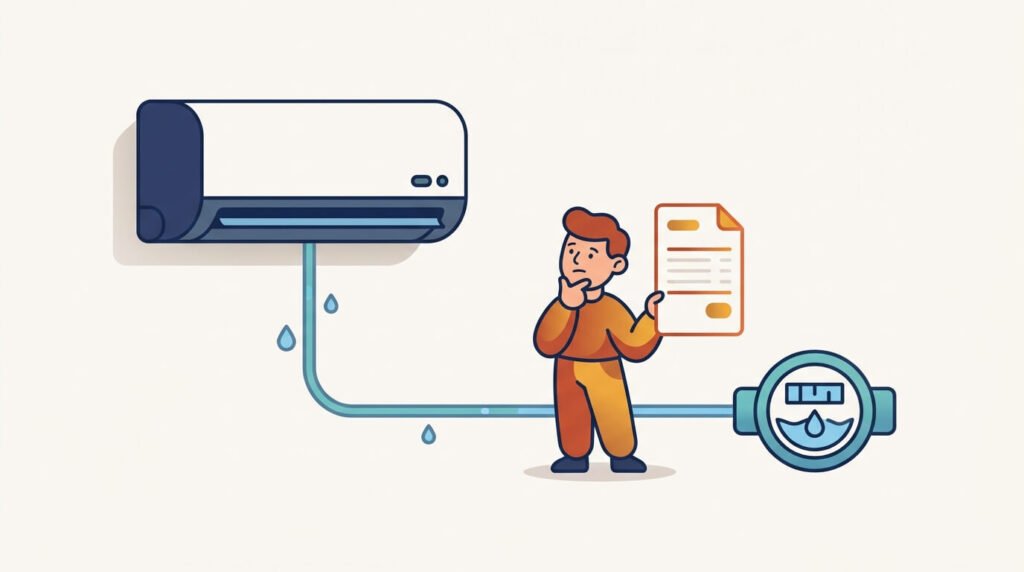
For most units, the answer is no, as explained in ” Does an air conditioner need water to run.
Split, window, and central air conditioners cool with a sealed refrigerant loop that never touches your water supply.
Evaporative coolers and water-cooled systems are the exceptions because they need water to work.
| AC type | Uses water to cool? | Effect on your water bill |
| Split or window AC | No | None |
| Central AC (air-cooled) | No | None |
| Portable AC | No | None |
| Evaporative cooler (often sold as an “air cooler”) | Yes | Raises the bill on a metered supply |
| Water-cooled or chilled-water AC | Yes | Raises make-up water use, mostly in large buildings |
Water shows up in three places around an AC, and only one of them can reach your bill.
| Layer | What it is | On your meter? | Reference figure |
| Direct use | Water the unit consumes to cool | Yes, for evaporative and water-cooled units only | About 7.6 gallons (29 liters) per operating hour for evaporative coolers, from a Phoenix-area study cited in a 1994 Arizona publication |
| Condensate | Moisture pulled from room air | No | Roughly 1 to 2 liters per hour from a residential unit |
| Upstream use | Water power plants use to generate electricity | No, it sits on the utility’s side | Up to 102 cubic meters per month of indirect withdrawals attributed to compression ACs where plants use once-through cooling (Pirouz and Maiolo, 2018) |
Only the first row changes what your water utility charges you. Condensate is free, and upstream use is the power company’s water, not yours.
Split, window, and central AC
- Split and window units keep refrigerant in a closed loop, so they have no water connection.
- Air-cooled central systems dump heat to outdoor air with a condenser coil and fan, so they use no water.
- The only water these units touch is condensate, which leaves through a drain hose or line.
- If your water bill rose after you installed one, the meter test further down will help you find the real cause.
Portable AC units
Portable air conditioners do not use water to cool either. They collect condensate in an internal tank or push it out a drain hose.
Emptying the tank costs nothing on your water bill. What a portable unit adds is electricity; for example, your window and split units can draw 1,000 to 2,000 watts while the compressor runs.
Where does AC water come from, and does it cost you anything?
AC water is humidity pulled from your room air, and it costs nothing because it never goes through your water meter.
Warm air crosses the cold evaporator coil; moisture condenses on it the way droplets form on a cold glass, and the water drips into a pan and out through a drain.
What condensate is and how much a unit makes
Output rises with humidity and run time, so read these figures as ranges.
| Unit type | Typical condensate | Where it goes |
| Residential split or central AC | About 1 to 2 liters (0.25 to 0.5 gallons) per hour, according to heating and cooling maker IRSAP | Outdoors through a drain hose or line |
| Portable AC | About 1 to 3 liters (0.25 to 0.8 gallons) on a muggy day and more in high humidity | Internal tank or drain hose |
Is AC water safe to drink or reuse?
- Do not drink it or cook with it, because it can pick up bacteria and biofilm from the coil and drain pan, and standing water carries a Legionella risk.
- The water is close to distilled, since it loses its minerals on the cold coil.
- That makes it usable for topping up a steam iron, a car battery, or a windshield washer reservoir.
- Collect it in a clean container and use it soon instead of letting it sit for weeks.
Why condensate never shows on your water meter
Your meter counts water entering your home through the supply pipe. Condensate starts as humidity in the air and leaves through a separate drain, so a unit that drips outdoors costs you nothing.
Water dripping indoors is a different problem, usually a blocked drain or a dirty filter, and it is a repair issue, not a billing one. If yours drips inside, see why your AC is leaking water.
Which Air Conditioners Do Use Water?
Evaporative coolers and water-cooled systems do, and our evaporative cooler vs air conditioner guide compares them with refrigerant units.
Evaporative coolers evaporate water from wet pads to chill the air. Water-cooled systems use water to carry heat away from the refrigerant.
Evaporative (swamp) coolers: real water numbers
Most of this data comes from dry climates, so humid regions will differ.
| Region | Reported water use |
| Phoenix area | About 7.6 gal/hr on average (4.4 without bleed-off, 10.4 with it) |
| United States, study average | About 66 gal/day, roughly 14,000 gal/yr over 212 cooling days |
| Australia | 41 to 70 L/hr (11 to 18 gal) in Hobart, 67 to 116 L/hr (18 to 31 gal) in Adelaide, for whole-house systems |
| Western Australia | 30,000 L (about 7,900 gal) or more per year, based on 6 hours a day for 50 days |
At 7.6 gallons an hour, a cooler running 8 hours uses about 61 gallons a day, enough to notice on a metered bill.
Water-cooled and chilled-water AC
Water-cooled air conditioners use water because a cooling tower evaporates it to release heat, so the system always needs make-up water.
They are common in large commercial buildings, and they run roughly 30 to 40 percent more efficiently than air-cooled systems.
Water-cooled AC is among the common causes of a high water bill. Homes and small buildings mostly use air-cooled systems, so you can rule this category out.
Bleed-off, the hidden water loss
Bleed-off is the water an evaporative cooler drains on purpose to flush out minerals that build up as water evaporates, which protects the pads and pump.
Bleed-off explains why two coolers of the same size can use very different amounts of water. Water Corporation lists bleed rates of 11 to 20 liters for typical systems and says newer models run as low as 3 liters per hour.
It compares a badly set bleed to a running toilet hidden on the roof. The Phoenix area figures above show the same gap: 4.4 gallons per hour without bleed-off, 10.4 with it.
Does AC raise your Electricity Bill?
Yes. Electricity is where an air conditioner shows up on your bills, and unit size and run time set the amount, as our guide on how much electricity an AC uses explains.
Multiply the kWh figures below by your local rate to estimate a cost.
Running cost by AC size (1HP, 1.5HP, 2HP)
| AC size | Approx. cooling capacity | Typical power draw | Energy per 8 hours of compressor run time |
| 1HP | ~9,000 BTU/hr | 0.7 to 0.9 kW | 5.6 to 7.2 kWh |
| 1.5HP | ~12,000 BTU/hr | 1.0 to 1.3 kW | 8.0 to 10.4 kWh |
| 2HP | ~18,000 BTU/hr | 1.6 to 2.0 kW | 12.8 to 16.0 kWh |
These are typical ranges for non-inverter units. Inverter models draw less, and real use is lower because the compressor cycles off.
The temperature setting matters too: don’t forget that each extra degree of cooling can add about 10 percent to running cost.
For a closer look at the two most common sizes, see 1HP vs 1.5HP AC running costs.
The indirect water footprint of electricity
Power plants use water, so an AC has an upstream water footprint even though it uses none at home.
In a 2018 case-study analysis, Behrouz Pirouz and Mario Maiolo estimated that operating a 24,000-Btu compression air conditioner in a 140 m² house for 18 hours per day could be associated with approximately 102.45 m³ of indirect water withdrawal per month when the electricity was generated by a natural-gas power plant using once-through cooling. The estimate represents water withdrawn for power-plant cooling, not water directly consumed by the air conditioner
Withdrawal is not consumption, since much of that water returns to its source, but it shows the footprint is real.
Which AC type uses more water depends on how your electricity is generated.
A University of Arizona Environmental Research Laboratory analysis estimated that cooling a 2,000-square-foot home in Tucson with an air conditioner would use about 425 gallons of water per month indirectly when powered by coal-generated electricity, compared with approximately 4,620 gallons for an evaporative cooler, including direct and indirect water use. Under the analysis’s hydropower assumptions, the estimates reversed: about 55,250 gallons per month for the air conditioner versus 20,745 gallons for the evaporative cooler. Because the analysis is based on older assumptions and a specific Tucson scenario, these figures illustrate how electricity sources can alter the water footprint of cooling systems rather than provide universal current values.
If you pump your own water from a borehole or tank, an air-cooled AC does not change how much you pump. Its cost shows up as grid electricity or generator fuel.
If your water bill went up, what else could it be?
Most unexplained jumps come from leaks or changes in how you use water, not from a refrigerant AC.
An unusually high bill is most often caused by a leak or a change in water use.
Common causes
- A leaking toilet is the most common cause of a high bill, and it can waste hundreds or thousands of gallons.
- Irrigation systems and lawn watering push summer bills up.
- Water softeners use water during regeneration and backwash.
- Broken pipes and water heater leaks can run unnoticed for weeks.
- Houseguests, a filled pool, or any other change in household use raises consumption.
- A water-cooled AC or an evaporative cooler is the only AC-related cause on this list.
A 15-minute test to see if your AC is the cause
- Identify your unit type from its label or manual. A split, window, portable, or central AC with an outdoor condenser is air-cooled. A unit with a water inlet and wet pads is evaporative.
- Turn the AC off, close every tap, and stop irrigation and water-using appliances.
- Note the meter reading, wait 5 minutes, and read it again. Any movement means a leak somewhere else, not your AC.
- If the meter held still, switch the AC on, wait 10 minutes, and read it again. Movement now points to an evaporative or water-cooled unit. No movement clears the AC.
- For an evaporative cooler, catch the bleed-off water in a bucket for 5 minutes and multiply by 12 to get liters per hour. Compare the result with the Water Corporation bleed figures above.
- Inspect the float valve and supply lines for leaks, then multiply hourly use by daily run hours to see whether it explains your increase.
How to Cut AC-related Water and Energy Costs
The biggest savings come from tuning an evaporative cooler’s bleed-off and from keeping a refrigerant AC clean and set to a moderate temperature.
Water-saving settings for evaporative coolers
- Set the bleed rate to the manufacturer’s specification, since bleed-off is the biggest source of difference in water use between coolers.
- Clean the unit and replace worn pads regularly, which Water Corporation names as the basis of efficient running.
- Do not pre-cool air with an evaporative cooler before switching on a refrigerant AC, because this makes the AC use more energy.
- Run ceiling fans to move cooled air around, and reuse bleed water on garden plants.
- Check supply lines and the float valve for leaks, and switch the unit off when you travel.
Keeping an AC efficient
- Set the thermostat between 24 and 26°C (75 to 79°F) and use the timer so the unit shuts off once the room is cool; this recommendation we give to clients after installation or maintenance.
- Change or clean filters regularly, because according to ASHRAE research, dirty filters can increase energy use by 5 to 15 percent higher energy use.
- Service the unit on a regular schedule so it keeps running efficiently.
- Clean the indoor coil between services with a homemade indoor coil cleaner.
If you are still unsure whether your unit is air-cooled or evaporative, the type label settles it before you troubleshoot or buy.
Our guide on does an air conditioner need water to run explains how refrigerant cycles work and which few designs need a water supply, so read it and check your unit’s label first.
FAQ: Does AC affect water bill?
Does a split AC increase my water bill?
No. A split AC cools with a sealed refrigerant loop and has no connection to your water supply, so it cannot raise your water bill.
The water dripping from its drain hose is moisture condensed from room air, not water you were billed for.
If your bill rose after installation, look for leaks, irrigation, or changes in household use instead, and run the meter test above to confirm.
Does an evaporative cooler increase my water bill?
Yes, on a metered supply it does. Evaporative coolers evaporate water through wet pads, and a Phoenix-area study averaged about 7.6 gallons (29 liters) per operating hour, from 4.4 without bleed-off to 10.4 with it.
Running one for 8 hours therefore uses roughly 60 gallons a day. A correct bleed rate and clean pads reduce that. Water-cooled systems also consume water, but they are rare in homes.
Why did my water bill go up after I installed an AC?
Probably not because of the AC, unless it is an evaporative or water-cooled unit.
A refrigerant AC uses no water, so the timing is usually a coincidence: hot weather also increases irrigation, showers, and pool top-ups.
Run the meter test above with the AC off and then on to see whether the meter moves. Check toilets for leaks too, since a running toilet is the most common cause of a high bill.
Before your next billing cycle, run the meter test above to confirm whether your unit is air-cooled or evaporative, then adjust the bleed rate or thermostat setting to match.
To learn more about evaporative cooling, read our comprehensive guide on the types of evaporative cooling systems.