
Evaporative cooling vs reverse cycle comes down to humidity and heating: evaporative coolers cost far less to run in hot, dry climates, while reverse cycle systems work in any climate and also heat your home.
If your hottest summer afternoons often reach 60 percent humidity or higher, choose reverse cycle or a split system.
If summers are dry and you can live with partly open windows, evaporative cooling is the cheaper option.
- Evaporative cooling wins in dry inland climates.
- Reverse cycle or a split system wins in humid, coastal, or heating-dependent homes.
- Running both suits homes that swing between dry heat and humid spells.
How Evaporative Cooling and Reverse Cycle Air Conditioning Work
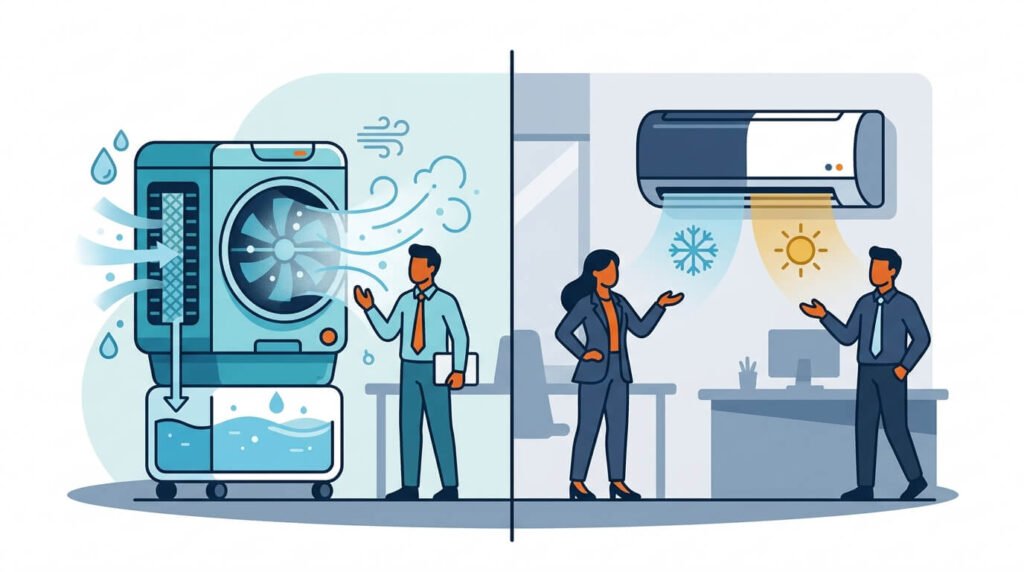
An evaporative cooler cools air by pulling it through wet pads, while a reverse cycle system uses a refrigerant loop that moves heat out of your home in summer and into it in winter.
What Is Evaporative Cooling?
Evaporative cooling is a system that uses a fan to pull outdoor air through water-soaked pads, cooling the air as the water evaporates, and then pushes that air through the house.
It needs only a fan and a small water pump, with no compressor or refrigerant. It is also called a swamp cooler.
What Is Reverse Cycle Air Conditioning?
Reverse cycle air conditioning is a refrigerant-based system that uses a compressor to move heat out of the house in summer and reverses direction to move heat in during winter.
It comes as a split system, with an indoor unit serving one room or zone, or as a ducted system with one central unit.
Most split systems both heat and cool, so this article uses “split system,” “reverse cycle,” and “air conditioning” interchangeably.
Should You Open Windows When Using Evaporative Cooling?
Yes, partly. An evaporative cooler pushes a constant flow of outdoor air into the house, so that air needs a way out: open a window or vent slightly in the rooms you want cooled.
Without ventilation, moisture builds up indoors.
| Feature | Evaporative cooling | Reverse cycle |
|---|---|---|
| Air source | Fresh outdoor air over wet pads | Indoor air, recirculated and cooled |
| Windows and doors | Partly open so air can exit | Closed |
| Air movement | Constant flow through the house | Gentle recirculation within rooms |
Disadvantages of Evaporative Cooling
The biggest disadvantage of evaporative cooling is that it loses most of its cooling power in humid weather; the other drawbacks are practical trade-offs you can plan around.
- Performance falls as humidity rises, so coastal areas often rule it out.
- Windows or vents must stay partly open, which affects security, noise, and smoke or pollen days.
- It uses water, and consumption varies widely with heat and unit size.
- It cannot heat, so winter needs a second system.
- It holds a set temperature less precisely than a split system.
- Pads and water parts need regular upkeep, and Comfy Home and Fused Air both say neglect cuts cooling and raises bills.
Does Evaporative Cooling Work in Humidity? Limits by Climate
Evaporative cooling works well in dry air and loses most of its benefit as humidity climbs. Australian Climate Systems reports reduced capacity as humidity rises toward 70 percent and little to no benefit above it.
Why Humidity Limits Evaporative Cooling: Wet-Bulb Explained
Dry-bulb temperature is the ordinary air temperature on a thermometer.
Wet-bulb temperature is the lowest temperature air can reach by absorbing evaporated water. It sits close to dry-bulb in humid air and well below it in dry air.
Wet-bulb depression is the gap between the two readings, and it caps how much an evaporative cooler can cool the air.
A real cooler removes only a share of that gap. The NSW Planning Portal says the BASIX assessment assumes about 80 percent. In humid air, the gap is small, so there is little room to cool.
How Cold Will an Evaporative Cooler Get? Supply Air by Temperature and Humidity
Assuming the cooler removes 80 percent of the wet-bulb depression, the BASIX assumption, supply air temperatures look like this.
Most users don’t understand how humidity hurts performance; this grid shows how much.
| Relative humidity | 30°C outside | 35°C outside | 40°C outside | 43°C outside |
|---|---|---|---|---|
| 15% | 17.5°C | 21.1°C | 24.6°C | 26.7°C |
| 30% | 20.7°C | 24.7°C | 28.7°C | 31.1°C |
| 45% | 23.1°C | 27.5°C | 31.8°C | 34.4°C |
| 60% | 25.2°C | 29.8°C | 34.4°C | 37.1°C |
| 75% | 27.1°C | 31.9°C | 36.7°C | 39.5°C |
As a comfort guide used here (not a standard), 26°C or below feels clearly cool, 26 to 29°C is marginal, and above 29°C gives little relief. At 35°C outside, supply air stays under 26°C only near 30 percent humidity or lower.
Worked check: at 35°C and 60 percent humidity, the wet-bulb is about 28.5°C, the depression is 6.5°C, and 80 percent of it is 5.2°C, so supply air is about 29.8°C. That is about 30°C for the same conditions.
These figures are estimates based on the Stull (2011) wet-bulb approximation. Real units vary, and indoor temperature settles above supply air once household heat is added.
Check typical 3 pm temperature and humidity for your postcode on the Bureau of Meteorology’s climate pages.
Which Australian Cities Suit Evaporative Cooling?
Evaporative cooling suits cities with dry summers, such as Perth, Adelaide, and Canberra, and Melbourne for most of the season, and it is a poor fit for humid coastal areas.
| City or region | Typical summer pattern | Suitability | Caveat |
|---|---|---|---|
| Perth and Adelaide | Hot and dry | Good | Humid storm days reduce cooling (Ambience Air) |
| Melbourne and Canberra | Hot spells, some humid changes | Good for most of summer | Cooling drops in a humid change (Seeley International) |
| Western Sydney | Hot, drier inland | Accepted in suitable postcodes | BASIX shows a validation message and blocks unsuitable postcodes (NSW Planning Portal) |
| Coastal and eastern Sydney | Humid | Generally unsuitable | Treated as unsuitable under BASIX |
| Queensland and subtropical coast | Humid summers | Poor | Reverse cycle is the practical choice (Seeley International, Arctic Aircon) |
| Darwin, Alice Springs, Mildura, Albury | Extreme heat or mixed humidity | Not recommended or questionable | Darwin and Alice Springs not recommended; Mildura and Albury questionable (The Fifth Estate, 2021) |
Evaporative Cooling vs Refrigerated Cooling
See the difference between evaporative cooling vs refrigerated cooling below:
| Feature | Evaporative cooling | Refrigerated cooling |
| How it works | Fan pulls air through water-soaked pads; water evaporation cools the air | Refrigerant cycle (compressor, condenser, evaporator) removes heat and moisture from the air |
| Best climate | Hot, dry | Any, including hot and humid |
| Humidity effect | Adds moisture to the air | Removes moisture |
| Cooling strength | Limited; cools to a few degrees above the wet-bulb temperature | Strong; reaches and holds a set temperature |
| Temperature control | Limited | Precise (thermostat) |
| Electricity use | Very low (fan and water pump) | High (compressor) |
| Water use | High | None |
| Refrigerant | None | Required (R410A, R32, R454B, etc.) |
| Airflow | Needs open windows or vents for exhaust | Sealed rooms work best |
| Upfront cost | Low | Higher |
| Running cost | Low | Higher |
| Maintenance | Pad replacement, water-tank cleaning, scale and mould control | Filter cleaning, refrigerant checks, annual servicing |
| Heating option | No | Yes (reverse cycle models) |
| Environmental impact | Low energy, no refrigerant emissions | Higher energy use; refrigerant leak risk |
Quick pick:
- Choose evaporative cooling in dry climates when low running costs matter most.
- Choose refrigerated cooling or a split system in humid climates, or when you want precise temperature control and year-round heating and cooling.
Is Evaporative Cooling Cheaper Than Air Conditioning? Running Costs Compared
Yes. Evaporative cooling costs less to run per hour than a split system or ducted reverse cycle, but a fair comparison also has to count water, winter heating, and solar.
For a wider head-to-head against every type of air conditioning, see evaporative cooling vs air conditioning.
Electricity Cost per Hour and per Summer: Evaporative vs Split System
Published figures vary because most sources do not state hours of use, house size, or tariff. All prices here are in Australian dollars.
| Measure | Evaporative cooling | Split system or ducted reverse cycle |
|---|---|---|
| Cost per hour | 5 to 20 cents (Arctic Aircon); 20 to 30 cents (Air Conditioning Doctor) | About 40 cents to $1.50 (Arctic Aircon) |
| Cost per summer | $20 to $40 for a mid-size home (Rosanna Heating and Cooling); $200 to $300 in Melbourne (Extrordinair) | $400 to $500 in Melbourne (Extrordinair) |
A spread of $20 to $40 against $200 to $300 for the same equipment type is too wide to be a hardware difference.
It most likely reflects different assumptions about hours and tariffs. For more detail on hourly figures, see evaporative cooling running costs per hour.
Water Use and Water Cost of Evaporative Cooling
Refrigerated systems do not use water to produce cooling, so water is a cost only evaporative owners pay (see whether AC needs water).
Published figures for evaporative coolers run from about 10 to 130 liters per hour because sources measure different things.
| Source | Liters per hour | What it measures |
|---|---|---|
| Water Corporation (Western Australia) | About 100 | Water evaporated from the pads in hot Perth weather |
| Water Corporation (Western Australia) | 11 to 20, and as low as 3 in newer units | Bleed-off, the flush that limits mineral build-up |
| Extrordinair | 10 to 30 on one page, 60 to 130 on another | Melbourne, unit size unstated |
Water Corporation’s own example is 100 liters an hour for 6 hours a day over 50 days, or 30,000 liters a year.
To convert liters to dollars, divide by 1,000 and multiply by your price per kiloliter. For a full breakdown, see how much water an evaporative cooler uses.
Reverse Cycle Running Costs With Solar Panels
With rooftop solar, a reverse cycle system’s daytime cooling can run largely on your own generation, which narrows or removes the running-cost gap.
This scenario may lead us to conclude that reverse cycle is likely the better choice for homes with a sufficiently sized system.
An evaporative cooler stays cheap without solar, and after sunset, reverse cycle draws from the grid or a battery.
For how much generation you need, see sizing solar panels to run reverse cycle air conditioning.
The Full 12-Month Cost: Cooling, Heating and Water
Summer electricity alone misses two costs: the heater an evaporative home still needs, and the water. A full-year comparison uses one formula for every system:
Annual cost = (cooling kWh × electricity price) + (water liters ÷ 1,000 × water price per kiloliter) + heating cost − solar savings
| Scenario | Cooling | Heating | Water | Solar effect |
|---|---|---|---|---|
| A: Ducted evaporative plus gas heating | Low electricity | Gas | Yes | Small |
| B: Ducted evaporative plus split for winter | Low electricity | Electric split | Yes | Offsets winter heating |
| C: Ducted reverse cycle | Higher electricity | Same system | None | Largest daytime offset |
| D: Zoned splits | Higher electricity, occupied rooms only | Same units | None | Depends on daytime use |
| E: C or D plus solar and battery | Daytime near zero at the margin | Evenings partly on battery | None | Depends on array size |
Fill in hours of use per year, electricity price, water price, gas price, system size, and the share of running hours that overlap with solar generation.
Scenario A tends to win where summers are dry, gas is connected, and water is cheap; scenarios C to E win where humidity is high, there is no gas, or solar covers daytime use.
Evaporative Cooling vs Reverse Cycle Price: Purchase and Installation Cost
Ducted evaporative cooling may cost about $3,000 to $6,000 or more installed; some other local HVAC company (see ducted evaporative cooling installation cost) may also charge well below the $10,000 to $18,000 or more that other HVAC companies charge for ducted reverse cycle.
A single split system costs less than either.
| System | Typical installed price | What drives the price | Source |
|---|---|---|---|
| Portable evaporative unit | $100 to $600 | Size and features | Check your Local Installer |
| Ducted evaporative | $3,000 to $6,000 or more | House size, number of outlets | Check your Local Installer |
| Split system | $1,500 to $3,500 | Capacity, pipe run | Check your Local Installer |
| Ducted reverse cycle | $10,000 to $18,000 or more | House size, zoning, ductwork | Check your Local Installer |
We highly recommend confirming prices and quotes from your various local HVAC companies before making a decision. Detailed figures are in reverse cycle air conditioner installation cost.
Do You Need Separate Heating With Evaporative Cooling?
Yes. An evaporative cooler only cools, so a home that uses one needs a separate heater for winter.
Ceiling vents can act like a chimney in cold months, which is why vent covers are sold.
| Option | Fit with evaporative cooling | Running cost basis | Main drawback |
|---|---|---|---|
| Gas ducted heating | A common pairing, according to Gas Works | Gas price per megajoule | Needs a gas connection, and new-connection rules differ by state |
| Wood heater | Suits the main living area | Cost of firewood | Heats one zone only |
| Reverse cycle split | Heats and cools the rooms it serves | Electricity | Adds a purchase cost |
Can You Have Evaporative Cooling and Reverse Cycle Together?
Yes. Many homes run evaporative cooling on dry hot days and reverse cycle on humid days and in winter, and Seeley International, a manufacturer, recommends combining both.
When Running Both Makes Sense
- On dry hot days, run the evaporative cooler for cheap whole-house cooling.
- On humid days, switch to reverse cycle, since evaporative output falls with humidity.
- In winter, use reverse cycle for heating instead of a separate heater.
- In a bedroom or home office, let a split serve that room while the ducted system covers the rest.
Adding a Reverse Cycle Split to a Home With Evaporative Cooling
A split system is the usual way to add reverse cycle to an evaporative home; for the trade-offs, see split system vs ducted reverse cycle.
- Choose the rooms that need it most, usually the main living area and one bedroom.
- Size the unit to those rooms, not the whole house.
- Cover the evaporative vents in winter so heated air does not escape.
- Set a switchover rule, such as using the split once outdoor humidity passes 60 to 70 percent.
- Review your bills after the first season and adjust the rule.
Which Is Better: Evaporative Cooling or a Split System?
A split system or ducted reverse cycle is the better all-round choice because it works in any humidity and also heats.
Evaporative cooling is better for a dry-climate home where low running cost and constant fresh air matter more than precise temperature control.
Evaporative Cooling vs Split System
See below a comprehensive difference between Evaporative cooling vs Split system:
| Feature | Evaporative cooling | Split system |
| Cooling method | Water evaporation | Refrigerant cycle, with indoor and outdoor units |
| Best climate | Hot, dry | All climates |
| Cooling output | Moderate; drops as humidity rises | High and consistent |
| Humidity control | None; adds humidity | Dehumidifies |
| Coverage | Whole home or large open areas (ducted) | Single room or zone (multi-split for several rooms) |
| Installation | Roof or wall unit with ducting and water connection | Wall-mounted indoor unit, outdoor unit and refrigerant piping; needs a licensed installer |
| Windows and doors | Must be partly open | Must stay closed |
| Power consumption | Roughly 10–25% of a split system’s | Higher |
| Water use | High | None |
| Air quality | Fresh, filtered outside air | Recirculated indoor air |
| Heating | No | Yes (reverse cycle models) |
| Purchase and install cost | Lower | Higher |
| Running cost | Lower | Higher |
| Maintenance | Seasonal pad changes and water system cleaning | Filter cleaning and periodic servicing |
| Lifespan | About 10–15 years | About 10–15+ years |
| Noise | Fan noise from the unit | Quiet indoors; outdoor unit noise |
A Six-Question Decision Checklist
- How often is humidity 60 percent or higher on your hottest afternoons? Check the Bureau of Meteorology’s 3 pm data for your postcode. As a rule of thumb, if most reach 60 percent or above, choose reverse cycle; if that is rare, evaporative cooling stays viable.
- Do you also need heating? With no gas connection, choose reverse cycle or budget for a second system.
- Do you have or plan solar? If yes, reverse cycle’s daytime costs fall the most.
- What do you pay for water, and are there restrictions? High prices or restrictions favor reverse cycle.
- Can your household live with partly open windows on hot days? If security, pets, noise, smoke, or pollen rule that out, choose reverse cycle.
- Which matters more, the lowest purchase price or the lowest ten-year cost? Purchase price favors evaporative cooling; the ten-year answer follows from questions 1 to 4.
Mostly dry-climate answers point to evaporative cooling, mostly humid or heating-needed answers point to reverse cycle, and a mix points to running both.
Best Choice by Home and Situation
| Situation | Best fit | Second choice | Why |
|---|---|---|---|
| Large open-plan home, dry climate | Ducted evaporative | Ducted reverse cycle | Cheap cooling of a large volume |
| Humid coastal home | Split or ducted reverse cycle | Zoned splits in main rooms | Evaporative output falls in humid air |
| New build | Reverse cycle | Evaporative, where the postcode qualifies | One system heats and cools |
| Solar and battery home | Reverse cycle | Evaporative plus reverse cycle | Daytime cooling on your own generation |
| Small budget or rental | Portable evaporative in a dry climate, or one split | Portable air conditioner | Lowest purchase price |
| Gas-heated home, dry climate | Ducted evaporative | Split for cooling | Gas already covers winter |
Renters and small budgets face a separate choice between portable units, covered in evaporative cooler vs portable air conditioner.
Once the checklist points to a system, the remaining questions are practical: size, layout, and installed price for your postcode.
Evaporative Cooling vs Reverse Cycle: Frequently Asked Questions
Does an evaporative cooler work in a heatwave or overnight?
It works in a heatwave only when the air is dry, and it cools less well overnight because relative humidity usually rises as temperatures fall.
At 43°C and 15 percent humidity, the estimated supply air is about 27°C, but at 43°C and 60 percent humidity it is about 37°C, which offers little relief.
Homes in humid regions should not rely on an evaporative unit alone during a heatwave.
Is evaporative cooling good for allergies and asthma?
Reverse cycle is the safer choice for people with allergies or asthma, especially on high-pollen or bushfire smoke days, because an evaporative cooler draws outdoor air into the house while a sealed reverse cycle system recirculates indoor air.
Installer advice conflicts: Australian Climate Systems describes evaporative cooling’s fresh air as good for air quality, while Melbourne Air Conditioning Specialist recommends sealed reverse cycle for allergy sufferers. Follow local health authority guidance on smoke days.
Does evaporative cooling make the house damp?
It adds moisture to the air, but it does not make a house damp when windows or vents are open so humid air can leave.
Without an exit path, humidity builds up indoors and cooling drops.
Refrigerated systems do the reverse and remove moisture as they cool, which is why evaporative air feels less dry on the skin than refrigerated air.
Can you still install evaporative cooling in a new build?
Yes, in many cases, but the rules depend on where you build.
In NSW, the BASIX assessment accepts evaporative cooling only in suitable postcodes and rejects it elsewhere, according to the NSW Planning Portal, whose page was last updated in June 2024.
One installer, Customised Air Conditioning, says almost all new homes choose reverse cycle. Check your own state’s energy-efficiency requirements before you commit to a design.