
If your HVAC contractor mentioned a new refrigerant this year, they were almost certainly talking about R32 or R454B.
These are the two low-GWP refrigerants that have taken over new air conditioner and heat pump manufacturing in the United States since January 1, 2025, under an EPA rule that caps new equipment at a global warming potential of 700 or lower.
R410A, the refrigerant that has powered residential AC systems since the mid-2000s, carries a GWP of 2,088, more than double the new ceiling.
That single number is the reason every major HVAC manufacturer redesigned its lineup around a different chemical in the past two years.
None of this means your existing system is illegal or that R410A has vanished from the market.
It means new equipment now runs on something else, and understanding the difference matters whether you’re buying a system, repairing one, or just trying to figure out what your technician is telling you.
What Is the New Refrigerant Replacing R410A?
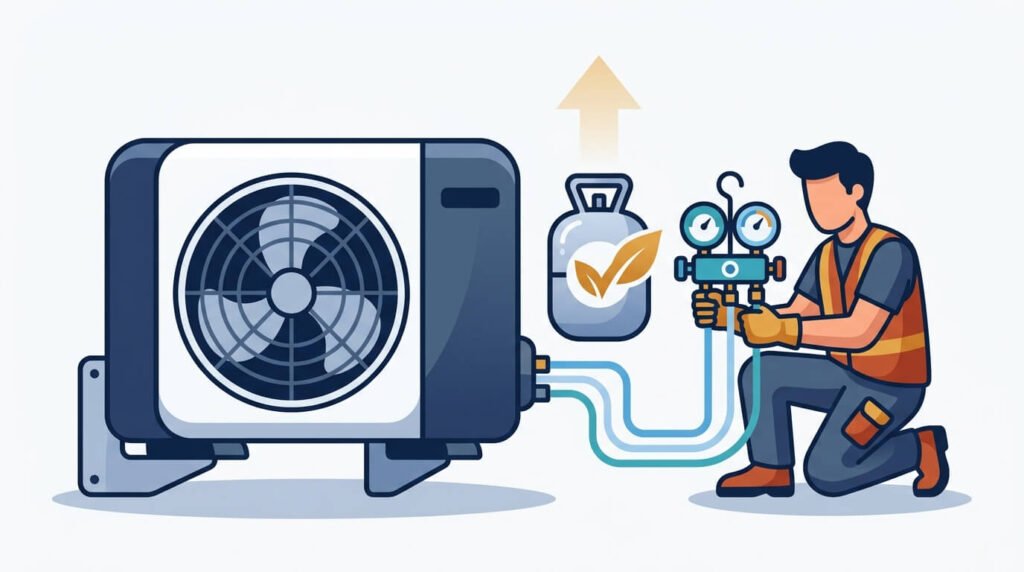
The refrigerant replacing R410A in new residential and light commercial equipment is one of two chemicals: R32 or R454B.
Both meet the EPA’s 700-GWP threshold, both are manufactured by every major refrigerant supplier, and which one shows up in a given system depends almost entirely on the equipment brand, not on anything the buyer chooses directly.
R32 and R454B: The Two Leading Replacements
R32 is a single-component HFC refrigerant with a GWP of 675. It has been used in split-system air conditioners outside the US for years and is favored by manufacturers with a global product line, since it simplifies inventory across markets that already use it.
R454B is a blend of 69% R32 and 31% R-1234yf, an HFO. Its GWP is 466, lower than pure R32, and it was engineered specifically to behave close to R410A in terms of pressure and capacity, which reduces redesign work for manufacturers converting existing product lines.
Both are classified A2L under ASHRAE Standard 34, meaning lower toxicity and mild flammability. Neither is toxic in the way older refrigerants like ammonia are, and neither burns easily under normal conditions.
Why the Switch Is Happening (GWP, Not Ozone)
The R410A transition has nothing to do with ozone depletion. That fight was already fought and won with R22, which contained chlorine and directly attacked the ozone layer.
R410A never had that problem; it earned the “safe” label decades ago precisely because it doesn’t damage ozone.
What R410A does have is a high global warming potential, meaning that if it leaks into the atmosphere, it traps far more heat than carbon dioxide over the same period.
The American Innovation and Manufacturing Act, passed in 2020, directed the EPA to phase down high-GWP HFCs across the economy, and HVAC equipment is one of the largest single-use categories affected.
The 700-GWP cutoff for new equipment took effect January 1, 2025, and it applies to manufacturing dates, not installation dates, which is where a lot of the confusion below comes from.
Is R410A Actually Banned?
R410A is not banned. It is being phased down, which is a narrower and more specific legal category than a ban, and the distinction changes what you’re actually allowed to do with an existing or newly purchased system.
What the EPA’s 2025–2026 Rules Actually Say
The EPA’s rule stopped new manufacturing of R410A residential equipment as of January 1, 2025.
It did not require existing R410A systems to be removed, and it did not initially prohibit installing equipment that was manufactured before that cutoff.
In May 2026, the EPA issued a further rule removing an installation deadline that had originally been set for later in 2026, which means pre-2025 R410A inventory can legally be installed for as long as that stock lasts.
Servicing an existing R410A system with R410A refrigerant remains legal indefinitely; there is no sunset date on that.
State Rules That Differ From the Federal Rule
The federal rule is the baseline, not the ceiling. States and cities can, and some do, keep stricter requirements even after the EPA loosens its own timeline.
- New York’s Department of Environmental Conservation adopted its own regulation, Part 494, which kept a January 1, 2026 installation deadline for new R410A equipment even after the EPA’s May 2026 rule removed that deadline federally.
- A contractor operating in New York cannot install leftover pre-2025 R410A inventory for a new job past that date, regardless of what a distributor still has in stock, because the state rule controls in that jurisdiction.
- Other states and municipalities may adopt similar carve-outs as building and mechanical codes catch up to the federal transition, so a rule that applies in one state is not guaranteed to apply next door.
- Before assuming the federal answer settles the question for your project, check your state’s environmental agency or your local building department, since that’s the only way to know which deadline actually governs your installation.
R32 vs. R454B vs. R410A: Full Comparison
Choosing between these three refrigerants isn’t really a choice most buyers make directly, but understanding the differences explains why your options look the way they do.
For a deeper breakdown of how R32 and R454B perform against each other specifically, see our full R32 vs. R454B performance comparison.
R454B VS R410A
See below the differences between R454B and R410A refrigerant:
| Feature | R410A | R454B |
| Composition | Blend of R32 (50%) and R125 (50%) | Blend of R32 (~68.9%) and R1234yf (~31.1%) |
| Type | HFC blend | HFC/HFO blend |
| Global Warming Potential (GWP) | ~2,088 | ~466 (about 78% lower) |
| Ozone Depletion Potential (ODP) | 0 | 0 |
| ASHRAE safety class | A1 (non-toxic, non-flammable) | A2L (non-toxic, mildly flammable) |
| Operating pressure | High | Very similar, slightly lower |
| Cooling capacity and efficiency | Baseline | Comparable, often slightly better efficiency |
| Refrigerant charge needed | Standard | Typically less, about 10–15% |
| Temperature glide | Near-azeotropic (negligible) | Small glide (about 1–1.5°C) |
| Compressor oil | POE | POE |
| Drop-in replacement? | N/A | No, it needs equipment designed for R454B |
| Service tools | Standard hoses and cylinders | A2L-rated tools, with left-hand-thread cylinder connections |
| Regulatory outlook | Being phased out in new equipment | Compliant with the ≤700 GWP limit for new residential and light commercial AC |
| Common trade names | Puron, Suva 410A, Forane 410A | Opteon XL41, Puron Advanced |
Key takeaway: R454B is the lower-GWP successor to R410A. It performs about the same, but it is mildly flammable, so it needs updated equipment, A2L-trained technicians, and the right tools. You cannot simply top up or swap it into an existing R410A system.
GWP, Capacity, and Efficiency Differences
| Property | R410A | R32 | R454B |
| GWP | 2,088 | 675 | 466 |
| ASHRAE Safety Class | A1 (non-flammable) | A2L (mildly flammable) | A2L (mildly flammable) |
| Composition | Blend (R32/R125) | Single component | Blend (69% R32 / 31% R-1234yf) |
| Capacity vs. R410A | Baseline | ~10% higher | Comparable to R410A |
| Manufacturing status | Stopped for new equipment Jan. 1, 2025 | Current standard for new equipment | Current standard for new equipment |
R32’s higher capacity means manufacturers building around it can use smaller compressors for the same cooling output, though R32 also runs at a higher discharge temperature, which requires design adjustments to stay within a safe operating range.
R454B was deliberately engineered to sit closer to R410A’s existing performance profile, which is part of why several major manufacturers chose it as their primary path rather than requiring a full compressor redesign.
Can You Put R32 or R454B Into an Existing R410A System?
No, you cannot put R32 or R454B into an existing R410A system, and this is the single most important technical fact in this entire transition.
R410A equipment was engineered, tested, and safety-listed as A1, non-flammable.
Charging an A2L refrigerant into that same hardware doesn’t just risk poor performance; it puts a mildly flammable gas into a system with components, seals, and electrical parts that were never rated to handle it safely, which is exactly what listing and certification standards exist to prevent.
If this sounds familiar, it should. The HVAC industry went through nearly the identical confusion during the previous refrigerant transition.
When R22 was phased out starting in 2010, plenty of homeowners and even some technicians assumed R410A could simply be poured into an old R22 refrigerant system.
It couldn’t, for the same underlying reason: R410A runs at meaningfully higher pressure than R22, and the compressors, metering devices, and line sets built for R22 were never designed to handle it.
The pattern repeating now with A2L refrigerants isn’t a coincidence; it’s what happens every time the industry moves to a chemically different refrigerant rather than a like-for-like substitute.
In both cases, the fix isn’t a refrigerant swap. It’s new equipment engineered and listed for the refrigerant you’re switching to.
Are A2L Refrigerants Safe?
Yes, A2L refrigerants are safe for normal residential and commercial use when installed in equipment designed and listed for them and serviced by a properly trained technician.
“Mildly flammable” describes a real but narrow risk category, not a hazard comparable to the fuels or gases most people picture when they hear the word flammable.
How flammable is R454B?
R454B is A2L, which means it is mildly flammable. Under ASHRAE Standard 34, “A” stands for lower toxicity, “2” for flammable, and “L” for a lower burning velocity of under 10 cm/s (R454B’s is about 5 cm/s).
It is much less flammable than propane (R290, A3, about 40 cm/s) but more flammable than R410A, which is non-flammable (A1).
Why R454B is hard to ignite:
- High ignition energy. It needs a much stronger ignition source than propane. An ordinary static spark or a standard light switch is very unlikely to ignite it.
- Narrow flammable range. It only burns when it mixes with air above its lower flammability limit (roughly 0.3 kg/m³) and an ignition source is present.
- Slow flame spread. If it does ignite, the flame moves slowly and is far less likely to cause an explosive reaction than A3 refrigerants.
How manufacturers keep it safe:
- Limited charge sizes, so a leak is unlikely to reach a flammable concentration in a room.
- Built-in leak detection sensors that switch on the fan to disperse leaked refrigerant.
- Ignition-safe components near refrigerant connections.
- Compliance with safety standards such as UL 60335-2-40 and ASHRAE 15.
Bottom line: R454B is flammable in principle, but it is very hard to ignite and burns slowly. With correct installation and A2L-trained technicians, the risk to homeowners is very low. R32, the other main R410A replacement, falls in the same A2L class.
What “Mildly Flammable” Actually Means
The A2L classification under ASHRAE Standard 34 sits between A1 (non-flammable, R410A’s category) and A3 (highly flammable, the category that includes propane and other hydrocarbon refrigerants like R290).
The distinguishing factor is ignition energy: A2L refrigerants require roughly 1,000 times more energy to ignite than A3-class refrigerants, according to industry safety literature on refrigerant flammability testing.
In practical terms, an open flame or a static spark that could ignite propane typically won’t ignite R32 or R454B under normal atmospheric conditions.
That gap is why code bodies allow A2L refrigerants in standard residential applications with additional precautions, rather than requiring the much stricter handling rules that apply to true A3 flammable refrigerants.
Safety Requirements for Technicians Working With A2L
Working safely with A2L refrigerants requires equipment and habits that go beyond standard R410A service work.
- Technicians need spark-free vacuum pumps and recovery machines with sealed relays, since standard tools can generate the kind of electrical arc that poses an ignition risk around a leak.
- A2L refrigerant cylinders use left-hand threaded fittings and red identification bands specifically so they can’t be confused with non-flammable refrigerant cylinders on a job site.
- New installations require active or passive leak detection systems built into the equipment, which shut down or ventilate the system automatically if refrigerant concentration crosses a safety threshold.
- Use A2L-rated tools and recovery equipment.
- Keep open flames and other ignition sources away from the work area.
- Ventilate the space and follow the manufacturer’s installation requirements.
- Technicians should complete manufacturer or industry A2L training before servicing this equipment, since the handling protocols differ enough from A1 refrigerant work that experience with R410A alone isn’t sufficient preparation. You can review the A2L refrigerant certification requirements for what that training typically covers.
What Does the New Refrigerant Mean for Your Wallet?
New refrigerant equipment costs more right now than comparable R410A systems did before the transition, and that gap is likely to persist for at least the next several years.
Anyone comparing the cost of a new heat pump or AC system in 2026 should expect the A2L price premium to factor into that number directly.
Why New Equipment Costs More Right Now
Several costs are stacking on top of each other during this transition.
Manufacturers had to redesign compressors, coils, and controls around a new refrigerant’s pressure and thermal profile, and that engineering cost shows up in retail pricing.
A2L-specific safety components, including leak detection sensors and updated electrical parts rated for use around a mildly flammable refrigerant, add material cost that R410A equipment never needed.
Meanwhile, contractors are investing in new spark-free tools and A2L training, and those costs get passed through in labor and installation pricing industry-wide.
As production scales and more manufacturers compete directly on A2L equipment, prices typically ease, similar to what happened in the years following the R410A transition itself, but there’s no fixed date when that happens.
Should You Buy Remaining R410A Stock or Go A2L?
Deciding between leftover R410A equipment and a new A2L system comes down to a short list of factors specific to your situation.
- Check your state and local rules first, since a jurisdiction like New York has already closed the door on new R410A installations regardless of what’s technically available federally.
- If your state still allows it, remaining pre-2025 R410A equipment is often priced below new A2L equivalents, which can matter if budget is the deciding factor and you plan to keep the system for its full service life.
- If you’re planning to keep the equipment 15 years or more, A2L equipment is the safer long-term bet, since R410A parts and refrigerant supply will only get scarcer and pricier over that time span- the same pattern R22 owners are living through today.
- Factor in available incentives before deciding either way, since many efficiency rebates and tax credits are now tied specifically to A2L-compatible equipment rather than legacy R410A systems. It’s worth reviewing current heat pump rebates and tax credits before you commit to either path.
Getting this decision right depends on the specifics of your equipment, your location, and your budget, which is exactly the kind of assessment a professional should walk through with you rather than a generic online calculator.
If you’re weighing a repair, a retrofit, or a full replacement, talk to a licensed HVAC contractor near you who can confirm which rules apply in your area and quote both R410A and A2L options side by side.
Frequently Asked Questions
Is R32 being phased out?
No, R32 is not being phased out. It is being phased down as part of the global HFC reduction, and it is one of the main replacements for R410A.
- It is a compliant replacement. R32 has a GWP of 675, about one-third of R410A’s. That is under the 700 GWP cap the US EPA set for new residential and light commercial air conditioners. This is why R32 and R454B are the two main R410A alternatives.
- The phase-down applies to HFCs as a group. Under the AIM Act (US) and the Kigali Amendment (global), total HFC production and consumption are being cut by 85% by 2036. This is a cap on overall quantities, not a ban on R32 specifically.
- Regulations vary by region and are still changing. In the EU, the revised F-gas rules tighten GWP limits on some small split systems in the coming years, so R32’s long-term future there is less certain. US rules have also been adjusted: some sources say the installation deadline for residential and light commercial equipment was removed in a May 2026 final rule, though the exact details aren’t specified.
- R32 is still a commodity refrigerant. Because R32 is pure and has no active patents, it is widely available and cost-effective.
Bottom line: R32 is safe to use in new equipment for the foreseeable future. Over the longer term, even lower-GWP options may gradually replace it, especially in Europe. Like R454B, R32 is an A2L refrigerant, so it needs proper handling.
Regulations differ by country, so we recommend you check in with your local regulator or HVAC professional for the latest rules.
Is R410A being phased out in 2026?
Yes, R410A is being phased down rather than banned outright.
New manufacturing of R410A residential equipment stopped on January 1, 2025, under the EPA’s AIM Act rule, and a May 2026 EPA rule removed the original 2026 installation deadline for pre-2025 inventory, meaning that stock can still be legally installed until it runs out.
Servicing existing R410A systems with R410A refrigerant remains legal with no end date currently set.
The practical effect is a slow supply squeeze rather than an immediate cutoff, similar to what happened with R22 starting in 2010.
What happened to R22, and is the same thing happening to R410A?
R22 went through a similar phase-down starting in 2010, with production and imports fully banned by 2020, and it’s a useful preview of what R410A owners can expect over the coming decade.
Both transitions followed the same pattern: production of the older refrigerant stopped first, existing systems kept operating legally, and supply of the phased-out refrigerant slowly became scarcer and more expensive as the years passed.
For a closer look at how the R22 phase-out played out before this, including current pricing and legal status, that history maps closely onto what R410A owners are likely to experience next.
[…] air conditioners use a different generation of gas altogether, covered in our guide to the new refrigerant now used in these […]