
Air conditioners are one of the highest electricity-consuming appliances in Nigerian homes and offices.
Whether you’re running a 1HP unit in a bedroom or a 2HP unit in the living room, understanding how many watts does an air conditioner use in Nigeria helps you plan smarter, from electricity bills to generator sizing and solar inverter capacity.
AC wattage is not fixed; it depends on the horsepower (HP) rating, whether you’re using an inverter or non-inverter model, and how long you run it daily. This article breaks all of that down so you can stop guessing and start calculating.
Expert Contributor:
Okorie, Udoka Ifeanyi | Assistant Chief Laboratory Technologist, Load Analysis Engineer (EE)
Department of Electrical and Electronic Engineering, School of Engineering
Maritime Academy of Nigeria, Oron, Akwa Ibom State
Contact: udoka.okorie@maritimeacademy.edu.ng | www.maritimeacademy.gov.ng
What Does AC Wattage Mean?
Definition of Wattage
Wattage is simply the amount of electrical power your air conditioner consumes while it is running. It is measured in watts (W) or kilowatts (kW).
Every AC unit has a power rating, and this tells you how much electricity it draws from the grid, your generator, or your inverter system at any given moment.
The higher the wattage, the more electricity it consumes and the more it costs to run.
Difference Between Watts and Kilowatts
One kilowatt (kW) equals 1,000 watts. So a 1,500W air conditioner is the same as a 1.5kW unit. The reason this matters is that the Nigerian Electricity Regulatory Commission (NERC) and electricity distribution companies bill users in kilowatt-hours (kWh) — not in watts.
A kilowatt-hour means you consumed 1kW of power for one hour. So a 1.5kW AC running for 4 hours uses 6 kWh. That is what shows up on your electricity bill.
Why Wattage Matters in Nigeria
Nigeria’s power supply situation makes wattage knowledge essential on multiple levels. First, your monthly electricity bill is directly tied to how many kWh your AC consumes.
Second, if you’re on a generator, knowing the running wattage and startup surge of your AC determines whether your generator can handle the load — or risk damage.
Third, for anyone considering solar, your AC’s wattage tells you what inverter capacity and battery storage size you actually need. Wattage is not just a technical number; it is a budgeting and planning tool.
How Air Conditioner Wattage Is Calculated
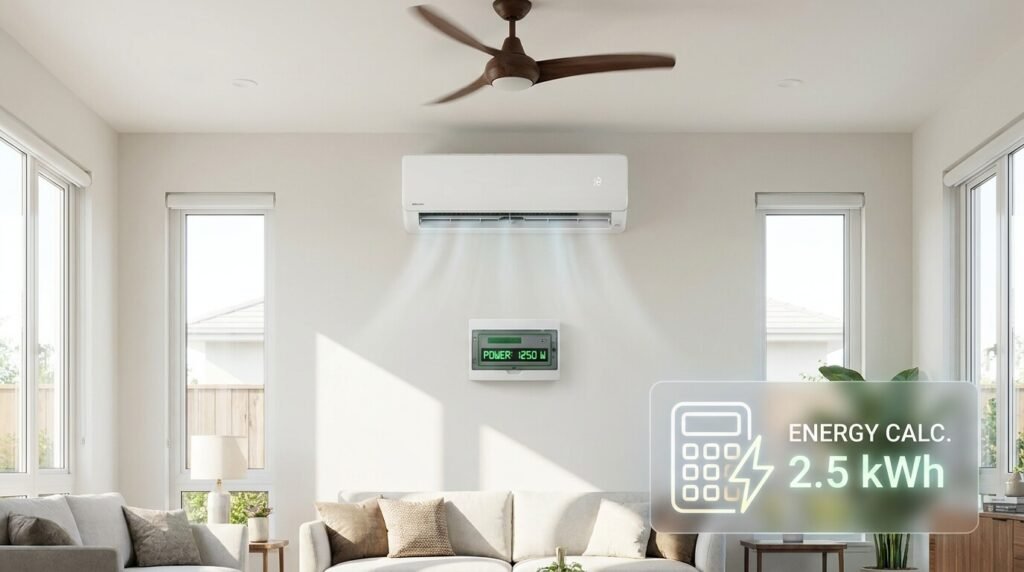
Horsepower (HP) to Watts Conversion
In Nigeria, air conditioners are commonly rated by horsepower (HP), which is a legacy unit of power. To get the wattage, you convert HP to watts.
The conversion is straightforward: 1HP = 746 watts. This standard was originally established by James Watt to compare the output of steam engines to the work done by horses, specifically, the ability to do 33,000 foot-pounds of work per minute.
That translates to approximately 746 watts in modern electrical terms.
“Power ratings are the same everywhere. What changes are the voltage and current at different frequencies? 1HP is approximately equivalent to 746 watts at 0.8 power factor. For a 2HP AC unit, the power consumed will be 746 watts × 2 = 1,492 watts. In Nigeria, we use 220V primarily. So for 1,492 watts at 220V, the current will be I = P ÷ (V × cos∅) = 1,492 ÷ (220 × 0.8) = 8.478 A. For American 110V spec, I = 1,492 ÷ (110 × 0.8) = 16.955 A. The only difference is the cable size — at 110V it would be twice as large — but power remains the same.”
— Okorie, Udoka Ifeanyi, Load Analysis Engineer, Department of Electrical and Electronic Engineering, Maritime Academy of Nigeria.
What this means practically: HP-to-watts conversion gives you the mechanical power equivalent, but actual electrical power consumption depends on the AC’s efficiency, power factor, and operating conditions.
Most manufacturers list the actual electrical input wattage on the product label; always check that figure.
Compressor Power Usage
The compressor is the heart of any air conditioning system and the biggest energy consumer in the unit. It compresses the refrigerant gas — typically R-410A — which drives the entire refrigeration cycle.
In a standard split AC, the compressor alone accounts for roughly 70–90% of total power consumption. This is the component that determines whether your air conditioner is easy on your electricity bill or not.
Compressor brands like Copeland are used across several mid-range and high-end AC units available in Nigeria.
Other Components That Consume Power
Beyond the compressor, a few other components add to the total wattage draw. The indoor and outdoor fan motors use power to circulate air across the evaporator and condenser coils.
The control board and display panel consume a small but consistent amount of electricity. Some modern ACs also include built-in air filtration or purification systems that add to the power draw.
Together, these secondary components typically add 50 to 150 watts on top of the compressor load.
Average Wattage of Common Air Conditioner Sizes in Nigeria
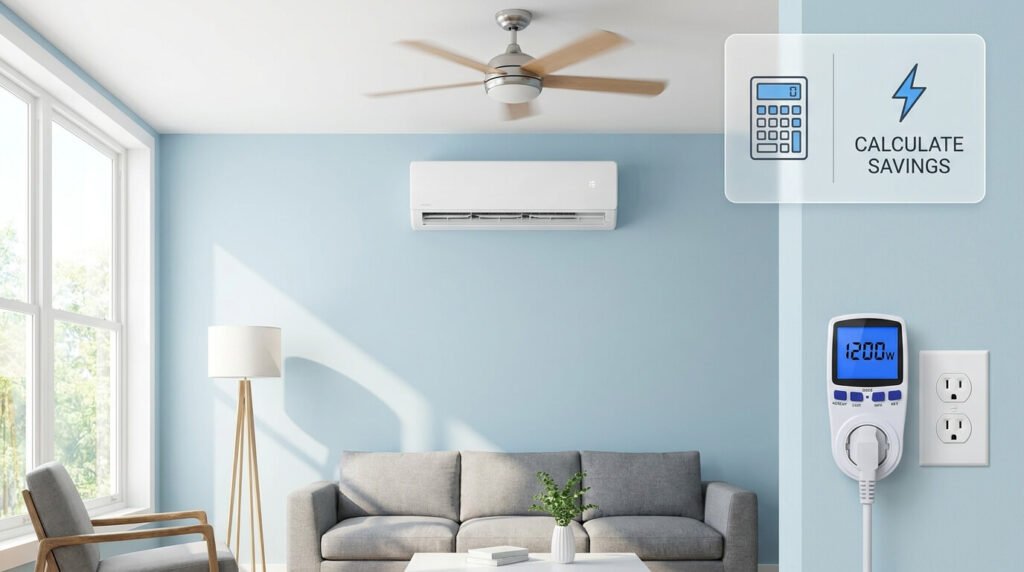
1HP Air Conditioner Wattage
A 1HP air conditioner is designed for small rooms, typically 10 to 15 square metres. The theoretical conversion gives 746W, but the actual electrical power consumption of a 1HP AC in Nigeria ranges between 700 and 900 watts, depending on the model and operating conditions.
Panasonic, Hisense, ScanFrost, Midea, Samsung, and LG Electronics, one of the most popular AC brands in Nigeria, produce 1HP units with actual running wattages within this range.
This size is practical for a small bedroom and places a manageable load on a backup power source.
1.5HP Air Conditioner Wattage
The 1.5HP AC is the most common household size in Nigeria. It works well in standard bedrooms and small offices. Its running wattage typically falls between 1,100 and 1,500 watts.
Hisense, a widely sold brand across Nigerian markets, offers several 1.5HP models in this range. If you are wondering about how many units of electricity an AC uses per hour in Nigeria, a 1.5HP unit drawing 1,200W uses 1.2 kWh per hour.
It runs a useful number to have when calculating the monthly cost.
2HP Air Conditioner Wattage
A 2HP air conditioner is built for larger spaces like living rooms and open-plan offices. According to Engr. Okorie’s calculation: 746 watts × 2 = 1,492 watts.
In practice, the actual power draw of a 2HP AC ranges between 1,500 and 2,200 watts, factoring in real-world efficiency, power factor, and the secondary components that also consume electricity.
Samsung Electronics and Panasonic produce popular 2HP split AC units available in Nigeria that fall within this range.
If you’re planning backup power for this size, you’ll want to read up on what size generator I need to run a 1.5HP air conditioner as a baseline, then scale up for 2HP requirements.
3HP and Above
3HP and above air conditioners are typically used in commercial spaces, server rooms, large offices, and open halls. A 3HP unit can draw anywhere from 2,200 to 3,000 watts or more.
These are not typical residential units, and running them on a standard home generator or inverter without proper load analysis is a recipe for equipment damage.
If you are running a business in Nigeria and managing multiple AC units, energy budgeting at this level requires careful planning around both PHCN tariffs and generator fuel costs.
Inverter vs Non-Inverter AC Power Consumption
How Inverter AC Reduces Watt Usage
An inverter AC uses a variable-speed compressor. Instead of shutting off completely and restarting when the room reaches the set temperature, the inverter compressor slows down and maintains a lower, consistent speed.
This eliminates the repeated high-power startup surges and means the AC uses significantly less electricity during steady-state cooling.
LG Electronics’ inverter lineup, for example, is designed specifically to adjust power consumption based on the real-time cooling demand of the room.
Over time, this translates to meaningful savings on both PHCN bills and generator fuel costs.
Why Non-Inverter AC Uses More Power
A non-inverter AC operates on a fixed-speed compressor. It runs at full power, and once the room hits the target temperature, the compressor switches off entirely.
When the room warms up again, it restarts at full power. This on/off cycle is where the inefficiency lies. Each startup draws a heavy current — the startup surge can be 2 to 3 times the running wattage.
Over hours of operation, a non-inverter AC from brands like Hisense in its basic range will consistently consume more electricity than an equivalent inverter model, especially in Nigeria’s warm climate, where the AC rarely gets to rest for long.
For more information about inverter ACs, read our guide on the difference between Non-inverter AC vs Inverter Air conditioners.
Real Electricity Cost Difference in Nigeria
The real-world electricity cost difference between inverter and non-inverter ACs in Nigeria is significant. An inverter AC can use 30 to 50% less electricity compared to a non-inverter unit of the same HP rating, depending on usage patterns.
For a household running its AC for 8 hours daily, that difference can amount to thousands of naira monthly.
If you’re also considering backup power options, you should explore Inverter AC and Generator, are they compatible? Because the answer affects how you plan your entire power setup.
Factors That Affect AC Watt Usage
Room Size
The physical dimensions of the room directly determine how hard the AC has to work. A 1.5HP AC installed in a 30-square-metre room will run its compressor almost continuously, drawing maximum wattage.
The same unit in a 14-square-metre room will cycle more efficiently. In Nigeria, room size matters even more because heat gain from direct sun on zinc roofing or poorly shaded walls adds to the cooling load significantly.
Always match your AC’s cooling capacity to your room size before purchase.
Temperature Settings
Every degree lower you set your thermostat increases the compressor’s workload and your electricity consumption.
Setting your AC to 16°C in a tropical environment like Nigeria means the compressor rarely slows down.
Honeywell and other thermostat manufacturers recommend setting ACs to between 24°C and 26°C for optimal comfort and energy efficiency in hot climates.
In Nigeria’s peak heat season, particularly between February and April, even this setting will keep the compressor working hard.
Duration of Use
Daily usage hours are one of the biggest determinants of your electricity bill. A 1.5HP AC drawing 1,200W running for 4 hours uses 4.8 kWh per day.
The same AC running for 10 hours uses 12 kWh, more than double. In Nigeria, where many households and offices run ACs through the night and into the afternoon, daily usage of 8 to 12 hours is common.
This directly shapes how much you pay on your monthly electricity bill and how much generator fuel or solar battery capacity you need.
Room Insulation
Insulation is not a topic many Nigerian homeowners think about, but it has a real impact on AC power consumption. A well-insulated room retains cool air and reduces the compressor’s duty cycle, the percentage of time it needs to run.
A room with gaps under doors, thin, curtainless windows, or direct afternoon sun exposure will warm up faster, forcing the AC to work harder.
Proper insulation per ASHRAE 90.1 guidelines enhances cooling efficiency (e.g., 7-50% potential savings per studies), and affordable fixes like blackout curtains plus door seals significantly cut energy needs in Nigerian homes.
How to Calculate AC Electricity Bill / Cost in Nigeria
Understanding Kilowatt-Hour (kWh)
The kilowatt-hour (kWh) is the unit that electricity providers operating under the Nigerian Electricity Regulatory Commission (NERC) framework use to calculate your bill.
One kWh = 1,000 watts consumed for one hour. Nigeria’s electricity tariff varies by distribution company and consumption band, but understanding kWh is your starting point for any cost calculation.
A smart meter, where available, tracks this in real time.
Calculating Daily AC Usage Cost
The formula is simple:
Daily Cost = (Wattage ÷ 1,000) × Hours of Use × Electricity Tariff per kWh
For example: A 1.5HP AC drawing 1,200W, used for 8 hours daily, at an electricity tariff of ₦68 per kWh (a common mid-band residential rate):
(1,200 ÷ 1,000) × 8 × 68 = 1.2 × 8 × 68 = ₦652.80 per day
This is the PHCN grid cost. Generator fuel cost will typically be higher per kWh when you factor in petrol consumption.
Monthly Electricity Cost Estimate
Multiply your daily cost by 30 for a monthly estimate. Using the example above: ₦652.80 × 30 = ₦19,584 per month from the grid alone, just for one 1.5HP AC.
If you are running two ACs, one in the bedroom, one in the sitting room, you’re looking at nearly ₦40,000 monthly in electricity just for cooling.
This level of energy budgeting is what helps Nigerian households make informed decisions about inverter upgrades, solar systems, and generator fuel allocation.
Can a Generator Power Your AC in Nigeria?
Generator Size Requirements for 1HP AC
A 1HP AC has a running wattage of around 700–900W. But because of the startup surge, which can spike to 1,500–2,000W at the moment the compressor starts, you need a generator with enough headroom.
A 2.0kVA generator is generally the minimum, though a 2.5kVA or 3kVA generator is more reliable for sustained operation.
Fireman’s Company’s generators or Honda generators are commonly used in Nigerian homes for this purpose due to their fuel efficiency and stable voltage output, which is critical for protecting AC compressors from voltage fluctuation damage.
Generator Size for 2HP AC
For a 2HP AC drawing up to 2,200W in running load, a 4kVA to 5kVA generator is more appropriate when the startup surge is factored in.
For detailed guidance on matching generator size to your specific AC, check out what size generator do I need to run a 1.5HP air conditioner for a full breakdown of generator-to-AC compatibility.
Startup Surge Considerations
Startup surge, also called inrush current, is one of the most misunderstood aspects of powering ACs in Nigeria.
When the AC compressor first kicks on, it draws 2 to 3 times its normal running current for a brief moment. A generator or inverter that is sized only for the running wattage will trip, struggle, or sustain damage when this surge hits.
This is especially important for inverter power systems, which have surge limits. Always account for at least 2× the running wattage as your minimum generator or inverter surge capacity when sizing backup power for an AC.
Can Solar Power Run an Air Conditioner?
Solar Inverter Capacity Requirements
Running an AC on solar is increasingly popular in Nigeria, especially with the improvement in solar inverter technology.
The starting point is matching your solar inverter’s capacity to your AC’s wattage and then adding a buffer for the startup surge.
For a 1.5HP AC drawing 1,200W, you need a solar inverter rated at least 2kVA, ideally 3kVA. Solar inverter compatibility with ACs is a nuanced topic; see the best solar air conditioners available in Nigeria for models specifically designed for solar and low-power environments.
Battery Storage Needs
Battery storage determines how many hours your AC can run when the sun is not shining. For a 1.5HP AC at 1,200W, running for 8 hours off battery, you need: 1.2kW × 8 hours = 9.6 kWh of usable battery capacity.
Given that you should not discharge most lithium batteries below 20–30%, your actual battery bank should be sized at 12–14 kWh.
This is a significant investment, but it eliminates both PHCN dependency and generator fuel costs in the long run. Tesla and other manufacturers produce deep-cycle battery solutions for this purpose.
Best AC Type for Solar Systems
Inverter ACs are the clear winner for solar systems. Their variable-speed compressors mean they draw lower, more stable wattage during normal operation, which is exactly what a solar inverter and battery system needs to manage efficiently.
Non-inverter ACs with their full-load startups and high surge currents are harder on battery banks and solar inverters.
For anyone building a solar-powered home in Nigeria, pairing a quality solar system with the best inverter AC for generator use in Nigeria is a smart dual-purpose investment. These ACs perform better on both solar and generator backup.
How to Reduce Air Conditioner Electricity Consumption
Choose Inverter AC
The single biggest thing you can do to reduce AC electricity consumption in Nigeria is to go with an inverter AC.
The energy efficiency ratio (EER) of inverter ACs is significantly higher than that of non-inverter models. Brands like LG Electronics, Daikin Industries, and Samsung Electronics all offer inverter AC lines that are well-suited to Nigeria’s climate and power conditions.
The higher upfront cost pays itself back in lower electricity bills within 12 to 18 months of use for most Nigerian households.
Set Efficient Temperature Levels
Set your thermostat to 24°C–26°C and use the fan mode or sleep mode when cooling demand is lower.
Sleep mode available on most modern ACs from LG and Samsung gradually raises the temperature by 1–2°C after you fall asleep, reducing power use without sacrificing comfort.
Avoid setting extreme temperatures like 16°C; this keeps the compressor running at maximum load continuously, burning through electricity with no proportional comfort benefit.
Maintain the AC Properly
A dirty air filter forces the AC to work harder to pull air through the evaporator coil, increasing power consumption without improving cooling.
Clean your filters every 2–4 weeks, especially during Nigeria’s dusty harmattan season. Have a technician service the condenser coil and check the refrigerant level at least once a year.
A well-maintained AC with clean coils and correct refrigerant charge operates closer to its rated efficiency and uses less electricity to deliver the same cooling.
Improve Room Insulation
Reducing heat gain in your room directly reduces how hard your AC works.
Practical steps for Nigerian homes include: installing thick blackout curtains to block solar radiation, sealing gaps under doors, using ceiling insulation boards to block heat from roofing, and avoiding leaving the AC running in a room with an open window or door.
These changes reduce the compressor’s duty cycle and translate to lower electricity consumption over time — without any change to the AC unit itself.
Common Mistakes About AC Wattage
Assuming HP Equals Exact Watt Usage
A common assumption is that 1HP = exactly 746W and nothing else. As Engr. Okorie noted, “It is an approximate value… depending on the horse breed.”
In practical terms, the 746W figure is the mechanical conversion, not the actual electrical input power of the AC. Real power draw depends on the AC’s efficiency rating, its power factor (typically 0.8 for most AC units), the operating conditions, and the specific components used.
Always check the appliance efficiency label on the unit or the manufacturer’s datasheet for actual electrical input wattage.
Ignoring Startup Power Surge
Many Nigerians size their generators or inverters based on running wattage alone and then wonder why the generator trips or the inverter shuts down when the AC starts.
Startup surge is real, it is significant, and it must be factored in. A 1.5HP AC with a 1,200W running wattage can draw 2,400–3,600W at startup.
If your generator is rated 2kVA, it simply cannot handle this surge. This mistake leads to costly generator and inverter repairs that are entirely avoidable with proper load analysis.
Underestimating Monthly Electricity Cost
Daily AC use adds up in a way that catches most Nigerian households off guard. A unit that costs ₦600 per day to run seems harmless until it becomes ₦18,000 per month, every month.
Add a second AC, and you are at ₦36,000 monthly. This is before generator fuel costs, which are higher per kWh than grid electricity.
Understanding monthly electricity cost is not just about budgeting; it is about making smart long-term decisions, whether that means switching to an inverter AC, investing in solar, or simply being more deliberate about daily usage hours.
Conclusion
Air conditioner wattage in Nigeria depends on AC size, technology type, and how you use it. A 1HP unit draws 700–900W; a 1.5HP draws 1,100–1,500W; and a 2HP pulls up to 2,200W.
These numbers directly shape your electricity bill, generator requirements, and solar system sizing. Inverter ACs are more energy-efficient and gentler on backup power systems.
Before buying any AC, think through your room size, daily usage hours, and available power source. Whether you’re on the grid, a generator, or solar, understanding your AC’s wattage puts you in control of your energy costs, not the other way around.
For clarity and other inquiries, kindly contact Engr. Okorie on: +234 803 267 8464 or +234 902 299 6474.