
An evaporative cooler cools a room well only when the air is hot and dry, while a portable air conditioner cools in any weather.
The reason is the wet-bulb temperature, the lowest temperature evaporation can reach. In desert air, that limit sits far below the thermometer reading.
In humid coastal or tropical air, it sits barely below it, so an evaporative cooler manages a degree or two and leaves the room damper.
This evaporative cooler vs portable air conditioner comparison covers cooling power, running cost, health effects, and sizing, and it shows you how to test your own weather before you spend money.
| Factor | Evaporative cooler | Portable air conditioner |
|---|---|---|
| Cooling in dry air | Strong: The U.S. Department of Energy says evaporative coolers lower air temperature by 15°F to 40°F in low humidity | Strong |
| Cooling in humid air | Weak, a few degrees at most | Strong |
| Running cost | Lower electricity use | Higher electricity use |
| Effect on room humidity | Raises it | Lowers it |
What is the difference between an evaporative cooler and a portable air conditioner?
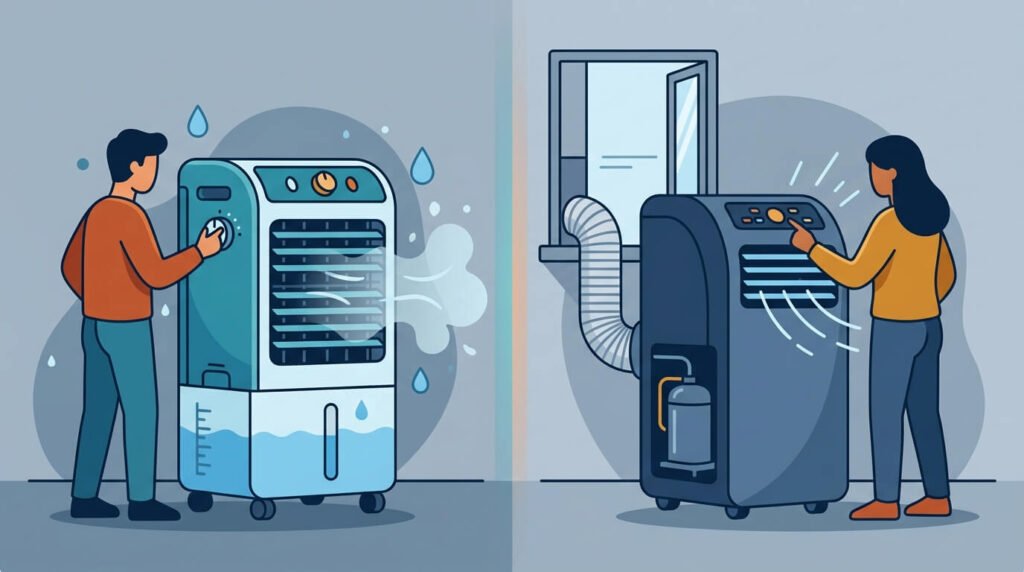
An evaporative cooler lowers air temperature by evaporating water, so the air leaves cooler and wetter.
A portable air conditioner removes heat from the room with a refrigerant loop, sends it outside through a hose, and pulls moisture out of the air along the way.
One trades heat for humidity. The other moves heat out of the room.
How does an evaporative cooler work?
Evaporative cooler: a cooler that lowers air temperature by evaporating water. A pump keeps porous pads wet, and a fan pulls air through them.
The water absorbs heat as it evaporates, so the air leaves cooler and more humid. There is no compressor and no refrigerant. For a fuller walkthrough, see how an evaporative cooler works.
How does a portable air conditioner work?
Portable air conditioner: a self-contained room cooler that removes heat with a refrigerant loop.
The compressor and coils sit inside the unit, and an exhaust hose carries the removed heat out through a window or door.
Moisture pulled from the air collects as condensate in a tray or drains away. Because the compressor is in the room, the retailer Mitre 10 warns that these units can be noisy.
Evaporative cooler vs swamp cooler vs air cooler: are they the same thing?
Swamp cooler and evaporative cooler are two names for the same device, and “air cooler” is the usual label for the portable version in many markets.
All three cool by evaporation. None of them is a plain fan, which moves air without cooling it, and none is a dehumidifier, because an evaporative cooler adds moisture to the air.
Evaporative cooling vs reverse cycle: where portable heat pumps fit
If you’re weighing evaporative cooling vs reverse cycle, the portable heat-pump air conditioner is the unit to compare.
The Australian consumer group CHOICE sorts portable coolers into two basic types: evaporative coolers and heat-pump air conditioners. “Reverse cycle” is the Australian term for a heat pump, which runs the same refrigerant loop in reverse to heat a room as well as cool it.
In cooling mode, it behaves like the portable air conditioner described above, so everything this guide says about portable air conditioners applies to it. Heating performance is outside the scope of this guide.
Do evaporative coolers work in humid climates?
Evaporative coolers work poorly in humid climates. Evaporation slows in air that already holds a lot of moisture, so there is little cooling to gain, and the unit adds humidity to a room that was already damp.
The Air-Conditioning, Heating, and Refrigeration Institute (AHRI) says evaporative coolers work best in very dry climates and are not suitable for much of the East Coast, the Midwest, and the coastal U.S.
What humidity is too high for an evaporative cooler?
The humidity a cooler can tolerate falls as the air gets hotter. PickHVAC’s chart of optimum humidity by temperature shows the band.
| Air temperature | Optimum relative humidity |
|---|---|
| 80°F (27°C) | 40% to 60% |
| 85°F (29°C) | 40% to 55% |
| 90°F (32°C) | 25% to 45% |
| 95°F (35°C) | 20% to 35% |
| 100°F (38°C) | 15% to 25% |
| 105°F (41°C) | 10% to 20% |
Relative humidity alone can mislead, because the same percentage means a different wet-bulb temperature at different heat.
Design criteria published by Istanbul Technical University use wet-bulb figures instead.
| Cooling goal | Minimum wet-bulb depression | Maximum wet-bulb temperature |
|---|---|---|
| Comfort cooling | 22°F (12°C) | 77°F (25°C) |
| Relief cooling | 16°F (9°C) | Not stated |
Wet-bulb depression is the gap between the air temperature and the wet-bulb temperature. It is the most cooling evaporation can deliver.
How to check your local wet-bulb temperature before you buy
This test takes about five minutes and settles the question for your weather.
- Look up the air temperature and relative humidity for the hottest hour in your hottest month, using a weather app or local climate records.
- Convert those two readings to a wet-bulb temperature with any free psychrometric or wet-bulb calculator.
- Subtract the wet-bulb temperature from the air temperature to get the wet-bulb depression.
- Estimate the supply air temperature as the air temperature minus 0.7 times the depression. The 0.7 treats the pads as about 70% effective, and it matches PickHVAC’s published supply-air chart within about 1°F at the points compared, including 84°F supply air at 90°F and 70% humidity.
- Compare your numbers with the thresholds above. A depression of at least 22°F with a wet-bulb no higher than 77°F points to comfort cooling. A depression under 16°F means you should buy an air conditioner.
Two worked examples show the range. At 100°F and 15% humidity, the wet-bulb temperature is about 67°F, the depression is 33°F, and supply air comes out near 77°F, so the cooler passes.
At 90°F and 65% humidity, the wet-bulb temperature is about 80°F, the depression is under 10°F, and supply air comes out near 83°F, so the cooler fails.
Does a portable air conditioner work in high humidity?
- Yes, a portable air conditioner keeps cooling in humid air because its refrigerant loop does not depend on evaporation.
- It removes moisture as it cools, and the water collects as condensate.
- Some of its capacity goes to drying the air, so a unit that is too small for the room will struggle in muggy weather.
- A single-hose model pulls replacement air into the room through gaps, and in humid weather that air arrives wet.
- It works best in a closed room, because open doors let humid air in.
Is evaporative cooling as good as air conditioning?
Evaporative cooling is as good as air conditioning only in hot, dry air, and this guide covers portable units only, so for whole-home systems, read evaporative cooling vs air conditioning.
In humid air, the gap is large. A portable air conditioner cools to its thermostat setting in either climate, while an evaporative cooler’s result swings with the weather, as the table below shows.
How much cooler will each one make a room?
| Weather | Air temp / RH | Wet-bulb | Evaporative drop | Supply air | Room humidity with evaporative cooler | Portable AC |
|---|---|---|---|---|---|---|
| Hot desert | 100°F (38°C) / 15% | 67°F | 23°F | 77°F | Rises, usually welcome | Cools and dries the air |
| Hot semi-arid | 95°F (35°C) / 30% | 72°F | 16°F | 79°F | Rises, usually welcome | Cools and dries the air |
| Humid subtropical | 90°F (32°C) / 65% | 80°F | 7°F | 83°F | Rises in already damp air | Cools and dries the air |
| Tropical coastal | 88°F (31°C) / 80% | 83°F | 4°F | 84°F | Rises in already damp air | Cools and dries the air |
| Tropical rainy season | 86°F (30°C) / 90% | 84°F | 2°F | 84°F | Rises in already damp air | Cools and dries the air |
These are illustrative figures, calculated with the Stull wet-bulb approximation and a 70% effectiveness assumption. Small portable pads can do worse.
Air cooler vs fan: what is the real difference?
An air cooler is an evaporative cooler, and with the water off, it behaves like a fan. Evaporative coolers rely heavily on the fan for much of the cooling effect people feel.
| Feature | Fan | Evaporative cooler, fan only | Evaporative cooler, with water | Portable AC |
|---|---|---|---|---|
| Lowers air temperature | No | No | Yes, depending on humidity | Yes |
| Adds moisture | No | No | Yes | No |
| Removes moisture | No | No | No | Yes |
| Needs water | No | No | Yes | No |
| Needs a vent hose | No | No | No | Yes |
Why some “portable air conditioners” are really evaporative coolers
- Check the spec sheet for a compressor or refrigerant, because a unit without either is an evaporative cooler.
- Look for an exhaust hose, since a true portable air conditioner needs one to send heat outside.
- Treat a price far below other compressor units with suspicion; evaporative coolers cost much less than compressor-driven portable air conditioners.
- A listing with no BTU or SACC figure gives you nothing to compare against a real air conditioner.
Evaporative cooler vs air conditioner power consumption
An evaporative cooler uses far less electricity than an air conditioner, with published savings between 60% and 80% depending on the source.
The U.S. Department of Energy says evaporative coolers use about one-quarter as much energy as central air conditioning, and the U.S. Department of Housing and Urban Development (HUD) puts the savings at 60 to 80 percent.
The savings only pay off when the cooler actually cools your room.
How many watts and kWh does each one use?
| Source | Scope | Electricity finding |
|---|---|---|
| U.S. Department of Energy | Evaporative cooling vs central air conditioning | About one-quarter as much energy |
| HUD | Swamp coolers vs air conditioners | 60 to 80 percent less electricity |
| University of Arizona (2007) | 2,000 sq ft home in Tucson | As low as 250 kWh a month vs. about 850 kWh, or $25 vs. $85 at 2007 prices |
| Research | Portable and room evaporative coolers | 18 W to 228 W, against about 900 W for a medium window air conditioner |
| CHOICE (Australia) | Portable evaporative coolers | About 3 to 7 Australian cents an hour for electricity |
Portable air conditioner wattage varies by model, and the spec label lists it. Air conditioners generally use two to four times more electricity than swamp coolers.
What does each one cost to buy and to own over five years?
Purchase price is the smaller part of the comparison. Add pads and electricity before deciding.
| Cost item | Evaporative cooler | Portable air conditioner |
|---|---|---|
| Example price in Bob Vila’s review | $171 for a Hessaire MC18M | $378 for a Black+Decker 14,000 BTU unit |
| Warranty or lifespan Bob Vila cites | About five years of warranty coverage | About 10 years average lifespan |
| Consumables | Pads, replaced at least twice a season | Filters, cleaned or replaced periodically |
| Five-year formula | Price + pads + (yearly kWh × rate × 5) | Price + (yearly kWh × rate × 5) |
Prices change often, so check current listings before you plug numbers into the formula.
Cost per degree of cooling: is the cheaper-to-run unit really cheaper?
A lower wattage saves money only if the unit delivers cooling. Cost per degree of cooling shows which unit is cheaper in your weather.
- Pick the weather row from the table above that is closest to your hottest weeks.
- Take the evaporative temperature drop for that row.
- Divide the unit’s hourly electricity use in kilowatt-hours (watts divided by 1,000) by that drop.
- Run the same division for the portable air conditioner, using its SACC BTU output and its watts.
A hypothetical shows how much weather matters. A 100-watt evaporative cooler uses 0.1 kWh an hour. If it delivers a 23°F drop in desert air, it costs about 0.004 kWh per degree-hour.
If it delivers 1.7°F in tropical rainy-season air, it costs about 0.056 kWh per degree-hour, roughly 13 times as much for the same unit.
A low-wattage unit that delivers one degree costs more per degree than a higher-wattage unit that delivers ten.
Water use: does an air conditioner use and need water?
An air conditioner needs no water to cool, but it produces some, and the electricity behind it uses water too.
| Water pathway | Evaporative cooler | Portable air conditioner |
|---|---|---|
| Direct water use | Portable units need about 1 to 4 liters (0.3 to 1 gallon) an hour, according to CHOICE; a whole-home swamp cooler in Tucson averaged 150 gallons a day in summer, according to the University of Arizona | None needed for cooling |
| Water you collect | None | Condensate builds up in a tray or drains away and needs regular emptying |
| Water behind the electricity | Less, because the unit draws less power | More, because the unit draws more power |
The Arizona study adds a caution. Hydropower, about 12% of Arizona’s electricity, consumes roughly 65 gallons of water per kilowatt-hour through reservoir evaporation, so the power source changes the comparison.
For where condensate comes from and what happens to it, see if an air conditioner uses and needs water.
Which is healthier: an air cooler or an air conditioner?
An air conditioner is the healthier choice for pollen, wildfire smoke, and humid weather. An evaporative cooler is a reasonable choice in dry weather when outdoor air is clean, and an open window is fine.
Allergies, pollen, and wildfire smoke
- A portable air conditioner cools a closed room, which keeps pollen and outdoor pollutants out, and counts that in its favor for people with allergies.
- An evaporative cooler needs an open window or door, so pollen and smoke enter along with the cooled air.
- The Department of Energy points out that an evaporative cooler supplies a steady stream of fresh air instead of recirculating the same air, which helps when outdoor air is clean.
- In wildfire areas, we recommend a dual-hose portable air conditioner because dual-hose units pull in little or no outside air, while single-hose models draw in air, smoke, and odor.
Humidity, mold, and damp
- Evaporating water raises indoor humidity, and AHRI says that in very dry climates, the added moisture can reach uncomfortable levels.
- HVAC technicians link the added humidity to mold and mildew risk in humid areas.
- A portable air conditioner removes moisture as it cools, so it leaves the room drier.
- In dry climates, most technicians treat the added moisture as a benefit.
- HUD advises cracking a window while a swamp cooler runs to prevent moisture buildup.
Do evaporative coolers need open windows?
Yes. An evaporative cooler needs at least one window or door partly open so air can escape, and a portable air conditioner needs the opposite.
| Feature | Evaporative cooler | Portable AC, single-hose | Portable AC, dual-hose |
|---|---|---|---|
| System type | Open | Closed | Closed |
| Windows and doors | Partly open so air can leave | Closed apart from the hose | Closed apart from the hoses |
| Effect on fresh air | Brings outdoor air in | Recirculates room air and pulls replacement air through gaps | Recirculates room air with little outside air pulled in |
| If set up wrong | A sealed room gets damp and cools less | Open doors let cooled air out and the unit runs longer | Open doors let cooled air out and the unit runs longer |
How often does each one need cleaning?
| Task | Evaporative cooler | Portable AC |
|---|---|---|
| Water tank | Empty and sanitize at least twice a week | Not applicable |
| Pads or filters | Clean monthly and replace at least twice a season, or monthly under constant use | Check about twice a month |
| Drain tray | Not applicable | Drain regularly |
The schedules above are very important. For the full procedure, see how to clean an evaporative cooler.
How to size an evaporative cooler or a portable air conditioner
Size a portable air conditioner by its SACC rating, not the BTU number on the box, and size an evaporative cooler by airflow in cubic feet per minute (CFM).
An undersized unit runs constantly and never reaches your target temperature.
SACC vs ASHRAE BTU: which rating is real?
Before you compare boxes, run your room through a portable air conditioner BTU calculator and match the result to a SACC rating.
SACC is the real one. It stands for Seasonal Adjusted Cooling Capacity, a weighted average of a unit’s performance at different temperatures and humidity levels that also accounts for air leaking into the room around single-hose units.
It is always lower than the ASHRAE number on the box.
| ASHRAE BTU (box) | SACC BTU | Typical room size |
|---|---|---|
| 8,000 | 4,000 to 6,000 | 125 to 250 sq ft |
| 10,000 | 6,000 to 7,000 | 250 to 300 sq ft |
| 12,000 | 7,000 to 10,000 | 300 to 450 sq ft |
| 14,000 | 9,000 to 12,000 | 400 to 550 sq ft |
Single-hose vs dual-hose portable air conditioners
| Feature | Single-hose | Dual-hose |
|---|---|---|
| Condenser air source | Room air | Outside air through a second hose |
| Effect on room pressure | Pulls replacement air in through gaps and cracks | Keeps pressure balanced |
| SACC for a 12,000 BTU ASHRAE unit | 7,000 to 8,500 BTU | 9,000 to 10,000 BTU |
| Best fit | Small rooms and spot cooling | Larger rooms and wildfire areas |
What size evaporative cooler do I need?
CHOICE gives a rule of thumb: divide the room’s volume by two to get the airflow the cooler should deliver. In cubic feet, the answer is in CFM.
| Room area | Volume at an 8-foot ceiling | Airflow needed |
|---|---|---|
| 120 sq ft | 960 cu ft | 480 CFM |
| 200 sq ft | 1,600 cu ft | 800 CFM |
| 300 sq ft | 2,400 cu ft | 1,200 CFM |
| 450 sq ft | 3,600 cu ft | 1,800 CFM |
| 950 sq ft | 7,600 cu ft | 3,800 CFM |
The table applies CHOICE’s rule to standard ceiling height. As a cross-check, other brands list a Hessaire cooler rated at 3,100 CFM for up to 950 square feet, a little under what the rule gives, so treat the rule as a cautious upper estimate.
Which is best: an evaporative cooler or a portable air conditioner?
Choose an evaporative cooler if your wet-bulb test passes and a window can stay open, and choose a portable air conditioner in every other case.
In humid or smoky air, or in a sealed room, an evaporative cooler will not deliver.
Choose an evaporative cooler if
- Your wet-bulb test shows a depression of at least 22°F and a wet-bulb temperature below 77°F.
- You can keep a window or door partly open whenever the unit runs.
- Outdoor air where you live is clean enough to let in.
- You want the lowest electricity bill and can empty and sanitize the tank twice a week.
- Extra humidity is welcome, as it is in dry desert homes.
Choose a portable air conditioner if
- Your local wet-bulb temperature is above 77°F, or summer humidity regularly tops 60%.
- Pollen, wildfire smoke, or pollution is a concern, in which case a dual-hose unit is the better pick for smoke.
- You need a set indoor temperature, whatever the humidity, since PickHVAC notes that air conditioners keep cooling consistently across humidity levels.
- You can’t leave a window open because of security or noise, a point HUD raises for swamp coolers.
- You want the room to feel less damp.
Five questions to answer before you buy
- Does your wet-bulb test pass? If not, choose a portable air conditioner and skip the rest.
- Can a window or door stay partly open? If not, choose a portable air conditioner.
- Are pollen, smoke, or damp a concern? If yes, lean toward a portable air conditioner, and pick dual-hose for smoke.
- What SACC or CFM does your room need? Use the two sizing tables above.
- What will five years cost, counting pads and electricity? Use the formula from the cost table.
Not sure which side of the wet-bulb line you’re on? Get a recommendation for your room size and local weather in your Locality.
Everything above applies to a single room. Cooling a whole house changes the numbers, because ducted evaporative systems and central air conditioning differ in installation cost, water demand, and humidity limits.
Evaporative cooler vs portable air conditioner: your questions answered
Can I use an evaporative cooler and a portable air conditioner in the same room?
No, avoid running them together. HUD’s energy guidance says swamp coolers and air conditioners should never be used to cool the same space at the same time.
The two work against each other: the evaporative cooler needs an open window to vent moisture, which lets cooled air escape from the air conditioner, and it adds humidity that the air conditioner then has to remove.
If one unit isn’t enough, run the portable air conditioner alone and check that it is sized by SACC.
Can a portable air conditioner work without a window?
Only if the exhaust hose has another way to reach the outdoors. The hose carries out the heat the unit removes, so a hose that ends inside the room puts that heat straight back.
A window kit, a sliding-door panel, or any other opening to the outside works. Portable units need external ducting and should sit near a window suited to the hose.
If you can’t vent at all, an evaporative cooler is the only portable option, but it also needs an open window.
Are evaporative coolers quieter than portable air conditioners for sleeping?
Not reliably, because the ranges overlap. The quietest portable air conditioners run at about 42 dB, and most fall between 50 and 53 dB.
Evaporative coolers could also be from 36 dB to 50 dB on another unit. Don’t forget that inverter compressors make fewer abrupt sounds because they run longer.
Compare the decibel rating at the fan speed you would use overnight, since some published figures are sleep-mode minimums.
Does a two-stage evaporative cooler fix the humidity problem?
Partly. A two-stage cooler pre-cools the air through a heat exchanger before it reaches the wet pad, so it adds less moisture.
According to AHRI, its supply air lands at 50 to 70 percent relative humidity, against about 80 percent for a traditional single-stage unit, and ASHRAE puts its energy saving at 60 to 75 percent.
AHRI also says the improvement depends on location and that evaporative coolers stay unsuited to much of the East Coast, Midwest and coastal U.S., so run the wet-bulb test first.