
Evaporative cooling costs 75–90% less to run than refrigerant-based air conditioning, but it works well only in dry climates, and the line between “works great” and “makes your house worse” comes down to one number: your local dew point.
If you’ve been comparing evaporative cooling vs air conditioning and getting conflicting advice, that number is why.
Both systems lower the temperature of the air in your home. How they do it, what they cost, and where each one fails are almost entirely different questions, and this guide answers all three.
How Evaporative Cooling and Air Conditioning Actually Work
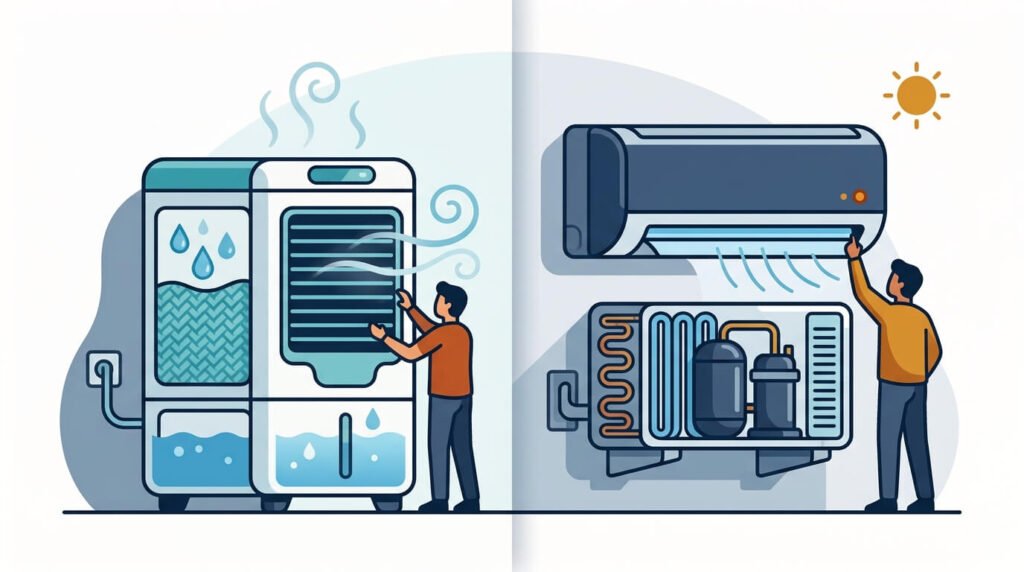
Evaporative coolers use water and airflow. Air conditioners use a chemical refrigerant and mechanical compression.
That single difference explains nearly every trade-off between the two systems: cost, climate sensitivity, humidity impact, and maintenance all trace back to it.
How evaporative (swamp) coolers work
An evaporative cooler pulls warm outdoor air through cooling pads that are kept continuously wet. As the air passes through the pads, some of the water evaporates, and evaporation absorbs heat from the surrounding air.
The cooled, more humid air is then pushed into the room, and an equal volume of indoor air escapes through an open window or vent.
Wet-bulb temperature is the lowest temperature air can reach through evaporation alone, and it sets the hard ceiling on how cold an evaporative cooler can ever make a room.
This term matters later; it’s the reason coolers underperform in some climates even when the humidity doesn’t feel obviously high.
How refrigerant-based air conditioning works
Central and split-system air conditioners use a refrigerant that cycles between liquid and gas.
Indoors, the refrigerant absorbs heat from room air as it evaporates; outdoors, a compressor pressurizes the gas back into a liquid, releasing that heat outside.
Unlike an evaporative cooler, an AC system recirculates the same indoor air rather than pulling in fresh air from outside, and it removes moisture from that air as a byproduct of cooling it.
This is also where AC and evaporative cooling vs reverse cycle air conditioning most often get confused.
Reverse-cycle systems use this same refrigerant cycle but can also run in reverse to provide heating, which evaporative systems cannot do at all.
The 60-Second Climate Test: Will Evaporative Cooling Work Where You Live?
You can find out in under a minute whether evaporative cooling will work in your climate, and the metric to check is dew point, not the relative humidity percentage your weather app shows by default.
Find your local summer dew point
- Search “[your city] average dew point July” or check a source like weather.gov’s climate normals for your area.
- Look specifically at the 3 p.m. average dew point during your hottest month, since that’s when cooling demand peaks.
- Compare that number against three bands: under 55°F, evaporative cooling works well; 55–65°F, performance is noticeably weaker and inconsistent; above 65°F, an evaporative cooler will typically add unwanted moisture without providing much cooling relief.
- If you’re near a threshold, check whether your area has a seasonal spike — Arizona and New Mexico, for example, see a monsoon season roughly from July through September when dew points rise sharply even though the region is dry the rest of the summer.
A city like Phoenix regularly sits below a 55°F dew point on summer afternoons outside monsoon season, which is why evaporative cooling performs so reliably there.
A city like Atlanta or Houston routinely sits above 65°F through the entire summer, which is why the same equipment underperforms there regardless of how it’s installed or maintained.
Why dew point matters more than “humidity percentage”
Relative humidity by itself doesn’t tell you how much cooling an evaporative system can deliver; dew point does, because it reflects the actual amount of moisture in the air rather than a ratio that changes with temperature.
Relative humidity is a percentage that changes as air temperature changes, even when the actual amount of moisture in the air stays the same.
Dew point measures the absolute moisture content, so it stays consistent across a hot afternoon and a cool evening in a way relative humidity does not.
That consistency is what makes it the right variable to check when you’re evaluating a cooling technology whose entire mechanism depends on how much additional moisture the air can absorb.
This connects directly back to wet-bulb temperature. As dew point rises, the gap between the air temperature and the wet-bulb temperature shrinks, which means there’s less room for evaporation to pull the temperature down.
Above roughly a 65°F dew point, that gap becomes too narrow for an evaporative cooler to produce a noticeable drop, which is why the unit can be running correctly and still deliver disappointing results.
It isn’t a malfunction; it’s the physical ceiling the technology was always going to hit in that climate.
Evaporative Cooling vs Air Conditioning: Cost Comparison
Evaporative cooling costs less to install and dramatically less to run than air conditioning, though the gap in upfront cost has narrowed as AC installation prices have risen in 2025 and 2026.
Upfront installation cost
| System | Typical installed cost |
| Evaporative cooler (portable or single-room unit) | $150–$600 |
| Whole-house evaporative cooler, installed | $1,500–$3,500 |
| Central air conditioning, installed | $4,000–$10,000+ |
Monthly operating cost
| System | Typical monthly operating cost (peak season) |
| Evaporative cooler | $15–$40 |
| Central air conditioning | $75–$150+ |
Evaporative coolers use only a fan and a small water pump, which is why they typically run on 75–90% less electricity than a comparably sized air conditioner.
A single split-system AC unit can draw as much power to cool a small office as an evaporative cooler uses to cool a warehouse many times that size.
The 2025–2026 refrigerant change and what it means for AC pricing
New central air conditioners installed in the US since January 1, 2025 must use a lower-global-warming-potential refrigerant, primarily R-454B or R-32, replacing the R-410A systems that were standard for the previous two decades, under EPA rules implementing the AIM Act.
The transition has added an estimated 15–20% to new AC installation costs, driven by equipment redesigns and additional technician training required to handle the new refrigerant safely, since it carries a mild flammability rating that R-410A did not.
If you’re pricing out a new central AC system in 2026, expect quotes to run higher than older published cost comparisons suggest and factor that into the comparison, since it widens the cost gap in evaporative cooling’s favor for anyone in a climate where evaporative cooling is a realistic option in the first place.
Health, Air Quality, and Maintenance Differences
Evaporative cooling carries a real mold and mildew risk in the wrong climate, while air conditioning generally offers better air filtration but requires more mechanical upkeep to avoid its own moisture problems.
Mold, mildew, and humidity-related health risks
- Running an evaporative cooler in a humid climate raises indoor moisture levels, which creates conditions favorable to mold and mildew growth.
- A 2017 study published through the National Center for Biotechnology Information found that homes using swamp coolers in the Great Basin desert region had higher concentrations of fungal pathogens linked to allergic reactions than homes using air conditioning in the same region.
- Standing water in an evaporative cooler’s reservoir or pads can become a breeding ground for bacteria and mold if the unit isn’t drained and cleaned on a regular schedule.
- Air conditioners can also develop mold, typically where cold and warm air meet inside ductwork or at vent registers, if the system isn’t serviced regularly.
Allergies, filtration, and indoor air quality
- Central air conditioning recirculates air through filters, which can trap dust, pollen, and other airborne particles and generally improve indoor air quality for allergy sufferers.
- Evaporative coolers pull in unfiltered fresh outdoor air, which can introduce pollen and outdoor allergens directly into the home rather than filtering them out.
- In a dry climate, the added humidity from an evaporative cooler can actually ease symptoms like dry eyes, dry skin, and irritated sinuses that overly dry AC air sometimes causes.
- Neither system is inherently better for every allergy profile; the right choice depends on whether your specific triggers are outdoor allergens or dry-air irritation.
Maintenance routines and expected lifespan
| Factor | Evaporative cooler | Air conditioner |
| Typical service cost | $250–$350 per service visit | Higher, especially with refrigerant refills |
| Key maintenance task | Cleaning or replacing cooling pads, preventing mineral buildup | Filter changes, refrigerant checks, compressor servicing |
| Typical lifespan | Up to 15+ years with proper maintenance | 12–20 years depending on system type and usage |
| Climate-driven wear | Hard water areas clog pads faster | Humid climates increase mold and coil maintenance needs |
Evaporative coolers need more frequent hands-on attention pad cleaning, water quality checks, and seasonal winterization but each individual service visit tends to cost less than AC servicing, which often involves refrigerant handling that only certified technicians can perform.
Read our seasonal swamp cooler maintenance checklist for a full task-by-task schedule.
Water Use and Environmental Impact
Evaporative cooling uses more water than air conditioning, but it also produces a smaller carbon footprint because it avoids refrigerants and uses far less electricity.
How much water an evaporative cooler uses
See our full breakdown of how much water a swamp cooler uses per day for unit-specific figures, but as a general range, a whole-house evaporative cooler can use anywhere from 3 to 15 gallons of water per hour during operation, depending on unit size, airflow settings, and outdoor humidity.
In areas facing drought restrictions or water scarcity, this ongoing water draw is a legitimate factor to weigh against the electricity savings, since local water costs and availability vary widely.
Air conditioning, by contrast, consumes very little water directly; most systems only produce a small amount of condensate as a byproduct of dehumidification.
Though the question of whether air conditioning needs water to run comes up often enough, we have answered this thoroughly in another article.
Carbon footprint and refrigerant impact of AC
Air conditioning’s environmental footprint comes primarily from electricity consumption and the refrigerants it relies on, some of which carry a high global warming potential if they leak into the atmosphere.
Because evaporative coolers use only a fan and pump, they draw a fraction of the electricity an AC system needs for comparable cooling, which translates into a smaller carbon footprint tied to power generation.
They also avoid refrigerants entirely, sidestepping the leak-related emissions concern that has driven the recent shift toward lower-impact refrigerants like R-454B and R-32 in new AC equipment.
The disadvantage is water use rather than emissions, which matters more in some regions than others depending on local water scarcity.
Which One Should You Choose? Use Case Breakdown
The right system depends on your climate first, your space second, and your priorities (cost, air quality, or environmental impact) third, not personal preference alone.
For a side-by-side on sizing and portability, see our guide to evaporative cooler vs portable air conditioner.
Best for dry-climate homes and apartments
- Your area’s summer dew point regularly stays under 55°F, based on the climate test earlier in this guide.
- You want to lower cooling costs significantly without a major installation budget.
- You don’t mind running the unit with a window partially open for airflow.
- You’d benefit from the added humidity in an already dry environment. See our comparison of a portable evaporative cooler vs. portable AC if you’re renting or cooling a single room.
Best for humid-climate homes
- Your area’s summer dew point regularly exceeds 60–65°F, which limits evaporative cooling’s effectiveness.
- You need consistent, precise temperature control regardless of daily weather swings.
- Allergy or asthma management depends on filtered, recirculated indoor air.
- You’re prioritizing home resale value, where central air conditioning remains a stronger selling point than an evaporative system.
Best for warehouses, garages, and open industrial spaces
Large open spaces with doors that stay open for much of the day favor evaporative cooling for warehouses and open industrial spaces over air conditioning, since AC becomes impractical when cooled air constantly escapes through open doorways.
- The space has significant airflow or open doors for most of the operating day.
- Heat-generating equipment or processes add to the cooling load.
- Budget constraints make AC’s operating costs unworkable at industrial scale.
- Workers benefit from the fresh-air exchange evaporative systems provide, rather than recirculated indoor air.
Running both: hybrid setups for shoulder seasons
Some homeowners in borderline climates run a hybrid evaporative cooling and AC setup, using the evaporative cooler during the drier parts of summer and switching to air conditioning when humidity spikes seasonally.
This is common in parts of Colorado and the desert Southwest, where a mostly dry summer includes a shorter humid stretch during monsoon season; Arizona and New Mexico are the clearest examples that would otherwise make an evaporative-only approach unreliable for a few weeks each year.
The upfront cost of owning both systems is higher, but for households right at the edge of the dew-point threshold, it captures the low operating costs of evaporative cooling most of the season while avoiding the discomfort and mold risk of running it through the humid weeks.
If you’re still weighing the two options for your specific home, a licensed HVAC technician can confirm your local dew point patterns and help size either system correctly before you commit to installation costs in either direction.
Frequently Asked Questions
Is evaporative cooling cheaper than air conditioning?
Yes, evaporative cooling is significantly cheaper both to install and to run, provided it works well in your climate.
Installation for a whole-house evaporative cooler typically runs $1,500–$3,500, compared to $4,000–$10,000 or more for central air conditioning, and monthly operating costs are usually $15–$40 versus $75–$150+ for AC during peak season.
That savings only holds up if your local summer dew point stays under roughly 55–60°F — in a humid climate, an evaporative cooler won’t deliver enough cooling to justify its cost at all, regardless of how cheap it is to run.
Can evaporative cooling replace central air conditioning entirely?
Evaporative cooling can fully replace central air conditioning, but only in climates where the summer dew point stays consistently low.
The 60-second climate test earlier in this guide is the fastest way to check whether that’s true for your location.
In a genuinely dry climate like much of the desert Southwest, a properly sized evaporative system can handle whole-house cooling on its own for most or all of the season.
In a humid climate, it cannot replace AC effectively at any price point, because the physical mechanism it relies on evaporation into already-moist air simply runs out of capacity to cool.