
There are three types of air conditioners that cover most homes: central air, ductless mini-splits, and window or portable units, plus a handful of niche categories like PTACs and evaporative coolers that solve for specific buildings or climates.
The type that’s actually right for you comes down to two questions before anything else: does your home have ductwork, and do you own or rent the space?
Everything else- cost, efficiency, noise- is secondary to those two constraints.
This guide walks through every category, what each one costs to buy and run, and how the current SEER2 efficiency rules apply differently depending on which type you’re looking at.
The main types of air conditioners at a glance
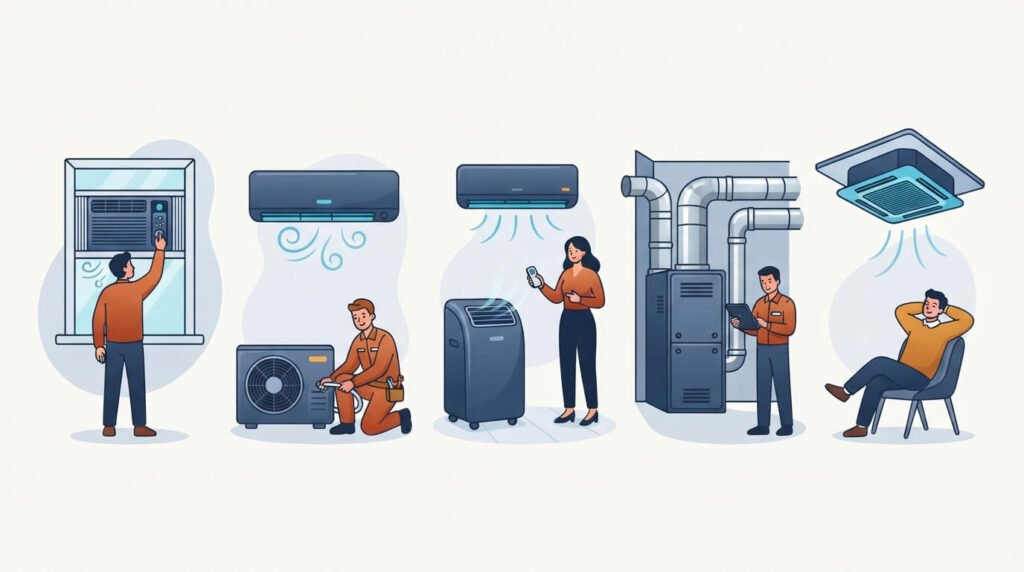
Sources disagree on exactly how many “types” of air conditioners exist because they’re counting different things; for example, the USA might have different types compared to the types of air conditioners in Nigeria.
The table below groups the seven categories covered in this guide by installation method, typical use case, and rough cost, so you can see where your situation fits before reading the full breakdown of each.
| Type | Installation | Best for | Installed cost range |
|---|---|---|---|
| Central air | Ducted, whole-home | Owned homes with existing ductwork | $3,500 to $12,500 |
| Ductless mini-split | Ductless, wall-mounted | Additions, homes without ducts, zoned cooling | $3,000 to $14,000+ |
| Window AC | Fits in a window frame | Single rooms, renters | $150 to $600 |
| Portable AC | Floor unit with exhaust hose | Rooms without window access for a permanent unit | $300 to $900 |
| Through-the-wall | Fixed sleeve in an exterior wall | Homes without a compatible window | $400 to $1,200 |
| PTAC | Wall sleeve, common in multi-unit buildings | Apartments, hotels, condos | $800 to $2,000 |
| Evaporative cooler | Ducted or portable, water-based | Hot, dry climates only | $300 to $3,000 |
Ducted vs. ductless: the distinction that actually matters
A ducted system cools air in one central location and pushes it through a network of ducts and vents to every room in the house.
A ductless system cools air at or near the point of use, either through an individual wall unit, a window frame, or a portable floor unit, with no ducts involved at all.
This single distinction explains most of the differences between the types covered in this guide. Central air is ducted.
Every other type on this page, mini-splits included, is ductless. If your home doesn’t already have ducts, installing them from scratch to accommodate central air typically costs more than the AC unit itself, which is why ductless options exist in the first place.
Why sources disagree on how many types exist
Carrier and Bryant describe three main types, while others list as many as eight or ten.
The gap comes from what’s being counted. Some technicians count by refrigeration technology, which produces a short list: compressor-based systems and evaporative systems.
Others count by installation format, which produces a longer list: central, mini-split, window, portable, through-the-wall, PTAC, and evaporative, since each of those is physically installed and used differently even when several of them rely on the same underlying compressor technology.
This guide counts by installation format, since that’s what actually determines whether a given type will work in your home.
Central air conditioning
Central air is a covered system most American homes already have: a single outdoor condenser and compressor connected to an indoor coil, distributing cooled air through ductwork to every room at once.
To know about the cost of installation, read our comprehensive article on central air conditioner cost guide.
How central AC works
The outdoor unit contains a compressor and condenser coil that pressurizes refrigerant and releases the heat it’s carrying outside.
Refrigerant then flows to an indoor evaporator coil, usually mounted above the furnace or air handler, where a blower pulls warm indoor air across the coil, cools it, and pushes it through the duct system to registers throughout the house.
Warm air returns to the system through return-air ducts, and the cycle repeats until the thermostat’s set temperature is reached.
Because one system serves the whole home, a single thermostat controls the temperature everywhere, though that also means you can’t cool one room more than another without a zoned duct setup.
Central air pros and cons
- Central air cools an entire home evenly from one thermostat, which is the main reason it remains the most common system in the United States.
- Standard-efficiency units (14.3 to 16 SEER2) install for $3,500 to $7,500, while high-efficiency models (17 SEER2 and up) run $8,000 to $12,500, according to 2026 HVAC pricing data.
- Installation requires either existing ductwork or the cost of adding it, which can add thousands of dollars to a home that doesn’t already have ducts.
- The outdoor condenser needs a dedicated pad or mounting location and generates some operating noise, though it’s positioned away from living space.
- Repairs on higher-efficiency variable-speed systems tend to run 10 to 20 percent more than standard units, since they need specialized technician training.
Ductless mini-split systems
A ductless mini-split pairs an outdoor compressor with one or more indoor wall-mounted units, cooling specific rooms or zones without any ductwork at all.
How mini-splits work
Like central air, a mini-split uses an outdoor compressor and condenser to move heat out of the home.
The difference is what happens after that. Instead of one indoor coil feeding a duct network, refrigerant lines run directly from the outdoor unit to one or more indoor air handlers, each mounted on a wall or ceiling in the room it serves.
Most mini-splits use variable-speed, inverter-driven compressors, which adjust their output continuously rather than cycling fully on and off, and that’s a large part of why mini-splits post some of the highest efficiency ratings on the market, with some models exceeding 22 SEER2.
Mini-split pros and cons
- No ductwork is required, which makes mini-splits the standard choice for additions, converted garages, and older homes that were never built with ducts.
- Each indoor unit can be set to a different temperature, giving you real zone control that whole-home central air can’t match without a separate zoning system.
- Mini-splits are the most efficient AC type available, and the higher upfront cost typically pays back in four to eight years through lower electricity bills.
- Indoor units are visible on the wall, which is a real aesthetic tradeoff some homeowners weigh against the efficiency gains.
- A whole-home multi-zone setup with several indoor heads can cost as much as or more than central air, so mini-splits aren’t automatically the cheaper option once you’re cooling an entire house rather than a room or two.
For a full breakdown of pricing by number of zones, see the ductless mini-split installation cost guide.
Window air conditioners
A window air conditioner is a self-contained unit that fits into a standard double-hung window frame, with all the refrigeration components housed in a single box.
Window AC pros and cons
- Window units cost the least per BTU of cooling capacity of any type on this list, with most models running $150 to $600 depending on size.
- Installation is simple enough for most renters and homeowners to do themselves in under an hour, with no professional required.
- A window unit blocks natural light and airflow through that window and can’t be used with windows that don’t open the standard double-hung way, including sliders or casements without an adapter kit.
- Larger units, especially anything above 10,000 BTU, generate noticeable operating noise since the compressor sits inside the same box as the room it’s cooling.
Best uses for a window unit
A window AC makes the most sense when you need to cool one room, don’t have access to whole-home cooling, and want the lowest possible upfront cost.
It’s a poor substitute for whole-house cooling in anything larger than a studio or one-bedroom apartment, since running multiple window units to cover several rooms usually costs more in electricity than a single right-sized central or mini-split system would.
Portable air conditioners
A portable air conditioner is a floor-standing unit on wheels that vents hot exhaust air outside through a flexible hose, typically run out a partially open window.
Portable AC pros and cons
- Portable units require no permanent installation and can be moved between rooms, which makes them the go-to option when a window’s shape or a lease’s terms rule out a window unit.
- The exhaust hose kit typically comes with an adjustable window bracket, so setup takes about the same amount of time as a window unit without needing to lift anything into a window frame.
- Portable units cost more upfront than window units of similar cooling capacity, typically $300 to $900, while delivering less effective cooling per BTU rated.
- The compressor, condenser, and evaporator all sit inside the room being cooled, which adds waste heat back into that room and works against the unit’s own cooling output.
Why portable units are the least efficient type
Every other type on this list keeps its hot components, the compressor and condenser, outside the space being cooled.
A portable AC keeps all of that inside the room, and while the exhaust hose vents some of that heat outside, a portion still radiates back into the room from the unit’s housing.
That’s the core reason portable units are consistently rated as the least efficient type of air conditioner available: they’re fighting the heat they generate in the same room they’re trying to cool.
If a window unit is physically possible for your space, it will almost always outperform a portable unit of the same rated capacity at a lower price.
Through-the-wall and PTAC units
Through-the-wall air conditioners and PTAC units both mount in a fixed sleeve cut into an exterior wall rather than a window, and they’re common in buildings designed around them from the start.
Through-the-wall vs. window AC
| Factor | Through-the-wall | Window AC |
|---|---|---|
| Installation | Requires a wall sleeve, typically professional | DIY-friendly, fits standard windows |
| Window access | Keeps the window fully usable | Blocks the window it occupies |
| Permanence | Semi-permanent, stays in the wall year-round | Removable, often seasonal |
| Cost | $400 to $1,200 including sleeve | $150 to $600 |
| Best for | Homes without a compatible window or wanting the window free | Renters and seasonal use |
PTAC units for landlords and multi-unit buildings
A PTAC, or packaged terminal air conditioner, is a specific type of through-the-wall unit built for the sleeve-and-cover systems common in hotels, apartment buildings, and senior living facilities.
Most PTACs also provide heating in addition to cooling, running as a single unit year-round rather than being swapped seasonally.
Because the wall sleeve is a fixed structural feature of the building, individual residents generally can’t install a PTAC on their own the way they could a window unit.
It’s a decision made by the property owner or manager, which is why PTACs show up almost exclusively in buildings that were designed around them rather than as a retrofit option a renter can choose.
Evaporative coolers (swamp coolers)
An evaporative cooler lowers air temperature by pulling warm air through water-saturated pads, and it works on a completely different principle than every other type covered so far.
How evaporative cooling differs from refrigerant-based AC
Every other type in this guide, central, mini-split, window, portable, through-the-wall, and PTAC, uses a compressor to pressurize refrigerant and physically move heat out of the air.
An evaporative cooler has no compressor and no refrigerant at all. Instead, a fan pulls outside air through pads soaked with water, and as the water evaporates, it absorbs heat from the air passing through, dropping the temperature by several degrees before pushing it into the room.
This makes evaporative coolers dramatically cheaper to run than any compressor-based type, but it also means they add humidity to the air rather than removing it, which is the opposite of what a refrigerant-based system does.
Where evaporative coolers work best
Evaporative cooling only works well in hot, dry climates where the added humidity improves comfort rather than making the air feel heavier.
In the arid Southwest, an evaporative cooler can drop indoor temperatures significantly at a fraction of the electricity cost of central air.
In humid regions, the same unit does little for comfort, since the air is already too saturated to absorb much additional moisture, and the cooling effect drops off sharply.
Installed cost ranges widely, from around $300 for a portable unit to $3,000 for a whole-house ducted system, but the climate restriction matters more than the price for most buyers deciding whether this type fits their situation at all.
Central air vs. mini-split vs. window AC: how to choose
These three types cover the situations most buyers are actually weighing against each other, and the right one depends on ductwork, budget, and how much of the home you need to cool.
| Factor | Central air | Mini-split | Window AC |
|---|---|---|---|
| Requires ductwork | Yes | No | No |
| Whole-home coverage | Yes, from one system | Yes, with multiple zones | No, single room only |
| Typical installed cost | $3,500 to $12,500 | $3,000 to $14,000+ | $150 to $600 |
| Efficiency ceiling | Up to around 20 SEER2 | Up to 22+ SEER2 | Rated in CEER, not SEER2 |
| Renter-installable | No | Rarely; needs landlord approval | Yes |
Best AC type by living situation
- Start by confirming whether you own the home or rent it, since renters are generally limited to types that require no permanent structural change: window units, portable units, and occasionally through-the-wall units if a compatible sleeve already exists.
- If you own the home, check whether existing ductwork is already in place, since that single factor makes central air the lower-cost option; without it, adding ducts usually costs more than switching to a mini-split instead.
- If you’re cooling more than two or three rooms and don’t have ducts, compare the cost of a multi-zone mini-split against the cost of adding ductwork for central air, since a large enough zone count can close the price gap between the two.
- If a mini-split’s outdoor condenser or wall-mounted indoor unit would require permanent mounting on a rented property, get written landlord approval before purchasing, since most leases treat this as a structural modification even though the equipment itself is removable.
For a deeper look at what qualifies as renter-friendly, see best air conditioner for apartments.
Best AC type by budget and installed cost
Use the air conditioner BTU calculator to size the right capacity before comparing costs, since an undersized or oversized unit skews both the purchase price and the operating cost below.
| Type | Installed cost | Annual operating cost (typical use) | Cost per BTU |
|---|---|---|---|
| Central air (standard) | $3,500 to $7,500 | $400 to $600 | Moderate |
| Central air (high efficiency) | $8,000 to $12,500 | $300 to $450 | Higher upfront, lower to run |
| Mini-split | $3,000 to $14,000+ | $250 to $500 | Lowest to run, highest upfront |
| Window AC | $150 to $600 | $100 to $250 per unit | Lowest overall |
| Portable AC | $300 to $900 | $150 to $350 per unit | Highest among room units |
| PTAC | $800 to $2,000 | $200 to $400 | Moderate |
| Evaporative cooler | $300 to $3,000 | $50 to $150 | Lowest to run, climate-restricted |
Annual operating costs assume roughly 1,500 hours of seasonal use at the U.S. average residential electricity rate of about $0.16 per kilowatt-hour, based on 2025 Energy Information Administration data.
Your actual cost will vary with local rates, climate, and how well-insulated the space is.
SEER2 ratings and 2026 efficiency rules by type
SEER2 is the current federal efficiency rating for central air conditioners, mini-splits, and heat pumps, and it doesn’t apply to every type covered in this guide the same way.
See the full SEER2 rating explained breakdown for how the rating is calculated.
What SEER2 means and how it differs from SEER
SEER2 stands for Seasonal Energy Efficiency Ratio 2, the U.S. Department of Energy’s updated efficiency measurement introduced in January 2023.
It replaced the older SEER standard with a testing method that accounts for more realistic ductwork resistance, which produces ratings that typically read about 5 percent lower than the same physical equipment scored under the old SEER test.
A unit that was rated 16 SEER under the old standard scores roughly 15.2 under SEER2, and the conversion works by dividing the old SEER number by approximately 1.05.
As of 2026, the DOE’s regional minimums require at least 13.4 SEER2 in northern states and 14.3 SEER2 in the South and Southwest.
Which AC types are actually covered by SEER2 minimums
- Central air conditioners, ductless mini-splits, and heat pumps are all rated and regulated under the SEER2 standard, and new installs in covered categories must meet their region’s minimum.
- Window air conditioners, portable air conditioners, and PTAC units are rated under a separate metric called CEER, or Combined Energy Efficiency Ratio, and are not subject to the SEER2 regional minimums at all.
- Evaporative coolers use no refrigerant and aren’t rated under either SEER2 or CEER, since the efficiency comparison that matters for them is water and electricity use rather than a cooling-per-watt ratio.
- If you’re shopping for a window or portable unit, the ENERGY STAR label and CEER rating are the numbers to compare, not SEER2, since SEER2 figures don’t appear on those product listings at all.
Matching the right type to your home usually takes more than reading a comparison table, especially once ductwork, zoning, and local climate all factor into the decision together.
A licensed HVAC contractor can walk your specific space and confirm which of the types above actually fits, size the unit correctly, and give you an installed quote before you commit to a purchase.
Frequently asked questions
What are the 3 main types of air conditioners?
The three main types most homeowners choose between are central air, ductless mini-splits, and window or portable units.
Central air uses ductwork to cool an entire home from one system and works best in homes that already have ducts installed.
Mini-splits cool without ductwork by mounting individual indoor units in each room or zone, making them the standard choice for additions and older homes.
Window and portable units cool a single room with no permanent installation, which makes them the default option for renters or anyone needing a quick, low-cost fix for one space.
What size air conditioner do I need for my room?
A common starting estimate is about 20 BTU of cooling capacity per square foot of room area, though ceiling height, sun exposure, and how many people typically use the room can push that number higher or lower.
A 300-square-foot bedroom would land around 6,000 BTU under that formula, while a sunnier or larger room might need 8,000 to 10,000 BTU to cool effectively.
Undersizing a unit means it runs constantly without reaching your target temperature, while oversizing wastes money upfront and can leave the room feeling clammy, since an oversized unit cools too fast to properly remove humidity from the air.
Do ductless mini splits need to be installed by a professional?
Yes, in nearly all cases.
A mini-split installation involves running refrigerant lines between the outdoor and indoor units, which requires evacuating air and moisture from those lines and charging them with the correct refrigerant amount, a process that legally requires EPA 608 certification to perform.
Some manufacturers sell simplified “DIY” mini-split kits with pre-charged line sets that skip the refrigerant handling step, but even those still require electrical work and precise mounting that most manufacturers recommend a licensed technician complete to keep the warranty valid.
Is a heat pump the same as an air conditioner?
No, though the two share the same core cooling technology.
A heat pump uses the identical compressor-and-refrigerant cycle as a central air conditioner or mini-split to cool a home in summer, but it also includes a reversing valve that lets it run the cycle backward to provide heating in winter, functioning as a furnace replacement rather than just a cooling system.
A standard air conditioner can only cool. For a full comparison of when a heat pump makes more sense than a standalone AC and furnace, see heat pump vs. air conditioner.
[…] Before you spend money on an AC, it helps to know what you’re actually buying. Nigeria’s climate is hot and humid almost year-round, which means your AC will work hard, unlike the types of Air Conditioners in other regions like the USA. […]