
Whether your air conditioner needs water depends entirely on what kind of unit you have. Central air, window units, and most mini-splits don’t need water to run; they cool your home with refrigerant and only produce water as a byproduct.
Portable air conditioners and swamp coolers are a different story: some of them run on water and won’t cool at all without it.
The confusion around this question almost always comes from the fact that “air conditioner” covers several different technologies that work in opposite ways, and most guides only explain one of them.
Does an air conditioner need water to run?
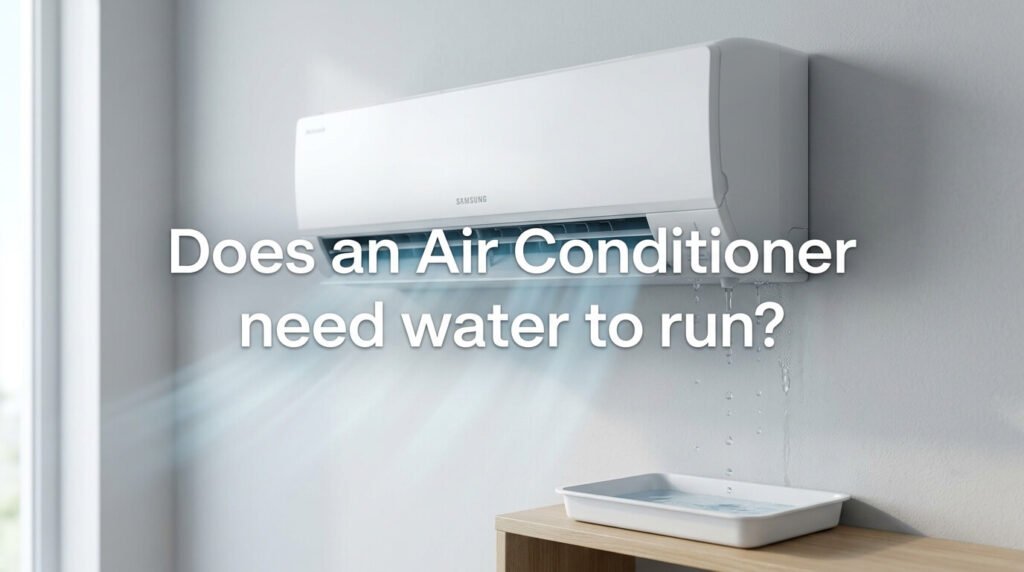
The short answer: it depends on what kind of “air conditioner” you have.
There are two fundamentally different cooling technologies sold under the name “air conditioner,” and they have opposite relationships with water.
Refrigerant-based systems, which include central air, window units, ductless mini-splits, and most portable ACs, compress and evaporate a chemical refrigerant in a closed loop.
They don’t consume water to run. Evaporative systems, including swamp coolers and “ventless” or “hydro-chill” portable units, cool the air by evaporating water directly into the airstream.
These need a constant water supply, and they stop cooling effectively the moment the water runs out.
To figure out which one you’re dealing with, answer these three questions:
- Does it vent hot air outside through a hose or duct? If yes, it’s a refrigerant-based unit, and it doesn’t need water to operate.
- Do you fill a water tank or reservoir before turning it on? If yes, it’s an evaporative unit, and it needs water to work at all.
- Is there a drain hose, bucket, or drip tray, but no tank you fill beforehand? If yes, it’s a refrigerant unit collecting its own condensate, and the water it holds is a byproduct, not fuel.
Keep that distinction in mind. Every section below is organized around it.
How refrigerant-based air conditioners work (central, window, mini-split)
Central air conditioners, window units, and ductless mini-splits all cool your home the same way: by moving heat out of the air using refrigerant, not water.
The refrigerant cycle, not water, does the cooling
Refrigerant is a chemical compound that absorbs heat as it evaporates and releases heat as it condenses. In an air conditioner, a compressor cycles refrigerant between a low-pressure evaporator coil (indoors) and a high-pressure condenser coil (outdoors).
Warm indoor air passes over the cold evaporator coil; the refrigerant absorbs that heat and carries it outside, and the condenser coil releases it into the outdoor air. The entire process happens in a sealed loop. No water enters this cycle at any point.
Why your AC still produces water (condensation explained)
The evaporator coil that absorbs heat from your indoor air is cold enough to drop below the dew point of the air passing over it. When that happens, moisture in the air condenses on the coil the same way condensation forms on a cold glass of water on a humid day.
A central air conditioner can pull several gallons of condensate out of the air over the course of a hot, humid day, purely as a side effect of cooling, not because it needs water to function.
How Much Water Does a Regular Air Conditioner Actually Produce?
The widely used industry rule of thumb is 0.1 to 0.3 gallons of condensate per ton of cooling capacity, per hour of runtime, with some North American averages closer to 0.5 gallons per ton per hour in more humid conditions.
That range, multiplied out over a typical cooling day, is where the “several gallons a day” figure above actually comes from.
Condensate Output by System Size (Estimated)
| AC size | Condensate per hour | Estimated per day (8 hrs runtime) |
| Window/portable unit (~0.5–1 ton equivalent) | 0.1–0.5 gallons | 1–4 gallons |
| 1.5-ton mini-split or central AC | 0.15–0.75 gallons | 1–6 gallons |
| 2-ton central AC | 0.2–1.0 gallons | 2–8 gallons |
| 3-ton central AC | 0.3–1.5 gallons | 2–12 gallons |
| 5-ton central AC | 0.5–2.5 gallons | 4–20 gallons |
These are estimates, not fixed figures; actual condensate output depends heavily on indoor humidity, outdoor temperature, system efficiency, and how much outside air the system handles. A system running in a dry climate can produce noticeably less than these ranges; one running in a hot, humid climate can exceed the high end.
Where that water goes: drain lines and condensate pumps
That condensate has to go somewhere. Most systems route it through a drain line, called a condensate line, to a floor drain, a drain pan under the unit, or directly outside.
In basements or locations without gravity drainage, a small condensate pump lifts the water up and out.
A clogged or disconnected condensate line is the single most common cause of an AC unit leaking water indoors, which we’ll cover later in this guide.
If you want to check whether your own drain line is set up correctly, this condensate drain line maintenance checklist walks through it step by step.
Do air conditioners use coolant instead of water?
Yes. What most people call “coolant” in an air conditioner is refrigerant, a chemical such as R-410A or R-32 that changes between liquid and gas inside the sealed coils.
Refrigerant is not water and isn’t meant to be added, drained, or refilled during normal use. If a refrigerant-based AC is running low on refrigerant, that means it has a leak, and it needs professional repair, not a top-off the way you’d add water to a car’s radiator.
Is the water from your AC safe to drink?
No, condensate water from an air conditioner should not be treated as drinking water.
It’s collected from indoor air, and it typically picks up dust, mold spores, and residue from the coil, drain pan, and drain line as it passes through the unit.
It’s soft, low in minerals, and some people use it for watering plants or as distilled water for irons and car batteries, but it isn’t filtered or sanitized, so it isn’t a safe substitute for drinking water.
Does a portable air conditioner need water?
“Portable air conditioner” is where most of the confusion in this topic comes from, because the category includes three genuinely different mechanisms, and only one of them needs water to run.
Vented portable ACs: no water needed to run
A vented portable AC works exactly like a mini window unit on wheels. It uses the same refrigerant cycle described above and vents hot air outside through an exhaust hose in a window kit.
It collects condensate the same way a central AC does, and in most climates, that condensate evaporates back into the exhaust airflow and out the hose automatically, so you rarely need to empty anything.
You never add water to a vented portable AC, and it won’t stop cooling if you don’t. If you’re comparing models, this list of top vented portable air conditioners that skip water refills is a useful starting point.
Ventless (evaporative) portable ACs: yes, they need water
Ventless portable units, sometimes marketed as “evaporative air coolers” or “personal air conditioners,” don’t use refrigerant at all.
They work like a compact swamp cooler: a fan pulls air through a water-soaked pad or mist chamber, the water evaporates, and the resulting cooler, more humid air blows into the room.
These units genuinely need water in the tank to produce any cooling effect. Run one dry, and it becomes an ordinary fan.
Self-evaporating portable ACs: a middle ground
Some portable ACs marketed as “no drain required” or “self-evaporating” are still refrigerant-based units, not evaporative coolers.
They redirect a portion of the collected condensate into the exhaust airstream, where it evaporates and vents outside along with the hot air, so the internal tank rarely fills up.
They don’t need water added, and in most conditions they don’t need manual draining either, though very humid climates can still cause the internal tank to fill faster than the exhaust can evaporate it. If yours does, setting up a continuous drain hose is the simplest fix.
Do window units and mini-splits need water?
Window air conditioners and water
Window units use the same sealed refrigerant cycle as central air. They don’t need water added, and any water you see is condensate draining out through weep holes on the back or bottom of the unit. That’s normal, particularly on humid days.
Ductless mini-split systems and water
Ductless mini-split systems, sometimes called split systems or split-type air conditioners, especially outside the US, also run on refrigerant, moving heat between an outdoor compressor unit and one or more indoor air handlers connected by a refrigerant line set.
Mini-splits also run on refrigerant, moving heat between an outdoor compressor unit and one or more indoor air handlers connected by a refrigerant line set.
Like other refrigerant-based systems, they produce condensate that drains through a small line, usually routed alongside the refrigerant lines to the outdoor unit.
They never require you to add water. For anyone installing a new system, this ductless mini-split installation guide covers what that drain setup should look like.
Swamp coolers (evaporative coolers): the systems that really do run on water
Swamp coolers are the one mainstream “air conditioner” category where water genuinely is the fuel, not a byproduct.
How evaporative cooling works
A swamp cooler, also called an evaporative cooler, cools air by pulling hot, dry outdoor air through water-saturated pads. As the water evaporates, it absorbs heat from the passing air, and a fan pushes that cooler, more humid air into the home.
Unlike refrigerant-based AC, this is an open system: it constantly draws in outside air and pushes indoor air out through open windows or vents, rather than recirculating the same air in a closed loop.
That’s also why swamp coolers work best in hot, dry climates and lose effectiveness once outdoor humidity climbs, since humid air can’t absorb much more moisture.
How much water a swamp cooler uses
| Unit type | Typical water use | Typical electricity draw |
|---|---|---|
| Small portable evaporative cooler (single room) | Under 1 gallon per hour | 100 to 300 watts |
| Mid-size evaporative cooler | 3 to 15 gallons per hour, depending on heat and humidity | 200 to 400 watts |
| Whole-house rooftop swamp cooler | Roughly 145 to 150 gallons per day, running on low during the day | 500 to 1,000+ watts |
Those whole-house figures come from a University of Arizona field study of a residential swamp cooler in Tucson running through a June heat wave, and they illustrate a real range: a single small unit sips water, while a whole-house system can use a meaningful amount over a full cooling season.
Swamp cooler vs. air conditioner: water use and cost compared
If you’re weighing a swamp cooler vs. central air comparison for a hot, dry climate, water is only half the picture. Electricity use, and the water that goes into making that electricity, matters just as much.
Direct water use: gallons per day side by side
| System | Direct water use | Electricity draw |
|---|---|---|
| Central air conditioner | None (condensate is a byproduct, not an input) | 3,000 to 5,000 watts |
| Whole-house swamp cooler | Roughly 145 to 150 gallons per day | 500 to 1,000 watts |
| Portable evaporative cooler | 1 to 15 gallons per day, depending on size | 100 to 400 watts |
On paper, central air uses zero direct water and a swamp cooler uses well over a hundred gallons a day. That’s the number every competing article stops at. It’s also incomplete.
The hidden water cost of AC: electricity generation
A central air conditioner uses essentially no water at the point of use, but its electricity may involve indirect water consumption at power plants.
In a 2003 National Renewable Energy Laboratory analysis, thermoelectric generation was estimated to evaporate about 0.47 U.S. gallons of fresh water per kWh of electricity consumed by the end user, while hydropower was estimated at 18 gallons per kWh, primarily from reservoir-surface evaporation.
These are historical, generation-weighted U.S. estimates—not universal current values—and actual water intensity varies by power-plant technology, location, electricity mix, and how reservoir evaporation is allocated among competing water uses.
A central air conditioner running at roughly 4,000 watts for 8 hours a day consumes about 32 kilowatt-hours daily. Multiply that by each grid type, and the picture changes depending on where your electricity comes from:
| Electricity source | Water evaporated per kWh | Estimated indirect water for 8 hrs/day of central AC |
|---|---|---|
| Thermoelectric (natural gas, coal, nuclear) | 0.47 gallons | About 15 gallons per day |
| Hydroelectric | 18 gallons | About 576 gallons per day |
On a grid dominated by natural gas or coal, an air conditioner’s hidden water footprint (roughly 15 gallons a day) is still far below a whole-house swamp cooler’s direct use (145 to 150 gallons a day).
But in regions where the grid leans heavily on hydropower, such as the Pacific Northwest, an air conditioner’s indirect water footprint can climb to several hundred gallons a day, potentially exceeding what a swamp cooler uses directly.
Neither system is universally “waterless.” Which one actually uses less water depends on your local power mix, not just on what’s plugged into your wall.
How to fix an air conditioner leaking water indoors
If you came here because you’re standing over an actual puddle, this full troubleshooting guide for AC leaks covers the complete diagnostic process, but here’s the short version.
Common causes of indoor AC leaks
- A clogged condensate drain line is blocking water from draining outside, forcing it to back up into the drain pan and overflow.
- A cracked or rusted drain pan is letting water escape before it reaches the drain line at all.
- A frozen evaporator coil, often caused by low refrigerant or restricted airflow, is melting and overflowing the drain pan faster than it can drain.
- A disconnected or poorly sloped drain line is preventing gravity from carrying water where it needs to go.
- A failed condensate pump, in systems that use one, is leaving water with nowhere to go but up and out.
Step-by-step: stopping and fixing the leak
- Turn off the air conditioner to stop the leak from getting worse while it thaws or drains.
- Check the drain line for visible clogs and clear them with a wet/dry vacuum from the outdoor end if you can reach it.
- Inspect the drain pan for cracks, rust, or standing water that suggests it’s no longer sealing properly.
- Check the air filter, since a dirty filter restricts airflow and is a common cause of the frozen-coil scenario.
- Call an HVAC technician if the coil is frozen, the pan is damaged, or the leak continues after you’ve cleared the line, since those repairs typically require specialized tools or parts.
How often to refill or drain your unit
Most guides say water use “depends on humidity,” and stop there. Here’s what that actually looks like in practice, using the ranges already covered above.
Evaporative/ventless units: refill schedule
- Small ventless portable units using well under 1 gallon per hour typically need a refill every 8 to 12 hours of continuous runtime at moderate humidity.
- Mid-size evaporative coolers using 3 to 15 gallons per hour will empty a standard 4-to-6-gallon built-in tank in under 2 hours on a hot, dry day, and closer to 4 to 6 hours in milder conditions.
- Units connected to a continuous water line don’t need manual refills at all, since a float valve maintains the water level automatically.
- Rising humidity shortens the interval between refills paradoxically less, since less water evaporates per hour as humidity climbs; the tradeoff is that the unit also cools less effectively at the same time.
Vented/self-evaporating units: drain schedule
- Vented portable ACs in average humidity rarely need manual draining, since the exhaust hose carries condensate out automatically.
- Self-evaporating units in humid climates (above roughly 60% relative humidity) may need the internal tank emptied every 1 to 3 days if the exhaust can’t evaporate condensate fast enough.
- Window units and central air essentially never need manual draining under normal operation, since the condensate line handles it continuously.
- A tank that’s filling faster than expected on a unit marketed as self-evaporating usually signals a kinked or improperly angled exhaust hose rather than a normal water level, and it’s worth checking the hose position before assuming the unit is faulty.
If you’re not sure whether your unit’s condensate system is draining the way it should, especially heading into peak cooling season, it’s worth having a technician check the drain line and coil during a routine tune-up rather than waiting for a leak to show up on your ceiling or floor.
Frequently asked questions
Do I need to add water to my air conditioner?
No, not if it’s a central, window, mini-split, or vented portable unit, since all of those run on refrigerant and treat any water they produce as a byproduct to be drained, not a fuel to be added.
The exception is evaporative equipment, meaning swamp coolers and ventless portable “air coolers,” which genuinely stop cooling if their water tank or reservoir runs dry.
If you’re unsure which type you have, check whether it vents hot air outside through a hose (refrigerant-based, no water needed) or requires you to fill a tank before turning it on (evaporative, water required).
Why is there water coming out of my air conditioner?
That water is condensate, formed when warm, humid indoor air passes over your AC’s cold evaporator coil, and moisture condenses out of it, the same way water beads on a cold glass on a humid day.
It’s a normal byproduct of cooling, not a sign that the unit runs on water. The water is meant to drain away through a condensate line to a drain, a pan, or outside; it only becomes a problem when that drainage path is blocked, cracked, or disconnected, which causes it to back up and leak into your home instead.
Does central air conditioning use water?
No, central air conditioning does not consume water to operate. It cools your home entirely through a sealed refrigerant cycle that compresses and evaporates a chemical refrigerant, never water, between an indoor coil and an outdoor coil.
The water people sometimes see near a central AC unit is condensate pulled from humid indoor air as a side effect of that cooling process, and it’s meant to drain away rather than being reused or replenished by the homeowner.
Can an air conditioner run without water?
Yes, for refrigerant-based systems, meaning central air, window units, mini-splits, and vented portable ACs, water is never required to run; these units will cool your home indefinitely without you ever adding a drop.
For evaporative systems, meaning swamp coolers and ventless portable coolers, the answer is no, since water evaporation is the actual cooling mechanism, and the unit becomes just a fan blowing room-temperature air once the water supply is gone.
Why does my portable AC water tank fill up so fast?
If your portable AC has an internal tank that’s filling quickly, it’s almost always a refrigerant-based unit collecting condensate rather than an evaporative unit, and the fill rate usually points to high indoor humidity, a kinked or poorly positioned exhaust hose that’s preventing self-evaporation, or an unusually warm, humid room that’s producing more condensate than the exhaust can carry away.
Checking and straightening the exhaust hose is the first thing to try before assuming the unit needs repair.
What happens if I don’t drain my portable AC?
On a refrigerant-based portable AC with a manual drain, most units have a built-in float switch that automatically shuts the compressor off once the internal tank is full, so the unit stops cooling until you empty it rather than overflowing on its own.
On an evaporative or ventless unit, running out of water simply turns the unit into a plain fan, since there’s no water left to evaporate and produce a cooling effect.
Is it normal for an AC unit to produce water?
Yes, producing some condensate is completely normal for any refrigerant-based air conditioner, particularly in humid weather when the evaporator coil is pulling more moisture out of the air.
The amount varies with humidity, temperature, and how hard the system is running, and it’s only a concern if that water isn’t draining properly and starts pooling or leaking indoors.
Do I need to drain my air conditioner?
No, not for central air, window units, mini-splits, or vented portable ACs.
All of these route condensate through a drain line or exhaust airflow automatically, with no manual emptying required under normal operation.
The exception is self-evaporating portable units in very humid climates, where the internal tank can sometimes fill faster than the exhaust can evaporate it; those may need occasional manual draining, covered in the refill/drain schedule section above.
Evaporative coolers and swamp coolers are the opposite case: instead of draining water out, you’re periodically adding water back in, since they consume it as part of the cooling process rather than collecting it as a byproduct.
Does air conditioning increase my water bill?
Not directly, since a refrigerant-based air conditioner doesn’t draw from your household water supply to operate.
However, it can affect your water bill indirectly through the electricity it consumes, since generating that electricity requires water for cooling at the power plant, at a rate that varies significantly depending on whether your local grid relies on thermoelectric or hydroelectric generation, as covered in the water use comparison above.
Is it normal for an AC to not drip water?
Yes, and it doesn’t mean anything is wrong. On cooler or less humid days, an air conditioner may pull very little moisture out of the air, producing only a small amount of condensate that evaporates before you’d ever notice it.
Whether an AC drips visibly depends heavily on humidity, runtime, and drainage setup, so the absence of visible dripping on a mild day is not a sign of a malfunction.
Do air conditioners use gas?
Refrigerant-based air conditioners run on electricity, not combustible gas like natural gas or propane; any “gas” involved is refrigerant, which is a different substance entirely and stays sealed inside the unit’s coils.
The confusion usually comes from central HVAC systems that combine a gas furnace for heating with an electric air conditioner for cooling in the same ductwork, but the cooling side itself doesn’t burn or consume fuel gas.
Does shutting off the water affect an air conditioner?
For the vast majority of residential air conditioners, meaning central, window, mini-split, and vented portable units, no, since they don’t use household water at all and will keep running normally if your water is shut off.
The exception is a rare category of water-cooled commercial or industrial AC systems that use a water line for condenser cooling, but these are uncommon in homes and not what most people mean by “air conditioner.”
Do air conditioners use a lot of electricity?
Yes, relative to other home appliances, central air conditioning is typically one of the largest electricity draws in a household during summer, often running at 3,000 to 5,000 watts while operating.
That’s a separate question from water use, though, since the two only connect through the indirect water cost of generating that electricity, covered in the comparison table above; for a full breakdown of AC electricity costs, a dedicated energy-use guide is the better resource.
[…] The unit makes this water as a byproduct, which raises a related question that we have answered in this comprehensive guide: does an air conditioner unit need water to function? […]