
An AC refrigerant recharge (often called a Freon recharge) is when a certified technician adds refrigerant to your air conditioner’s sealed system after it has dropped below the manufacturer’s specified charge.
It usually follows a leak, costs about $200 to $600 for most home systems, and homeowners can’t legally do it on a central or split AC.
Most online answers about home AC contradict each other because half of them are written about car AC, where DIY recharge kits are legal and sold at any auto parts store.
Home and central AC systems run under a completely different set of rules. Some checks you can do in five minutes with nothing but your eyes and a thermometer.
Others legally require a certified technician. This guide separates the two and includes real numbers for what a proper recharge should cost.
What Is an AC Refrigerant Recharge?
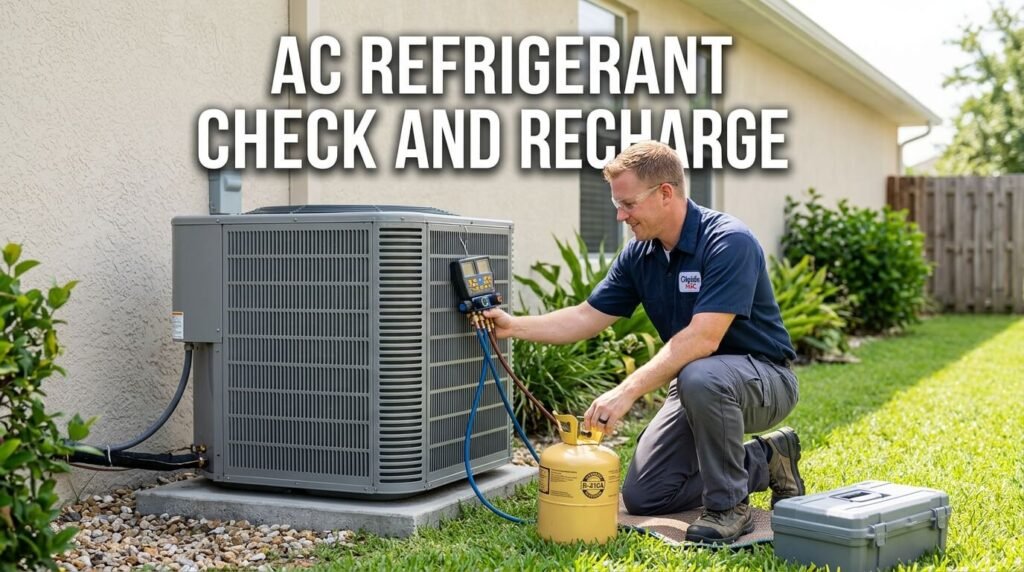
An AC recharge, also called a Freon recharge or refrigerant refill, means a technician adds refrigerant back into your air conditioner’s sealed system because the charge has dropped below the level the manufacturer specified.
(In some regions, including Australia and the UK, it’s called an “air con recharge” or “regas.”)
It isn’t a tune-up or routine maintenance. It’s a response to refrigerant that has gone missing, almost always through a leak.
Recharging a home AC usually involves finding and fixing the leak, removing air and moisture with a vacuum pump (called “evacuate and recharge” when the system is opened), then adding refrigerant to the exact weight or target readings for that unit.
How does refrigerant keep your AC cooling?
Refrigerant is the chemical that cycles through your AC’s coils, absorbing heat from inside your home and releasing it outside as it changes from liquid to gas and back.
No refrigerant, no cooling. But more refrigerant doesn’t mean more cooling; the system is engineered for one specific charge weight, and anything off that number throws off the pressure balance that the whole cycle depends on.
Why a healthy AC should rarely need refrigerant added
A correctly installed AC is a closed, sealed loop. The refrigerant inside it isn’t consumed like gas in a car; it just circulates indefinitely unless something breaks the seal.
If your unit asks for refrigerant every year or two, that’s not normal wear. That’s a leak in the line set, coil, or fittings, and recharging without finding it means paying for the same fix on repeat.
A proper split AC maintenance checklist catches small issues, loose fittings, and early coil corrosion before they lead to a leak.
7 Signs Your AC Needs a Recharge (Freon)
The clearest signs your AC needs freon or a recharge are warm air from the vents, ice on the indoor coil or the larger refrigerant line, and a system that runs nonstop without reaching the set temperature.
A hissing or bubbling sound near the lines points to a leak. Any of these means the system should be checked by a certified technician, not topped off by feel.
Keep in mind that low refrigerant isn’t the only cause of these symptoms, which is covered in the next section.
Signs of low refrigerant
- Warm or lukewarm air comes from the vents even with the thermostat set well below room temperature.
- Ice or frost builds up on the indoor evaporator coil or the larger line running to the outdoor unit.
- The system runs nearly nonstop, rarely shutting off, because it can’t reach the set temperature.
- A hissing or bubbling sound comes from the line set, often pointing to the leak itself rather than just the low level it caused.
Signs of an overcharged system
- The compressor short-cycles, shutting off within a few minutes of starting, because a high-pressure safety switch keeps tripping.
- The system blows cold air at first, then warm, as liquid refrigerant floods back into the compressor instead of fully evaporating.
- You hear a knocking or thumping sound from the outdoor unit — a sign that liquid refrigerant is hitting parts built to handle gas only.
Overcharging isn’t really a separate problem from low refrigerant; it’s usually what happens after someone tries to fix low refrigerant without the gauges needed to measure what’s actually missing.
A can added by feel, with no target pressure to check against, overshoots just as easily as it undershoots.
Do You Need an AC Recharge or an AC Repair?
Warm air doesn’t automatically mean you need a recharge. Refrigerant is only one of several causes, and paying for a recharge when the real problem is something else is one of the most common wasted repair bills.
| Symptom | Points to low refrigerant if… | Points to something else if… |
| Warm air from vents | Ice on the coil or line, and hissing near fittings | The outdoor unit isn’t running, which suggests a bad capacitor or contactor |
| Weak airflow | Rare | Usually a dirty filter, a frozen coil from restricted airflow, or a blower problem |
| Long run times | The system never shuts off and ice forms | Dirty condenser coil or a dirty filter |
| Compressor won’t start or hums | Only after a long period of low charge | Failed capacitor or a compressor issue |
| Higher bills, still cooling | Gradual decline over a season | Dirty coils, a system past 12–15 years, or duct leaks |
How to decide: if the system still cools but weakly, and the filter and outdoor coil are clean, low refrigerant is likely, so book a leak check and a recharge.
If the outdoor fan or compressor isn’t running at all, or you hear loud buzzing or clicking, that’s a repair call first.
And if the unit is already needing its second recharge in two years, the leak was never fixed, so ask for a repair quote instead of another top-off.
If you’re unsure whether the compressor itself has failed or just needs refrigerant, a technician’s pressure and amperage readings settle it in one visit.
See the Recharge, Repair, or Replace section below for when the repair math stops making sense.
How to Check Your AC’s Refrigerant Level (Freon) at Home
You can’t measure your AC’s exact refrigerant level at home, because only pressure gauges and superheat/subcooling calculations can do that.
But you can tell whether low refrigerant is likely: check for ice on the indoor coil or the larger line, compare the temperature of the air at a return vent and a supply vent (a healthy system drops it by 15–20°F), look for oily residue near the fittings, and listen for hissing.
If two or more of those checks point to low refrigerant, book a technician. Don’t buy a recharge kit; a central AC can’t legally be recharged without EPA Section 608 certification.
You can check your AC Freon (refrigerant) condition without ever touching a gauge.
What you can’t do without one is measure the exact level; gauges read pressure, and pressure is the only reliable way to know the charge weight.
Everything below tells you whether refrigerant is likely the problem, not how many pounds you’re short.
Non-invasive checks you can safely do yourself
- Feel the larger of the two refrigerant lines at your outdoor unit. It should feel cool, not room temperature, and not coated in ice.
- Check the supply vents with a basic thermometer. A healthy system cools air by 15 to 20 degrees Fahrenheit between return and supply air.
- Look at the outdoor condenser coil for visible oil residue, which often marks the exact point of a leak.
- Listen near the fittings and indoor coil for hissing — escaping refrigerant usually makes a sound before it makes an obvious problem.
- Match the check to your system type. Central systems use the line set and coil above. Split and mini-split units leak more often at the flare fittings behind each indoor head’s wall plate. Window units have the whole circuit sealed in one cabinet, so a technician check beats chasing it yourself — and many HVAC companies won’t even service window units, which makes replacement the more common fix anyway.
Why gauge-based checks cross into certified-technician territory
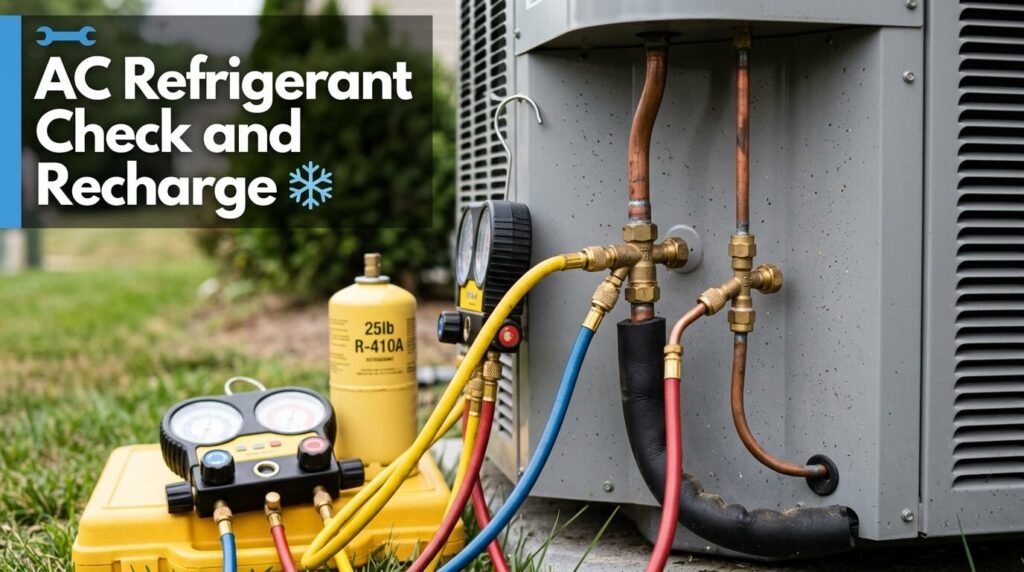
The line between what you can check and what only a certified technician can touch isn’t about danger; it’s about what counts as “service” under federal law.
State agencies that summarize the rule plainly, including Minnesota’s Pollution Control Agency, define service activity needing certification as attaching hoses and gauges to measure pressure, or any action that breaks the seal of the refrigerant circuit while it’s charged.
The moment a gauge connects to a service port, you’ve moved from observing to servicing the line, which the next section covers.
How Much Refrigerant Does Your AC Need?
The correct amount depends on the model, and the exact number is stamped on the nameplate (data plate) of your outdoor unit. It lists the refrigerant type and the factory charge in pounds and ounces.
As a rough guide, most residential systems hold about 2 to 4 pounds of refrigerant per ton of cooling capacity, so a 3-ton system typically holds 6 to 12 pounds.
The real figure also depends on the length of the line set running between indoor and outdoor units, which is why installers adjust the charge on site.
That’s also why you can’t tell “how much to add” from the total capacity. A technician who finds the system low doesn’t guess: they recover any excess or add refrigerant until superheat and subcooling reach the manufacturer’s target numbers.
What to know before the visit: write down the refrigerant type on the nameplate (R-22, R-410A, or R-454B).
It’s the biggest driver of your price (see the cost table below), and it helps you compare quotes accurately.
Can You Recharge Your Home AC Yourself? (Is It Legal?)
No. You can’t legally recharge a central or split home AC yourself. That’s true even if you have gauges and a can of refrigerant, because attaching gauges and adding refrigerant counts as servicing a regulated system.
EPA Section 608 certification
Section 608 certification is the federal credential the EPA requires before anyone can legally buy, handle, or service refrigerant in a stationary appliance- anything that doesn’t move, like a central AC, a split system, a window unit, or a refrigerator.
The certification level matters: Type I only covers small appliances holding five pounds or less, while Type II or Universal is what most central and split AC work actually requires.
Wholesalers must confirm a buyer’s certification before selling refrigerant, which is the real mechanism keeping most homeowners from buying it in the first place.
Car AC callout
Looking for car AC instructions? This guide covers home and central air conditioning.
Car AC systems are regulated differently: uncertified buyers can purchase small self-sealing cans of R-134a or R-1234yf, which is why DIY car recharge kits exist. Home AC systems have no equivalent exemption.
Why car AC recharge kits are legal, but home AC kits aren’t
This is the part that confuses most technicians, and it is good to note that the EPA treats them as two different categories entirely.
| Feature | Car AC (MVAC) | Home / Central AC |
|---|---|---|
| Certification is required to buy refrigerant | None, for small cans | Section 608, always |
| Legal container size for uncertified buyers | 2 lbs or less, self-sealing valve | Not sold to uncertified buyers, at any size |
| Where it’s sold | Auto parts stores, big-box retailers | Certified HVAC wholesalers only |
| Penalty for unlicensed handling | None — exempt by design | Noncompliance can lead to substantial Clean Air Act civil penalties, potentially up to $59,114 per day per violation. |
The EPA carved out the small-can exemption specifically to let people keep servicing their own cars, on the condition that the cans hold two pounds or less with a self-sealing valve that limits what escapes during the swap.
No equivalent exemption exists for stationary equipment: home AC systems hold far more refrigerant, and an untrained person guessing at the charge is more likely to overcharge a sealed system than safely top off a small one.
What to Consider Before Buying a High-Mileage Refrigerant Refill
- Refrigerant type. Cars from about 2015 onward mostly use R1234yf, and older cars use R134a. Check the under-hood label or your manual. Never mix the two, and don’t use a DIY can on an R1234yf system.
- Leak sealer content. “High mileage” refills usually contain stop-leak additives. These only suit small, slow leaks, and they won’t fix a large leak.
- Risk of clogging. Sealer can clog the expansion valve, orifice tube, or condenser. Some repair shops refuse or charge extra to service systems containing sealer, because it can damage their recovery machines.
- Oil compatibility. Make sure the oil in the can matches your compressor (PAG or POE). Hybrids and EVs with electric compressors need POE oil and should not get stop-leak products.
- Leak size. If the system loses its charge within weeks, find and repair the leak instead of topping it up.
- Built-in gauge. Choose a can with a gauge and a hose with a low-side coupler, so you can avoid overcharging. Overcharging reduces cooling and can damage the compressor.
- Can size and brand. Buy a reputable brand and don’t add more than the system needs.
- Compressor condition. If the compressor is noisy, seized, or not engaging, a refill won’t help.
- Cost. Compare the price with a professional recharge, which includes leak detection and the correct charge by weight.
How to Check Car AC Refrigerant Level
Method 1: Gauge check (most reliable DIY method)
- Park in the shade and start the engine.
- Turn the AC to max cool with the fan on high.
- Locate the low-pressure service port (the larger line, usually marked “L”).
- Connect the gauge and let the compressor engage.
- Read the pressure against the ambient temperature. As a rough guide:
| Outside temperature | Typical low-side pressure (R134a) |
| 65–75°F (18–24°C) | 25–35 psi |
| 75–85°F (24–29°C) | 35–40 psi |
| 85–95°F (29–35°C) | 40–50 psi |
Below range means the refrigerant is low. Above range suggests overcharge or another fault. R1234yf pressures differ slightly, so follow the gauge chart for your refrigerant.
Method 2: Vent temperature
- Place a thermometer in the center vent. Healthy cooling is roughly 35–50°F (2–10°C) at the vent after a few minutes. Warm air points to low refrigerant or another fault.
Method 3: Compressor clutch behavior
- If the clutch cycles on and off rapidly (every few seconds), the charge is likely low.
- If it never engages, the pressure may be too low for the safety switch, or there is an electrical fault.
Method 4: Visual inspection
- Look for oily residue or green UV dye on hoses, fittings, the condenser, and the compressor. These mark leak points.
- Older cars may have a sight glass. Constant bubbles mean low refrigerant.
When to see a professional: a gauge alone can’t confirm the exact charge, and a low reading means a leak. A shop can use manifold gauges, UV dye, or an electronic leak detector, then recharge by weight.
How Much Does an AC Refrigerant Recharge Cost?
A typical home AC refrigerant recharge or refrigerant (Freon) refill runs from $200 to $600 for most US homes, or lower, depending on your country, including the service call, leak diagnosis, and refrigerant.
Older systems on scarcer refrigerant push that well past $1,000.
Cost by refrigerant type: R-22 vs. R-410A vs. R-454B
| Refrigerant | Installed cost per pound | Typical pounds needed | Notes |
|---|---|---|---|
| R-22 | $90–$150 (rising as supply shrinks) | 6–15 lbs for most homes | Production stopped in 2020; only reclaimed stock remains |
| R-410A | $50–$80 | 6–15 lbs for most homes | Most common refrigerant in systems installed 2010–2024 |
| R-454B | $80–$150 | 6–15 lbs for most homes | Standard in new equipment built 2025 and later |
A 3-ton system typically needs 6 to 12 pounds for a full recharge, so the per-pound price compounds fast.
A full R-22 refill can easily exceed $1,000 once labor and recovery fees are added, while the same job on R-410A often stays under $600.
What pushes your final price up or down
- A small top-off after a minor leak costs less than a full refill, since you’re paying for fewer pounds.
- Leak detection adds $100 to $300 before any refrigerant goes in — skipping it just means paying for the same recharge again next season.
- Recovery fees of $50 to $300 apply when old refrigerant has to be pulled and disposed of properly, as federal rules require.
- Refrigerant type matters more than system size — a smaller R-22 system can still cost more to service than a larger R-410A one.
- Labor rates shift by region, typically $100 to $250 per hour.
As more new systems convert to A2L refrigerants, that cost gap will keep shifting. Our R-410A to A2L refrigerant transition guide covers what that means if you’re closer to a new system than another recharge.
What Happens During a Professional Refrigerant Check
A technician checking your AC’s refrigerant runs a multi-step diagnostic before touching the charge, ruling out cheaper problems first; a clogged filter or dirty coil can mimic low-refrigerant symptoms without costing a cent in refrigerant.
Step-by-step: what a licensed tech actually does
- Check airflow components first — filter, blower, evaporator coil — since restricted airflow produces the same warm-air complaint as low refrigerant.
- Attach manifold gauges to the service ports to read suction and head pressure.
- Compare those pressures against the refrigerant’s pressure-temperature chart for the current outdoor temperature.
- Calculate superheat and subcooling, then compare to the manufacturer’s target numbers for that specific unit.
- Recover refrigerant that needs to come out, or add refrigerant to reach the target weight; never both blindly at once.
- Run a leak test, often with an electronic detector or UV dye, before closing the system back up.
- Document the refrigerant type and quantity added, which federal rules require for any system holding more than five pounds.
How to verify your technician is properly certified
- Ask to see their EPA Section 608 certification card, listing their name, certifying organization, and certification number.
- Confirm the certification type matches your equipment — Type II or Universal covers most central and split systems; Type I only covers small appliances.
- Check that the certifying organization is one the EPA currently approves, listed at epa.gov/section608, since cards from defunct programs can still circulate.
- Ask for an invoice listing the refrigerant type and exact quantity added, not just a flat “recharge” line — federal rules require them to keep this on file.
Recharge, Repair, or Replace? Making the Right Call
Air conditioner freon recharge makes sense when the leak is small, found, and fixed, and the system is still within its expected service life.
It stops making sense once you’re treating the same symptom on repeat. At that point, you’re funding the unit’s slow failure, not maintaining it.
Our guide to signs your AC needs replacement goes deeper on the unit-age side of this decision.
When a recharge alone is the right fix
If your AC is under 10 to 12 years old, the leak has been found and sealed, and this is the first time refrigerant has dropped low enough to notice, a recharge is the right call and a relatively small expense.
The math changes once the system is older or the leak keeps reappearing somewhere new; both point to a line set or coil degrading as a whole, not just one bad fitting.
When recharging is just delaying a bigger problem
- Has this system needed refrigerant more than once in the past two years? Repeat recharges usually mean the original leak was never fixed.
- Is the unit running on R-22? Reclaimed R-22 now costs $90 to $150 a pound and keeps climbing; often, repairing costs more here than on a newer system.
- Is the system past 12 to 15 years old? Compressors and coils age together, so a unit old enough to need refrigerant is usually close to needing other expensive parts too.
- Would the repair cost more than half of a comparably sized new system, installed? If so, you’re paying near-replacement money to keep an aging unit running.
Rule out the cheapest possible cause first; a dirty filter can choke airflow badly enough to mimic a refrigerant problem exactly, and cleaning your AC filter takes ten minutes and costs nothing.
Run the non-invasive checks from this guide before you call anyone, and write down what you find: whether the line feels cool, what the vent thermometer reads, and any sound near the coil.
A technician who hears “the line isn’t cold, and there’s a hiss near the indoor unit” diagnoses faster than one who just hears “it’s not cooling,” and a faster diagnosis usually means a cheaper bill.
FAQ
How do I know if my AC needs a recharge?
Warm air from the vents, ice on the indoor coil or refrigerant line, a system that runs constantly, and a hissing sound near the lines are the main signs.
But those symptoms also come from dirty filters, failed capacitors, or a failing compressor, so a technician’s pressure readings are the only way to confirm it’s refrigerant.
A recharge only makes sense once the leak is found and fixed.
How long does an AC refrigerant (Freon) recharge take?
Most residential recharges take one to three hours, depending on how many pounds the system needs and whether a leak has to be found first. A top-off on an already-sealed leak can finish in under an hour.
Can low refrigerant permanently damage my AC?
Yes. Running a system low on refrigerant for long enough can overheat and damage the compressor, the single most expensive part in the unit.
How often should a healthy AC need recharging?
Never, in a properly sealed system, is refrigerant consumed during normal operation. A schedule of recharges just means a leak you haven’t found yet.
What’s the difference between Freon and refrigerant?
Freon is DuPont’s old brand name for R-22, though people use it generically for any AC refrigerant. R-410A and R-454B aren’t technically Freon, even though most homeowners still call them that.
Can I add refrigerant myself in an emergency?
No, not for a central or split home AC; there’s no emergency exemption in the EPA’s certification requirement. Run the non-invasive checks above, then call a certified technician.
Does homeowner’s insurance cover a refrigerant leak repair?
Usually not, since standard policies treat this as routine wear rather than sudden damage. Some home warranty plans, a separate product from insurance, do cover it.
Will a recharge fix a hissing noise from my AC?
A recharge alone won’t fix the hiss, because that sound is the leak itself, not a symptom that goes away once pressure is restored. Sealing the leak first, then recharging, is the only fix that lasts.
What happens if I ignore the signs of low refrigerant?
The compressor runs harder to compensate and can overheat, shortening its lifespan or causing it to fail outright. A small, cheap leak ignored long enough often turns into a full compressor replacement.
Is R-22 refrigerant still available in 2026?
Only as reclaimed stock; new production and imports stopped in 2020. Prices now run $90 to $150 per pound installed and keep climbing as supply tightens.
[…] gas refill restores cooling performance, but the underlying leak needs to be found and fixed first; otherwise, the refrigerant will escape […]