
Most homeowners think about AC maintenance exactly once a year when the unit stops cooling in July.
That’s too late. Good AC maintenance is a year-round habit, and the line between what you can do yourself and what requires a licensed technician matters more than most guides admit.
Get that line wrong, and you risk more than a warm house. You risk voiding a warranty worth thousands of dollars.
This guide covers the full picture: monthly DIY tasks, what a professional tune-up actually includes, real cost numbers, and the warranty rule that nobody bothers to explain clearly.
Why AC Maintenance Matters More Than Most Homeowners Realise
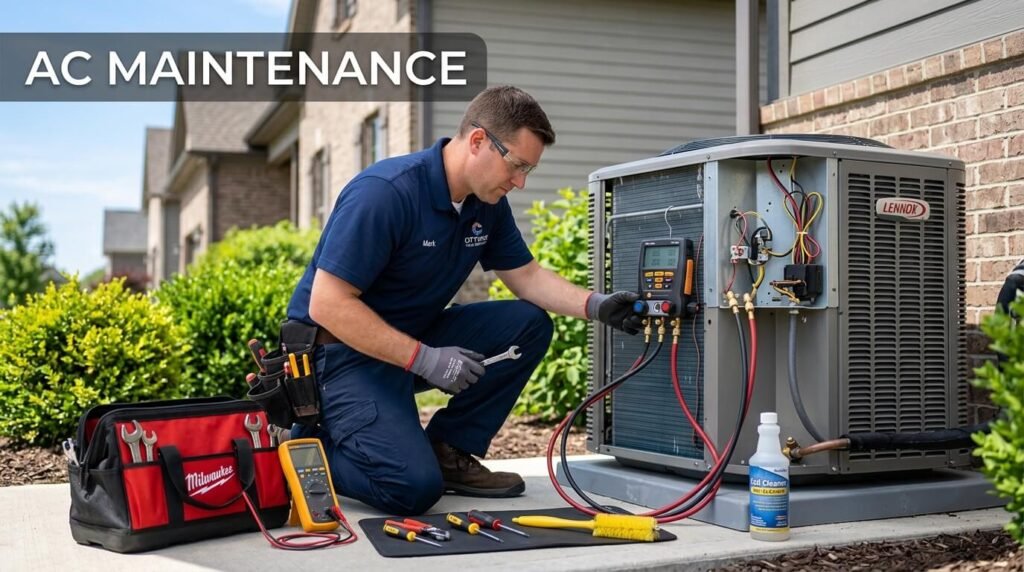
Skipping maintenance doesn’t just mean a dirtier system. It means a more expensive one. A well-maintained AC unit lasts 15 to 20 years.
A neglected one often fails by year 10, sometimes earlier in hot climates.
That’s a $7,500 replacement arriving five to seven years ahead of schedule.
The Real Cost of Skipping It: Energy Bills, Repairs, and System Life
Dirty coils make your system work harder to move the same amount of air. Clogged filters restrict airflow, forcing the motor to compensate.
Unlubricated parts create friction. None of this is dramatic until it is — and by then you’re looking at a repair bill, not a maintenance bill.
The EPA’s preventive maintenance guidance puts the return at roughly $4 saved for every $1 spent on maintenance. That figure shows up in avoided emergency repairs, lower monthly energy bills, and a longer system life.
According to the U.S. Department of Energy’s (DOE) Operations and Maintenance Best Practices Guide (specifically the FEMP guide), predictive and preventive maintenance programs reduce system breakdowns by 70–75% and cut breakdown duration by 35–45%.
Regular filter changes alone are the cheapest task on this list, producing a 5–15% reduction in monthly utility costs according to HVAC cleaning studies tracked by WorkTrek.
- An unmaintained system typically runs 10–15% less efficiently within a single season, because dirty coils reduce airflow by that margin or more.
- Post-cleaning HVAC systems deliver 10–46% more airflow compared to uncleaned units.
- Homes scheduling biannual maintenance save up to $500 per year in repair costs, based on industry data compiled by regional HVAC operators.
- A neglected condenser coil doesn’t just reduce efficiency — it can cause compressor failure, which runs $1,500 to $2,500 to repair.
How a Neglected System Fails (and What That Failure Costs)
| Failure Type | Likely Cause | Average Repair Cost | Timeline if Ignored |
|---|---|---|---|
| Compressor failure | Dirty coils, low refrigerant | $1,500–$2,500 | 1–3 seasons |
| Blower motor burnout | Clogged filter, unlubricated bearings | $400–$900 | 1–2 seasons |
| Frozen evaporator coils | Restricted airflow or refrigerant leak | $200–$1,500 | Weeks |
| Water damage from drain overflow | Clogged condensate line | $500–$3,000+ | Days to weeks |
| Capacitor failure | Heat stress, age acceleration | $150–$400 | Unpredictable |
| Full system replacement (premature) | Accumulated neglect across components | $5,000–$12,500 | Years earlier than necessary |
AC Maintenance Tasks You Can Do Yourself (Monthly & Quarterly)
You can handle more than you think: filters, visual checks, and basic cleaning around the outdoor unit.
What you can’t handle is refrigerant, electrical diagnostics, or coil cleaning that requires disassembly. The tasks below are genuinely safe for homeowners with no HVAC training.
Air Filter: How Often to Check, Which Type to Buy, and How to Replace It
Check your filter every 30 days. Replace it when it looks grey or clogged; for most homes, that’s every 1 to 3 months. If you have pets or allergies, monthly replacement is the right call.
For a full breakdown of filter types and MERV ratings, see our complete AC filter replacement guide.
- Turn off the AC at the thermostat before touching the filter.
- Locate the filter slot — usually in the return air vent or inside the air handler unit.
- Slide out the old filter and note the size printed on the frame (e.g., 16x20x1).
- Hold the old filter up to the light. If you can’t see light through it, it needs replacing.
- Insert the new filter with the arrow on the frame pointing toward the blower motor (away from the return air duct).
- Turn the system back on and confirm airflow feels normal at the nearest vent.
Cleaning the Outdoor Condenser Unit: A Safe Step-by-Step Process
The outdoor unit pulls air through its fins to release heat. When those fins are clogged with leaves, grass, or dirt, the system has to work harder, and it shows up on your energy bill.
- Turn off power to the outdoor unit at the disconnect box beside the unit (flip the breaker or pull the disconnect block).
- Remove any visible debris — leaves, grass clippings, sticks — from the top and sides of the unit by hand or with a soft brush.
- Use a garden hose on a gentle setting to rinse the fins from the inside out. Never use a pressure washer — the fins bend easily.
- Clear a 2-foot perimeter around the unit of plants, mulch, or stored items that restrict airflow.
- Check that the unit sits level on its pad. If it’s tilted, the compressor oil can settle unevenly, causing long-term wear.
- Restore power only after the unit is fully dry.
Checking and Flushing the Condensate Drain Line
The condensate drain removes the humidity your AC pulls from the air. When it clogs — and it does, with algae and debris — water backs up into the drain pan, overflows, and can cause damage to ceilings or floors.
- Locate the condensate drain line — a white PVC pipe, usually ¾ inch, running from your indoor air handler to a drain or outside.
- Find the access port (a T-shaped cap near the air handler) and remove it.
- Pour one cup of distilled white vinegar into the line. This kills algae without damaging the pipe.
- Wait 30 minutes, then flush with a cup of water.
- Check the outdoor end of the drain line to confirm water is flowing out freely.
- If the line is already clogged, use a wet-dry vacuum at the outdoor end to suction the blockage clear before flushing.
Other Quick Monthly Checks (Thermostat, Vents, Refrigerant Line Visual Inspection)
- Set the thermostat to cooling mode and confirm the system responds within a minute — if it doesn’t, the thermostat or a capacitor may need attention.
- Walk through each room and confirm supply vents are open and unblocked by furniture; closed vents increase system pressure and accelerate wear.
- Check the refrigerant lines running into the outdoor unit for ice buildup or oily residue — either one signals a refrigerant problem that needs a technician, not a homeowner fix.
- Listen to the unit running: a consistent hum is normal; banging, rattling, or squealing is not.
- Wipe down the indoor air handler cabinet with a dry cloth to remove dust from the exterior.
What a Professional AC Tune-Up Includes (and Why You Can’t Replace It with DIY)
A professional tune-up covers the parts of your system you can’t safely reach, legally handle, or accurately diagnose without calibrated equipment.
Most manufacturers require annual professional service, not annual homeowner service. That distinction is the one most people miss, and it matters most when you file a warranty claim.
The Full Professional Inspection Checklist (25+ Point Breakdown)
| Task | Who Performs It |
|---|---|
| Replace or inspect the air filter | Homeowner (monthly) / Pro confirms |
| Clean evaporator coils | Pro only — requires coil cleaner and disassembly |
| Clean condenser coils | Pro only — chemicals required |
| Check and adjust refrigerant levels | Pro only — EPA certification required |
| Inspect and test capacitors | Pro only — live electrical components |
| Inspect and tighten electrical connections | Pro only |
| Lubricate fan motor bearings | Pro (some homeowners can do this with guidance) |
| Test thermostat calibration | Pro |
| Measure temperature differential (supply vs. return) | Pro |
| Inspect condensate drain and pan | Homeowner (basic flush) / Pro (full inspection) |
| Check refrigerant line insulation | Pro |
| Test contactors and relays | Pro only |
| Inspect ductwork connections at the air handler | Pro |
| Measure amp draw on blower motor and compressor | Pro only |
| Check for refrigerant leaks with detection equipment | Pro only |
| Inspect and clean drain pan | Homeowner (visual) / Pro (chemical treatment) |
| Test safety shutoffs and limit controls | Pro only |
| Inspect fan blades for balance and damage | Pro |
| Clear debris from the condenser housing | Homeowner (exterior) / Pro (interior) |
| Document service in writing | Pro only (required for warranty) |
For detailed guidance on coil cleaning, see our step-by-step evaporator and condenser coil cleaning guide.
Tasks That Require a Licensed Technician (and Why)
- Refrigerant handling — Touching refrigerant without EPA Section 608 certification is illegal, not just inadvisable. See our guide on how refrigerant checks and recharges work for what the process involves.
- Electrical diagnostics — AC systems run on 240-volt power. Testing capacitors, contactors, and relays without proper equipment risks electrocution and component damage.
- Refrigerant leak detection — You cannot smell or see a refrigerant leak reliably. Technicians use electronic leak detectors calibrated to catch leaks as small as 0.1 oz per year.
- Coil cleaning with chemicals — Coil cleaning agents are alkaline or acidic, depending on the coil type. Wrong chemical, wrong concentration, or improper rinsing damages fins and corrodes components.
- Warranty documentation — Only a licensed technician can produce the signed service record that satisfies manufacturer warranty requirements.
How Long Does an AC Tune-Up Take?
Most professional AC tune-ups take 45 minutes to 90 minutes for a standard central air system. If the technician finds a problem, dirty coils that need extended cleaning, a refrigerant issue, or a failing component, expect closer to two hours.
Schedule it in spring before demand spikes; April and early May appointments are easier to get and often cheaper than June.
The Warranty Rule Most Homeowners Don’t Know About
Most AC manufacturers require annual professional maintenance to keep the warranty valid. Changing your filters every month and hosing down the condenser does not satisfy this requirement.
That’s not a technicality buried in the fine print; it’s the central condition of most residential HVAC warranties, and ignoring it can cost you thousands.
Why Skipping Professional Maintenance (Even Once) Can Void Your Warranty
Manufacturer warranties from brands like Carrier, Trane, and Lennox contain specific language requiring annual service by a licensed HVAC technician as a condition of coverage.
The warranty doesn’t say “keep the system in good condition.” It says professional maintenance, and if you file a claim without service records, the manufacturer asks for them. No records, no coverage.
Warranty clause language typically reads: A warranty claim may be denied if the equipment has not been maintained according to the manufacturer’s recommended maintenance schedule, including annual inspection and service by a qualified HVAC contractor.
Here’s what that looks like in practice: a homeowner installs a new heat pump for $8,500 with a 10-year parts warranty. They change filters regularly but skip professional service for three years to save money.
In year four, the compressor fails. The manufacturer requests maintenance records. None exist. The claim is denied. The compressor repair costs $2,100 out of pocket — more than a decade of annual tune-ups combined.
DIY Filter Changes Are Not Enough: What the Fine Print Actually Requires
Manufacturer warranty agreements typically require:
- Annual inspection and service by a licensed HVAC contractor (not just a handyman).
- A signed, dated service invoice or inspection report documenting what was checked and done.
- Service performed using the manufacturer’s recommended refrigerant type and charge specifications.
- Replacement parts that meet the manufacturer’s specifications (generic parts can create warranty disputes).
- Compliance with local codes — some warranties require the contractor to be licensed in the state where the equipment is installed.
DIY maintenance, no matter how thorough, does not produce a signed service record from a licensed contractor. That’s the document the manufacturer requires, and it’s the document you won’t have.
How to Document Your Maintenance for a Warranty Claim
- After every professional service visit, ask for a written invoice that lists each task performed, the technician’s license number, and the date.
- Photograph the invoice and store the image in a dedicated folder — cloud storage works well because it survives a house fire.
- Keep the physical invoice in the same location as your AC’s installation paperwork and warranty card.
- Record the model number, serial number, and installation date of your unit somewhere separate from the unit itself — you’ll need these for any warranty claim.
- If your manufacturer offers a warranty registration portal, register within 30 days of installation and link your maintenance records there if the feature is available.
AC Maintenance Cost: What to Expect in 2025 and 2026
Annual AC maintenance costs between $150 and $450 for most residential systems in 2025.
That range is wide because it depends on system type, system age, and what the technician finds. Central air is on the lower end; mini-splits run slightly higher per unit.
For current AC tune-up pricing by region, see our guide on current AC tune-up pricing by region.
Annual Tune-Up Cost vs Emergency Repair Cost vs Full Replacement Cost
| Cost Category | Low Estimate | Mid Estimate | High Estimate |
|---|---|---|---|
| Annual professional tune-up | $60 | $150–$300 | $450 |
| Filter replacement (DIY, annual) | $20 | $60 | $120 |
| Emergency repair (minor) | $150 | $400 | $800 |
| Emergency repair (major – compressor) | $1,500 | $2,000 | $2,500 |
| Premature system replacement | $5,000 | $7,500 | $12,500+ |
| Full replacement (end of natural life, 17–20 yrs) | $5,000 | $7,500 | $12,500+ |
The math isn’t subtle. A $200 annual tune-up across 15 years costs $3,000 total. One denied warranty claim plus a compressor replacement costs more than that in a single afternoon.
The ROI of Preventive Maintenance (EPA’s $1-Saves-$4 Framework)
The EPA’s preventive maintenance guidance documents a 4:1 return on investment; every dollar spent on maintenance avoids four dollars in repair costs. Here’s what that looks like across three realistic homeowner scenarios over 15 years:
| Scenario | Annual Maintenance Spend | Major Repairs (estimated) | Replacement Timeline | 15-Year Total Cost |
|---|---|---|---|---|
| A — Regular biannual maintenance | $300/yr ($4,500) | $500 (minor) | Year 17–20 (natural) | |
| B — Skipped 3 years, then repaired | $300/yr for 12 yrs ($3,600) | $2,100 compressor repair | Year 14–15 (early) | |
| C — Minimal maintenance throughout | $100/yr DIY only ($1,500) | $3,500+ (multiple repairs) | Year 8–10 (premature) | Two replacements at $7,500 each + repairs = ~$19,000+ |
Scenario A wins by $2,000 to $7,000, depending on what breaks in the other paths. The maintenance isn’t the cost. The maintenance is what keeps the higher costs from arriving early.
AC Maintenance Service Plans: Are They Worth It?
For most homeowners who have a central AC unit less than 12 years old, a maintenance plan is worth it. Not because of the convenience, but because of the warranty documentation it produces automatically.
The plan ensures you never forget a service year and always have a paper trail. To learn more about evaluating the terms, see our guide on how to evaluate an HVAC maintenance contract.
What a Good HVAC Maintenance Contract Should Include
Must-haves:
- At a minimum, two visits per year (spring and fall), not one.
- Written documentation after each visit listing every task performed.
- Refrigerant level check included (not billed separately).
- Priority scheduling for repairs — plan members shouldn’t wait behind regular customers during a summer heatwave.
- Discounts on parts and labor for repairs discovered during maintenance visits.
Red flags:
- Contracts that list only “inspection” without specifying what gets inspected — vague contracts produce vague service records.
- Auto-renewal clauses with price escalators buried in the agreement.
- Plans that cover only one unit when you have two.
- No guarantee of a licensed technician — some companies send trainees on maintenance calls.
Maintenance Plan vs Pay-Per-Visit: A Direct Cost Comparison
| Dimension | Maintenance Plan | Pay-Per-Visit |
|---|---|---|
| Annual cost (typical) | $150–$350/yr | $200–$450 per visit × 2 visits = $400–$900 |
| Warranty documentation | Automatic — included with each visit | Depends on whether you remember to schedule |
| Repair discounts | Usually 10–20% off parts and labor | Full price |
| Priority scheduling | Yes — typically guaranteed | No |
| Flexibility | Locked into one company | Can shop around each year |
| Best for | Systems under 12 years old, warranty-active units | Older systems nearing replacement, or areas with reliable independent techs |
The plan costs less per year in most markets and produces the service records you need. Pay-per-visit makes more sense once a system is old enough that replacement is the next logical step anyway.
Seasonal AC Maintenance Schedule: A Full-Year Calendar
The goal of a seasonal schedule isn’t to do more work — it’s to spread the work across the year so nothing accumulates into a problem.
Spring: Pre-Season Prep Before You Turn It On
- Replace the air filter before the first cooling run of the season.
- Clear debris that accumulated around the outdoor unit over winter.
- Inspect the condensate drain line and flush it with vinegar before the humidity season starts.
- Schedule your annual professional tune-up for April or early May — before the summer rush.
- Test the thermostat in cooling mode and confirm the system responds correctly.
- Check refrigerant lines for frost or oily residue from the winter off-season.
Summer: Monitoring Tasks During Peak Usage
- Check the filter monthly during peak usage — summer is when it clogs fastest.
- Listen to the system running; any new sounds that weren’t there in spring need attention.
- Keep the outdoor unit clear of summer growth — grass and shrubs reclaim ground quickly.
- Monitor your energy bill; a sudden spike without a change in usage often means the system is working harder than it should.
- Check the condensate drain pan monthly during humid months — overflow happens faster than most people expect.
Fall & Winter: Shutdown and Off-Season Care
- Schedule a fall inspection if your system is older than 8 years — pre-winter is a good time to catch anything that strained during summer.
- Clean around the outdoor unit and remove leaves that have settled into the fins.
- Consider a breathable cover for the outdoor unit if your region gets heavy snow or ice — but avoid airtight covers that trap moisture and encourage rust.
- Note any performance issues from the summer while they’re fresh — write them down somewhere you’ll find them before next spring’s service call.
- Confirm your service records from the current year are filed and accessible.
Signs Your AC Needs Servicing Right Now (Don’t Wait for the Annual Tune-Up)
Annual maintenance handles routine wear. These symptoms mean something is already wrong and needs attention before your next scheduled visit.
Warning Signs That Indicate Immediate Attention Needed
| Symptom | Likely Cause | DIY Fix? | Urgency | Cost If Ignored 30 Days |
|---|---|---|---|---|
| Warm air from vents | Low refrigerant or compressor issue | No | Emergency — call now | $1,500–$2,500 compressor damage |
| Ice on refrigerant lines | Restricted airflow or refrigerant leak | No | Call within 24–48 hrs | Evaporator coil damage, $500–$1,500 |
| Water pooling near indoor unit | Clogged condensate drain | Yes — flush the drain | Within 3 days | Water damage to ceiling/floor, $500–$3,000+ |
| Short cycling (turns on and off rapidly) | Oversized unit, dirty coils, or failing capacitor | No | Schedule within 7 days | Compressor wear, $1,500–$2,500 |
| Rattling or banging sounds | Loose fan blade or debris in housing | Check for visible debris only | Within 7 days | Fan motor damage, $400–$900 |
| Squealing sounds | Belt or motor bearing wear | No | Schedule within 7 days | Motor burnout, $400–$900 |
| Burning smell | Electrical component overheating | No | Emergency — shut off and call | Fire risk or full electrical failure |
| Weak airflow | Clogged filter or duct blockage | Check the filter first | Within 7 days if the filter is clean | Evaporator freeze, motor overwork |
| Sudden spike in energy bills | Dirty coils, refrigerant loss, failing motor | Check filter | Within 14 days | Compressor strain, escalating bills |
When to Repair vs When to Replace
The industry rule of thumb is the 5,000 rule: multiply the system’s age by the estimated repair cost. If the result exceeds $5,000, replacement is usually the better financial decision. A 12-year-old system needing a $500 repair = $6,000. That argues for replacement.
- Replace when the system is over 12 years old and facing any repair over $400.
- Replace when refrigerant is R-22 (phased out in 2020) — recharging it is expensive, and the supply is shrinking.
- Repair when the system is under 8 years old and the repair is a single component under $1,000.
- Repair when the warranty is still active — covered repairs cost nothing out of pocket.
For a detailed decision framework, see our guide on signs your AC needs replacement rather than repair.
Ready to Schedule Your AC Maintenance?
If you haven’t had a professional tune-up this year, now is the right time — before a missed service visit becomes a voided warranty claim or an emergency repair. Find a licensed HVAC technician in your area and ask specifically for a written inspection report you can keep on file.
Schedule Your AC Servicing Today →
Frequently Asked Questions About AC Maintenance
How often should I schedule professional AC maintenance?
Once a year, the baseline is spring, which is the best time. If your system is older than 10 years or runs year-round in a hot climate, twice a year makes more sense, and most manufacturers’ warranties support that schedule.
Can I do AC maintenance myself, or do I need a professional?
Some tasks are genuinely DIY: filter changes, clearing debris from the outdoor unit, flushing the condensate drain.
Anything involving refrigerant, electrical components, or coil chemicals requires a licensed technician, not because it’s difficult, but because it’s illegal or dangerous to handle without certification.
Does skipping professional maintenance void my AC warranty?
Yes, it can, and most homeowners find this out when they file a claim. Manufacturer warranties from brands like Carrier, Trane, and Lennox typically require annual service by a licensed contractor as a condition of coverage.
DIY maintenance doesn’t produce the signed service record the manufacturer asks for.
How much does an AC tune-up typically cost?
Between $60 and $450, depending on system type and location, with most central air tune-ups falling between $150 and $300. A maintenance plan usually runs $150–$350 per year and covers two visits, which is cheaper than two separate pay-per-visit appointments in most markets.
What is the best time of year to service an air conditioner?
Spring, specifically April or early May, in most climates. Technicians are less busy than in summer, scheduling is easier, and you catch any issues before the system runs hard. If you live somewhere with year-round heat, fall is a useful second visit.
For specific regions like Nigeria, the best time to service your AC is before the rainy season and before the start of the Harmattan season. To learn more, see this guide: How often should you service your AC in Nigeria?
Is an HVAC maintenance plan worth the money?
For most homeowners with a system under 12 years old, yes. The cost is lower than two separate tune-up appointments, the documentation is automatic, and most plans include repair discounts.
For older systems approaching replacement, pay-per-visit makes more financial sense.
How long does a well-maintained AC unit last?
15 to 20 years is the standard range for a well-maintained central air system. Systems that miss regular maintenance often fail by year 10 to 12 — sometimes earlier in climates with heavy seasonal use. The difference in lifespan is usually 5 to 7 years.
What happens to my AC if I never clean the filter?
A permanently clogged filter restricts airflow enough to freeze the evaporator coils, burn out the blower motor, or cause the compressor to overheat. Any of those repairs costs more than a decade of filter replacements.
The filter is the cheapest thing in the system and the most commonly ignored.
Do mini-split ACs need the same maintenance as central air?
Mini-splits need maintenance on the same schedule as annual professional service plus monthly filter cleaning, but the tasks differ slightly.
The filters are washable and cleaned by the homeowner monthly. Professional service involves cleaning the indoor head unit’s blower wheel, which collects mold and debris that homeowners can’t safely reach. Annual costs run $300–$550 per unit.