
Your AC is running, but the room takes 40 minutes to cool. Or it stopped cooling entirely.
Either way, you’re searching for AC servicing and not entirely sure what that means, what a technician actually does, what it costs, or whether it’s even the right thing to book.
This article answers all of that. No filler, no upsell. Just a clear breakdown of what a service visit includes, what it doesn’t, and what signs tell you it’s time to pick up the phone.
What Is AC Servicing? (And How It Differs from AC Maintenance)
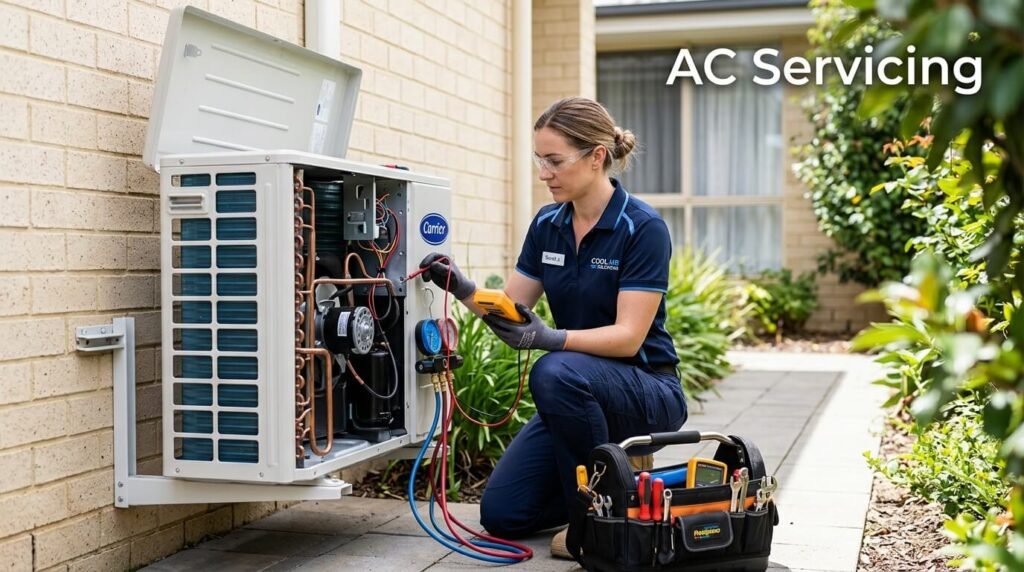
AC servicing is a one-time visit by a technician to clean, inspect, and restore your unit’s performance. That’s it. You book it, they come, they fix or service the unit, and they leave. It’s reactive; something prompted you to call.
AC maintenance is different. It’s a scheduled, preventive program with quarterly or annual check-ups designed to catch problems before they become expensive. Some companies sell this as a contract.
Most people use the two terms interchangeably. They’re not the same thing, and confusing them leads to booking the wrong service.
AC Servicing: The One-Time Visit Defined
AC Servicing: A single visit by a licensed technician to clean, inspect, and restore an air conditioning unit. Typically triggered by a performance problem, a seasonal need, or a long gap since the last visit. Not a recurring contract.
AC Maintenance vs AC Servicing — The Key Difference
| AC Servicing | AC Maintenance | |
| Trigger | Problem or long gap | Scheduled calendar date |
| Frequency | As needed | Annually or quarterly |
| Goal | Restore performance | Prevent problems |
| Who books it | Homeowner reacting to an issue | Homeowner on a contract |
| Cost structure | One-time fee | Ongoing plan or annual fee |
| Best for | Units that need attention now | Units you want to keep healthy |
Which one do you actually need right now?
- My AC stopped cooling, or performance has dropped → Book AC servicing
- I want to prevent problems before summer hits → Look into an ongoing AC maintenance plan
- I’m not sure → Read the signs checklist in the section below
What Does AC Servicing Include? A Full Checklist
A standard AC service covers both the indoor and outdoor units. What a technician does at each varies slightly by company, but this is what a proper service looks like.
Indoor Unit Service Steps
- Switch off and isolate the unit before any work begins.
- Remove the front panel and take out the air filter.
- Clean the filter with water and mild detergent, or replace it if it’s beyond cleaning.
- Clean the evaporator coil — dust buildup here is one of the most common causes of poor cooling.
- Flush the condensate drain line to clear blockages (a blocked drain causes indoor water leaks).
- Check and clean the drip pan to prevent mold and mildew buildup.
- Inspect the blower fan and motor for dust accumulation and abnormal wear.
- Check electrical connections inside the unit and tighten any that are loose.
- Test thermostat calibration and verify the unit responds correctly to temperature changes.
- Run the unit and check airflow from the supply vents.
Outdoor Unit (Condenser) Service Steps
- Inspect the condenser coil and clean with pressurized water or an approved chemical cleaner.
- Check the condenser fan blade — clean it, inspect for cracks or bends.
- Inspect the compressor for unusual noise, vibration, or current draw.
- Check the refrigerant lines visually for insulation damage and frost or sweating patterns.
- Measure compressor amperage with a clamp meter against the manufacturer’s rated value.
- Inspect and test the high-pressure and low-pressure cut-out switches.
- Check for rust on the unit casing — scrape and repaint corroded spots to prevent further damage.
- Verify the unit is level and that vibration mounts are intact.
What Is NOT Included in a Standard AC Service
Find below what is not included in a standard AC service and what causes the most post-service frustration.
- Refrigerant (gas) recharge — included only if the service package explicitly states so. If your unit has a refrigerant leak, recharging costs an extra $200–$500 and requires a separate diagnosis. Topping up gas without fixing the leak is a short-term fix, not a solution.
- Duct cleaning — A completely separate service, typically costing $200–$1,200 depending on system size. A standard AC service does not touch your ductwork.
- Electrical component replacements — If the technician finds a failed capacitor, a burnt relay, or a faulty contactor, those parts are charged separately. Expect $100–$400 per component, depending on the part.
- Fan motor or compressor replacement — Major components are never included in a standard service fee. These are repair jobs quoted separately.
- UV sanitisation or air purifier servicing — Add-ons that cost extra, if offered at all.
Ask before you book what the flat fee covers. If the quote seems low, ask specifically whether gas, parts, and repairs are included or extra.
How Much Does AC Servicing Cost in 2025 and 2026?
A standard residential AC service visit typically costs between $75 and $200. That range covers the technician’s time, basic cleaning, filter check, and system inspection. Beyond that, costs vary by what the technician finds.
Average Cost by Service Type
| Service | Typical Cost Range | Notes |
| Basic tune-up/inspection | $75 – $150 | Cleaning, filter check, visual inspection |
| Mid-level service | $150 – $250 | Adds chemical coil cleaning, drain flush, amp check |
| Premium / comprehensive service | $200 – $350 | 21-point inspection, full component testing |
| Refrigerant recharge (if needed) | $200 – $500 | Not included in standard service |
| System inspection only | $80 – $120 | Diagnosis without cleaning |
| Annual service contract (full HVAC) | $150 – $300 | Covers both AC and heating, typically 2 visits |
Technician hourly rates have stabilized in 2025, running $110–$150 per hour depending on experience and location.
What Makes AC Servicing Cost More (or Less)
- Unit age — Older units take longer to service and are more likely to need parts.
- How long since the last service — A unit that hasn’t been touched in 3 years takes significantly more work than one serviced 12 months ago.
- Unit type — Central ducted systems cost more to service than split or window units.
- Location — Urban markets and areas with high demand during summer months push prices up.
- Service add-ons — Chemical cleaning, blower cleaning, and drain treatments are often charged separately.
For unplanned breakdowns and emergency repairs, see our breakdown of average AC repair costs; those numbers look different from scheduled servicing.
How Often Should You Get Your AC Serviced?
Once, twice, or thrice a year is the baseline recommendation for most residential units because they aren’t used often or run 24 hours non-stop.
Annual servicing keeps the system efficient, extends its lifespan, and satisfies most manufacturer warranty requirements. But “once a year” is a starting point, not a universal rule.
For a more specific region, read our guide on: how often should you service your AC in Nigeria.
The General Rule — and When to Break It
- Once a year covers most homes with moderate use in a temperate climate.
- Twice a year makes sense if you run the AC almost continuously, have pets that shed heavily, live near construction or a dusty environment, or have a unit older than 8 years.
- Every quarter applies to light-commercial settings — offices, shops, or buildings where the AC runs 10+ hours a day.
- More often than you think applies in tropical or high-humidity climates, where filters and drain lines clog faster than the standard schedule assumes.
The best time to book is before the hot season, not during it. Technicians are easier to schedule in March or April than in July. Frequent users often find an annual AC service contract cheaper than booking individual visits each time.
Signs Your AC Needs Servicing Right Now
Don’t wait for the annual date if you’re seeing any of these:
- The room takes noticeably longer to cool than it did six months ago. This points to dirty coils, low refrigerant, or a struggling compressor.
- Airflow from the vents is weak even after you’ve cleaned the filter — the blower or indoor coil may be obstructed.
- Water is dripping from the indoor unit — the condensate drain is blocked, or the coil is freezing and thawing.
- The outdoor unit is louder than usual — rattling, grinding, or a new humming noise suggests a mechanical issue.
- Your electricity bill spiked without a change in usage — a dirty or struggling AC draws more current to hit the same temperature.
- There’s a musty smell when the AC runs — mold in the drain pan or on the coil. Don’t ignore this one.
If performance doesn’t improve after a service, review the signs your AC needs replacing rather than servicing.
What to Expect on the Day of Your AC Service
A technician arrives, confirms what service you’ve booked, and starts with the indoor unit before moving outside. The work is methodical, not rushed.
How Long Does a Service Visit Take?
A standard residential service runs 45 minutes to 90 minutes for a single split unit. Add 20–30 minutes per additional indoor unit. If the technician finds something that needs repair, that extends the visit, or they may quote separately and return.
Questions to Ask Your Technician
- What’s included in today’s service — and what would be extra if you find a problem?
- What are the refrigerant levels, and is the system holding pressure correctly?
- Is there anything showing early wear that I should watch over the next 6 months?
- Does this service satisfy the documentation requirements of my manufacturer’s warranty?
- What’s the recommended next service date based on what you’ve seen today?
Read our guide on: Servicing and Maintaining a Split AC unit
Can You Service Your AC Yourself?
Some tasks, yes. Most of the important ones, no.
What You Can Safely Do at Home
The simplest task any homeowner can handle is filter cleaning. Here’s exactly how to clean your AC filter at home.
- Clean or replace the air filter every 4–6 weeks during heavy use — this single task has the biggest impact on day-to-day efficiency.
- Clear around the outdoor unit — remove leaves, debris, and overgrown plants that restrict airflow.
- Check the condensate drain outlet — if water isn’t draining from the outlet pipe, pour a small amount of diluted bleach solution to clear algae buildup.
- Wipe down the indoor unit’s outer casing and check that the vents aren’t blocked by furniture.
- Listen and observe — tracking unusual noises or smells early is genuinely useful and costs nothing.
What Must Be Left to a Professional
- Refrigerant handling — In most countries, only licensed technicians can legally handle refrigerants. R-410A (the current standard) is being phased out and replaced with R-454B and R-32; handling these requires specific certification and tools.
- Electrical testing — Measuring amperage, testing capacitors, and checking contactor condition require proper tools and training. One mistake here is a safety risk.
- Coil cleaning with chemicals — The wrong chemical concentration damages aluminum fins. Professionals use approved cleaners at the right dilution.
- Refrigerant pressure checks — Gauge manifold readings require calibrated equipment and knowledge to interpret correctly.
- Internal blower and motor inspection — Disassembling these without experience causes more problems than it solves.
Does AC Servicing Void Your Warranty?
Before booking, it helps to understand what your HVAC warranty actually covers, because skipping professional service can quietly invalidate it.
Most manufacturer warranties for residential AC units require annual professional servicing by a licensed technician.
Some are explicit about it: if you can’t produce service records showing annual maintenance, a warranty claim for compressor failure can be denied. This happens more than people expect.
What Warranty Documents Usually Require
- Annual inspection and service by a licensed HVAC technician (not a DIY service).
- Written documentation of each service visit, including the date and technician’s certification number.
- Use of approved refrigerants only — using a substitute refrigerant voids most warranties immediately.
- No unauthorized modifications to the unit or its electrical connections.
- Filter cleaning or replacement on the manufacturer’s recommended schedule.
How to Keep Your Warranty Valid
- Book a professional service at least once a year — mark the date in advance so it doesn’t slip.
- Ask the technician to provide a signed service report after every visit. Keep these in a folder.
- Record the technician’s license or certification number on each invoice.
- If a part is replaced, ensure the technician uses an OEM (original equipment manufacturer) or approved equivalent part — generic parts can void coverage.
- Read your warranty document specifically for the maintenance clause — some brands like Daikin, Mitsubishi, and Carrier have model-specific requirements that differ from the general guidance above.
How to Choose a Reliable AC Service Technician
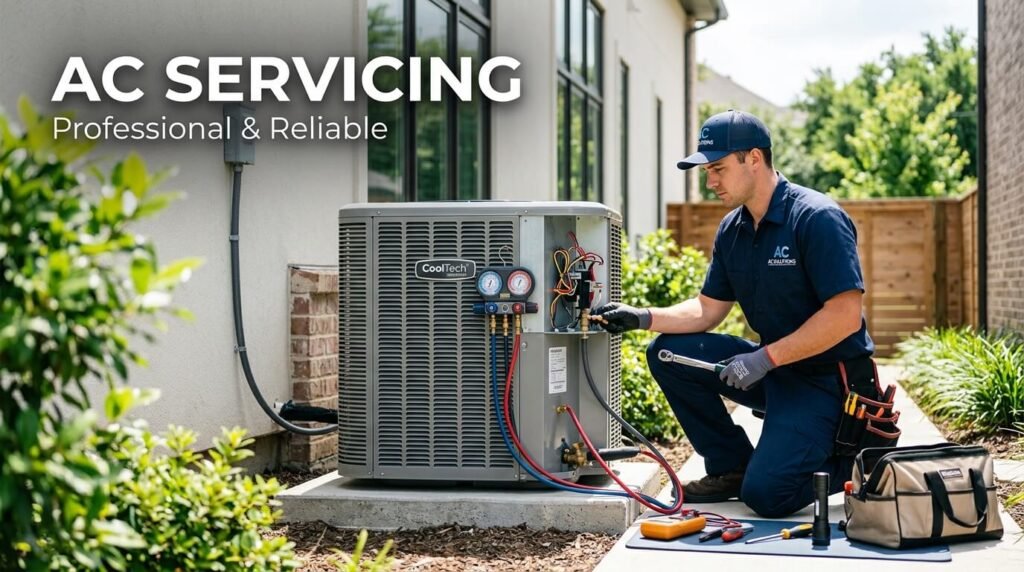
The market has good technicians and cut-price ones who do a 15-minute spray-and-go and call it a service. Here’s how to tell them apart before you book.
- Check for licensing — In most markets, HVAC technicians need to be certified to handle refrigerants. Ask for their certification number and verify it.
- Get a written quote upfront — Any technician who quotes over the phone without asking about your unit type, age, or last service date is guessing.
- Ask what’s included specifically — “Full service” means different things to different companies. Ask for the checklist.
- Check reviews for specifics — “Great service!” tells you nothing. Look for reviews that mention punctuality, what was found, and whether the technician explained the work.
- Ask if the diagnostic fee applies toward repairs — Many reputable companies apply the call-out fee toward the cost of any work done. Those that don’t are charging you twice.
Red Flags to Watch Out For
- No written quote or invoice — If there’s no paperwork, there’s no accountability.
- Immediate pressure to replace the whole unit — A technician who recommends full replacement after a 10-minute look without proper testing is either unskilled or incentivized to sell.
- No mention of refrigerant licensing — Handling refrigerants without certification is illegal in most jurisdictions.
- Very low flat-rate price with no explanation — $35 for a “full AC service” is not a deal. It’s a 15-minute visit that won’t touch the condenser coil.
- No service report provided — If they can’t give you a written record of what was done, it won’t satisfy your warranty requirements.
Questions to Ask Before Booking
- Are you licensed to handle refrigerants, and can I have your certification number?
- What exactly does your standard service include — can you send me the checklist?
- Is the diagnostic/call-out fee applied toward any repairs found?
- Do you provide a written service report after the visit?
- If you find a fault, do you quote separately before doing any repair work?
Book a service before you need to. A clean, well-serviced AC uses up to 15% less electricity than a neglected one (Energy Star). Booked before summer, a service visit costs $75–$200. A compressor replacement costs $700–$2,500. The math isn’t close.
Frequently Asked Questions About AC Servicing
What does AC servicing include?
A standard service covers filter cleaning or replacement, evaporator and condenser coil cleaning, condensate drain flushing, electrical connection checks, thermostat calibration, and a performance run test.
Refrigerant top-ups and part replacements are usually charged separately.
How much does it cost to service an AC unit?
A standard residential service runs $75–$200 in 2025. Premium services with 21-point inspections go up to $350. Costs rise if the technician finds refrigerant loss, electrical faults, or components that need replacement.
What is the difference between AC servicing and AC maintenance?
AC servicing is a one-time visit triggered by a problem or a long gap since the last visit. AC maintenance is a recurring, preventive program — scheduled visits designed to prevent problems before they happen. Servicing is reactive. Maintenance is proactive.
Can I service my AC myself?
Filter cleaning, clearing around the outdoor unit, and checking the drain outlet are all DIY-friendly.
Everything involving refrigerants, electrical components, or coil chemicals requires a licensed technician, both for safety and to stay legal in most jurisdictions.
What are the signs that my AC needs servicing?
Longer cooling times, weak airflow after filter cleaning, water dripping from the indoor unit, unusual outdoor unit noise, a spike in electricity bills, and musty smells when the AC runs. Any one of these is enough reason to book.
Does AC servicing void my warranty?
Skipping professional servicing can void your warranty, not the service itself. Most manufacturers require annual service by a licensed technician with written documentation. A DIY service, even a thorough one, typically doesn’t satisfy this requirement.
Is AC servicing worth the cost?
Yes, in almost every case. A properly serviced unit runs up to 15% more efficiently (Energy Star data), lasts 3–5 years longer than a neglected unit, and is far less likely to fail during a heatwave when replacement parts and technicians are hardest to find.