
If you are shopping for the best air conditioning brand system in Port Harcourt or Nigeria, the decisions you make before you buy matter more than the brand name on the box.
Port Harcourt’s climate — 30–35°C average temperatures, 80–90% relative humidity, and fewer than 12 hours of grid power daily in most areas creates buying conditions that generic guides written for Lagos or Abuja simply do not account for.
This guide covers every decision you need to make: the right AC type for your space, how to calculate the correct capacity, whether an inverter model is worth the extra cost on generator power, what installation actually costs locally, and how to keep your unit running in a coastal humidity environment.
Types of Air Conditioning Systems Available in Port Harcourt and Nigeria
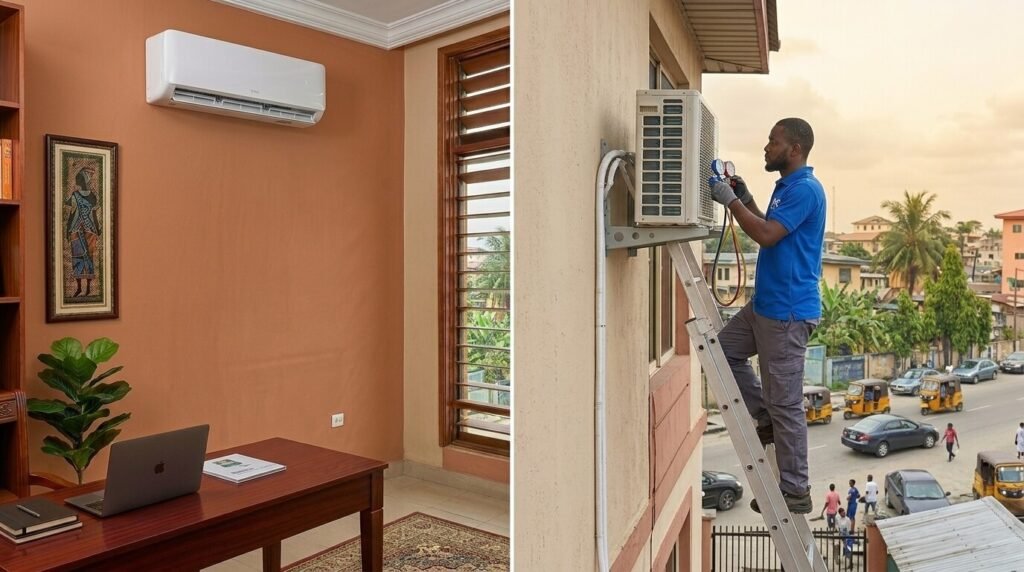
The right AC type depends on your room configuration, budget, and whether you need single-room or multi-room coverage — not on which type looks most common in the market.
Split AC vs window AC vs standing AC vs ceiling cassette: which is right for your space?
| Type | Best for | Approx. price (₦) | Pros | Cons |
| Split AC (wall-mounted) | Bedrooms, offices, medium rooms | ₦280,000 – ₦580,000 | Quiet, efficient, no window loss, inverter options available | Requires installation; the outdoor unit needs wall space |
| Window AC | Small rooms with suitable window/wall opening | ₦200,000 – ₦275,000 | Cheaper to buy and install; self-contained | Noisy; blocks the window; fewer inverter options |
| Standing / floor-mounted AC | Living rooms, large open spaces | ₦500,000 – ₦1,500,000+ | No wall drilling; movable; high capacity options | Bulky; takes floor space; more expensive per HP |
| Ceiling cassette AC | Offices, hotel rooms, commercial spaces | ₦400,000 – ₦1,350,000+ | Even airflow in all directions; discreet ceiling-mounted look | Requires a false ceiling; higher installation cost |
For most Port Harcourt residential applications, a bedroom, study, or small office, a wall-mounted split AC is the most practical and cost-effective choice.
When to choose commercial AC types for offices and hospitality spaces in Port Harcourt
- Ceiling cassette units are appropriate for conference rooms, hotel rooms, and retail spaces where even air distribution matters more than aesthetics — the 360-degree airflow prevents hot spots in large open areas.
- Concealed ducted systems suit open-plan offices where visible indoor units would compromise the interior design; they run through a false ceiling with grille outlets in each zone.
- Standing (floor-console) units work well in server rooms, generator rooms, and spaces where ceiling or wall installation is impractical due to structural constraints.
- For buildings with five or more rooms to cool simultaneously, a centralised system will almost always cost less to run long-term than multiple standalone units — see our guide to VRF systems for multi-room and commercial cooling in Port Harcourt.
What AC Capacity Do You Actually Need?
Buying the wrong AC capacity is the most common and most costly mistake Port Harcourt buyers make.
An undersized unit runs continuously without reaching the set temperature; an oversized unit short-cycles and fails to remove humidity properly, a critical failure in a city with 80–90% ambient humidity.
AC capacity by room size: Port Harcourt adjustment table
The baseline formula for capacity selection is: room area (sqm) × 500 = minimum BTU/hr required.
Port Harcourt’s climate conditions, sustained high heat, high humidity, and common use of zinc/metal-sheet roofing without ceiling insulation, regularly require 20–30% more capacity than this formula suggests.
| Room size (sqm) | Standard BTU needed | Port Harcourt adjusted BTU | Recommended capacity | Notes |
| 9–12 sqm | 4,500–6,000 BTU | 5,400–7,800 BTU | 1HP (9,000 BTU) | Small bedroom, study |
| 13–15 sqm | 6,500–7,500 BTU | 7,800–9,750 BTU | 1HP minimum; 1.5HP recommended | Standard bedroom |
| 16–20 sqm | 8,000–10,000 BTU | 9,600–13,000 BTU | 1.5HP (12,000 BTU) | Master bedroom, medium office |
| 21–28 sqm | 10,500–14,000 BTU | 12,600–18,200 BTU | 2HP (18,000 BTU) | Living room, large bedroom |
| 29–40 sqm | 14,500–20,000 BTU | 17,400–26,000 BTU | 2.5HP (24,000 BTU) | Open-plan living area |
| 41–70 sqm | 20,500–35,000 BTU | Varies | 3HP–5HP | Commercial spaces, large halls |
How to calculate the right AC capacity for your room
- Measure your room length × width in metres to get the floor area in sqm.
- Multiply by 500 to get the baseline BTU requirement (e.g., 18 sqm × 500 = 9,000 BTU).
- Apply Port Harcourt upward adjustments as relevant to your room:
- Add 25% extra BTU if your room is on the top floor directly under a zinc or metal-sheet roof with no ceiling insulation.
- Add 15% extra BTU if the room has a west-facing wall or window with direct afternoon sun exposure.
- Add 10% extra BTU if the room regularly has 4 or more occupants (living rooms, meeting rooms).
- Convert final BTU to HP: 9,000 BTU ≈ 1HP; 12,000 BTU ≈ 1.5HP; 18,000 BTU ≈ 2HP; 24,000 BTU ≈ 2.5HP.
- When in doubt, size up by one step — a slightly oversized unit runs efficiently in a well-sealed room; an undersized unit never stops running.
Factors that push capacity higher in Port Harcourt
- Zinc roofing without false ceiling: Radiant heat from metal roofing can raise room temperature by 8–12°C above ambient, the single biggest reason Port Harcourt buyers end up with ACs that “never cool the room properly.”
- High ambient humidity: At 80–90% relative humidity, your AC must remove substantial moisture from the air before it can cool it — this dehumidification work consumes capacity that the BTU formula does not account for.
- Poorly sealed rooms: Gaps under doors, louvre windows, and open ceiling voids allow warm air to constantly re-enter, forcing the AC to work against an unfixable heat load — seal these before or alongside installation.
- Multiple heat-generating appliances: Rooms with computers, televisions, cooking equipment, or many occupants have a higher internal heat load that the room-size formula ignores.
Inverter AC vs Non-Inverter AC: The Decision That Matters Most in Nigeria
For Port Harcourt buyers running on generator power for 8–12 hours daily, the inverter vs non-inverter decision is not just about comfort; it is a significant financial decision that affects your fuel spend every single day.
Inverter vs non-inverter: head-to-head for Nigerian buyers
| Dimension | Non-inverter AC | Inverter AC |
| How it works | Compressor runs at full power, then stops; cycles on/off repeatedly | The Compressor varies speed continuously to match the cooling load |
| Upfront cost (1.5HP) | ₦350,000 – ₦400,000 ( depending on the AC brand) | ₦400,000 – ₦580,000 (depending on the AC brand) |
| Energy consumption (1.5HP) | 1,300–1,500W | 800–1,100W (at part-load) |
| Generator compatibility | Higher startup current; harder on generators | Lower startup current; gentler on generators |
| Temperature stability | Fluctuates as compressor cycles | Maintains set temperature consistently |
| Lifespan | 5–8 years (more wear from start-stop cycling) | 8–12 years (gentler on compressor) |
| Energy saving vs non-inverter | Baseline | 30–50% less electricity at part-load |
The real cost difference in Port Harcourt. A 1.5HP non-inverter AC draws 1,300–1,500W; a 1.5HP inverter model draws 800–1,100W at typical part-load.
Running 8 hours daily on a generator at ₦1250/litre (2026 pricing), a generator producing 1kW consumes roughly 0.35–0.5 litres of petrol per hour.
The non-inverter AC’s additional 400–700W draw translates to approximately 1–2 extra litres of fuel per 8-hour day — a daily cost difference of ₦1250–₦1,300. Over 12 months, that is ₦400,000,450–₦678,900 in fuel savings alone, which covers the inverter price premium in its first year of operation for most households.
A 200Ah battery bank also powers an inverter AC for 2.5–3.5 hours versus only 1.5–2 hours for a non-inverter — relevant if you are combining AC with a battery inverter system.
For the full breakdown of inverter AC options, specifications, and brand recommendations, see our full inverter AC buying guide for Nigeria.
Running an AC on a generator in Port Harcourt: sizing and safety
Before consulting our generator sizing guide for Nigerian homes and offices, note the minimum generator capacity requirements for common AC sizes in Nigeria:
- 1HP AC: Minimum 2.5 kVA generator; 3.5 kVA recommended for safe margin.
- 1.5HP AC: Minimum 3.5 kVA generator; 4.5 kVA recommended.
- 2HP AC: Minimum 5 kVA generator; 6.5 kVA recommended.
- Inverter ACs can operate with 20–30% smaller generators than equivalent non-inverter models due to lower startup current — a 1.5HP inverter AC can often start reliably on a 3 kVA generator where a non-inverter model would stall it.
- Never run an AC on a generator smaller than the minimum spec — undersized generators cause voltage fluctuations that damage compressor electronics and void manufacturer warranties.
Air Conditioner Prices in Nigeria: What to Budget in 2026
AC prices in Nigeria have increased significantly since 2023 due to naira depreciation and the removal of import subsidies. The figures below reflect late-2025 market rates and should be confirmed with local suppliers at the time of purchase.
Current ₦ prices by brand, capacity, and type
| Brand / Model | 1HP Split | 1.5HP Split | 2HP Split | 2HP/3HP Standing | Notes |
| Hisense (non-inverter) | ₦200,000–₦280,000 | ₦280,000–₦320,000 | ₦320,000–₦450,000 | ₦500,000–₦800,000 | Budget tier; widely available PHC |
| Polystar (non-inverter) | ₦200,000–₦275,000 | ₦250,000–₦320,000 | ₦300,000–₦450,000 | N/A | Entry-level; limited warranty support |
| LG (non-inverter) | ₦280,000–₦320,000 | ₦300,000–₦350,000 | ₦350,000–₦480,000 | ₦350,000–₦500,000 | Mid-range; strong after-sales in Nigeria |
| LG Gencool (inverter) | ₦365,000+ | ₦388,900+ | ₦713,000+ | ₦977,500+ | Premium inverter; copper coil |
| Panasonic (non-inverter) | ₦275,000–₦350,000 | ₦385,000–₦400,000 | ₦450,000–₦470,000 | ₦600,000–₦800,000 | Reliable mid-tier |
| Panasonic (inverter) | ₦415,000–₦546,000 | ₦450,000+ | ₦500,000+ | ₦849,000+ | High efficiency; 10-yr compressor warranty |
| Daikin (inverter) | ₦300,000–₦450,000 | ₦400,000–₦600,000 | ₦550,000+ | N/A | Premium; excellent tropical performance |
What drives price differences
- Inverter technology adds ₦50,000–₦150,000 to the purchase price but reduces running costs by 30–50%, with payback typically within 12 months on generator power.
- Copper condenser coils cost more than aluminium but resist Port Harcourt’s coastal humidity and salt air far better — aluminium coils corrode faster in this environment and reduce efficiency over time.
- R32 refrigerant is more efficient and environmentally preferable to R410A and is now standard on most inverter models; it also requires smaller refrigerant volumes, reducing pipe costs slightly.
- Brand warranty depth varies significantly — Panasonic offers a 10-year compressor warranty on some inverter models; budget brands may offer only 12 months total, with no authorised service centre in Port Harcourt.
Best AC Brands in Nigeria: How the Main Options Compare
No single brand is “the best” in Nigeria — the right choice depends on your budget, how long you plan to own the unit, and whether you need local warranty service in Port Harcourt specifically.
Top brands compared across the dimensions that matter in Nigeria
| Brand | Energy efficiency | Warranty | PHC availability | Price tier | Copper coil? |
| LG | High (inverter models top-rated) | 1–5 yr; 10 yr compressor (inverter) | Good — distributor network in PHC | Mid to premium | Yes (inverter models) |
| Hisense | Moderate | 1–2 yr typical | Excellent — widely stocked | Budget to mid | Varies by model |
| Panasonic | Very high (inverter COP among the best) | Up to 10 yr compressor | Moderate in PHC | Mid to premium | Yes |
| Daikin | Excellent (designed for hot climates) | 5 yr parts; 10 yr compressor | Limited direct; order through distributor | Premium | Yes |
| Midea | Good | 1–3 yr | Good | Budget to mid | Some models |
| Samsung | Good | 1–2 yr standard | Moderate | Mid | Varies |
Copper vs aluminium condenser coil: why it matters in Port Harcourt
Port Harcourt’s proximity to the coast and its year-round humidity accelerate corrosion of aluminium condenser coils, the outdoor unit component most exposed to the elements.
Copper coils resist corrosion significantly better in this environment, maintain heat exchange efficiency longer, and are easier to repair when damaged (aluminium coils cannot be brazed in the field; copper can).
For any AC intended to last 8+ years in Port Harcourt, specifying a copper-coil model from the outset is the more economical long-term choice, even at a higher purchase price.
For a detailed breakdown across all available models and specifications, see our detailed brand comparison for air conditioners in Nigeria.
AC Installation in Port Harcourt: Costs, Process, and What to Watch For
Installation quality determines how long your AC lasts and how efficiently it runs. A correctly installed mid-range unit will outperform a premium unit installed badly.
Installation cost breakdown: Port Harcourt fair market rates (2025)
| Item | Fair price range (₦) | Notes |
| Standard installation labour | ₦10,000–₦20,000 or more | For a standard split AC at ground or first floor |
| Copper pipe (per metre) | ₦3,000–₦5,000 | Insulated copper refrigerant pipe; standard 3m run included in most quotes |
| Pipe insulation foam (per metre) | ₦1,500–₦3,000 | Should not be omitted — exposed pipes degrade quickly in PHC humidity |
| Wall bracket set (outdoor unit) | ₦3,000–₦5,000 | Should be galvanised or powder-coated steel |
| Drain hose (per metre) | ₦500–₦1,000 | Incorrect slope causes water leakage; insist on proper routing |
| Electrical disconnect / isolator | ₦5,000–₦8,000 | Required for safe operation; omitting this is a safety risk |
| Commissioning and test cooling | Included in labour | Any charge for this separately from a new installation is suspicious |
| Typical total (3m pipe run, split AC) | ₦35,000–₦65,000 | Standard residential; multi-storey or longer runs cost more |
Critical note: New AC units come pre-charged with refrigerant from the factory. Any installer who charges a separate fee for “refrigerant top-up” or “gas charging” on a brand-new installation is either using a defective unit or adding a fraudulent charge.
For a vetted list of qualified contractors, see our directory of professional AC installation services in Port Harcourt.
Step-by-step: what happens during a professional AC installation
- Site assessment: The installer inspects the room, identifies indoor and outdoor unit positions, measures the pipe run distance, and confirms the electrical supply point.
- Positioning: Indoor unit is mounted at least 2.1–2.4 metres from the floor on an exterior or internal wall; outdoor unit is positioned with adequate clearance for airflow (minimum 30cm on all sides).
- Wall penetration: A correctly angled hole (slightly downward to the outside) is drilled through the wall for refrigerant pipes, electrical cable, and drain hose.
- Pipe installation: Insulated copper refrigerant pipes are run through the wall penetration and connected to both indoor and outdoor units.
- Drain hose routing: The condensate drain hose is run with a continuous downward slope to a suitable discharge point — no traps, no upward sections.
- Electrical connection: A dedicated electrical circuit or disconnect is connected to the outdoor unit; the indoor unit is wired to the controller.
- Leak test: A qualified installer will pressure-test the refrigerant circuit before powering up — skipping this step is a common shortcut that causes early gas loss.
- Power-up and commissioning: The system is started, indoor and outdoor units are confirmed running, the set temperature is tested, and the airflow direction is adjusted.
Red flags from unqualified AC installers in Port Harcourt
- Using an undersized pipe gauge (6.35mm/4.76mm vs the specified sizes for the unit) reduces system efficiency and can void warranty — always ask for the pipe specification before the installer begins.
- Skipping the vacuum pump step before charging or reconnecting refrigerant lines introduces moisture into the system, which damages the compressor over time — you will not see the damage immediately.
- Incorrect drain slope or drain trap installation causes condensate to back up into the indoor unit, resulting in water dripping from the unit onto walls or ceilings — one of the most common post-installation complaints in Nigeria.
- Mounting the outdoor unit on a wall bracket that is too small or improperly anchored creates vibration noise and becomes a structural safety risk over time, especially on rendered block walls.
AC Maintenance in Port Harcourt: Schedule, Costs, and Common Problems
Port Harcourt’s humidity and coastal air accelerate AC degradation faster than drier climates. A unit that might run 3 years without servicing in a drier city will show performance decline within 6–12 months here without basic maintenance.
Recommended maintenance schedule for Port Harcourt
| Task | Monthly | Quarterly | Annually | Approx. cost (₦) |
| Clean indoor unit air filters | ✓ | Free (DIY) | ||
| Check and clear drain hose | ✓ | Free (DIY) | ||
| Clean indoor unit fan coil (evaporator) | ✓ | ₦3,000–₦8,000 | ||
| Clean outdoor unit condenser coil | ✓ | Included above | ||
| Check refrigerant pressure | ✓ | ₦3,000–₦5,000 | ||
| Full refrigerant leak detection | ✓ | ₦5,000–₦10,000 or more | ||
| Lubricate fan motor bearings | ✓ | Included in service | ||
| Check and tighten all electrical connections | ✓ | Included in service | ||
| Full performance test and report | ✓ | ₦10,000–₦20,000 total annual service |
For ongoing service contracts and preventive maintenance packages, see our directory of AC service and maintenance contracts in Port Harcourt.
Most common AC faults in Nigeria and what causes them
- Refrigerant gas loss: Almost always caused by a leak at a pipe joint or flare fitting — the result of poor installation, not a manufacturing defect. Signs include reduced cooling, ice forming on the indoor unit, and hissing sounds. A top-up without fixing the leak is a temporary and costly non-solution.
- PCB (control board) failure: Caused by voltage spikes and sustained overvoltage from unregulated generator power — fit a quality Automatic Voltage Regulator (AVR) on any AC running on a generator to prevent this.
- Dirty condenser coil: The outdoor unit coil becomes clogged with dust, leaves, and insect nests in Port Harcourt’s environment, reducing heat rejection and forcing the compressor to work harder — a quarterly clean prevents this.
- Compressor burnout: Usually caused by running the AC persistently on an undersized generator (low voltage overheats the compressor windings) or a long-running refrigerant shortage that causes the compressor to run hot without adequate lubrication.
- Water dripping from indoor unit: Caused by a blocked or incorrectly sloped drain hose — one of the most common service calls in Nigeria and entirely preventable with a correct initial installation.
Need an air conditioning system for your home or office in Port Harcourt? Contact a qualified HVAC contractor for a free site assessment, correct capacity calculation for your room, and a transparent installation quote. Use the installation cost table above as your reference before accepting any quote, or send us an email.
Frequently Asked Questions About Air Conditioning in Port Harcourt
What size AC do I need for my bedroom in Port Harcourt?
For a standard 13–15sqm bedroom, a 1.5HP (12,000 BTU) split AC is the recommended minimum in Port Harcourt’s climate. If the room is on the top floor under a zinc or metal roof, size up to 1.5HP regardless of whether a 1HP would technically cover the floor area on paper.
What is the best AC brand in Nigeria?
For budget buyers prioritising availability, Hisense offers solid performance with a wide service network coverage in Port Harcourt.
For buyers prioritising long-term efficiency and durability, LG inverter (Gencool series) and Panasonic non-inverter or inverter models offer the best combination of energy performance, copper-coil construction, and warranty depth available in the Nigerian market.
How often should I service my AC in Port Harcourt?
Clean your indoor unit air filters monthly and arrange a professional service, including coil cleaning and refrigerant pressure check, every three months.
Port Harcourt’s humidity and coastal dust load mean quarterly servicing is necessary here, where annual servicing might suffice in a drier climate.
Why is my AC not cooling my room in Nigeria?
The three most common causes are: the unit is undersized for the actual room heat load (especially in top-floor rooms under zinc roofing); refrigerant gas has leaked from a poorly installed pipe joint; or the condenser coil on the outdoor unit is clogged with dirt, restricting heat rejection.
Rule out dirty coils first, as this is DIY-fixable; refrigerant issues require a qualified technician.
Can I run an AC on an inverter (battery) system in Nigeria?
Yes, but only with an inverter. Non—inverter ACs draw too much startup current for most residential battery inverter systems.
A 1.5HP inverter AC needs a minimum of 4 × 200Ah batteries for 4–6 hours of runtime; a 3–4kW solar array is required for daytime AC operation without depleting the battery bank. Consult a solar installer for system sizing before connecting.