
The main types of evaporative cooling systems are direct, indirect, and two-stage, with dew-point coolers as a refined form of indirect cooling.
Each process type comes in portable, window, ducted, or industrial formats. The process decides how much humidity the unit adds and how it handles muggy weather.
We have carefully sorted them so you can pick one from each group.
But first, let us lay a foundation on Evaporative cooling.
Evaporative cooling is the cooling effect created when water evaporates into an airstream and absorbs heat from it.
The lowest temperature a basic direct unit can reach is the wet-bulb temperature of the incoming air.
Three Ways to Classify Evaporative Cooling Systems
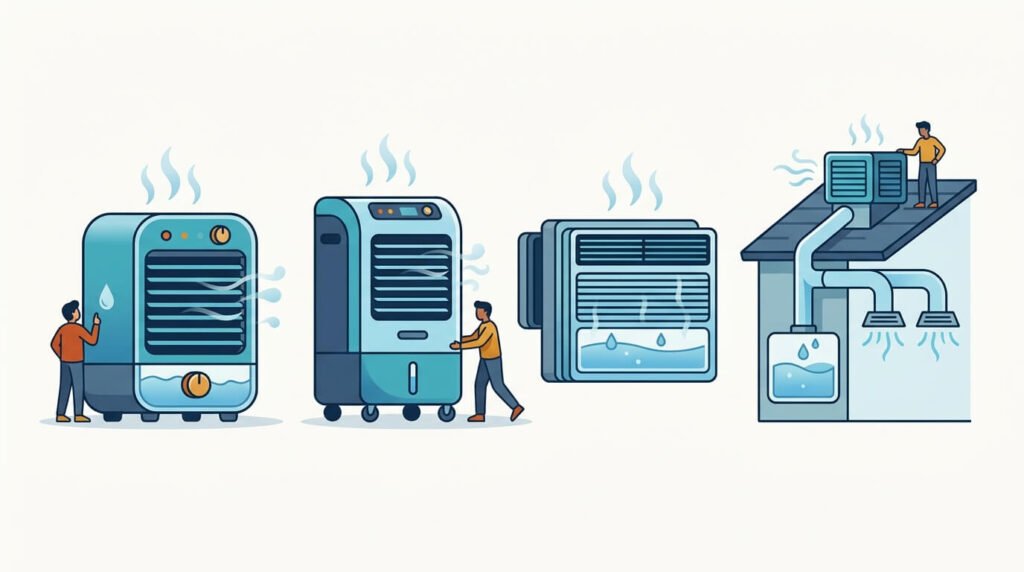
Every evaporative cooling system can be sorted by process, by format, and by pad hardware.
Each axis answers a different buying question: process tells you about humidity and climate limits, format tells you about size and price, and hardware tells you about upkeep.
If we blend everything, that will be an error; for example, some people think that direct and indirect coolers are both commonly known as two-stage.
They aren’t. Two-stage means an indirect stage followed by a second direct stage. See below for the distinctions:
By process: direct, indirect, two-stage
| Process type | What happens to the air | Moisture added to supply air | Lowest supply temperature |
| Direct | Air passes through a wetted pad | Yes | Wet-bulb of incoming air |
| Indirect | A heat exchanger separates supply air from the wet surface | No | Wet-bulb of incoming air |
| Two-stage (indirect/direct) | Indirect stage first, direct stage second | Less than direct alone | Below what either stage reaches alone |
| Dew-point (Maisotsenko) | Indirect design that recirculates part of the cooled air | No | Moves toward dew-point temperature |
Commercial building inspectors group the first three as the standard evaporative cooling technologies.
By format: portable, window, ducted, industrial
| Format | Mobility | Installation |
| Portable | Rolls or carries room to room | Plug in and fill the tank |
| Window or wall-mounted | Fixed | Mounted in a window or wall opening |
| Ducted (whole house) | Fixed | Roof unit with ductwork to ceiling outlets |
| Industrial or commercial | Fixed or mobile | Large central or spot units |
Swamp cooler, desert cooler, air cooler: same thing?
Swamp cooler is the common name for a direct evaporative cooler. The same machine is also sold as an evaporative air conditioner, desert cooler, wet air cooler, or swamp box.
Retailers often label small portable units “air coolers,” but the physics is identical: water evaporates into moving air.
Direct Evaporative Cooling Systems
A direct evaporative cooler pulls air through a water-soaked pad, which lowers the temperature and adds moisture in one step. It’s the most common type in homes and works best in hot, dry climates.
How a direct (swamp) cooler works
Here is the sequence in brief;
- A pump wets the cooling pads from the water reservoir.
- A fan draws warm outdoor air through the wet pads.
- Water evaporates and absorbs heat, so the air gets cooler and more humid.
- The cooled air flows into the room, or through ducts to ceiling outlets in a whole-house system.
- Humid air leaves through an open window or vent. These coolers pull fresh air from nearby open windows.
Pad and media types: rigid, aspen, rotary, slinger
| Hardware | How it wets the air | Notes |
| Random media pad | Air passes through wetted pad material | Usually aspen wood or plastic fiber and foam |
| Rigid media pad | Water runs down a stiff, corrugated structure | Often a sturdy honeycomb-shaped cardboard |
| Rotary pad | The pad turns through a water bath | The rotation wets and washes the pad |
| Slinger | A water slinger wets the media section | Used in packaged units with a separate fan section |
Pad choice affects water use and upkeep, so read about evaporative cooler pad types before buying replacements.
Strengths, limits, and best climate
Direct coolers do these things well:
- They cost little to buy and run. Direct systems can deliver a 20-degree drop for a fraction of the purchase and operating cost.
- They bring a continuous supply of fresh outdoor air into the building when ducted or wall-mounted.
- They use few parts, so repairs usually mean a pump, a motor, or pads.
Direct coolers fall short in these areas:
- They add moisture, and the air can only be cooled to the wet-bulb temperature of the outside air.
- The more humid the climate, the harder it is for a direct system to cool effectively.
- Running a conventional air conditioner alongside a direct cooler is a bad idea, because the AC dehumidifies while the cooler humidifies.
Indirect Evaporative Cooling Systems
Indirect evaporative coolers lower the temperature without adding moisture to the air entering the room, because a heat exchanger keeps the supply air away from the wet surface.
They cool a primary airstream by evaporating water into a separate secondary airstream.
How indirect cooling keeps humidity out
- Water evaporates into a secondary airstream, which cools that stream.
- The cooled secondary air passes along one side of an air-to-air heat exchanger.
- Outdoor supply air passes along the other side and gives up heat without touching any moisture.
- The supply air enters the building at a lower temperature and the same moisture content.
- The hot, humid secondary air is expelled outside.
Direct vs indirect evaporative cooling
| Feature | Direct | Indirect |
| Moisture added to supply air | Yes | No |
| Supply air limit | Wet-bulb temperature | Wet-bulb temperature for conventional designs |
| Best climate | Dry, arid regions | A much broader geographic range |
| Main hardware | Wetted pad, fan, pump | Heat exchanger plus a wet secondary stage |
| Common use | Homes | Commercial outside-air pre-cooling, often alongside compressor-based cooling |
Two-Stage (indirect/direct) Evaporative Cooling
A two-stage evaporative cooler sends air through an indirect stage first and a direct stage second.
The supply air comes out colder than either stage could produce alone. It also carries less moisture than a direct unit delivers.
How a two-stage cooler works
- Outdoor air enters the indirect section and loses heat without gaining moisture.
- The pre-cooled air moves through wetted direct-cooling media.
- Evaporation lowers the temperature again and adds some moisture.
- The supply air enters the building. Because the second stage starts from already-cooled air, it can finish colder than the original wet-bulb temperature.
Two-stage vs single-stage: temperature, humidity, water
The figures below come from Oxycom, a two-stage manufacturer, for outdoor air at 35°C and 30% relative humidity. Treat them as vendor data.
| Measure | Single-stage (direct) | Two-stage |
| Wet-bulb effectiveness | 85% | 114% |
| Indoor relative humidity | About 80% | About 69% |
| Moisture added to the air | 118 L/h | 22 L/h |
Less moisture in the room doesn’t mean less water used. One study found the combined mode consumed 55% more water than direct cooling.
Dew-point (Maisotsenko) Evaporative Coolers
Dew-point coolers are a refined form of indirect cooling that can deliver air below the incoming wet-bulb temperature.
The Maisotsenko cycle lets product air approach the ambient dew-point temperature, while typical indirect coolers stop at the wet-bulb.
How a dew-point cooler beats wet-bulb
Maisotsenko cycle (M-cycle) is an indirect evaporative design in which part of the indirectly cooled air is recirculated into the wet channel of the heat exchanger.
Water then evaporates into air that is already cool, and that air has a lower wet-bulb temperature than the outdoor air did.
What “above 100% wet-bulb effectiveness” means
Wet-bulb effectiveness is the share of the gap between dry-bulb and wet-bulb temperature that a cooler removes. At 100%, supply air leaves at the outdoor wet-bulb temperature.
Conventional indirect coolers reach about 1.0, while M-cycle devices have been reported up to 1.80.
You can estimate supply temperature yourself: dry-bulb minus effectiveness times (dry-bulb minus wet-bulb).
The table applies it to a 35°C day at three humidity levels. Wet-bulb values are rounded from standard psychrometric data, and the effectiveness values are rated figures, not field averages.
| Outdoor air | Wet-bulb | Direct at 85% | Indirect at 100% | Two-stage or dew-point at 114% |
| 35°C, 30% RH | about 22°C | about 24°C | about 22°C | about 20°C |
| 35°C, 50% RH | about 26°C | about 27°C | about 26°C | about 25°C |
| 35°C, 70% RH | about 30°C | about 31°C | about 30°C | about 29°C |
The advantage shrinks as humidity rises, and real performance can fall below rated numbers.
One laboratory test of a double counter-flow dew-point cooler reached 118% wet-bulb and 83% dew-point effectiveness at 38°C dry-bulb and 23°C wet-bulb.
In a tropical-humidity test, a Maisotsenko unit without desiccant managed a 1.7°C temperature drop and 37.3% wet-bulb effectiveness at 3 m/s.
Evaporative Coolers by Format: Portable, Window, Ducted
Format decides how much space a cooler covers and whether it draws outside air or recirculates room air. All three formats run the process types above, and most residential units are direct.
Portable evaporative coolers
- Portable units draw in room air, while ducted and wall-mounted units draw in outside air. In a sealed room, a portable unit keeps humidifying the same air.
- Place them near an open window or an exterior door with an opening on the opposite side of the room.
- They suit small rooms and are cheap and easy to set up.
- One consumer guide puts small portable models at under $100.
If you’re weighing a portable evaporative unit against a compressor-based one, read our comparison of evaporative cooler vs portable air conditioner.
Window and wall-mounted units
- They fit a window or wall opening and cool a single room, garage, or open-plan living space.
- They pull in outside air, so the room gets a steady supply of fresh air while the unit runs.
- Fixed units are plumbed and wired permanently and cost more than portable models.
Ducted and whole-house (rooftop) systems
- The main unit sits on the roof and sends cooled air through ducts to ceiling outlets in different rooms.
- Ducted systems can use a significant amount of water over summer in hot, dry climates, and they must refresh their water regularly, or it becomes too salty.
Format comparison: coverage, price, fresh air, water
| Format | Air source | Coverage | Price signal | Water note |
| Portable | Room air | One small room or spot | Under $100 for small models | Tank refills by hand |
| Window or wall | Outside air | One room, garage, or open-plan space | More than portable | Some models plumb to a supply |
| Ducted | Outside air | Whole home | Up to about $1,500 for down or side discharge units | High in hot, dry climates |
Commercial and Industrial Evaporative Cooling Systems
Commercial and industrial buildings use the same direct, indirect, and two-stage processes at a larger scale.
Those three are the types found in commercial buildings. Factories, warehouses, and workshops are the usual sites.
Spot, central, and tower systems
- Portable spot coolers are mobile units for flexible indoor and outdoor use.
- Central systems cool an entire space or several rooms through ducted distribution.
- Cooling-tower or coil coolers pair a water cooler with a water-to-air coil and circulating pump, and the IFC building standard files them under indirect systems.
Pre-cooling and hybrid setups with mechanical AC
Indirect evaporative cooling often pre-cools outside air ahead of compressor equipment.
The two methods run one at a time, not together. Hybrid may involve pairing a two-stage unit with a small mechanical system, and the evaporative side can work stand-alone up to 90% of the time.
However, before you do this, we recommend you perform a local test to gather data before sizing around it.
Which Type Works in Your Climate?
Direct coolers work best in hot, dry climates, indirect and two-stage units cover a wider range, and no evaporative cooler performs well when outdoor air is nearly saturated.
At 80% or 90% relative humidity, even a two-stage system can’t cool as effectively as it does in drier air.
Climate match by type and humidity band
| Outdoor condition | Direct | Indirect or two-stage | Dew-point |
| Hot and dry | Works well | Works well, with a drier supply | Lowest supply temperatures |
| Hot with moderate humidity | Added humidity can leave little comfort benefit | Outperforms direct systems | Strong on rated data, so check field tests |
| Hot and humid | Weak | Limited, as the 80% to 90% warning above shows | Limited, as the tropical test above shows |
How to check your local limit (wet-bulb depression)
- Find the outdoor dry-bulb temperature and relative humidity for your hottest afternoons in local weather data.
- Read the wet-bulb temperature from a psychrometric chart or an online calculator.
- Subtract wet-bulb from dry-bulb to get the wet-bulb depression.
- Apply the effectiveness formula from the worked example above to estimate supply temperature for each process type.
- Compare that estimate with your comfort target. If the drop is only a few degrees, the unit adds humidity for little benefit, and a two-stage or dew-point unit, or mechanical cooling, fits better.
For city-level detail, see our guide to evaporative cooling in humid climates.
How to Choose the Right Type
Choose the process from your climate first, then the format from your space and budget, and only then the pad hardware.
That order keeps you from buying a cheap portable unit that your humidity level can’t support.
Five questions to pick the type
- What is your afternoon wet-bulb depression? A small gap rules out direct units.
- Can the space tolerate added moisture? If not, choose indirect, two-stage, or dew-point.
- How much space needs cooling? One room points to portable or window; a whole home to ducted.
- Can you supply and drain water continuously? Ducted buyers should ask about the water management system and typical hourly or daily water use in their area.
- Do you want fresh outside air or recirculated room air? Window, wall, and ducted units bring in outside air, and portable units don’t.
Once you have a type, how to size an evaporative cooler determines the airflow to buy, because a badly sized unit wastes water and energy and can cause excess humidity, not a water bill increase due to AC use.
When an evaporative cooler is the wrong choice
If your climate stays humid or you need dehumidification, evaporative cooling vs air conditioning sets out the trade-offs.
Swamp coolers add moisture, while air conditioners remove it. A direct unit in a muggy region is the most common mismatch, followed by a portable unit in a closed room.
For homes that also need heating, compare evaporative cooling vs. reverse-cycle air conditioning.
Picking an evaporative cooling system comes down to two numbers: your afternoon wet-bulb depression and the humidity your space can tolerate, and a short review of your space can confirm both before you spend anything.
Frequently asked questions
Do portable evaporative coolers actually cool a room?
Yes, but only in dry air and with somewhere for humid air to go.
A portable unit draws in room air, so in a sealed room it keeps humidifying the same air and the cooling fades.
Placing it near an open window or an exterior door with an opening on the far side lets fresh air replace what the unit has humidified.
Treat portable units as spot coolers for small rooms, not whole-room solutions.
Can you run an evaporative cooler and an air conditioner together?
Not at the same time with a direct evaporative cooler.
An air conditioner removes moisture from the air while a direct cooler adds it, so the two machines work against each other and waste energy.
Indirect evaporative units are different: they can pre-cool outside air for compressor-based equipment, with the two methods running in sequence rather than together.
Ask your installer how any hybrid design switches between modes.
Is a two-stage evaporative cooler worth the extra cost?
It is worth it when your climate has moderate humidity or the space needs a drier supply of air.
Data shows a two-stage unit adding about one-fifth the moisture of a direct unit at 35°C and 30% relative humidity.
In very dry climates, a direct unit already delivers a large temperature drop for far less money.
Weigh the water use too, since one study found two-stage operation consumed 55% more water.
What size evaporative cooler do I need?
Size it by airflow, measured in cubic feet per minute (CFM), rather than by floor area alone.
An undersized unit can’t move enough air to cool the space, while an oversized one wastes water and energy and can leave rooms too humid.
Check the CFM rating on the specification label, then compare it with the room volume you want to cool and the supply temperature you calculated for your local climate.