
If your AC is running but your house still feels warm, the most common cause is a refrigerant leak, not old age or a dying compressor. Air conditioners are sealed systems, so they don’t burn through refrigerant the way a car burns gas.
A drop in refrigerant almost always means it’s escaping somewhere, and the longer that leak goes unfixed, the more expensive the repair gets.
This guide walks through the seven signs that point to low refrigerant, why your AC ended up low in the first place, what it costs to fix by refrigerant type, and when repairing stops making financial sense compared to replacing the unit.
Freon vs. Refrigerant: What’s the Difference?
“Freon” is a brand name owned by Chemours, originally for R-22, and it’s the word most homeowners default to no matter what’s actually in their system.
“Refrigerant” is the broader, correct term for any of the chemicals that cycle through your AC, absorbing and releasing heat, including R-22, R-410A, R-454B, and R-32.
So when someone asks whether their AC “needs Freon,” what they usually mean is whether it needs more refrigerant, regardless of which type their unit actually uses.
That distinction matters later in this guide, because the type of refrigerant your system runs on changes both the diagnosis and the price by a wide margin.
7 Signs Your AC Is Low on Refrigerant
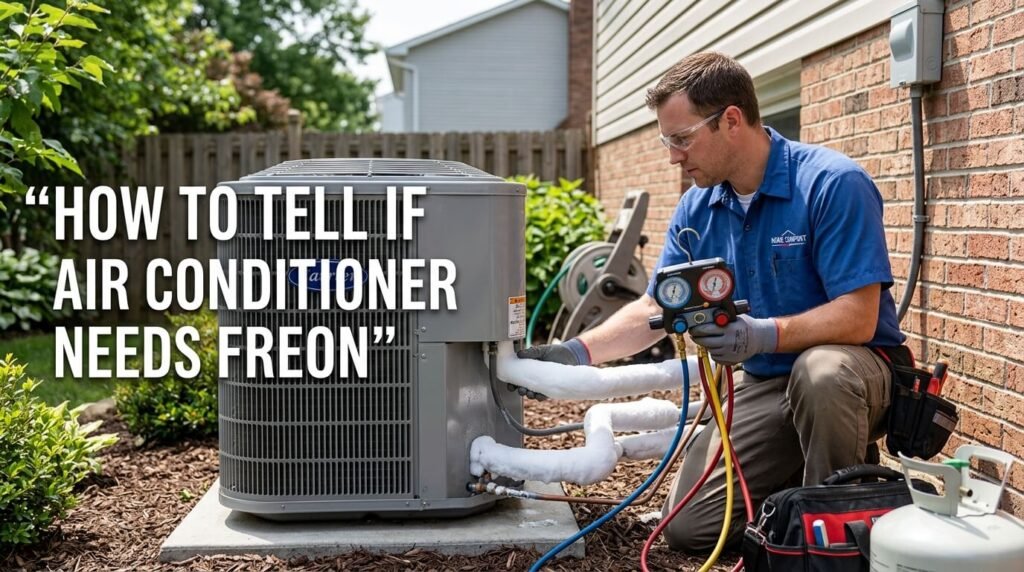
Low refrigerant produces a fairly consistent set of symptoms, and most homeowners can spot at least two or three of them before ever calling a technician.
None of these signs confirm low refrigerant on their own, since a dirty filter or a failing fan can mimic a few of them, but seeing several together is a strong indicator.
1. Warm or Weak Airflow from the Vents
Hold your hand up to a vent while the AC is running. If the air feels lukewarm instead of cold, or barely moving at all, refrigerant is the first thing worth ruling out.
Refrigerant is what actually removes heat from the air passing over the evaporator coil, so when there isn’t enough of it, the system can still blow air; it just can’t cool it properly.
A simple check: measure the temperature at the return vent and at a supply vent with a basic thermometer. A healthy central AC should produce air that’s roughly 15 to 20 degrees Fahrenheit cooler at the supply vent than at the return.
2. Ice Buildup on the Refrigerant Lines or Coil
Ice forming on the copper refrigerant lines outside, or frost building up on the indoor evaporator coil, is one of the more reliable signs of low refrigerant.
When pressure drops inside the coil, the remaining refrigerant gets too cold and causes moisture in the air to freeze on contact instead of just condensing off.
If you pull the panel off your indoor unit and see the coil coated in frost or ice, that’s a strong signal to shut the system off before it damages the compressor, and to call a technician rather than trying to thaw it yourself.
3. Hissing or Bubbling Sounds Near the Unit
A hissing or bubbling noise coming from the refrigerant lines usually means refrigerant is actively escaping through a leak.
Small leaks can be nearly silent and only show up as a slow performance decline over weeks or months, but a larger leak, like a punctured line or a failed valve, can hiss loudly enough to hear from several feet away.
If you hear this, it’s worth calling for service soon rather than waiting, since the leak will keep draining the system until it’s found and sealed.
4. AC Runs Constantly Without Cooling the Home
A properly charged central AC typically cools a house by around 10 degrees within a few hours of steady operation.
If your system is running nearly nonstop and the house still isn’t reaching the thermostat setting, low refrigerant is a likely culprit, especially if this is a new pattern rather than how the system has always behaved.
Constant runtime with poor results also strains the compressor, which is the most expensive component to replace if the problem is left unaddressed.
5. A Sudden Spike in Your Electric Bill
An AC that’s low on refrigerant works harder to produce less cooling, and that shows up on your utility bill.
If your electric bill jumps noticeably compared to the same month last year, without a corresponding increase in how much you’re running the AC, refrigerant loss is one of several possible explanations worth checking, alongside a dirty filter, blocked outdoor unit, or aging compressor.
How to Tell If Your AC Needs Refrigerant Without Gauges
You don’t need a manifold gauge set to get a strong read on whether your AC is low on refrigerant. Gauges give a technician exact pressure readings, but the signs below are what any homeowner can check just by watching and listening to the system:
1. Warm or weak airflow from the vents: If the compressor and fan are both running but the air coming out isn’t cold, that’s the clearest sign of low refrigerant. The system is moving air; it just doesn’t have enough refrigerant left to actually pull heat out of it.
2. Ice or frost on the copper line or evaporator coil: Low refrigerant drops the pressure inside the coil low enough that moisture in the air freezes onto it, even in warm weather. If you see frost or ice on the indoor unit or the refrigerant line running to the outdoor unit, that’s a strong indicator, not a sign the system is “working too well.”
3. Hissing or bubbling sounds near the unit: A steady hissing sound, especially near the refrigerant lines or the outdoor unit, often means there’s an active leak letting refrigerant escape as gas. Bubbling or gurgling can indicate a leak in liquid refrigerant lines. Either sound is worth acting on quickly, since the system keeps losing charge until the leak is sealed.
4. AC runs longer but doesn’t reach the set temperature. When refrigerant is low, the system has to work harder and longer to move the same amount of heat. If you notice the unit cycling for much longer than usual, or never quite hitting the thermostat setting, that’s consistent with an undercharged system.
5. Higher electricity bills without a change in usage: A low-refrigerant AC has to run longer to do the same job, which shows up on the power bill even if you haven’t changed your habits or the weather hasn’t gotten hotter.
6. Indoor humidity feels off: Part of an AC’s job is pulling moisture out of the air. Low refrigerant reduces that dehumidifying effect, so rooms can feel clammy or damp even while the AC is running.
7. The outdoor unit’s larger copper line feels warm, not cool: On a properly charged system, the larger of the two copper lines running to the outdoor unit should feel cool to the touch when the AC is running. If it feels warm or only slightly cool, that’s often a sign of low charge.
None of these signs tell you exactly how much refrigerant is missing, which still requires a technician with gauges. But if you’re noticing two or more of these together, it’s a strong enough signal to schedule a professional check before the system works harder than it needs to.
Why Is My AC Low on Freon in the First Place?
A home air conditioner is a closed, sealed loop. Refrigerant circulates between the indoor and outdoor coils and back again without ever being consumed or used up the way fuel is.
That means a properly functioning, leak-free AC should never need refrigerant added after its initial installation charge.
It’s Almost Always a Leak, Not Normal Use
If your technician tells you the system is low on refrigerant, the real diagnosis isn’t “it needed a refill”; it’s “something is leaking.”
Common leak points include brazed joints in the refrigerant lines, the evaporator or condenser coil itself, and valve fittings that loosen or corrode over time.
Simply topping off refrigerant without finding and repairing the leak is a short-term fix. The level will drop again, sometimes within months, and you’ll pay for another recharge on top of the one you just paid for.
You can read more about how refrigerant leak detection works if you want to understand what a proper leak search actually involves before you agree to a repair.
What Happens If You Ignore a Refrigerant Leak
Running an AC on low refrigerant for an extended period causes damage that compounds the longer it continues.
- The compressor can overheat and fail because refrigerant also helps cool and lubricate it as it circulates, and this is by far the most expensive single repair on the whole system.
- Liquid refrigerant can return to the compressor in the wrong state, a condition sometimes called slugging, which can crack internal components.
- The evaporator coil can freeze solid, and repeated freeze-thaw cycles stress the coil’s metal and its refrigerant line connections.
- Your energy bills keep climbing as the system works harder for less cooling, and that cost adds up faster than most homeowners expect.
- What starts as a $200 leak repair can turn into a $1,500 or more compressor replacement, or push you into buying an entirely new unit years earlier than planned.
Compressor damage in particular is the outcome most homeowners are trying to avoid by asking about this in the first place, and it’s the strongest reason not to let a known leak go unaddressed through another cooling season.
R-22 vs. R-410A vs. R-454B: Which Refrigerant Does Your AC Use?
Knowing which refrigerant your system runs on changes both what a recharge will cost and how urgently you should consider replacing an aging unit instead of repairing it.
You can see the full differences between R-22 and R-410A systems in more detail, but the short version is below.
| Refrigerant | Typical System Age | Availability in 2026 | Approximate Cost per Pound |
|---|---|---|---|
| R-22 (Freon) | Installed before 2010 | Production banned since 2020; only reclaimed supply remains | $90 to $600, depending on regional supply |
| R-410A | Installed 2010 to 2025 | Being phased out of new equipment as of 2025, still widely available for servicing | $12 to $80 |
| R-454B / R-32 | Installed 2025 or later | Current standard for new A2L systems | $60 to $345 |
How to Identify Your System’s Refrigerant Type
The refrigerant type is printed on the manufacturer’s nameplate, usually a metal or vinyl sticker on the outdoor condenser unit near the electrical connections.
Look for a line labeled “Refrigerant Type” or “Factory Charge,” which will list R-22, R-410A, R-32, or R-454B directly.
If the sticker has worn off or you can’t find it, the age of the system is a rough proxy: units installed before roughly 2010 almost always run R-22, while anything installed since then typically runs R-410A or, starting in 2025, one of the newer A2L refrigerants.
Why R-22 Systems Cost So Much More to Recharge
R-22 production and import into the United States stopped completely in 2020 under EPA regulations tied to the Montreal Protocol, because the chemical damages the ozone layer.
Since then, the only legal source of R-22 has been reclaimed refrigerant recovered from decommissioned systems and reprocessed to meet purity standards.
That shrinking supply is why R-22 now costs several times more per pound than R-410A, and why a recharge on an older R-22 system can run into the hundreds or even low thousands of dollars depending on how much refrigerant the leak repair requires.
Can You Check or Add Freon Yourself?
No. Under EPA Section 608 of the Clean Air Act, only a certified HVAC technician can legally purchase, handle, or add refrigerant to a home air conditioning system, whether it’s R-22, R-410A, or one of the newer A2L blends.
Why EPA Rules Require a Certified Technician
Refrigerants are regulated substances because releasing them into the atmosphere contributes to ozone depletion and climate change, and because handling them incorrectly, especially the newer mildly flammable A2L types, carries real safety risk.
Retailers are legally barred from selling refrigerant in quantities over two pounds to anyone without EPA 608 certification, which is why you won’t find canisters of R-410A or R-22 sitting on a hardware store shelf the way you might find window-unit coolant additives.
Technicians earn this certification by passing an EPA-approved exam covering safe handling, recovery, and disposal procedures.
What a Technician Checks That You Can’t
A homeowner can spot the symptoms on this page, but confirming low refrigerant and finding out why requires equipment most people don’t own.
A technician connects a manifold gauge set to the system’s service valves to read suction and discharge pressures, then compares those readings against the specific pressure-temperature chart for your refrigerant type.
That’s the only reliable way to confirm the system is actually low, rather than experiencing a different problem, like a failing capacitor or a blocked condenser coil, that happens to produce similar symptoms.
How Adding Freon Actually Works (Why It’s Not a DIY Project)
Adding refrigerant correctly is a multi-step process, not a matter of hooking up a can and topping things off.
A technician first uses a recovery machine to pull any remaining refrigerant out of the system for reuse or proper disposal, then locates and repairs the leak, whether that means resealing a fitting, replacing a section of line, or repairing the coil itself.
After the repair, the system gets pulled into a vacuum to remove air and moisture, since either one left in the lines can cause corrosion and reduce efficiency.
Only then does the technician weigh in the exact factory-specified charge, using a scale rather than guessing, because both overcharging and undercharging a system cause real performance and reliability problems.
How Much Does It Cost to Fix Low Refrigerant?
The average AC recharge cost by refrigerant type ranges from a couple hundred dollars for a minor R-410A top-off to well over a thousand for an older R-22 system that needs a full recharge plus leak repair.
The number that matters most is the refrigerant type, followed by how many pounds the system needs and whether the leak itself is easy or difficult to reach.
Cost by Refrigerant Type (R-22, R-410A, R-454B)
| Refrigerant | Cost per Pound | Typical Pounds Needed (2 to 4 lbs per ton) | Estimated Recharge Cost |
|---|---|---|---|
| R-22 | $90 to $600 | 4 to 12 lbs for a typical 2 to 3 ton system | $400 to $1,500+ |
| R-410A | $12 to $80 | 4 to 12 lbs | $150 to $600 |
| R-454B / R-32 | $60 to $345 | 4 to 12 lbs | $250 to $900+ |
These figures cover the refrigerant itself. Leak detection typically adds $100 to $300, and repairing the leak can add another $200 to $1,500 depending on where it’s located and how accessible the line is.
A technician who wants to recharge the system without first finding and fixing the leak is worth a second opinion, since a recharge alone is a temporary fix that will need to be repeated.
Repair the Leak or Replace the AC?
Deciding between repairing a refrigerant leak and replacing the whole unit comes down to a few concrete factors, roughly in this order of importance.
- Check the refrigerant type first. If your system runs on R-22, the combination of high per-pound cost and shrinking supply makes replacement the financially sounder choice in most cases, especially for anything beyond a minor, easily located leak.
- Weigh the system’s age against its expected lifespan. Central air conditioners typically last 15 to 20 years, so a unit already past the 12 to 15 year mark facing a significant repair bill is a strong candidate for replacement rather than another recharge.
- Factor in repeat leaks. A system that has needed refrigerant added more than once in the past few years likely has an underlying issue, such as coil corrosion, that will keep producing new leaks even after the current one is fixed.
- Compare the repair estimate to a realistic replacement cost. If a leak repair and recharge on an older system runs $1,000 or more, and a new higher-efficiency unit costs $4,000 to $8,000 installed, many homeowners find the math favors replacement once repair costs cross roughly a quarter of that range.
For a longer walkthrough of this decision, including how to get accurate quotes for both paths, see the full repair vs. replace decision guide.
Get a Professional Diagnosis Before You Decide
Everything on this page can help you narrow down whether refrigerant is the likely cause of your AC’s problems, but only a licensed technician with gauges and a leak detector can confirm it and tell you exactly what repair the situation calls for.
Given how much the right answer depends on refrigerant type, system age, and where the leak is located, getting an actual diagnosis before committing to a recharge or a replacement will save you from paying twice.
If you’re ready for that next step, you can find a certified HVAC technician near you to get an accurate read on your system before the problem gets worse.
Frequently Asked Questions
Is it normal for an AC to need Freon every year?
No, it isn’t normal, and it’s a sign your system has a leak that needs to be found and repaired rather than repeatedly topped off. A properly sealed, functioning air conditioner holds its original refrigerant charge for the life of the unit without needing more added.
If a technician has recharged your system more than once in the past few years, ask them to locate the source of the leak instead of simply refilling it again, since the underlying problem will keep recurring and getting more expensive until it’s actually fixed.
Staying current with a seasonal AC maintenance checklist can also help catch small leaks and coil issues before they turn into a full refrigerant loss.
Can I add Freon to my AC myself?
No, adding refrigerant to a home air conditioner yourself is illegal under EPA Section 608 of the Clean Air Act unless you hold EPA certification, and retailers can’t legally sell you more than two pounds of it without that credential.
Beyond the legal restriction, doing it safely requires a recovery machine, a vacuum pump, and a manifold gauge set most homeowners don’t own, plus the training to read pressure readings correctly for your specific refrigerant type.
Overcharging or undercharging a system by even a small amount can damage the compressor, so this is one repair where hiring a licensed technician is both required by law and the safer choice for your equipment.
How much does it cost to add Freon to a home AC?
Cost depends heavily on which refrigerant your system uses and your country(location): expect roughly $150 to $600 for R-410A, but $400 to $1,500 or more for older R-22 systems because of its limited remaining supply.
On top of the refrigerant itself, most jobs include leak detection, typically $100 to $300, and leak repair, which can range from $200 for an easily accessible fitting to $1,500 or more for a leak buried inside a coil.
Getting an itemized quote that separates refrigerant cost, labor, and leak repair helps you compare estimates accurately, since a low headline price sometimes hides a recharge-only fix that won’t last.
Will low Freon damage the compressor?
Yes, running an AC on low refrigerant for an extended period is one of the most common ways a compressor gets damaged, since refrigerant also helps cool and lubricate it as it circulates through the system.
When levels drop, the compressor works harder and runs hotter than it’s designed to, and in some cases liquid refrigerant can return to it in the wrong state and damage internal components directly.
Because a compressor replacement often costs more than the leak repair that would have prevented it, addressing a refrigerant leak as soon as you notice symptoms is the cheaper path in almost every case.
If any of these signs match what you’re seeing, don’t wait through another cooling season on a guess. A quick diagnostic visit from a licensed technician will tell you exactly what’s going on and what it will take to fix it, before a minor leak turns into a compressor replacement.