
A solar powered air conditioner for home use is an air conditioning system that runs partly or entirely on electricity generated by rooftop or ground-mounted solar panels, rather than pulling all its power from the grid.
It comes in two very different forms: a self-contained solar AC appliance built around dedicated panels, or a conventional AC powered by a whole-home solar system.
Those two options cost differently, pay back differently, and suit different homes, and most buyers don’t realize which one they’re actually shopping for until they’re deep into quotes.
Before you spend anywhere from $3,400 to $35,000, there’s one question most buyers never think to ask: are you buying an appliance or a power system?
Those are two completely different purchases with different costs, different payback timelines, and different answers depending on where you live.
And there’s a second thing worth knowing right now: the 30% federal tax credit for residential solar expired on December 31, 2025.
What Is a Solar Powered Air Conditioner for Home (and What It Isn’t)
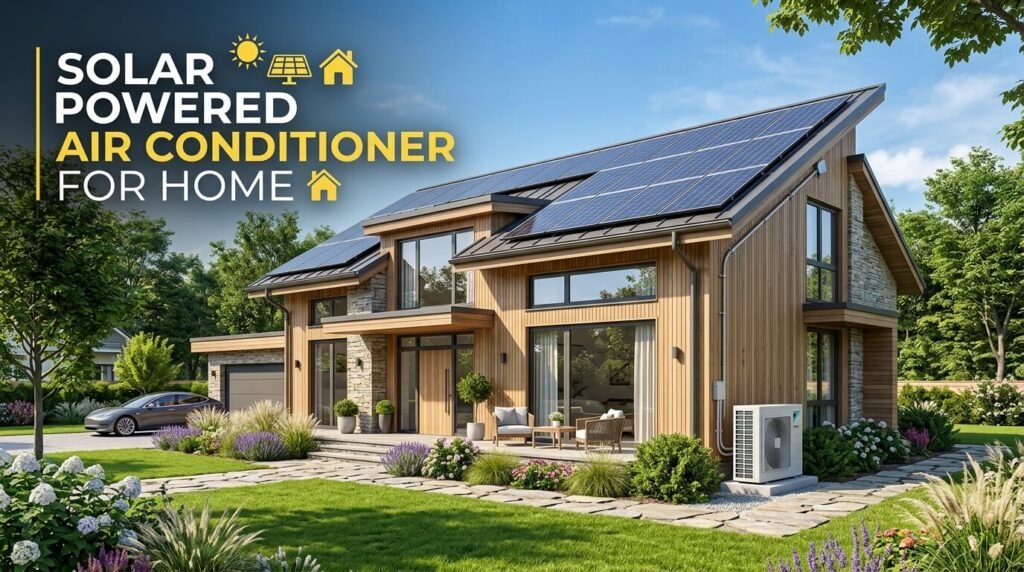
A solar powered AC for home use isn’t just one thing. It’s two fundamentally different products that most buyers confuse until they’re already deep into quotes.
The Appliance vs System Distinction That Changes Your Entire Budget
Solar AC unit (the appliance): A self-contained cooling system bundled with dedicated solar panels, typically a mini-split design where the panels power the compressor directly. Average cost: $3,400. Average payback period: 21 years, according to SolarReviews analysis.
Whole-home solar + conventional AC (the system): A rooftop solar array sized to cover your home’s full electricity load, including whatever AC you already own or install separately.
Average system cost after the now-expired federal tax credit was $13,200. Without it, you’re looking at $18,000–$25,000+, depending on system size. Payback period: 10–14 years — and it covers every appliance in the house, not just the AC.
Most people searching for “solar powered air conditioner” are imagining option one and budgeting for option one. But for homes with adequate roof space, option two almost always makes more financial sense.
That doesn’t mean option one is wrong; it means buyers need to know which one they’re actually evaluating.
How Solar AC Systems Actually Work (PV Panels → Power → Cooling)
- Photovoltaic (PV) panels on the roof or ground mount convert sunlight into direct current (DC) electricity.
- That DC power either flows directly to a DC-compatible compressor (in a DC solar AC unit) or passes through an inverter that converts it to AC power for a standard air conditioner.
- On hybrid and grid-tied systems, the grid picks up any shortfall when solar output drops — during clouds, evenings, or high-load periods.
- On off-grid systems, a battery bank stores surplus daytime energy for use at night; without a battery, the AC stops when the sun does.
- The cooled air circulates through the home via ductwork (central AC) or directly from the wall unit (mini-split).
Types of Solar Air Conditioners: DC, AC-Grid, and Hybrid Explained
The three types aren’t just technical categories; they’re three different answers to the question “what happens when the sun goes down?”
DC Solar AC: Best for Off-Grid Homes
An off-grid solar air conditioner is, in practical terms, a DC solar AC; the two terms describe the same setup: a unit that runs directly on solar panel output without depending on grid power.
DC solar ACs connect directly to PV panels without an inverter, which makes them the most efficient option when grid power isn’t available.
The HotSpot Energy ACDC12C, one of the most referenced DC units on the market, can operate entirely on solar during daylight without any grid connection.
- They’re the only real option for homes without grid access — rural properties, remote cabins, off-grid builds.
- Without battery storage, operation stops at sunset; with a properly sized battery bank, 24-hour cooling is possible.
- Installation is more complex than a hybrid unit because the DC wiring runs directly from panels to the outdoor compressor — not a standard HVAC setup.
- SEER2 ratings on DC units vary widely; units without variable-speed compressors can be significantly less efficient at partial load.
Hybrid Solar AC (AC/DC): Best for Most Homeowners
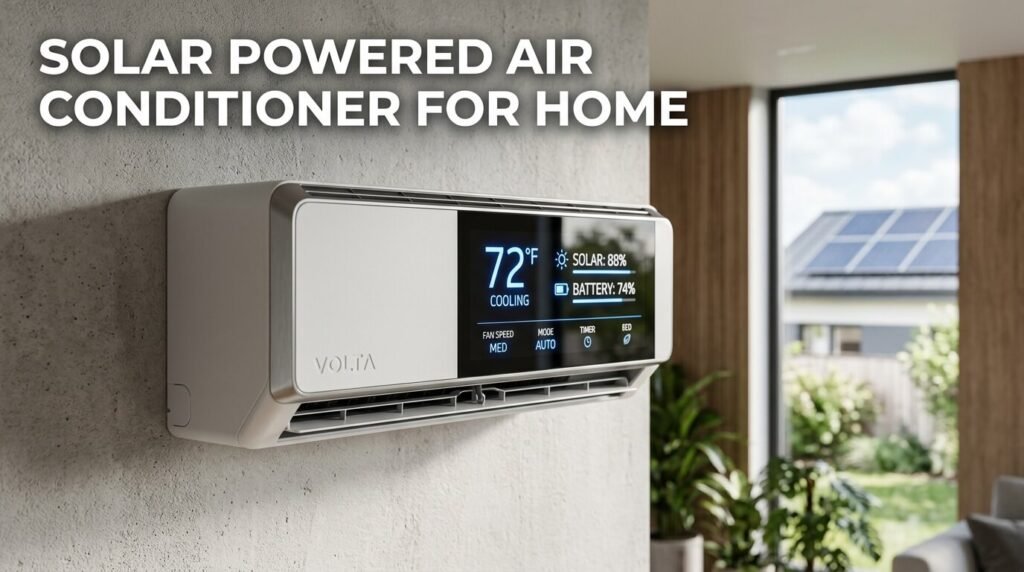
Hybrid systems run the compressor on solar DC power during the day and draw from the grid when solar production falls short.
If you have grid access, this is the type that actually delivers the 30–40% energy bill reduction that solar AC marketing leads with.
For setup guidance beyond the basics, see our solar mini-split installation and sizing guide.
- The EG4 Hybrid Solar Mini-Split (SEER2 ratings of 21–22 at 12K–24K BTU) is the most frequently cited example in current professional reviews.
- DC-capable compressors eliminate inverter losses, improving overall system efficiency by 8–12% compared to a fully AC-powered equivalent.
- You keep full cooling at night because the grid handles it, no battery required, unless you want outage protection.
- These are the most practical choices for suburban homeowners who want solar savings without going fully off-grid.
Grid-Tied Solar + Conventional AC: The Often-Overlooked Option
This isn’t a solar AC unit at all; it’s a standard rooftop solar installation that offsets the electricity your existing (or new) AC draws from the grid.
No special AC equipment needed. The solar array earns credits through net metering, and your electricity bill drops.
- For homes with a conventional AC already installed, this path requires no new HVAC equipment and no specialized solar-AC compatibility.
- A properly sized array in a sunny climate can cover 85–92% of cooling costs, based on real installation data from Phoenix and North Carolina published by SolartechOnline.
- The catch: you’re paying for a full home solar system ($18,000–$25,000 in 2026 without the federal tax credit), not just an AC upgrade.
- Net metering policies vary by state and utility; some have cut export rates significantly, which affects how much credit you earn from surplus production.
Solar-Powered Window Air Conditioners: Do They Exist?
Not really, not as a standalone consumer product in the way solar mini-splits exist.
Window units are compact, plug-in appliances designed for a standard 110/120V outlet, and pairing one with dedicated solar panels adds complexity that outweighs the benefit for most buyers.
If you’re specifically looking to run a window AC on solar, you have two realistic paths:
- Small DC-compatible units, similar in concept to the DC mini-splits covered above, exist but are far less common and harder to source than DC mini-split systems.
- Grid-tied solar offsetting a standard window unit — the far more practical option. Install a small solar array sized to your home’s electricity use (window AC included), and let net metering handle the accounting rather than trying to wire the AC directly to panels.
For a 5,000 BTU window unit drawing roughly 500 watts, 2–3 solar panels can offset its daytime running cost, but a standalone solar-powered window unit isn’t a product category worth shopping for directly; you’re better off treating it as part of a broader home solar decision.
Can Central Air Run on Solar Power?
Yes, but rarely as a dedicated “solar AC” appliance; central systems draw too much power (2,500–5,000+ watts) for a small, purpose-built solar array to make financial sense on its own.
In practice, running central air on solar means one of two things:
- Whole-home solar covering the AC as part of your total electricity load — this is the standard path, and the one that actually works at scale. A 3-ton central system needs roughly 12–16 panels just for its own draw, which is most of a typical residential solar array before you’ve covered anything else in the house.
- A hybrid DC-capable central system — these exist commercially but are far less common than hybrid mini-splits, more expensive to install, and usually only make sense for new construction where the electrical design is being planned around solar from the start.
If central air is your main cooling load, skip searching for a “solar central AC unit” and instead size a whole-home solar system that accounts for your central air’s full running wattage. See the panel sizing table above for the 2-, 3-, and 5-ton reference numbers.
Side-by-Side: Which System Type Is Right for Your Situation?
| Feature | DC Solar AC | Hybrid Solar AC | Grid-Tied Solar + Standard AC |
|---|---|---|---|
| Grid required? | No | Yes (preferred) | Yes |
| Runs at night? | Only with a battery | Yes (grid backup) | Yes (grid) |
| Best for | Off-grid homes | Most grid-connected homeowners | Homes with existing AC |
| Upfront cost range | $3,000–$8,000 | $5,000–$15,000 | $18,000–$30,000+ |
| Payback period | 15–21 yrs | 10–14 yrs | 10–14 yrs (covers full home) |
How Many Solar Panels Do You Need to Run an Air Conditioner?
The number of panels isn’t fixed; it depends on your AC’s wattage, your daily runtime, your local sun hours, and whether you’re sizing for daytime-only or 24-hour operation with a battery.
The Sizing Formula Solar Professionals Use
The formula solar designers use:
Panels needed = (AC wattage × daily runtime hours) ÷ (panel wattage × peak sun hours × 0.80)
The 0.80 efficiency factor accounts for real-world losses from heat, wiring resistance, and imperfect panel orientation — typically 20–25% below rated output. A 3,000W AC running 6 hours/day in a location with 5 peak sun hours, using 400W panels:
(3,000 × 6) ÷ (400 × 5 × 0.80) = 18,000 ÷ 1,600 = 11.25 panels → round up to 12
For a detailed calculator by BTU rating and sun-hour zone, see our complete solar panel sizing guide for air conditioners.
Panel Count by AC Type and Home Size (Reference Table)
| AC Type | BTU | Running Watts | Panels Needed (400W, 5 sun hrs) | Notes |
|---|---|---|---|---|
| Window unit | 5,000 | 500W | 2–3 panels | Daytime only; no battery needed |
| Mini-split (1 zone) | 12,000 | 900–1,200W | 4–6 panels | Most common solar AC pairing |
| Mini-split (2 zones) | 24,000 | 1,800–2,200W | 7–10 panels | Hybrid system recommended |
| Central AC (2 ton) | 24,000 | 2,500W | 9–12 panels | Whole-home solar path makes more sense |
| Central AC (3 ton) | 36,000 | 3,000–3,500W | 12–16 panels | Full array; grid-tied system |
| Central AC (5 ton) | 60,000 | 5,000W+ | 18–22 panels | Whole-home solar only |
Do You Need Batteries? What That Means for Night Operation
You need a battery if your home has no grid connection, or if you want the AC to keep running during a grid outage. For grid-connected homeowners, a battery adds $8,000–$15,000 to your system cost and extends payback by several years.
For battery sizing and brand comparisons, see our home solar battery storage options and costs.
- Off-grid homes have no choice — a battery bank is the only way to cool at night.
- A 3,000W AC running for 6 hours at night needs 18 kWh of stored energy; at 4.8 kWh per 48V/100Ah LiFePO4 battery, that’s at least four batteries.
- Grid-connected homeowners who just want lower bills don’t need a battery — the grid handles nights and cloudy periods while net metering credits cover the cost.
- Battery backup makes financial sense primarily in areas with frequent outages or time-of-use utility rates where nighttime electricity is significantly cheaper.
Solar Powered Air Conditioner Cost: What You Actually Pay in 2026
A solar powered air conditioner for home use costs between $1,600 and $35,000+, depending on what you’re actually buying. The range isn’t vague — it’s because “solar AC” means different things.
Full Cost Breakdown: Unit, Panels, Inverter, Battery, and Installation
| Cost Component | Low Estimate | Mid Estimate | High Estimate |
|---|---|---|---|
| Solar AC unit (mini-split) | $1,000 | $2,000 | $4,000 |
| Solar panels (2–16 panels) | $800 | $3,200 | $6,400 |
| Inverter (if required) | $500 | $1,500 | $3,000 |
| Battery storage (optional) | $3,000 | $8,000 | $15,000 |
| Installation (labor + electrical) | $1,500 | $3,500 | $6,000 |
| Total without battery | $3,800 | $10,200 | $19,400 |
| Total with battery | $6,800 | $18,200 | $34,400 |
Solar AC Kits: What’s Actually Included
A “solar AC kit” is a packaged version of the solar AC appliance path, typically a mini-split unit bundled with a matched set of solar panels, mounting hardware, and the cabling needed to connect them.
Buying a kit trades some flexibility for simplicity: the components are pre-matched for compatible voltage and wattage, so you’re not sourcing panels and a compressor separately and hoping they pair well.
What’s usually included:
- The indoor and outdoor mini-split units
- A matched set of solar panels (commonly 2–6 panels for smaller kits)
- Mounting rails and hardware for both the panels and the outdoor unit
- DC wiring and connectors sized for the specific panel-to-compressor pairing
What’s usually not included, and worth budgeting separately:
- Professional installation labor
- A battery bank, if you want nighttime or off-grid operation
- An inverter, for hybrid or grid-tied configurations
- Permitting and utility interconnection fees, where applicable
Kits simplify the buying decision, but they don’t eliminate the licensed electrician and refrigerant-handling requirements covered in the installation section below. A kit is a parts bundle, not a DIY-friendly installation.
Solar AC Appliance vs Whole-Home Solar System: Total Cost Compared
If you’re evaluating full home solar coverage rather than a single-appliance unit, start with our whole-home solar panel system buying guide.
| Feature | Solar AC Appliance | Whole-Home Solar System |
|---|---|---|
| Typical upfront cost (2026) | $3,400 average | $18,000–$25,000 (no federal credit) |
| What it powers | AC only | Full home electricity load |
| Payback period | ~21 years | ~10–14 years |
| Roof space needed | 2–6 panels | 12–22+ panels |
| Best for | Off-grid, limited roof space, supplement to existing solar | Most grid-connected homeowners |
For most homeowners with adequate roof space and electricity bills above $150/month, whole-home solar is the better financial call — even now that the federal tax credit is gone.
A solar AC appliance makes more sense for off-grid homes, renters who can take the unit with them, or homeowners who already have a solar array and want to add a dedicated cooling circuit.
Federal Tax Credit for Solar AC in 2026: What Actually Changed
The 30% federal Residential Clean Energy Credit (Section 25D) expired on December 31, 2025. If you install a solar system in 2026, you get nothing from the federal government.
Some users who still believe this credit is “available through 2032” are referencing the Inflation Reduction Act timeline that ended with the One Big Beautiful Bill Act, signed in 2025.
The Residential ITC Expired December 31, 2025 — Here’s What That Means
Section 25D status: Terminated. The IRS page for the Residential Clean Energy Credit now reads: “The credit is not available for any property placed in service after December 31, 2025.”
For a $20,000 solar AC system, that’s $6,000 no longer on the table. The payback math is worse. Not unworkable, but worse.
The Congressional Joint Committee on Taxation estimated the IRA clean energy credits would cost roughly $370 billion over ten years, and Congress chose not to extend the residential portion.
The commercial solar ITC (Section 48E) for businesses still exists through 2027.
State Incentives Still Available in 2026 (and How to Find Them)
For a full, regularly updated list, see our state-by-state solar incentives still available in 2026.
| State | Incentive Type | Maximum Value | Source |
|---|---|---|---|
| New York | State tax credit (25%) | $5,000 | NY-Sun Program |
| Arizona | State tax credit (25%) | $1,000 | AZ Dept. of Revenue |
| South Carolina | State tax credit (25%) | $3,500 | SC Dept. of Revenue |
| New Mexico | State tax credit (10%) | $6,000 | NM Energy, Minerals & Natural Resources |
| Iowa | State tax credit | $5,000 | Iowa Economic Development |
| Massachusetts | State tax credit (15%) | $1,000 | MassCEC |
| Montana | State tax credit | $1,000 | MT Dept. of Revenue |
Check the DSIRE database (dsireusa.org) for utility rebates and local incentives in your area. These can add several hundred to several thousand dollars on top of state credits.
The Lease/PPA Loophole: How Some Homeowners Still Access Tax Savings
Third-party-owned solar systems, leases, and power purchase agreements (PPAs), still qualify for the commercial ITC (Section 48E) because the financing company owns the panels, not you.
The company claims the 30% credit and typically passes some savings through lower monthly rates.
- You don’t own the system, which means you can’t sell it with the house the same way or claim the credit yourself.
- Monthly payments under a solar lease are often lower than your current electricity bill from day one.
- After 6 years on some prepaid lease structures, you may have the option to purchase the system — potentially after the depreciation and credit benefit have been captured by the lessor.
- This path works best for homeowners who can’t use a large tax credit (low tax liability) or who want to avoid the upfront capital outlay entirely.
Is a Solar Powered Air Conditioner Worth It? The Honest Payback Math
In a hot, sunny climate with electricity bills above $200/month: yes, often. In a temperate or cold climate with cheap electricity, the numbers rarely work.
The answer isn’t climate alone; it’s the combination of sun hours and electricity rate in your specific location.
Solar AC Appliance: 21-Year Payback vs Whole-Home Solar’s 10-Year Path
A household spending $115/month on electricity and $46/month on AC-related costs:
| Scenario | System Cost (2026) | Annual Savings | Payback Period |
|---|---|---|---|
| Solar AC appliance ($3,400 + install) | ~$5,200 after install | ~$552/yr | ~21 years |
| Whole-home solar system | ~$20,700 (no ITC) | ~$1,800–$2,400/yr | ~10–12 years |
| No solar (grid electricity) | $0 upfront | $0 savings | N/A — ongoing cost |
The whole-home system costs four times more up front and pays back twice as fast. After the payback period, the electricity is essentially free for another 10–15 years of panel life.
When Solar AC Makes Financial Sense (and When It Doesn’t)
Good fit:
- Off-grid homes with no utility connection — solar AC is the only way to cool with electricity.
- Hot-dry climates (Phoenix, Tucson, El Paso) with 6–7 peak sun hours and electricity rates above 13¢/kWh — payback periods of 7–10 years are realistic.
- Homeowners with limited roof space who can’t fit a full array but can support 2–6 panels for a mini-split circuit.
- Existing solar array owners who want to add a dedicated cooling circuit without expanding the main system.
Poor fit:
- Moderate or cold climates (Minneapolis, Chicago, Denver) with 3.5–5 sun hours — payback stretches to 18–25+ years.
- Homes with electricity rates below 10¢/kWh: the savings base is too small for the math to work.
- Homeowners who plan to move within 10 years are unlikely to recoup the investment before the sale.
- Anyone expecting the federal tax credit to still apply: it doesn’t, and the payback math in most older guides doesn’t reflect current 2026 costs.
Pros and Cons of Solar Air Conditioners for Home
Advantages: Energy Savings, Grid Independence, and Lifespan
- Switching to a solar AC can reduce cooling-related electricity costs by up to 40%, which translates to roughly $46/month for the average U.S. household spending $115/month on electricity, according to HVAC.com.
- Solar panels typically carry 25-year performance warranties, meaning the system keeps producing for well beyond any payback period in a sunny climate.
- Hybrid and off-grid systems provide some protection against grid outages during summer peak periods, when rolling blackouts are most common.
- Air conditioning accounts for 12% of U.S. residential electricity costs — up to 27% in hot-humid climates per the EIA — so solar’s impact on the bill is concentrated exactly where bills are highest.
- Solar energy production naturally peaks in summer, which is when cooling demand peaks, giving solar AC systems a built-in seasonal alignment that most other appliances don’t have.
Disadvantages: Upfront Cost, Long Payback, and Performance Limits
- Upfront costs run $5,000–$35,000, depending on system type — substantially more than a $3,000–$5,000 conventional mini-split installation without solar components.
- The federal residential solar tax credit expired on December 31, 2025, adding $1,500–$6,000+ back onto the total cost compared to what buyers paid before 2026.
- Solar AC appliances have a 21-year average payback period, which is longer than the AC unit’s own lifespan of 15–20 years — meaning you may replace the AC before the solar investment pays off.
- Performance drops on cloudy days and stops without battery backup at night; grid-tied hybrids solve this, but purely solar DC systems don’t.
- The system requires more maintenance than a standard AC; solar panels need periodic cleaning and a professional inspection every few years, which is why following a solar AC maintenance schedule and panel cleaning guide matters for long-term output.
Installation: What the Process Looks Like and Who Should Do It
Most solar AC installations are not DIY projects. The electrical work, especially refrigerant handling, DC wiring from roof panels to the compressor, and grid interconnection, requires licensed contractors in most states.
What Professional Installation Involves (and Why Most Can’t DIY)
- Site assessment: a contractor evaluates roof orientation, shading, structural load capacity, and panel placement options.
- System design: sizing the array to match the AC’s wattage, runtime, and local sun hours using the formula covered earlier.
- Panel mounting: rails and mounting hardware secured to roof rafters; panels connected in series or parallel depending on voltage requirements.
- DC wiring run (licensed electrician required): cables from panels to the outdoor AC unit or inverter, run through conduit and properly fused.
- Refrigerant lines and indoor unit installation (EPA Section 608 certification required): refrigerant handling is federally regulated — unlicensed handling is illegal.
- Grid interconnection (utility approval required for grid-tied systems): the utility must inspect and approve the system before it connects to the grid.
- System commissioning: testing all components under load, verifying solar input is powering the compressor, and checking battery charge cycles if applicable.
Plug-and-play hybrid mini-splits like some EG4 models simplify steps 4–6 for the solar connection itself, but the refrigerant and electrical work still requires licensed professionals.
Roof Requirements, Panel Placement, and Orientation for Maximum Output
- South-facing roof sections produce the most annual output in the Northern Hemisphere; east- and west-facing roofs lose 10–20% of potential production but still work.
- Each 400W panel needs roughly 17–20 square feet of unshaded roof space — a 6-panel setup requires about 100–120 square feet clear.
- Shade from trees, chimneys, or neighboring buildings during peak sun hours (10 am–3 pm) significantly reduces output — even partial shading of one panel can reduce the whole string’s performance.
- The roof structure must support an additional 2–4 lbs per square foot from panel weight; most modern roofs are adequate, but older structures may need inspection.
- Panels should be tilted at an angle roughly equal to the installation’s latitude for optimal annual production — adjustable mounts can improve output by 5–15% over flat-mounted panels.
Ready to find the right solar cooling setup for your home? Get quotes from licensed solar installers in your area and ask specifically for a breakdown that compares the solar AC appliance path against a whole-home solar system. The numbers often surprise people.
Get Solar AC Quotes from Local Installers →
Frequently Asked Questions About Solar Powered Air Conditioners
Can you run an air conditioner entirely on solar power?
Yes, with the right system design. A DC solar AC runs entirely on solar during daylight hours, and with a properly sized battery bank, it can run 24/7. Grid-tied hybrid systems run on solar during the day and draw from the grid at night.
How many solar panels do I need to run a 1.5-ton AC unit?
A 1.5-ton (18,000 BTU) mini-split draws roughly 1,500–1,800 watts running. Using 400W panels with 5 peak sun hours and the standard 0.80 efficiency factor, you need 6–8 panels for daytime-only operation. Add battery storage, and the panel count increases to cover nighttime charging.
What is the difference between a DC and a hybrid solar AC system?
A DC solar AC runs directly on solar panel output with no inverter efficient for off-grid use, but it stops cooling when solar production drops.
A hybrid system uses solar to power the compressor during the day and switches to grid electricity automatically when needed, so cooling continues at night without battery storage.
Can a solar air conditioner run at night or during cloudy weather?
A hybrid or grid-tied system runs normally at night by drawing grid power. A pure DC solar AC stops running without either a battery or a grid backup.
On cloudy days, hybrid systems throttle to available solar production and pull the remainder from the grid; DC systems reduce output or stop entirely depending on cloud cover.
How much does a solar powered air conditioner cost to install?
A solar AC mini-split with 4–6 panels and professional installation runs $5,000–$12,000 in 2026 without battery storage.
Adding a battery bank pushes the total to $13,000–$27,000. Full central air coverage via whole-home solar costs $18,000–$30,000+.
Is it better to buy a solar AC unit or add solar panels to power my existing AC?
For most homeowners with roof space and electricity bills above $150/month, adding solar panels to cover the whole home’s load has a shorter payback period — roughly 10–14 years vs 21 years for a dedicated solar AC appliance.
A solar AC unit makes sense for off-grid homes or as a supplement to an existing solar array.
What SEER rating should I look for in a solar air conditioner?
Look for SEER2 ratings of 18 or higher for a solar-paired system — higher efficiency means fewer panels are needed to cover the same cooling load, which reduces your upfront cost.
The EG4 Hybrid Solar Mini-Split posts SEER2 ratings of 21–22, which is at the top of the residential range.
How long does a solar powered air conditioner last?
The AC unit itself lasts 15–20 years with regular maintenance. Solar panels carry 25-year performance warranties and typically last 30+ years at reduced output.
Inverters last 10–15 years and are usually the first component to need replacement. Battery storage systems (LiFePO4 type) typically last 10–15 years before significant capacity loss.