
Harmattan arrives, and almost immediately, your AC starts struggling blowing weaker, working harder, and cooling less.
You’ve changed nothing, yet the same unit that handled the rainy season now feels like it’s gasping for air. The dust isn’t just outside your window; it’s quietly suffocating your cooling system from the inside.
Cranking up the temperature settings won’t fix this; cleaning and protecting your unit before and during harmattan will.
This post breaks down exactly how harmattan dust affects air conditioners in Nigeria, the specific components it attacks first, and the practical steps that keep your unit cooling efficiently through the dry season.
Here’s the uncomfortable truth: your AC isn’t aging faster because it’s cheap; it’s aging faster because harmattan is a maintenance event most Nigerians never prepare for.
What Is Harmattan and Why Does It Matter?
Understanding Harmattan Season in Nigeria
Harmattan is a dry, dusty trade wind that blows from the Sahara Desert across West Africa, typically between November and early March.
It carries enormous volumes of fine Saharan dust particles so fine that they stay suspended in the air for hours, penetrating through window gaps, door frames, and ventilation openings.
For air conditioners, which continuously pull in surrounding air to function, this season creates a challenging environment.
The air intake vent draws in whatever is floating in the atmosphere, and during Harmattan, that air is loaded with airborne particles.
Regions Most Affected by Harmattan
Northern Nigeria bears the heaviest impact, with states like Kano, Kaduna, Sokoto, and Maiduguri experiencing intense dust exposure for months.
The Middle Belt, including Abuja, Jos, and Lokoja, sees significant Harmattan effects as well. Even in the South, particularly in states like Rivers, Delta, and Anambra, the tail end of the Harmattan season still brings noticeable dust, especially in December and January.
The point is that no part of Nigeria is completely immune, and AC units across the country face increased dust infiltration during this period.
To learn more about the type of AC that will work effectively in the North, read our guide on the best Air Conditioners for dry heat.
How Harmattan Changes Indoor Air Quality
Even with doors and windows shut, Harmattan dust finds its way indoors. It enters through tiny gaps, settles on surfaces, and circulates through ventilation systems.
The result is a steady decline in indoor air quality throughout the season. When your air conditioner is running, it pulls this dust-laden air through its filters and across its internal components.
If the filter is not clean enough to capture everything, those fine particles move deeper into the system, and that is where the real problems begin.
How Air Conditioners Work During Harmattan
Air Intake and Filtration Process
An air conditioner works by drawing warm air from the room through its air intake vent, passing it across the evaporator coil where heat is absorbed, and then releasing cooled air back into the space.
This cycle happens continuously while the unit is running. The key thing to understand is that the system is essentially a giant air-processing machine, and anything in that air, including Harmattan dust, gets processed too.
Why Dust Enters the AC System
Constant air circulation is both the AC’s strength and its vulnerability during Harmattan. Because the indoor unit is always pulling air in, it is always pulling dust in too.
The higher the concentration of airborne particles in the room, which spikes significantly during Harmattan, the more dust the system encounters every hour it runs.
Running your AC for longer hours, which many Nigerians do during the dry season for comfort, only increases the total dust exposure.
The Role of Filters During Dusty Seasons
The air filter is the first line of defense against dust buildup inside the AC.
Under normal conditions, cleaning the filter monthly is usually sufficient. During Harmattan, however, that timeline shortens dramatically.
The filter captures dust particles before they reach the evaporator coil and other internal components, but once it becomes saturated, it stops working effectively.
A clogged filter does not just fail to protect, but it also actively becomes a problem, restricting airflow and forcing every other component to work harder.
How Harmattan Dust Affects AC Performance
Clogged Air Filters
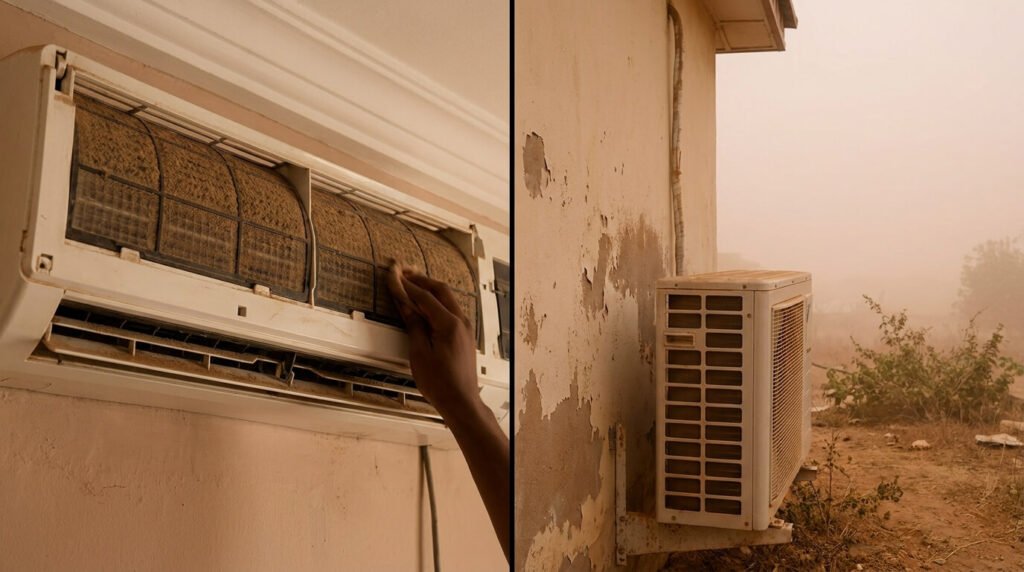
This is the most immediate and visible effect. Dust accumulation on the filter happens fast during Harmattan, which might take a month under normal conditions, but can happen in one to two weeks during the peak dusty season.
A clogged filter reduces airflow significantly. The AC unit struggles to pull enough air across the evaporator coil, which means less cool air gets pushed into the room.
Filter clogging is the starting point for most of the performance problems that follow.
Dirty Evaporator Coils
From my five years servicing AC units across Port Harcourt and surrounding areas, the evaporator coil is where I’ve seen Harmattan do its worst work.
When the filter cannot catch everything or when it has been left uncleaned too long, fine dust particles pass through and coat the evaporator coil’s fins.
Over time, this dust mixes with the moisture naturally produced by the coil during the cooling process, forming a thick, muddy layer.
I have dismantled units where this buildup had turned into what can only be described as grey mucus caked between every fin. When I wash these coils with high-pressure water during servicing, the amount of dark sludge that comes off is genuinely alarming.
This coating on the evaporator coil is a serious problem because the coil needs direct contact with air to absorb heat. When it is covered in dust and sludge, heat transfer efficiency drops sharply.
The coil cannot absorb heat as effectively, cooling output falls, and in severe cases, the coil begins to freeze, and ice forms internally on a component that should never ice up during normal operation.
When this happens, you will notice the airflow from the unit feels weak even with the blower running at full speed.
That is your signal that the evaporator coil needs urgent professional attention. If you are not sure what is causing your unit to underperform, why does my AC stop working during harmattan? Is a question worth exploring? It often comes back to this exact issue.
Dust on Condenser Coils
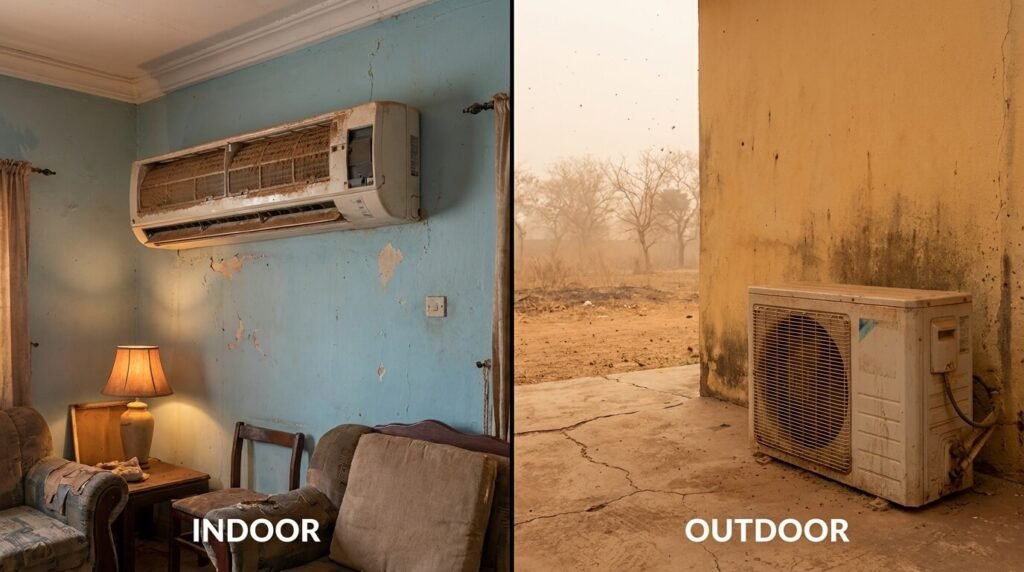
While the evaporator coil sits inside, the condenser coil is located in the outdoor unit, right in the path of Harmattan winds.
The condenser coil’s job is to release the heat that was absorbed indoors back into the outside air. When Harmattan dust coats the condenser coil, heat dissipation becomes inefficient.
Heat gets trapped, the system’s internal temperature rises, and the compressor is forced to work harder to compensate. This is one of the primary causes of compressor strain during the Harmattan season.
Blocked Drainage Systems
Here is something that surprises most AC owners: dust causes water leakage.
During Harmattan, the blower pulls in dust-laden air, and that dust eventually finds its way into the water tray beneath the evaporator coil.
As condensed water flows across the tray toward the drain pipe, it carries that dust with it. Over time, the dust and water combine to form a sludge that gradually blocks the drain pipe.
When the drain is blocked, water has nowhere to go and starts overflowing from the indoor unit, dripping onto your walls, ceiling, or floor.
I have resolved hundreds of these cases over the years. The fix involves loosening the evaporator unit, removing and washing the drain line, then reattaching it.
A quicker field method I have used in urgent situations: go to the outlet end of the drain hose and carefully clear the blockage manually using your mouth by blowing in air ( please don’t do this as you could swallow the mucus).
You will see a rush of water and dark sludge come through once the line is clear. It works, but proper servicing is always the better long-term solution.
Impact on Cooling Efficiency
Reduced Airflow
When filters are clogged and coils are contaminated, the volume of cool air the unit can push into the room drops noticeably.
The blower wheel works against increased resistance, and the result is weaker airflow from the vents.
Rooms that used to reach a comfortable temperature within 20 minutes now take an hour or more. This is airflow restriction in action, and it is one of the clearest early signs that your AC is suffering from Harmattan dust buildup.
Longer Cooling Cycles
Because the unit is delivering less cool air per cycle, it takes longer to bring the room to the target temperature set on the thermostat. The compressor keeps running — and running — trying to hit a target it cannot reach efficiently.
These extended cooling cycles add hours of extra runtime to your AC every day during Harmattan, putting consistent mechanical stress on every component in the system.
Increased Energy Consumption
Longer runtime means higher power consumption. An AC struggling against clogged filters and dirty coils can consume significantly more electricity than a clean, well-maintained unit doing the same job.
For Nigerian households and businesses already dealing with high electricity costs and generator fuel expenses, this is a real financial impact.
Many people do not connect their rising electricity bills to their AC’s maintenance state, but the link is direct and measurable. Energy waste from a dirty AC is one of the most avoidable costs of the Harmattan season.
How Harmattan Dust Affects AC Components
Compressor Stress
The compressor is the most expensive component in any AC system, and it is also the one most vulnerable to the chain reaction caused by dust buildup.
When airflow is restricted and heat dissipation is poor, the compressor has to work under greater load to maintain the refrigerant pressure needed for cooling.
This increased workload generates more heat within the compressor itself, accelerating wear and tear.
Compressor failure does not usually happen overnight; it is the result of months of operating under stress, and Harmattan is the season when that stress peaks.
Fan Motor Strain
The fan motor drives the blower wheel inside the indoor unit and the fan blades in the outdoor unit. When dust coats the fan blades, they become unbalanced and face more resistance as they spin.
The motor has to draw more current to maintain the same speed. Over time, this strain heats the motor windings, degrades the motor’s insulation, and shortens the fan motor’s operational lifespan.
You might notice this as increased noise or vibration from the unit, the kind of rattling or humming that was not there before Harmattan.
Sensor Malfunction
Modern AC units rely on temperature sensors and thermostats to regulate their operation. When fine Harmattan dust settles on these sensors, particularly inside the indoor unit, it creates an insulating layer that interferes with accurate temperature readings.
The thermostat may read the room as warmer or cooler than it actually is, causing the system to short-cycle or run longer than necessary.
Sensor malfunction from dust is more common than most people realise, and it can lead to confusing behaviour from an otherwise functional unit.
Circuit Board Exposure
The PCB board that controls the AC’s electronic functions is housed inside the unit, but it is not immune to fine dust infiltration.
Harmattan dust is exceptionally fine, fine enough to settle on circuit board components and create pathways for electrical shorts or moisture-related corrosion.
PCB contamination is one of the hardest and most expensive issues to diagnose and fix, and it is often the result of years of neglected maintenance during dusty seasons.
Signs Harmattan Is Affecting Your Air Conditioner
Weak Cooling Performance
If your room is taking noticeably longer to cool down, or simply is not reaching a comfortable temperature despite the AC running continuously, dust buildup is almost certainly a contributing factor.
This is usually the earliest and most obvious sign that something is wrong.
Unusual Noise From the Unit
Rattling, humming, or grinding sounds that were not present before Harmattan started are a red flag. These often point to fan blade imbalance from dust accumulation or increased motor strain.
Do not ignore unfamiliar noises; they rarely resolve on their own and usually indicate a problem that will worsen over time.
Water Leakage
Water dripping from your indoor unit during or after operation is a strong indicator of a blocked drain line.
As discussed, dust and moisture combine in the water tray to form sludge that blocks the drain pipe.
If you see water stains on your wall beneath the unit or notice dripping during operation, the drain system needs immediate attention.
Higher Electricity Bills
If your electricity consumption has climbed during Harmattan without a corresponding increase in usage, your AC is likely working harder than it should be.
A clean, well-maintained AC uses power efficiently. One struggling against dust buildup does not. Track your bills across months; a spike during the Harmattan season is often the system telling you it needs servicing.
How to Protect Your AC During Harmattan
Clean Filters More Frequently
During Harmattan, increase your filter cleaning frequency to once every one to two weeks, depending on how dusty your environment is. This single habit alone significantly reduces the rate of dust infiltration into the rest of the system.
Filter cleaning is something homeowners can do themselves: remove the filter, wash it with clean water, let it dry completely, and refit it.
Service the AC Regularly
Professional maintenance becomes even more critical during Harmattan. A certified AC technician will clean the evaporator and condenser coils, clear the drain line, check refrigerant pressure, and inspect the electrical components.
For a deeper look at how often this should happen, read our guide on how often you should service your AC. It walks through the recommended intervals for different usage levels and climates, including Nigeria’s Harmattan season.
Protect Outdoor Units
The condenser unit outside is directly exposed to Harmattan dust. Where possible, position it in a location with some shelter from direct wind, or install a louvred screen that allows heat to escape while reducing dust contact.
Ensure there is always adequate ventilation clearance around the unit, at least half a metre on all sides, so heat dissipation is not compromised.
Avoid fully covering the outdoor unit when the AC is running, as this restricts the airflow needed for the condenser to work.
Keep Doors and Windows Closed
It sounds simple, but it makes a significant difference. Every time a door or window is opened during a dusty period, a fresh wave of Harmattan dust enters the space and eventually gets pulled into the AC.
Keeping your indoor space as sealed as possible during peak dust periods reduces the concentration of airborne particles the system has to handle, lightening the load on your filters and coils.
How Often Should You Service Your AC During Harmattan?
Residential AC Maintenance Frequency
For home use, a full professional servicing before Harmattan begins (October) is strongly recommended.
During the season, filter cleaning every one to two weeks and a mid-season professional service in January or February will keep the system in good shape.
If the unit is running daily for more than eight hours, lean toward the shorter intervals.
Office AC Maintenance Frequency
Office environments typically run AC units for longer hours and with more people moving in and out, which means more dust entry and faster filter saturation.
For offices, monthly professional servicing during Harmattan is a reasonable standard, with filter cleaning happening weekly. Higher-traffic environments like shops, clinics, or schools may need even more frequent attention.
Signs That Immediate Servicing Is Needed
Do not wait for the scheduled service date if you notice: a sudden drop in cooling output, water dripping from the indoor unit, a musty or unpleasant smell when the AC runs, or unusual noise from the unit.
These are indicators that something inside the system has already been compromised and needs a professional assessment promptly.
Harmattan and Indoor Air Quality
Dust Circulation Through AC Systems
A dirty AC filter does not just fail to clean the air; it actively degrades it. When a filter is saturated with dust, particles that should be trapped instead bypass it and get blown back into the room through the air vents.
Your AC, meant to improve indoor comfort, becomes a dust distribution system. This is particularly problematic for children, the elderly, and anyone with respiratory sensitivities.
Allergies and Respiratory Issues
Harmattan dust is a well-known trigger for allergies, asthma, and respiratory irritation in Nigeria. When AC filters are not maintained, allergens and fine particles circulate freely through the conditioned space.
People in these environments experience increased sneezing, congestion, eye irritation, and breathing discomfort.
Maintaining clean filters and a well-serviced AC unit is not just about comfort during Harmattan; it is a genuine health consideration aligned with World Health Organization guidelines on indoor air quality.
Importance of Air Purification Filters
For environments where air quality is a priority, homes with young children, medical facilities, or offices with vulnerable occupants, consider upgrading to AC units or add-on systems with HEPA filters or advanced anti-dust filters.
Brands like Panasonic and Hisense offer models with enhanced dust capture technology designed for tropical and dusty climates. These systems provide better filtration efficiency, reducing the allergen and particle load that circulates indoors during Harmattan.
Common Mistakes Nigerians Make During Harmattan
Ignoring Filter Cleaning
This is the single most common and most damaging mistake. Many people service their AC once a year — if that — and do not touch the filter in between.
During Harmattan, an uncleaned filter can become fully saturated within two weeks. Everything downstream from that point suffers: reduced airflow, dirtier coils, a stressed compressor, and eventually, a breakdown that costs far more than a routine cleaning would have.
Running AC With Dirty Filters
Some people know their filter is dirty but continue running the AC because they do not want the discomfort of downtime. This is understandable but counterproductive.
Running the AC with a clogged filter forces every component to work harder, accelerates coil contamination, and increases the risk of compressor damage.
A few hours without AC while the filter dries after washing is far less disruptive than a compressor failure that sidelines the unit for days or weeks.
Delaying Maintenance
“It is still working, so it is fine” is a mindset that leads to expensive repairs. AC problems during Harmattan are usually incremental dust buildup does not break a unit instantly.
It degrades it gradually, and by the time performance drops noticeably, significant damage may already have occurred.
Preventive maintenance is always cheaper than reactive repair, and this is especially true during Harmattan when the system is under the highest environmental stress.
Covering Outdoor Units Incorrectly
Some homeowners, trying to protect their outdoor unit from dust, cover it completely with plastic sheeting or a tarpaulin while the AC is running. This is a serious mistake.
The outdoor unit needs open airflow to release heat from the condenser coil. Blocking this airflow causes the system to overheat, triggers thermal overload protection, and can lead to compressor damage.
If you want to shield the outdoor unit from dust, use a louvred cover or mesh screen that blocks particles while allowing air to pass through freely.
Best AC Features for Harmattan Conditions
Advanced Dust Filters
When shopping for an AC unit suitable for Nigerian conditions, prioritise models with multi-layer or high-density filtration systems.
Anti-dust filters with finer mesh capture more of the Saharan dust particles that Harmattan carries.
Brands like Daikin and Panasonic have incorporated these into some of their split AC ranges, and they make a measurable difference in how quickly internal components become contaminated.
Self-Cleaning Technology
Some newer AC models — particularly from LG Electronics and Samsung — include self-cleaning functions that periodically dry out the evaporator coil and dislodge dust.
While not a substitute for professional servicing, self-cleaning technology reduces the rate of buildup between service visits.
For busy households or offices where regular manual cleaning is difficult to maintain, this feature adds meaningful protection during Harmattan.
Anti-Corrosion Protection
Harmattan dust, combined with humidity, which can still be present in parts of southern Nigeria during the season, creates conditions where metal components corrode faster.
Look for AC units with anti-corrosion coating on the condenser coil and outdoor unit casing. This extends the system lifespan significantly, particularly for outdoor units that are directly exposed to dusty, sometimes humid air.
Strong Airflow Systems
An AC unit with a powerful, well-designed airflow system can maintain adequate circulation even as filters accumulate some degree of dust between cleanings.
This does not remove the need for regular cleaning, but it provides a buffer. Units with higher-capacity blower wheels and fan motors handle the added resistance of partially loaded filters better than lower-spec models, maintaining cooling efficiency for longer into the dust accumulation cycle.
Conclusion
Harmattan is an unavoidable part of life in Nigeria, but the damage it does to your air conditioner is largely avoidable.
Dust accumulation clogs filters, coats evaporator and condenser coils, blocks drain lines, stresses the compressor, and degrades indoor air quality, all of which compound into bigger, costlier problems if left unaddressed.
The good news is that regular maintenance, more frequent filter cleaning, and simple protective measures are enough to keep your AC performing well through the season.
Treat Harmattan as your reminder to be more intentional about AC care; your system will last longer, cool better, and cost less to run.