
Buying an air conditioner in Nigeria sounds simple until you’re standing in a store, staring at a wall of options with no clear idea what separates them.
Pick the wrong one, and you’re dealing with poor cooling, sky-high electricity bills, or a unit that doesn’t survive the first power surge.
This AC buying guide for Nigeria cuts through the noise. Whether you’re cooling a bedroom, a living room, or an office, the right AC comes down to a few key factors: room size, AC type, horsepower, inverter technology, energy efficiency, and how well it handles Nigeria’s power realities. This guide covers all of it.
Why Buying the Right AC Matters in Nigeria
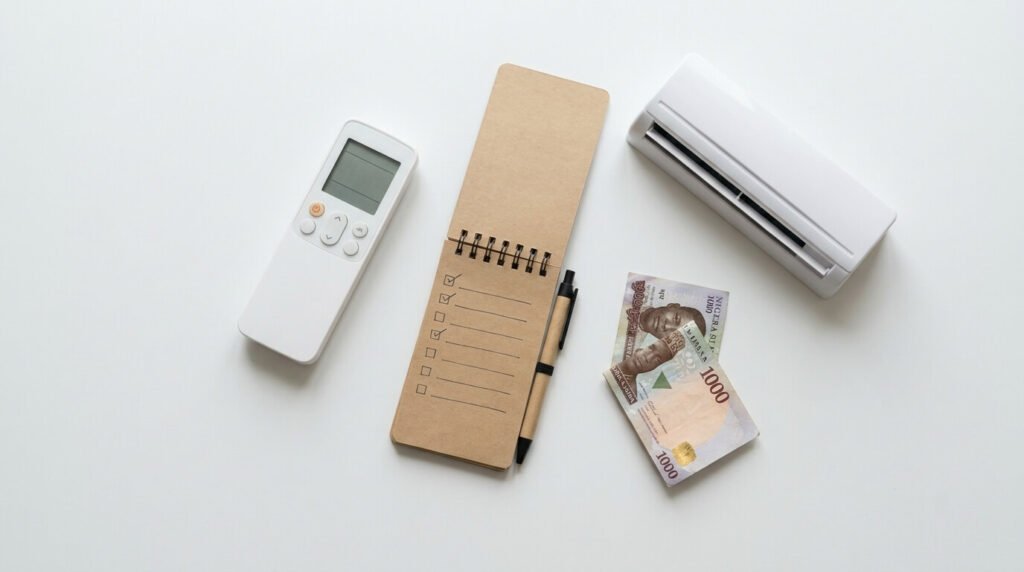
Nigeria’s heat and humidity aren’t forgiving. Getting your AC choice right from the start saves you money, frustration, and the cost of replacement or repair down the line.
If you want a full foundation before diving in, our complete guide on understanding Air conditioners is the right place to start.
Adapting to Nigeria’s Climate
Nigeria sits in the tropics hot, humid, and intense for most of the year.
Cities like Lagos, Port Harcourt, and Warri deal with both high temperatures and high humidity, which means your AC isn’t just cooling a room; it’s also removing humidity to make the space livable.
An underpowered or poorly chosen unit will run non-stop, struggle to reach your set temperature, and wear out faster than it should. Matching your AC to Nigeria’s climate conditions isn’t optional; it’s the baseline.
Managing Electricity Costs
Electricity consumption is one of the highest ongoing costs of owning an AC in Nigeria. With tariffs rising, especially on Band A, and metering becoming more accurate, the difference between an efficient and an inefficient AC becomes clear on your monthly bill.
The Nigerian Electricity Regulatory Commission has acknowledged the impact of high-consumption appliances on household budgets.
Choosing an energy-efficient model — particularly one with inverter technology can save you tens of thousands of naira a year in running costs.
Handling Unstable Power Supply
Nigeria’s power supply situation is a real factor in AC buying decisions. Voltage fluctuation can damage compressors, fry PCB boards, and shorten the life of any AC unit, inverter, or otherwise.
Factor in protection from the start: a voltage stabilizer from Binatone is a practical essential, and units with built-in auto-restart and power surge protection from Schneider Electric add another layer of security.
Generator compatibility is also worth checking if your AC will regularly run on a Fireman generator during outages. Confirm the unit’s power requirements match your generator’s output.
Types of Air Conditioners Available in Nigeria
Nigeria’s market has several AC types to choose from, each designed for a specific space and use case. For a detailed breakdown of each, see our complete guide to the various types of Air conditioners.
Split Air Conditioners
The split AC is the most popular choice for Nigerian homes and offices. It has a wall-mounted indoor unit and a separate outdoor unit connected by copper pipes.
Samsung Electronics, Panasonic, Skyrun, Thermocool, Hisense, and LG Electronics both have strong split AC ranges widely available across Nigeria.
Split systems are quiet, efficient, and suitable for bedrooms, living rooms, and office spaces of most sizes. They’re the default recommendation for most buyers.
Window Air Conditioners
Window ACs are self-contained single units that fit into a window frame or wall opening. Midea Group is one of the most widely available brands for this type in Nigeria.
They’re cheaper to buy and install than split systems and work well for small rooms, single offices, and budget-conscious setups. The trade-off is slightly higher noise and less flexibility in where they can be installed.
Portable Air Conditioners
Portable ACs from brands like Honeywell don’t require permanent installation; they sit on the floor and vent heat through a hose placed near a window.
They’re ideal for renters or spaces where wall modifications aren’t possible. They’re less efficient than fixed units and generate more noise, but the flexibility they offer is genuine and useful in the right situation.
Floor-Standing Air Conditioners
Floor-standing units are high-capacity systems that stand on the floor rather than being mounted on a wall.
They deliver powerful cooling across large spaces — event halls, large offices, church auditoriums — where a standard split AC wouldn’t have the coverage.
They pair with an outdoor unit like a split system and are available in higher horsepower (HP) ratings suited to big rooms.
Cassette and Central AC Systems
Cassette ACs mount flush with the ceiling and distribute air in multiple directions, making them ideal for commercial offices, restaurants, and retail spaces.
Central AC systems use ductwork to cool entire buildings from a single unit — Daikin Industries is one of the leading suppliers globally for this type. Both cassette and central systems are primarily commercial solutions and require professional design and installation.
Choosing the Right AC Capacity
Understanding Horsepower (HP)
In Nigeria, air conditioner capacity is commonly rated in horsepower (HP) rather than BTU, though both measure the same thing: how much cooling the unit delivers.
Panasonic Holdings and other manufacturers specify their units in HP for the Nigerian market. A higher HP means more cooling power, but it also means higher electricity consumption.
Getting the right HP for your room size is one of the most important decisions in this entire buying process.
Matching Room Size to AC Capacity
Here’s a practical guide for matching HP to room size in Nigerian conditions:
- Small rooms (up to 12sqm) — a 1HP unit is sufficient for a standard bedroom or small office.
- Medium rooms (12–20sqm) — a 1.5HP unit handles most living rooms, medium bedrooms, and mid-sized offices comfortably.
- Large rooms (20–35sqm) — a 2HP unit is the right fit for large living rooms, open-plan offices, or rooms with significant heat gain from sunlight.
- Very large spaces (35sqm and above) — consider multiple split units, a floor-standing system, or a cassette unit, depending on the ceiling and layout.
Why Correct Sizing Matters
An undersized AC runs at maximum load constantly, it never quite reaches your set temperature, consumes more electricity trying, and wears out faster.
An oversized AC short-cycles — it cools the room quickly, shuts off, and restarts repeatedly, which is inefficient, hard on the compressor, and leaves humidity poorly managed.
Both outcomes cost you more in the long run. Always size based on actual room dimensions and cooling load, not guesswork.
Inverter vs Non-Inverter AC
This is one of the most important decisions in the buying process. For a detailed comparison, read our full article on inverter vs non-inverter AC, which covers every angle of the decision.
What Is an Inverter AC?
An inverter AC uses a variable-speed inverter compressor that adjusts its speed based on how much cooling the room needs at any given time.
Daikin Industries pioneered much of the technology behind modern inverter compressors.
Rather than switching fully on and off, the compressor slows to a lower speed once the room reaches the target temperature, maintaining comfort without drawing full power repeatedly.
Benefits of Inverter AC in Nigeria
- Lower electricity bills — by avoiding repeated full-power restarts, inverter ACs consume 30–50% less electricity than non-inverter models over the same usage period.
- Better efficiency — LG Electronics inverter units maintain room temperature more precisely, reducing the warm-cool-warm cycle that non-inverter systems produce.
- Quieter operation — variable-speed compressors run more smoothly and with less noise, which matters for bedrooms and professional office environments.
- Longer lifespan — less mechanical stress on the compressor means fewer breakdowns and a longer service life overall.
When Non-Inverter AC Makes Sense
Non-inverter ACs from brands like Hisense are much more affordable upfront, sometimes significantly, and they cool effectively.
If your budget is tight, your usage is occasional (a few hours per week rather than daily), or you need a quick replacement, a non-inverter unit is a reasonable choice.
Just go in understanding that the monthly running cost will be higher, and that the electricity saving from an inverter model won’t be there to offset ongoing bills.
Energy Efficiency and Electricity Consumption
Understanding Energy Ratings
Energy efficiency in ACs is measured through ratings like the Energy Efficiency Ratio (EER) — the ratio of cooling output to electricity input.
Energy Star certification is used by leading brands to signal high efficiency. A higher EER means more cooling per unit of electricity consumed.
When comparing models, don’t just look at price and HP — check the energy rating. Two ACs of the same HP can have meaningfully different electricity consumption depending on how efficiently they’re built.
AC Power Consumption in Nigeria
Several factors affect how much electricity your AC actually uses day to day: the HP rating of the unit, whether it’s an inverter or non-inverter, how well your room is insulated, how often you open doors and windows while it runs, and the ambient outdoor temperature.
In Nigeria’s heat, ACs work harder than they would in cooler climates, which is why energy efficiency matters more here than in most places.
The Nigerian Electricity Regulatory Commission’s rising tariff structure makes this calculation increasingly important for households and businesses alike.
Reducing Energy Costs
- Set your thermostat between 24°C and 26°C — this range delivers comfort without pushing the compressor harder than necessary.
- Improve room insulation where possible — ASHRAE standards show that better-insulated spaces retain cool air longer, reducing how often the AC cycles on.
- Use sleep mode at night — Samsung Electronics builds sleep mode into their AC range specifically to reduce overnight power draw without sacrificing comfort.
- Keep doors and windows closed while the AC runs — every gap lets warm air in, increasing the cooling load and the electricity bill.
- Clean your air filter every 2–4 weeks — a clogged filter forces the unit to work harder to push air through, consuming more power for the same result.
Best AC Features to Consider
Fast Cooling Technology
Turbo cooling — a feature built into many Hisense models blasts the room at maximum capacity for the first few minutes to bring the temperature down quickly.
This is useful in Nigeria’s heat, where you often walk into a room that has been closed all day and need it to be cool fast.
It’s not a long-running mode, but as a quick-start feature, it makes a real difference to how usable the AC is in the first few minutes.
Air Purification and Filters
The air filter in your AC does more than protect the unit; it cleans the air you breathe. Panasonic Holdings builds multi-layer filtration into several of its AC models, removing dust, allergens, and fine particles from indoor air.
For households with children, allergy sufferers, or anyone in a dusty Nigerian environment, air purification features are worth prioritising.
The World Health Organization links indoor air quality directly to respiratory health, making this more than just a comfort feature.
“Household air pollution is a risk for acute lower respiratory infections in adults and contributes to 22% of all adult deaths due to pneumonia; exposure to household air pollution almost doubles the risk for childhood LRI and is responsible for 44% of all pneumonia deaths in children less than 5 years old – WHO.“
Low Noise Operation
Noise level matters more than most buyers realise until they’re trying to sleep next to a loud AC. Daikin Industries consistently produces some of the quietest AC units on the market.
Their residential inverter range operates at noise levels that are barely noticeable at night. For bedrooms, study rooms, and professional office environments, a quiet unit isn’t a luxury; it’s a necessity for sleep quality and focus.
Smart Controls and Timers
Smart AC features — Wi-Fi connectivity, app control, and scheduling add genuine convenience for busy households and offices.
Google’s integration with smart home systems has made it possible to control compatible ACs remotely. Even without full smart connectivity, a programmable timer lets you schedule the AC to cool your room before you arrive, avoiding the wait and reducing the overall hours the unit runs each day.
Auto-restart, available on many Samsung Electronics models, is particularly practical in Nigeria it brings the unit back to your preferred settings automatically after a power outage.
AC Installation Considerations
Choosing the Right Installation Location
For split ACs, the indoor unit should be mounted high on the wall — at least 2.1 metres from the floor — for even air distribution across the room. Avoid positioning it directly above beds, sofas, or desks where the airflow will blow directly onto people.
The unit should also be placed on a wall that gives it clear airflow across the widest part of the room, not tucked into a corner where its reach is limited.
Outdoor Unit Placement
The outdoor unit needs a well-ventilated spot where it can expel heat freely. Avoid enclosed spaces, direct sunlight where possible, and anywhere the expelled hot air recirculates back toward the unit — this reduces efficiency significantly.
The condenser coil in the outdoor unit works by releasing heat into the surrounding air; if that air is already hot and trapped, the unit has to work harder to do its job. Keep the area around the outdoor unit clear.
Professional Installation Importance
AC installation isn’t a DIY job. Proper refrigerant handling, correct copper pipe sizing and routing, secure wall mounting, and proper drain pipe setup all affect how well your AC performs and how long it lasts.
A poorly installed AC — even a premium one will underperform and develop faults faster. Hire a qualified installation technician, and don’t compromise on this to save a few thousand naira.
The cost of fixing a bad installation is almost always higher than paying for a proper one upfront.
AC Maintenance and Servicing
Cleaning Filters Regularly
Your AC’s air filter is the easiest maintenance task and one of the most impactful. A clean filter means better airflow, more efficient cooling, and cleaner indoor air.
In Nigeria’s dusty environments, filters clog faster than the manufacturer’s general guideline suggests — aim to clean yours every 2–3 weeks during heavy use periods.
Most split AC filters slide out easily and can be rinsed under clean water and left to dry before reinserting.
Routine Servicing
Beyond filter cleaning, your AC needs a full AC servicing every 3–6 months from a qualified technician.
This covers cleaning the evaporator coil and condenser coil, checking electrical connections, inspecting the drain pipe for blockages, and confirming the unit is operating within normal parameters.
Daikin Industries recommends routine maintenance as the single most effective way to extend AC lifespan and maintain peak efficiency.
Skipping service appointments is one of the fastest ways to shorten the life of an otherwise good unit.
Checking Refrigerant Levels
If your AC is cooling less effectively than it used to, taking longer to reach temperature or not getting the room as cold as your set point, low refrigerant is a likely culprit.
A gas refill restores cooling performance, but the underlying leak needs to be found and fixed first, otherwise the refrigerant will escape again.
Common refrigerants in Nigerian market ACs include R-410A and R-32. This is a job for a licensed technician: never attempt to handle refrigerant yourself.
Common Mistakes Nigerians Make When Buying ACs
Buying Based Only on Price
The cheapest AC on Jumia or in a local market isn’t necessarily the best value. A low-priced unit with poor energy efficiency will cost you far more in electricity over 2–3 years than a better-specified model would have.
Factor in running cost, warranty coverage from brands like LG Electronics, and the reputation of the after-sales service network before committing to any purchase based on price alone.
Choosing the Wrong HP
Underestimating room size — or simply picking a 1HP unit because it’s cheaper without checking whether it fits the room is one of the most common and costly mistakes.
An undersized AC runs nonstop in Nigeria’s heat without reaching your target temperature. It wears out faster, uses more electricity, and delivers less comfort than a correctly sized unit would. Always measure your room and match the HP accordingly.
Ignoring Electricity Usage
Many buyers focus on the purchase price and forget to think about what the unit will cost to run every month.
A non-inverter AC might save you ₦30,000 at the point of purchase, but cost you an extra ₦5,000–₦10,000 per month in electricity compared to an inverter model.
Over a year, that’s a significant sum. Always think in terms of the total cost of ownership, not just what you pay on the day.
Poor Installation Choices
Choosing the cheapest available installation service to save money is a false economy.
An improperly installed AC — wrong pipe sizing, poor drainage setup, badly positioned indoor or outdoor unit will underperform, develop faults sooner, and cost more to fix than a proper installation would have.
Budget for professional installation from the start and treat it as part of the cost of the AC, not an optional add-on.
Best AC for Different Nigerian Needs
Matching your AC to your specific use case matters as much as the technical specs. For brand-specific recommendations, our guide on the best AC brands covers the top options available in Nigeria across every category.
Best AC for Bedrooms
Bedrooms need quiet, energy-efficient cooling above everything else. An inverter split AC in the 1HP to 1.5HP range — from a brand like Daikin Industries or LG Electronics delivers the combination of low noise level, stable temperature control, and an overnight energy saving mode that makes for genuinely restful sleep.
Sleep mode and a programmable timer are useful features to prioritise for bedroom use.
Best AC for Living Rooms
Living rooms are larger, deal with more occupants, and often have more heat gain from windows and electronics. A 1.5HP to 2HP split AC is the right starting point for most Nigerian living rooms.
Look for units with wide-angle airflow, turbo cooling for quick temperature drop when you first enter the room, and strong dehumidification for coastal cities.
Samsung Electronics, Panasonic, Midea, and LG Electronics both have popular living room models widely available in Nigeria.
Best AC for Offices
Office cooling needs to be consistent across long working hours without distracting noise or frequent cycling.
Inverter split ACs, non-inverters, or cassette units work best for office environments; they maintain steady temperatures, run quietly, and consume less electricity over extended operational hours.
The International Labour Organization links thermal comfort directly to productivity, so this is a business investment, not just a comfort decision.
For large open-plan offices, multiple split units or a cassette system will outperform a single oversized split.
Best AC for Small Apartments
Small apartments need space-efficient, affordable cooling that doesn’t overload a limited electrical circuit. A 1HP inverter split AC handles most small apartments effectively while keeping monthly running costs manageable.
Window units from Midea Group are a solid budget alternative where installation flexibility is limited. Prioritise energy efficiency in a small apartment; the AC is often the biggest single contributor to the electricity bill.
Conclusion
Buying the right AC in Nigeria comes down to knowing your room size, understanding the difference between AC types and inverter technology, and being honest about your budget, both upfront and monthly.
An AC that looks affordable on the shelf but doubles your electricity bill isn’t a good deal. Take the time to match cooling capacity to your space, choose energy-efficient technology where your usage justifies it, invest in proper installation, and commit to routine maintenance.
Make those decisions right, and your AC will serve you reliably through Nigeria’s heat for years to come.