
Two questions come up almost every time someone is buying an AC in Nigeria: how much will it cost to run, and will it survive the light situation?
That’s exactly why the debate around inverter vs non-inverter AC in Nigeria matters so much. These are the two main AC technologies on the market, and they behave very differently when it comes to electricity bills, cooling consistency, and handling our power supply realities.
Rising energy costs and an unstable national grid mean your choice between these two directly affects your wallet. This article breaks down everything you need to know to decide confidently.
What Is an Inverter Air Conditioner?
If you’re new to AC technology, our complete guide on understanding Air conditioners gives you a solid foundation before diving into the comparison.
Definition of Inverter AC
An inverter AC is an air conditioner built around a variable-speed compressor that continuously adjusts its output based on the room’s cooling demand at any given moment.
Rather than operating at a single fixed speed, it speeds up when the room is hot and slows down as the target temperature is reached.
LG Electronics is one of the most recognised brands globally for inverter AC technology, with a strong presence across Nigerian markets.
How Inverter Technology Works
The variable speed compressor, the kind Daikin has refined across decades of engineering, is the heart of inverter technology. When you turn on an inverter AC in a hot room, the compressor runs at high speed to cool the space quickly.
Once the room reaches your set temperature, it doesn’t switch off; it throttles down to a low speed to maintain that temperature. This continuous operation at reduced speed is what makes inverter ACs so much more efficient than their traditional counterparts.
Main Features of Inverter AC
- Energy saving — the compressor never draws the high startup power of a full restart, cutting electricity consumption by 30–50% compared to fixed-speed units.
- Quiet operation — variable speed compressors run more smoothly and generate significantly less noise, making inverter ACs ideal for bedrooms and quiet office spaces; Daikin’s inverter range is particularly noted for low noise levels.
- Stable cooling — temperature stability is one of the biggest advantages; Samsung Electronics builds inverter units that maintain room temperature within a very narrow range, so you’re not constantly feeling the room warm up and cool down.
- Sleep mode and energy saving mode — features like LG Electronics’ sleep mode allow the unit to gently reduce power during the night without sacrificing comfort.
What Is a Non-Inverter Air Conditioner?
Definition of Non-Inverter AC
A non-inverter AC uses a fixed-speed compressor that has only two states: fully on or fully off. It runs at maximum capacity until the room reaches the set temperature, then shuts off completely.
When the room warms up again, it restarts at full power. Hisense, Panasonic, Skyrun, Midea, Thermocool and LG offer widely available non-inverter models across Nigeria, and they remain a popular entry-level choice for budget-conscious buyers.
How Non-Inverter Technology Works
The fixed speed compressor, like those used in Haier’s conventional AC range, operates on a start-stop cycle. Every time the room temperature rises above your set point, the compressor kicks back on at full power.
This repeated full-power startup draws a surge of electricity each time, which is the core reason non-inverter ACs consume more power over time.
The thermostat, such as a Honeywell unit, controls when the compressor turns on and off, but it can’t modulate the speed; it’s binary.
Main Features of Non-Inverter AC
- Lower initial cost — non-inverter units are consistently cheaper to purchase upfront than inverter models of the same cooling capacity, making them accessible for buyers on tighter budgets.
- Simpler system design — fewer electronic components mean the PCB board and internal electronics are less complex, which can make basic repairs more straightforward.
- Widely available — non-inverter ACs are stocked across virtually every electronics market in Nigeria, from Jumia to local shops in Onitsha and Lagos.
Main Differences Between Inverter and Non-Inverter AC
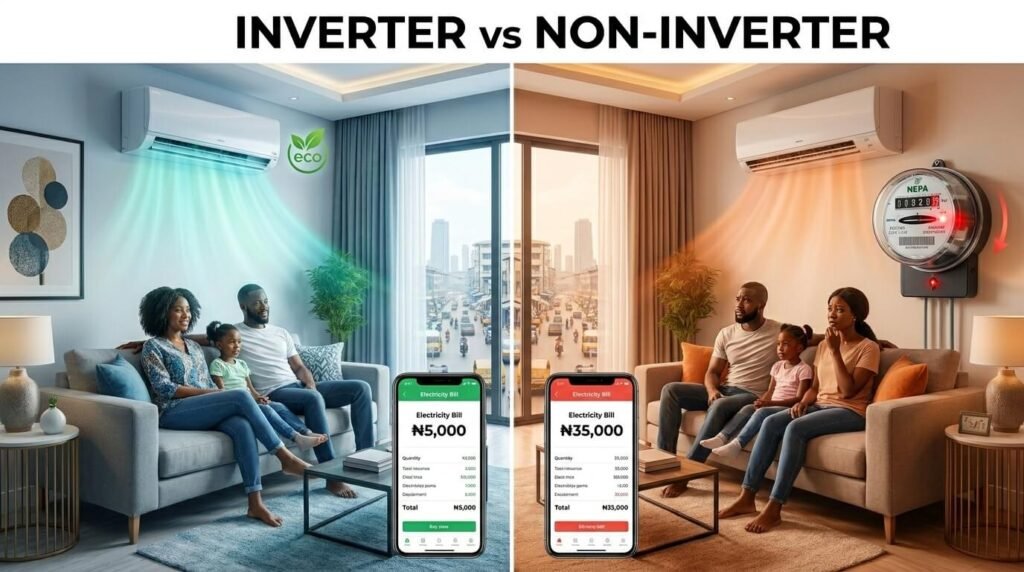
Compressor Operation
This is the fundamental difference. An inverter AC’s variable speed compressor, like those engineered by Copeland for high-efficiency units, adjusts continuously between low and high speeds depending on the cooling load of the room.
A non-inverter AC’s fixed-speed compressor runs at one speed only, either fully on or fully off. Everything else, the difference in electricity bills, noise, comfort, and lifespan, flows from this single distinction.
Energy Consumption
Non-inverter ACs consume more electricity because of the start-stop cycle — each full compressor restart draws a power surge before settling into normal operation.
This is amplified in Nigeria’s climate, where high heat gain means the compressor restarts frequently throughout the day.
Inverter ACs avoid this entirely through continuous operation at reduced speed, which keeps electricity consumption significantly lower over the same period.
Cooling Consistency
With a non-inverter AC, you’ll notice the room temperature fluctuating. It cools down, the compressor cuts off, the room warms slightly, then the compressor restarts.
This cycle repeats throughout the day. An inverter AC maintains a much steadier temperature because the compressor never fully switches off; it simply slows down.
For bedrooms, offices, and any space where consistent comfort matters, inverter technology delivers a noticeably better experience.
Electronic Panel Design
Another major difference overlooked between an inverter and a non-inverter Air conditioner is this: An inverter AC unit has an electronic panel board, or what is mostly called a communication board, inside the outdoor or condenser unit, while a non-inverter AC doesn’t have one.
This control panel or communication board is like the brain that controls the outdoor unit. The moment this electronic board goes bad, it is very difficult to repair.
You either replace it or your only option will be to connect the outdoor unit directly to power (bypassing the damaged panel). This should be done by a certified or trained AC technician.
Finally, it is good we note here that another type of non-inverter AC that has this electronic panel control is the standing 5 tonnage or 5HP AC unit, like the Panasonic Brand.
Electricity Consumption in Nigeria
How Inverter AC Saves Electricity
The energy savings from an inverter AC compound over time. A 1.5HP inverter split AC might draw around 900–1,100 watts when working hard to cool a room, but once that temperature is reached, it can throttle down to 300–500 watts to maintain it.
Over an 8-hour night, the difference in total energy consumed compared to a non-inverter unit cycling on and off at full power is substantial.
Energy Star efficiency ratings, which leading brands like LG Electronics and Daikin target for their inverter ranges, confirm these savings are real and measurable.
Why Non-Inverter ACs Consume More Power
Every time a non-inverter AC’s fixed-speed compressor restarts, it draws a startup surge — typically 2–3 times the running wattage — for a few seconds before settling.
In a hot Nigerian environment, that compressor might restart dozens of times a day. The Nigerian Electricity Regulatory Commission has documented the strain that high-consumption appliances place on household budgets as tariffs rise.
A non-inverter AC running 8 hours daily can add significantly more to your bill than an equivalent inverter model doing the same job.
Impact on Nigerian Electricity Bills
For households served by distributors like Eko Electricity Distribution Company or Port Harcourt Distribution Company, where billing has become more metered and accurate, the monthly difference between running an inverter versus a non-inverter AC is increasingly visible.
Over 12 months of regular use, the electricity savings from an inverter AC can offset a significant portion of the price difference between the two unit types, which is why the return on investment calculation increasingly favours inverter models for anyone using their AC daily.
Cooling Performance Comparison
Which AC Cools Faster?
Interestingly, non-inverter ACs can feel like they cool a room faster initially because they blast at full compressor power from the moment they start.
Many non-inverter models also include turbo cooling modes (Hisense builds this into several of their models) that push maximum output for the first few minutes.
Inverter ACs ramp up quickly but don’t always hit the same immediate blast of cold air. For most users, though, the difference in how fast a room reaches a comfortable temperature is marginal in practice.
Temperature Stability
Once the initial cooling is done, inverter ACs win decisively on temperature stability. The continuous operation of a variable speed compressor means the room stays at your set point without the warm-cool-warm cycling that non-inverter units produce.
Samsung Electronics’ inverter models, for example, are specifically engineered for tight temperature stability, keeping variance within one degree of the set point. For sleep quality and sustained comfort in office environments, this consistency matters.
Performance in Hot Nigerian Weather
Nigeria’s climate — hot, humid, and relentless — puts AC systems under real stress. High humidity levels mean ACs need to work harder on dehumidification alongside cooling.
Daikin’s inverter units handle this well because the compressor can sustain moderate-speed operation for extended periods without the mechanical strain of repeated full-power starts.
In areas with high heat gain from direct sunlight, like south-facing rooms or poorly insulated buildings, an inverter AC’s ability to maintain continuous operation makes it the more reliable choice.
Cost Comparison in Nigeria
Initial Purchase Price
Non-inverter ACs are affordable upfront — sometimes by 30–50% for equivalent horsepower (HP) ratings.
A 1.5HP non-inverter split AC from a reputable brand, like Skyrun, Binatone, Nexus, or Hisense, might sell for about ₦285,000–₦380,000 in Nigeria, while an inverter model of the same capacity from LG Electronics, Panasonic or Daikin could be ₦350,000–₦590,000 or more, depending on the retailer.
For buyers making a buying decision based purely on what leaves the pocket today, the non-inverter wins on initial cost.
Installation Costs
Installation costs are broadly similar for both types. Whether you’re installing an inverter or non-inverter split AC, you’re looking at the same process: mounting the indoor unit, positioning the outdoor unit, running copper pipe and electrical connections, and setting up the drain pipe.
The materials and labour costs don’t differ significantly between the two technologies. Budget ₦15,000–₦35,000 for a standard installation in most Nigerian cities.
Long-Term Running Costs
This is where the calculus shifts. Over 12–18 months of daily use, the electricity savings from an inverter AC typically offset the higher purchase price.
Running a non-inverter AC 8 hours daily at Nigeria’s current electricity tariffs adds up considerably more than running an inverter equivalent.
Factor in generator fuel cost, a FireMan or Honda generator isn’t cheap, and the long-term savings from an inverter unit become even more significant.
For anyone using their AC daily, the inverter model is almost always cheaper over a 3–5 year ownership period.
Durability and Maintenance
Maintenance Needs
Both AC types need routine maintenance, cleaning the air filter every 2–4 weeks, professional servicing every 3–6 months, and periodic gas refill if refrigerant levels drop.
Panasonic recommends filter cleaning as the single most impactful maintenance habit for sustaining cooling efficiency and extending AC lifespan.
The main difference is that inverter ACs have more complex electronics, particularly the PCB board, which can be more expensive to replace if it fails, though this is relatively uncommon with reputable brands.
Performance Under Power Fluctuations
Voltage fluctuation is a daily reality in Nigeria, and it affects both AC types. Non-inverter ACs with simple fixed-speed compressors can be vulnerable to the stress of repeated restarts under low or unstable voltage.
Inverter ACs are sensitive to voltage irregularities because their variable-speed electronics require a stable input to function correctly.
For either type, a quality voltage stabiliser from Binatone and power surge protection from APC by Schneider Electric are essential investments.
Units with low voltage operation capability and auto-restart features, common in Samsung Electronics models, add an extra layer of protection.
Lifespan Comparison
Inverter ACs generally last longer under normal conditions because the variable speed compressor experiences less mechanical stress — no repeated high-load startups, no aggressive stop-start cycles.
Daikin inverter units are often cited for their AC lifespan, with well-maintained units serving reliably for 10–15 years.
Non-inverter ACs, with simpler mechanics, are easier and cheaper to repair when something does go wrong, but the compressors’ start-stop cycle does create more wear over time.
Repair complexity for non-inverter units is generally lower, which can offset some of the durability advantage of inverter models.
Best Option for Nigerian Homes
For Small Apartments
In a small apartment where the AC runs a few hours a day, evenings and nights only, a non-inverter unit can be a perfectly reasonable choice.
The lower upfront cost makes sense when usage is limited, and the electricity savings from an inverter model don’t accumulate as meaningfully.
A 1HP non-inverter split from Hisense or a window unit from Midea can handle a small room without breaking the budget. That said, if you can stretch the budget even slightly, an inverter model will still serve you better in the long run.
For Family Homes
Family homes where ACs run for 8–12 hours daily are exactly the scenario where inverter technology earns its premium.
The electricity savings compound quickly with heavy daily use, humidity control is more consistent (important in Nigeria’s coastal and riverine zones), and the quieter operation makes shared living spaces more comfortable.
For living rooms and master bedrooms in family homes, an inverter split AC from Panasonic, Midea, LG Electronics, or Daikin is the stronger long-term investment.
For Areas With Unstable Electricity
If you’re in an area with severe voltage fluctuation and frequent outages, generator compatibility and low voltage operation capability matter more than the inverter vs non-inverter distinction.
Both types need protection — pair whichever you choose with a Binatone voltage stabiliser and ensure the unit has auto-restart.
In very unstable areas, some users prefer non-inverter units because the simpler electronics are seen as less vulnerable to irregular power, though the evidence for this is mixed. Either way, don’t skip the stabiliser.
Best Option for Nigerian Offices
Small Office Spaces
For a small office running 8–10 hours, five days a week, an inverter AC makes financial sense even at the higher upfront cost.
Office cooling that runs consistently through working hours accumulates electricity savings quickly. A 1HP or 1.5HP inverter split AC handles most small offices comfortably while keeping running costs manageable.
The quieter operation also makes for a less distracting work environment, which is a genuine productivity benefit.
Large Office Environments
Large open-plan offices that run AC continuously during business hours will feel the electricity cost of non-inverter systems acutely.
The International Labour Organisation links thermal comfort directly to workplace productivity, but that comfort needs to be sustainable.
For large offices, inverter split systems or inverter cassette units (Panasonic makes excellent commercial-grade options) deliver consistent cooling across long operating hours at significantly lower monthly electricity costs than non-inverter equivalents.
Commercial Usage
For commercial spaces like restaurants, retail stores, or hotel rooms where ACs operate almost around the clock, the return on investment from inverter technology is hard to argue against.
The electricity savings over 12 months of near-continuous operation easily justify the higher purchase price. Daikin’s commercial inverter range is widely used in Nigerian hospitality and retail environments for exactly this reason; the long-term savings on power bills are substantial when the units run 12–18 hours daily.
When to Choose an Inverter AC
For a full breakdown of the options available, see our guide on the types of air conditioners. It covers every AC category in the Nigerian market.
Frequent Daily Usage
If your AC runs for 6 or more hours every day, an inverter model is almost certainly the right choice.
The continuous operation at variable speed means the electricity savings are real and accumulate meaningfully over weeks and months.
The higher purchase price becomes less significant the more frequently you use the unit, and in Nigeria’s climate, most people use their AC far more than they initially expect to.
Reducing Electricity Costs
For anyone who has opened a power bill after a hot month and winced, inverter technology is the most direct answer. The energy saving from avoiding repeated full-power startups is consistent and measurable.
Over a year of daily use, the difference between running an inverter and a non-inverter AC of the same capacity can amount to tens of thousands of naira in electricity costs, enough to matter in any household or business budget.
Need for Quiet Operation
Bedrooms, study rooms, home offices, and professional workspaces all benefit from quieter AC operation.
Inverter ACs run their compressors at variable, often reduced speeds, producing less vibration and noise than a non-inverter unit cycling on and off at full power.
If noise level is a concern for you, the inverter is the clear choice. Daikin’s residential inverter range consistently ranks among the quietest in the industry.
When to Choose Non-Inverter AC
Lower Budget Buyers
If your budget limits you to a non-inverter unit, that’s a perfectly valid starting point. A well-chosen non-inverter AC from a reputable brand will cool your space reliably.
The key is to pair it with proper voltage protection and commit to regular maintenance. It may cost more to run monthly, but it cools effectively, and the lower initial cost removes a barrier that would otherwise mean no AC at all.
Occasional Usage
If you only run your AC a few hours a week in a guest room, a storage office, or a seasonal space, the electricity savings from an inverter model won’t accumulate enough to justify the price premium.
For occasional, low-frequency use, a non-inverter unit does the job at a fraction of the cost. The break-even point on an inverter AC’s premium depends on usage hours; at low usage, it simply doesn’t come.
Simple Replacement Option
Sometimes the decision is pragmatic, an old AC has packed up, and you need a quick, affordable replacement to get the room cooling again.
Non-inverter ACs are widely available, quickly installed, and don’t require the same budget planning as an inverter purchase. For a fast, budget-conscious upgrade, they remain a legitimate option. Just go in knowing what the running costs will look like.
Common Mistakes When Choosing Between an Inverter and a Non-Inverter AC
Before finalising any decision, also read our guide on things to know before buying an Air conditioner, which covers the full purchasing picture beyond just technology type.
Focusing Only on Purchase Price
This is the most common mistake. A non-inverter AC looks affordable on the shelf, but the total cost of ownership, purchase price plus electricity bills over 2–3 years, often makes it the more expensive option.
Always calculate long-term running costs alongside the sticker price. Factor in how many hours per day you’ll actually use the unit and what your current power bill looks like; the numbers often change the decision entirely.
Choosing the Wrong Capacity
Whether you go with an inverter or a non-inverter, buying the wrong cooling capacity for your room negates most of the benefits of either technology.
An undersized unit — wrong horsepower (HP) for the room size — runs at full load constantly, consuming more electricity than a correctly sized model and never quite reaching your desired temperature.
Always match BTU or HP to your room’s actual cooling load, accounting for room size, sunlight exposure, and typical occupancy.
Ignoring Power Conditions
Both inverter and non-inverter ACs can be damaged by Nigeria’s voltage fluctuation.
Inverter ACs are particularly sensitive because their variable-speed electronics require stable input power to operate correctly. Don’t buy either type without budgeting for a voltage stabiliser and considering power surge protection.
Check whether your chosen model has low-voltage operation capability; it could be the difference between an AC that survives Nigeria’s grid and one that doesn’t.
Our guide on Best Air conditioner brands highlights which manufacturers build the most reliable protection features into their Nigerian-market models.
Conclusion
Inverter and non-inverter ACs both have their place in Nigeria; the right choice depends on how you’ll actually use the unit.
If you’re running your AC daily, the inverter model’s electricity savings, quieter operation, and longer lifespan make it a stronger long-term investment despite the higher upfront cost.
If the budget is tight or usage is occasional, a non-inverter unit does the job reliably at a lower entry price.
What matters most is matching your choice to your real usage patterns, your electricity situation, and what your budget can genuinely sustain both at purchase and through months of running costs.