
Nigeria’s heat doesn’t negotiate. Whether you’re in Lagos, Abuja, or Port Harcourt, staying cool indoors isn’t a luxury; it’s a daily need.
But here’s what most people get wrong: they walk into a store, pick the first AC they see, and wonder later why it’s not cooling properly or why their electricity bill doubled.
Understanding the types of air conditioners available in Nigeria is the first step to making a smart choice.
Each AC type is designed for a specific space, budget, and cooling need. This guide breaks them all down so you can buy with confidence.
Why Understanding Air Conditioner Types Matters
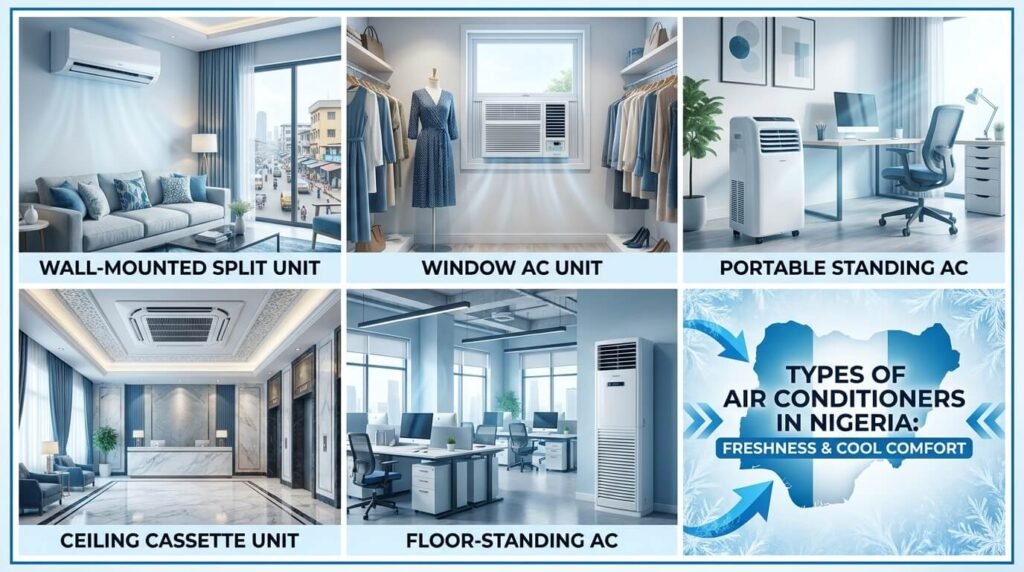
Before you spend money on an AC, it helps to know what you’re actually buying. Nigeria’s climate is hot and humid almost year-round, which means your AC will work hard, unlike the types of Air Conditioners in other regions like the USA.
The wrong type for your space means poor cooling, wasted electricity, and frustration. Here’s why it pays to understand your options first.
And if you’re starting from scratch, our complete guide to the definition of Air Conditioners is a solid foundation.
Choosing the Right Cooling System
Different spaces have different cooling needs. A studio apartment doesn’t need the same system as a hotel lobby, and a home bedroom isn’t the same as a commercial office.
Matching the AC type to your space determines how effectively and efficiently it cools. Getting this wrong means your unit either struggles to keep up or overshoots, and both outcomes cost you money.
Managing Electricity Costs
Power consumption varies significantly across AC types. Inverter ACs reduce energy use by adjusting compressor speed, while non-inverter models cycle on and off at full power.
In a country where electricity tariffs keep rising, and generator fuel isn’t cheap, choosing the right AC type directly affects how much you spend monthly on cooling your home or office.
Installation and Maintenance Requirements
Some AC types need professional installation with copper pipe runs and wall drilling; others just plug in and go.
Maintenance costs also differ; central systems require more extensive routine maintenance than a simple split AC.
Understanding these requirements upfront helps you budget beyond just the purchase price and avoid surprise expenses down the line.
Split Air Conditioners
The split AC is the most common type you’ll find in Nigerian homes and offices. It’s the one with a sleek indoor unit on the wall and a separate outdoor unit outside the building.
What Is a Split AC?
A split air conditioner has two separate components: an indoor unit ( normally called the Evaporator) that distributes cool air into the room and an outdoor unit that houses the compressor and condenser, expelling heat outside.
The two units are connected by copper pipes carrying refrigerant and electrical cables. Panasonic, Midea, Skyrun, Samsung, and LG Electronics are some of the most popular split AC brands in Nigeria, known for reliable performance across their residential range.
Benefits of Split Air Conditioners
- Quiet operation — the compressor sits outside, so indoor noise levels are very low, making it great for bedrooms and office environments.
- Efficient cooling — the evaporator coil inside absorbs heat effectively, delivering consistent temperature control.
- Suitable for homes and offices — split ACs work in virtually any indoor setting, from a small bedroom to a medium-sized office.
- Dehumidification — they reduce moisture alongside temperature, which is critical in Nigeria’s coastal and riverine cities.
Best Use Cases for Split AC in Nigeria
Split ACs are ideal for bedrooms, where quiet operation and consistent cooling matter most. They work equally well in living rooms, small to medium offices, and shop spaces.
If you want one AC type that handles most residential and commercial cooling needs in Nigeria, the split system is it.
Window Air Conditioners
Window ACs were the standard before split systems became affordable. They’re still very much in use across Nigeria, especially in older buildings and budget setups.
What Is a Window AC?
A window AC is a single, self-contained unit installed directly into a window frame or a purpose-cut hole in a wall. Everything- compressor, condenser, evaporator coil, air filter, and thermostat — sits in one box.
Midea, Panasonic, LG, and other brands are among the most widely available window AC brands in Nigeria, offering affordable units that are straightforward to install.
Advantages of Window AC
- Lower upfront cost — window units are generally more affordable to buy than split ACs of equivalent cooling capacity.
- Simpler installation — no need to mount a separate outdoor unit or run long copper pipe connections.
- Easy maintenance — the self-contained design makes filter cleaning and basic servicing straightforward.
- No outdoor space needed — works well for rooms in multi-storey buildings where outdoor unit placement is difficult.
Best Use Cases for Window AC in Nigeria
Window ACs are best suited for small rooms — a single bedroom, a small office, a shop, or a security post.
They’re also the go-to choice for budget-conscious buyers who need a functional cooling solution without the higher cost of a split system.
If your room is small and your wall or window setup supports it, a window AC is a practical pick.
Portable Air Conditioners
Portable ACs offer something no other type does: the ability to move your cooling from room to room without any permanent installation.
What Is a Portable AC?
A portable AC is a freestanding unit on wheels that cools a room by drawing in warm air, passing it over an evaporator coil, and exhausting the heat through a hose vented out of a window.
Honeywell is one of the well-known brands in this category. It requires no wall drilling, no outdoor unit, and no professional installation; just plug it in and position the exhaust hose.
Advantages of Portable AC
- Flexibility — you can move it between rooms depending on where you need cooling most at any given time.
- No permanent installation — ideal for renters who can’t modify walls or windows.
- Quick setup — most portable units are ready to use within minutes of unboxing.
- Generator compatibility — portable units typically have modest power requirements that work well with a Honda generator during outages.
Limitations of Portable AC
Portable ACs have real drawbacks worth knowing. Their cooling efficiency is lower than that of split or window units of similar capacity; they work harder to deliver less.
Noise levels are noticeably higher, which can be distracting in quiet work or sleep environments. They also need a window or opening nearby for the exhaust hose, and without proper insulation around that hose, warm air leaks back in, reducing effectiveness.
Inverter Air Conditioners
If there’s one AC type that’s changed the conversation around home cooling in Nigeria, it’s the inverter AC. For a direct comparison of your options, see our breakdown of the difference between non-inverter and inverter AC.
What Is an Inverter AC?
An inverter AC uses a variable-speed compressor that adjusts its output based on how much cooling the room needs at any given moment.
Instead of switching fully on and off like a traditional unit, it slows down or speeds up smoothly. LG Electronics pioneered much of the inverter technology widely used in consumer ACs today, and its inverter range is among the most popular in Nigeria.
Benefits of Inverter Technology
- Lower electricity consumption — the compressor never draws the surge of power that comes with a full restart, reducing overall energy use by 30–50% compared to non-inverter models.
- More consistent cooling — because the system modulates rather than cycles, room temperature stays steadier and more comfortable.
- Longer lifespan — less mechanical stress on the compressor means fewer breakdowns and a longer service life.
- Quieter operation — variable-speed compressors run more smoothly and generate less noise.
Why Inverter AC Is Popular in Nigeria
With electricity tariffs climbing and power supply remaining unpredictable, Nigerians are increasingly turning to inverter ACs to cut running costs.
The higher purchase price compared to non-inverter models pays itself back through lower monthly electricity bills, often within 12 to 18 months of consistent use.
Brands like LG Electronics and Daikin have made their inverter ranges widely available across major Nigerian markets.
Floor-Standing Air Conditioners
When a space is too large for a wall-mounted split AC but a central system is overkill, the floor-standing AC fills that gap perfectly.
What Is a Floor-Standing AC?
A floor-standing AC — sometimes called a standing or tower AC — is a tall, freestanding indoor unit paired with an outdoor unit.
It doesn’t mount on a wall; it stands on the floor and delivers cooling from ground level upward.
Panasonic, Samsung, and Gree Electric are among the leading manufacturers of floor-standing units, with high-capacity models from 5HP upward designed for large, open spaces or heavy industrial rooms where all-around cooling is needed.
An easy way to know if an Air conditioner is a Floor or Standing AC is to check the outdoor unit or condenser. Does it come with a double fan blade? One at the top and the other at the bottom? If you see two fans, then it’s a standing AC unit.
Advantages of Floor-Standing Units
- Powerful cooling — floor-standing units typically come in higher horsepower (HP) ratings, making them capable of cooling large spaces effectively.
- No wall mounting — useful in spaces where wall drilling isn’t practical or permitted.
- Wide air distribution — taller units cover more vertical space, helping cool rooms with high ceilings more evenly.
- Turbo cooling — many floor-standing models include fast cooling modes for rapidly bringing down temperatures in large rooms.
Best Applications in Nigeria
Floor-standing ACs are well-suited to event halls, large open-plan offices, church halls, hotel lobbies, and any space where wall-mounted split ACs would be insufficient.
Their cooling load capacity makes them a practical choice for commercial settings where you need serious, sustained cooling without committing to a full central system.
Cassette Air Conditioners
Walk into most well-fitted Nigerian offices or restaurants and look up: there’s a good chance you’ll see a cassette AC mounted flush with the ceiling.
What Is a Cassette AC?
A cassette AC is a ceiling-mounted unit that sits recessed into a false ceiling, with only the grille visible from below.
It distributes air in multiple directions simultaneously — typically four-way — covering a wide area evenly. Panasonic is one of the leading brands for ceiling cassette ACs, with units designed specifically for commercial and semi-commercial environments.
Benefits of Cassette AC
- Even air distribution — four-way airflow from the ceiling reaches all corners of a room more evenly than a wall-mounted unit.
- Space-saving design — with the unit recessed into the ceiling, it doesn’t take up any wall or floor space.
- Aesthetically clean — only the grille is visible, giving commercial spaces a neater, more professional look.
- Suitable for humidity control — Daikin’s cassette range includes strong dehumidification, useful in Nigeria’s coastal cities.
Best Use Cases
Cassette ACs are the preferred choice for offices, restaurants, retail stores, hotel rooms, and any commercial space with a false ceiling.
They’re particularly effective in open-plan environments where a single unit needs to cover a wide area without hot or cold spots.
Central Air Conditioning Systems
Central AC is the highest-tier cooling solution available, built for entire buildings rather than individual rooms.
What Is Central AC?
A central air conditioning system uses a network of ducts to distribute cooled air from a single large unit throughout an entire building.
The system includes a central compressor and condenser unit (usually installed on a rooftop or external area), connected to indoor air handlers through ductwork.
Carrier Global is one of the most recognised names in central AC systems globally and in Nigeria’s commercial sector.
Advantages of Central Cooling
- Large-scale temperature control — one system manages the climate across multiple rooms or floors simultaneously.
- Even distribution — ductwork delivers consistent cooling throughout the building with no hot zones.
- Centrally managed thermostat — building-wide temperature regulation from a single control point.
- Less visual clutter — no individual units mounted on walls in every room.
Best Applications in Nigeria
Central AC systems are the standard for hotels, large office complexes, shopping malls, hospitals, and commercial buildings in Nigeria.
They’re not practical for most homes given the high installation cost and the need for extensive ductwork, but for large-scale operations where consistent, building-wide cooling is non-negotiable, they’re the right investment.
Comparing Air Conditioner Types
Not all ACs are equal, and the differences matter more in Nigeria than in many other markets. Before you decide, it helps to also read What to know before buying an Air Conditioner as a Nigerian, ” which covers the full picture beyond just type selection.
Cooling Efficiency Comparison
Split ACs and inverter ACs deliver the best cooling efficiency for their size.
They cool quickly, maintain temperature consistently, and handle humidity well.
Cassette and floor-standing units are suitable for larger spaces. Portable ACs trail the pack in efficiency; they cool the same space using more power and with less precision than a fixed installation.
Window ACs sit in the middle, reliable but not particularly efficient.
Electricity Consumption Comparison
Inverter ACs consume significantly less electricity than non-inverter models over time, thanks to their variable compressor speed.
Panasonic, LG, Samsung, or Hisense non-inverter models, for example, cycle their compressor fully on and off — each restart draws a power surge.
Central systems consume the most raw electricity but distribute it across larger spaces, so the per-room cost can be reasonable when the building is full.
Portable ACs consume more power relative to their output than most other types.
Cost Comparison
Window ACs have the lowest purchase price, followed by portable units. Split ACs are mid-range but offer the best value for most Nigerian homes.
Inverter split ACs cost more upfront but save money on electricity over time — the energy savings over 12–18 months typically offset the price difference.
Floor-standing and cassette units are premium products. Central systems have the highest installation cost by far, often requiring significant building work to install ductwork and air handlers.
How to Choose the Best AC Type in Nigeria
Based on Room Size
Room size is the starting point for any AC decision. Cooling capacity is measured in BTU or horsepower (HP) in Nigeria — a 1HP unit suits rooms up to about 12sqm, 1.5HP handles 15–20sqm, and 2HP covers larger living spaces.
For a small bedroom, a split or window AC does the job. For a large hall or open-plan office, you’re looking at floor-standing units or multiple splits.
The cooling load of the room, including sunlight exposure and the number of occupants, affects this further.
Based on Power Supply Conditions
Nigeria’s power supply situation makes this a critical factor. If you’re in an area with relatively stable electricity, an inverter split AC is your best option for efficiency.
If you experience frequent outages and rely heavily on a generator, check that your chosen AC model has generator compatibility and consider a voltage stabiliser from Binatone to protect the unit.
Models with auto-restart (common in Samsung Electronics units) and low voltage operation, which tolerates the fluctuations typical of the Nigerian grid, as acknowledged by the Nigerian Electricity Regulatory Commission, are strong practical choices.
Based on the budget
If the budget is tight, a window AC or a basic non-inverter split from Hisense gets you functional cooling at the lowest entry cost.
If you can stretch your budget, an inverter split AC pays back the difference in lower electricity bills within a year or two.
For commercial spaces, the calculation shifts; a cassette or floor-standing unit may cost more initially but delivers the kind of coverage and durability that cheaper alternatives can’t match.
Power surge protection from APC by Schneider Electric is worth adding to any budget.
Common Mistakes When Choosing an AC Type
Buying the Wrong Type for the Room
This is the most common and costly mistake. An undersized AC runs non-stop without reaching your desired temperature; an oversized one short-cycles, struggles with humidity control, and wears out faster.
Neither is acceptable. Always match the AC type and capacity to your room size, and heat gain factors like large windows, direct sunlight, and high occupancy all increase the cooling load and push you toward a higher capacity unit.
Ignoring Energy Efficiency
Many buyers focus only on the purchase price and overlook the energy efficiency ratio (EER) of the unit.
A cheap, low-efficiency AC may save you money on day one, but costs significantly more to run every month.
In Nigeria’s electricity environment, this adds up quickly. Always factor in power consumption alongside price. The long-term savings from a more efficient unit are real and measurable.
Not Considering Installation Requirements
Every AC type comes with its own installation requirements and costs. A split AC needs a technician, copper pipe runs, wall drilling, and a suitable location for the outdoor unit.
A cassette AC requires a false ceiling. Central systems need ductwork throughout the building. These aren’t optional extras; they’re part of the total cost of ownership.
Factor in installation cost, maintenance cost, and potential gas refill expenses before committing to any AC type.
For a full picture of what to expect, our guide on the Best Air Conditioner Brands in Nigeria also walks through what each brand offers in terms of after-sales support and servicing.
Conclusion
Nigeria has a growing range of air conditioner types to choose from: split, window, portable, inverter, floor-standing, cassette, and central systems.
Each serves different spaces and needs. The best AC for you isn’t the most expensive or the most popular brand; it’s the one that matches your room size, fits your budget, suits your power supply situation, and keeps running costs manageable.
Take time to evaluate your cooling needs honestly, consider Nigeria’s electricity realities, and don’t overlook maintenance requirements. The right choice upfront saves you money, stress, and discomfort for years to come.
[…] Sources disagree on exactly how many “types” of air conditioners exist because they’re counting different things; for example, the USA might have different types compared to the types of air conditioners in Nigeria. […]