
A VRF system, Variable Refrigerant Flow, is one of the most efficient ways to heat and cool a commercial building, but it’s also one of the most misunderstood.
Most people or untrained technicians treat it as a single technology when it’s actually two distinct system types that serve different buildings differently.
There’s also a refrigerant change that took effect January 1, 2025, that most facility managers or uninformed technicians don’t know about, and it affects every VRF purchase decision you will make this year.
This guide covers how VRF works, which type fits your building, what it costs, and what the refrigerant transition means for new installations.
What Is a VRF System? (And Why VRF and VRV Mean the Same Thing)
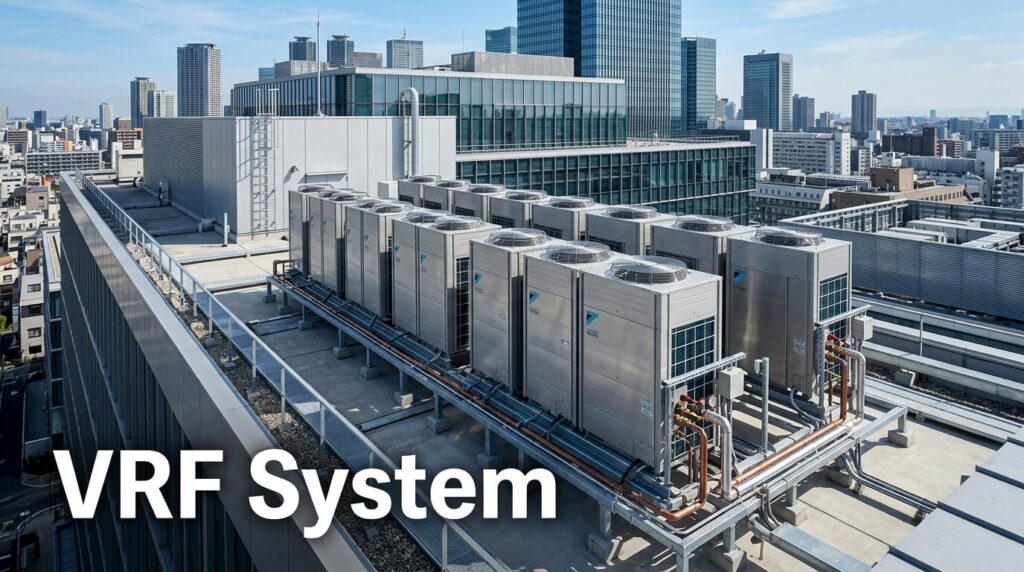
A VRF system is a multi-zone HVAC technology that uses refrigerant rather than air or water as the primary heat transfer medium between a central outdoor unit and multiple indoor units throughout a building.
Each indoor unit controls its own zone independently, and the outdoor unit adjusts refrigerant flow continuously to match the combined load.
That continuous adjustment is what separates VRF from conventional on/off systems and where the efficiency gains come from.
How Variable Refrigerant Flow Technology Works
The refrigerant cycle in a VRF system runs like this:
- The outdoor unit houses an inverter-driven compressor that modulates speed continuously — not just on or off — to match the exact cooling or heating demand at any given moment.
- Refrigerant flows from the outdoor unit through insulated copper piping to each indoor unit (fan coil unit) throughout the building.
- Each indoor unit has an electronic expansion valve (EEV) that controls how much refrigerant enters that zone, independently of every other zone.
- In cooling mode, the indoor unit’s refrigerant absorbs heat from the room air and carries it back to the outdoor unit, where it’s released outside.
- In heating mode (heat pump type), this process reverses — the outdoor unit extracts heat from outside air and delivers it indoors via the refrigerant circuit.
- The building management system or individual zone controllers send demand signals back to the outdoor unit, which adjusts compressor speed in real time to meet the aggregate load.
VRF vs VRV: The Naming Confusion Explained
VRF (Variable Refrigerant Flow): The generic industry term used by every manufacturer except Daikin to describe this technology. Mitsubishi, LG, Carrier, Toshiba, and others all use VRF.
VRV (Variable Refrigerant Volume): Daikin’s trademarked name for the same technology, registered when they invented it in 1982. Technically, VRV refers specifically to Daikin equipment. In practice, the two terms describe identical systems.
The confusion trips up buyers and specifiers constantly. If you see VRV in a specification document, it means VRF and vice versa. The only difference is the brand.
VRF System Working Principle
VRF systems work on a refrigerant-based heat transfer principle controlled by variable-speed compression.
Unlike conventional HVAC systems that run compressors at fixed speeds and cycle on and off to match load, a VRF outdoor unit runs its inverter compressor at whatever speed the current load demands, from 10% capacity to 100%. This is the core efficiency mechanism.
VRF System Types: Heat Pump vs Heat Recovery (The Decision That Changes Everything)
The single biggest cost and capability decision in any VRF project is whether to specify a heat pump (HP) or heat recovery (HR) system. These are not variations on the same thing; they work differently and suit different buildings.
Heat Pump VRF: All Zones Heat or Cool at Once
A heat pump VRF system operates all indoor units in the same mode simultaneously — either all cooling or all heating, never both at the same time. The outdoor unit switches between modes based on a majority demand signal or a manual override.
- Best for buildings with uniform loads: hotels where all rooms tend to need cooling in summer and heating in winter, single-exposure office floors, and schools.
- First cost is 10–15% lower than a heat recovery system of equivalent capacity because the refrigerant circuit is simpler, with two pipes instead of three.
- Not appropriate for buildings with simultaneous heating and cooling needs across zones (interior vs perimeter offices, server rooms adjacent to occupied spaces).
- Operates effectively in outdoor temperatures as low as -13°F on most modern units, making it suitable for cold climates with appropriate low-ambient kits.
Heat Recovery VRF: Simultaneous Heating and Cooling
A heat recovery VRF system can cool some zones while heating others at the same time, and the waste heat from the cooling zones gets transferred to the heating zones rather than dumped outside.
This is where the “recovery” in the name comes from.
For full design and zoning guidance, see our complete guide to VRF heat recovery system design.
- Best for mixed-use buildings where interior zones (server rooms, conference rooms, densely occupied core spaces) need cooling while perimeter zones need heating — a scenario that occurs on mild days for most of the year in temperate climates.
- The Branch Controller (BC box or BS box, depending on manufacturer) is the key additional component — it manages refrigerant distribution between heating and cooling circuits.
- Energy savings vs. HP are significant in mixed-load buildings because recovered heat displaces what would otherwise be purchased heating energy.
- First cost is 10–15% higher than a comparable HP system due to the three-pipe circuit and BC boxes.
Heat Pump vs Heat Recovery: Side-by-Side Comparison
| Dimension | Heat Pump VRF | Heat Recovery VRF |
|---|---|---|
| Simultaneous heating + cooling | No one mode at a time | Yes — zone-by-zone, independently |
| Pipe configuration | 2-pipe | 3-pipe (liquid, suction, hot gas) |
| Relative first cost | Baseline | 10–15% higher |
| Best building type | Hotels, schools, uniform-load spaces | Mixed-use offices, hospitals, retail+office |
| Energy savings vs conventional HVAC | 25–35% | 30–40% (higher due to heat recovery) |
| Complexity | Moderate | Higher — BC boxes require commissioning |
Water-Source VRF: The Option Most Guides Skip
Water-source VRF replaces the air-cooled outdoor unit with a water-cooled heat exchanger connected to a building’s condenser water loop or ground-source loop.
This is a less common configuration, but it makes sense in high-rise buildings where rooftop space is constrained or in campus environments with existing condenser water infrastructure.
Efficiency is generally higher than air-source VRF in hot climates because water-side heat rejection is more efficient than air-side. First cost is higher due to the water-side infrastructure.
To find out the cost of installing VRF in the West African region, read our guide on VRF systems in Port Harcourt, Nigeria, for details.
What Is the Difference Between VRF and HVAC?
VRF is a type of HVAC system, not a separate category.
HVAC (Heating, Ventilation, and Air Conditioning) is the broad term covering all building conditioning systems. VRF sits within that category alongside chillers, VAV systems, fan coil units, packaged rooftop units, and others.
The practical difference buyers are usually asking about is VRF vs. conventional unitary HVAC: conventional systems use fixed-speed compressors, duct-distributed air, and single-zone or basic multi-zone control.
VRF uses variable-speed refrigerant flow, direct refrigerant-to-air exchange at each zone, and precise individual zone control. That’s what makes VRF more efficient and more expensive.
What Is the Difference Between VRF and FCU?
A fan coil unit (FCU) is an indoor terminal device — it conditions air in a single zone using hot or chilled water supplied from a central plant (chiller or boiler).
A VRF system uses refrigerant instead of water, and the outdoor unit is the central plant. The distinction matters for building design: FCUs need a chilled water and heating water distribution system, which requires mechanical rooms, pumps, and piping infrastructure.
VRF uses refrigerant piping only, which is smaller, lighter, and easier to route. In some buildings, VRF indoor units look similar to FCUs and occupy the same ceiling space, but the energy source and distribution medium are different.
FCU systems generally pair with chillers in large buildings; VRF replaces the chiller-and-FCU combination with a single refrigerant-based system.
Is a VRF a Condenser?
No. A VRF system is a complete HVAC system. The outdoor unit contains the condenser (and compressor), but the outdoor unit alone is not the system.
The confusion arises because HVAC technicians sometimes refer to outdoor units generically as “condensers.” In a VRF system, the outdoor unit houses the inverter compressor, condenser coil, and expansion components.
The indoor units contain evaporator coils and fans. Together, they form the complete refrigerant circuit. Calling a VRF system “a condenser” is like calling a car “an engine” — accurate about one component, misleading about the whole thing.
Which Type of Compressor Is Used in VRF?
VRF systems use inverter-driven scroll compressors.
The scroll compressor design, with two interlocking spiral elements, one fixed and one orbiting, is preferred for VRF because it operates quietly, handles variable-speed operation efficiently, and has fewer moving parts than reciprocating or rotary compressors.
The inverter drive is what enables the compressor to modulate speed continuously between roughly 10% and 100% of capacity rather than cycling on and off.
That modulation is the primary source of VRF’s part-load efficiency advantage. Some larger VRF outdoor units use two or three scroll compressors staged together to extend the capacity range and improve redundancy. If one compressor fails, the others can maintain partial cooling.
What Are the Two Types of VRF Systems?
The two types are heat pump (HP) and heat recovery (HR). Heat pump VRF operates all zones in the same mode simultaneously.
Heat recovery VRF allows individual zones to heat or cool independently while transferring waste heat between them.
A third configuration — water-source VRF — uses water rather than air for heat rejection at the outdoor unit, but this is a variation on the heat pump type rather than a distinct category. When specifiers refer to “the two types of VRF,” they mean HP and HR.
What Are the 3 Pipes in a VRF System?
The three pipes in a VRF heat recovery system are the liquid line, the suction (low-pressure gas) line, and the hot gas (high-pressure discharge) line.
The liquid line carries high-pressure liquid refrigerant from the outdoor unit to the branch controller boxes. The suction line returns low-pressure refrigerant gas from indoor units in cooling mode back to the outdoor compressor.
The hot gas line carries high-pressure discharge gas to indoor units operating in heating mode, allowing simultaneous heating and cooling across zones.
Heat pump VRF systems use only two pipes, liquid and suction, because they don’t support simultaneous heating and cooling. The third pipe is what makes the heat recovery operation mechanically possible.
What Is the Other Name for VRF?
VRV — Variable Refrigerant Volume — is Daikin’s trademarked name for VRF technology. Daikin registered the VRV trademark in 1982 when it commercialized the technology.
Every other manufacturer uses VRF because they cannot use the Daikin trademark. The terms are technically interchangeable in practice.
You may also see VRF referred to as a “multi-split system” in residential contexts, though that term more accurately describes smaller-scale configurations without the full building management integration of commercial VRF.
What Size Building Is a VRF System Best For?
VRF systems are most cost-effective in buildings between 10,000 and 80,000 sq ft, based on a U.S. General Services Administration technology evaluation report.
Below that threshold, the complexity and first cost of VRF are hard to justify — conventional unitary systems or mini-splits deliver adequate performance at lower upfront cost.
Above approximately 1,000 refrigeration tons of cooling load, chiller plants become more economically competitive because their scale economics favor water-cooled central plant infrastructure over distributed refrigerant piping.
The 10,000–80,000 sq ft Sweet Spot (and Why It Exists)
The sweet spot exists because of how VRF’s cost structure works. The outdoor unit and refrigerant piping represent fixed infrastructure costs that need enough indoor units to justify them, typically 8 or more zones.
At the upper end, refrigerant piping runs longer, pressure drop management becomes complex, and the engineering cost of a single large VRF installation approaches what a chiller plant would cost with better redundancy.
| Building Size | Typical Cooling Load | Recommended System | Reason |
|---|---|---|---|
| Under 5,000 sq ft | Under 15 tons | Mini-splits or unitary AC | VRF overhead is not cost-justified |
| 5,000–10,000 sq ft | 15–30 tons | Unitary or small VRF | Borderline; project-specific |
| 10,000–80,000 sq ft | 30–250 tons | VRF (HP or HR) | Optimal efficiency and zoning ROI |
| 80,000–250,000 sq ft | 250–750 tons | VRF or hybrid VRF + DOAS | Depends on zone diversity and load profile |
| Over 250,000 sq ft | 750+ tons | Chiller plant | Scale economics favor a central plant |
If your building is between 10,000 and 80,000 sq ft with diverse zone loads, interior spaces that cool while perimeter spaces heat — VRF almost always makes financial sense.
Outside that range, run the lifecycle cost numbers before committing.
Best Applications: Office, Hotel, Hospital, Retail, Multifamily
- Office buildings suit VRF heat recovery particularly well because interior zones (server rooms, core conference rooms) need cooling year-round while perimeter zones need heating in winter, exactly the simultaneous load profile HR was designed for.
- Hotels are the classic HP VRF application: each room is an independent zone with predictable loads, and the uniform heating/cooling pattern across floors means simultaneous HR operation isn’t needed.
- Hospitals use VRF for patient room wings and administrative areas, though critical care zones and operating rooms typically require dedicated systems with stricter ventilation standards (DOAS pairing is common).
- Retail with mixed tenancy benefits from the zone independence — a restaurant tenant generating high cooling loads can operate independently from an adjacent clothing retailer that needs heating.
- Multifamily residential above roughly 20 units benefits from VRF’s individual metering capability; each unit controls its own consumption, which simplifies billing and reduces common-area energy waste.
VRF System Cost: Installation Benchmarks for 2025–2026
VRF installation costs between $15 and $45 per square foot, depending on system type, building complexity, and geographic market. That’s a wide range — it narrows considerably once you specify the system type and building size.
For project-specific cost analysis, see our detailed VRF system cost breakdown by building type.
Cost Per Square Foot and Cost Per Ton Ranges
| System Type | Cost per Sq Ft | Cost per Ton | Example: 30,000 sq ft Office |
|---|---|---|---|
| VRF Heat Pump (2-pipe) | $15–$28 | $1,800–$2,800 | $450,000–$840,000 |
| VRF Heat Recovery (3-pipe) | $22–$38 | $2,200–$3,500 | $660,000–$1,140,000 |
| VRF + DOAS (ventilation air) | $28–$45 | $2,800–$4,200 | $840,000–$1,350,000 |
| Conventional VAV (for comparison) | $18–$30 | $1,500–$2,500 | $540,000–$900,000 |
Why VRF Costs 20–50% More Upfront Than Traditional HVAC
The first-cost premium is real, and buyers should understand exactly where it comes from rather than just accepting the number.
- Inverter compressor technology costs more to manufacture than fixed-speed compressors — the power electronics and variable-frequency drive add roughly $800–$1,500 per outdoor unit compared to a conventional compressor.
- Refrigerant-grade copper piping throughout the building is more expensive and requires more skilled labor than sheet metal ductwork in smaller gauge runs, though the piping footprint is far smaller.
- Electronic expansion valves (EEVs) on every indoor unit add $200–$400 per zone compared to simple thermal expansion valves in conventional systems.
- Branch controller boxes in heat recovery systems add $1,500–$4,000 per BC box, with one BC box typically serving 4–8 indoor units.
- Manufacturer-specific commissioning requirements — most VRF brands require factory-certified technicians for startup, adding cost that conventional systems don’t require.
Payback Period and Lifecycle Savings
“VRF systems can offer substantial energy savings and may achieve reasonable payback in some projects, but the payback period varies widely by climate, building type, and installed-cost premium.
Published Washington State University material notes that VRF systems are promising but that installed cost data are scarce and highly variable, with reported incremental-cost premiums of about 20%–50% over code-compliant baseline systems.”
The payback is faster in climates with high cooling loads and moderate heating loads — marine and mixed-humid zones — and slower in cold climates where heating dominates.
| Climate Zone | Example Cities | Estimated HVAC Energy Savings vs Conventional | Typical VRF Payback Range |
|---|---|---|---|
| Hot-Dry (ASHRAE 2B/3B) | Phoenix, Las Vegas | 28–32% | 4–6 years |
| Hot-Humid (1A/2A) | Miami, Houston | 25–30% | 5–8 years |
| Mixed-Humid (3A/4A) | Atlanta, Charlotte | 30–35% | 5–7 years |
| Marine (3C/4C) | Seattle, Portland | 36–37% | 4–6 years |
| Cold (5A/6A) | Chicago, Minneapolis | 20–25% | 7–10 years |
“A Washington State University energy case study reported roughly 36–37% savings in the Seattle/Portland climate for a 25,000 sq ft assisted-living building, based on measured operational data rather than only modeled projections.”
VRF delivers its strongest ROI in marine and mixed-humid climates. In cold climates (Zone 5 or 6), the savings are real, but the payback stretches; factor this in before spec’ing HR over a simpler HP system in Minneapolis.
VRF Energy Efficiency: What the Data Actually Says
VRF systems save 25–40% on annual HVAC energy compared to conventional VAV or packaged rooftop systems, based on a Pacific Northwest National Laboratory study commissioned by the GSA.
The range matters: the 25% end applies to cold climates with simple zone loads; the 40% end applies to mixed-load buildings in moderate climates where heat recovery is doing meaningful work.
30% Energy Savings vs Conventional HVAC — Source and Context
The 30% figure that circulates most widely comes from the GSA’s Federal Buildings Technology Assessment program, which evaluated VRF against conventional VAV systems in federal office buildings.
That’s a real number from a credible source, but it’s an average across building types and climates. The actual savings in your building depend on four variables:
- What system are you replacing (VAV systems are less efficient than chillers at part load; the comparison baseline matters)?
- Your climate zone — marine and mixed-humid climates see higher savings than cold climates.
- Your internal load profile — buildings with diverse simultaneous heating and cooling zones extract more value from HR systems.
- Operating hours — buildings with long occupied hours generate more part-load hours, which is where VRF’s inverter compressor advantage compounds.
Why Part-Load Efficiency Is the Real VRF Advantage
Most commercial buildings spend the majority of their operating hours at 40–70% of peak cooling load, not at design conditions.
Conventional fixed-speed compressors are designed for peak load and run inefficiently at partial load, cycling on and off to maintain setpoints.
An inverter-driven VRF compressor runs continuously at whatever speed matches the current partial load, which is inherently more efficient than cycling.
The efficiency ratio (COP or EER) at 50% load for a VRF system is typically 30–50% better than at full load, the opposite of what happens with a fixed-speed system, which degrades at partial load.
That’s where the annual energy savings accumulate: not on the handful of peak-load days, but across the hundreds of moderate-load days that make up most of a building’s operating year.
VRF vs Chiller and VAV: When Each System Wins
VRF wins on zoning flexibility, installation footprint, and efficiency in mid-size buildings. Chillers win on cost per ton at large scale. VAV wins on first cost in buildings where ductwork infrastructure already exists.
The decision isn’t about which system is better overall — it’s about which system fits the building’s size, load profile, and mechanical room constraints.
VRF vs VAV Systems: Energy, Cost, and Zoning Comparison
| Dimension | VRF | VAV |
|---|---|---|
| Zoning precision | Individual zone EEV control | Zone-level air volume control |
| Energy at part load | High — inverter compressor modulates | Moderate — fan energy dominates at low flow |
| Ductwork required | No — refrigerant piping only | Yes — significant duct infrastructure |
| First cost (30,000 sq ft) | $450,000–$1,140,000 | $540,000–$900,000 |
| Best for | Buildings with diverse zone loads, limited ceiling space | Large open-plan spaces, existing duct infrastructure |
VRF vs Chiller: The 1,000-Ton Threshold
Below 1,000 refrigeration tons, VRF is generally more cost-effective than a chiller plant on a lifecycle basis.
Above 1,000 tons, the chiller plant’s economy of scale — a single large chiller costs less per ton than equivalent VRF outdoor units — shifts the economics in the chiller’s favor.
For a full lifecycle cost comparison, including water-cooled options, see our VRF vs chiller system full lifecycle cost analysis.
| Dimension | VRF | Chiller Plant |
|---|---|---|
| Optimal scale | 30–750 tons | 500 tons and above |
| First cost per ton | $1,800–$3,500/ton | $1,200–$2,500/ton (at scale) |
| Mechanical room required | No — outdoor unit only | Yes — chiller, cooling tower or condenser, pumps |
| Refrigerant piping vs chilled water | Refrigerant (smaller pipe) | Chilled water (larger pipe, insulation) |
| Best for | Mid-size buildings, renovation, limited mechanical space | Large campuses, high-rises, buildings above 250,000 sq ft |
VRF Refrigerant in 2025–2026: What the R-410A Phase-Out Means for New Installations
R-410A is banned in new VRF systems manufactured in the United States as of January 1, 2025. Every VRF guide that still lists R-410A as the standard refrigerant is describing equipment you can no longer buy new. This is not a future transition — it has happened.
R-410A Is Banned in New VRF Systems — Here’s the Timeline
- January 1, 2025: EPA AIM Act HFC phase-down takes effect. R-410A (GWP 2,088) cannot be used in newly manufactured VRF equipment in the U.S.
- Through December 31, 2025: Installers may continue installing VRF units from existing R-410A inventory produced before the manufacturing ban.
- January 1, 2026: Installers are prohibited from installing new R-410A VRF equipment. R-410A inventory units may no longer be placed into new service.
- 2025 onward: All new VRF systems ship with A2L refrigerants — primarily R-32 or R-454B, depending on manufacturer.
R-32 and R-454B: The A2L Replacements for VRF Systems
For contractor-specific transition requirements, see our A2L refrigerant transition guide for VRF contractors.
| Property | R-410A | R-32 | R-454B |
|---|---|---|---|
| GWP (100-year) | 2,088 | 675 (68% lower) | 466 (78% lower) |
| ASHRAE Safety Class | A1 (non-flammable) | A2L (mildly flammable) | A2L (mildly flammable) |
| Capacity vs R-410A | Baseline | Similar | Similar |
| Discharge temperature | Moderate | Higher — requires POE oil specification | Similar to R-32 |
| U.S. VRF market adoption | Being phased out | Daikin, Mitsubishi, and LG primary choices | Carrier, Trane primary choice |
What A2L Classification Means for Installation and Safety
For full installation requirements beyond refrigerant handling, see our VRF system installation requirements and commissioning checklist.
- A2L refrigerants are mildly flammable — ASHRAE defines them as having a burning velocity below 10 cm/s, which is slow enough that most real-world ignition sources won’t sustain a flame, but flammability provisions still apply.
- Open-flame leak detection is prohibited for A2L refrigerants; electronic leak detectors calibrated for the specific refrigerant are required.
- ASHRAE Standard 15 (updated December 2022) sets maximum refrigerant charge limits per occupied space for A2L — refrigerant charge calculations per zone are now a required design step, not optional.
- R-32’s higher discharge temperature requires POE (polyolester) oil with a viscosity grade specified by the equipment manufacturer — substituting oil types voids the equipment warranty.
- Equipment rooms and mechanical spaces housing A2L VRF components need ventilation designed to prevent accumulation above 25% of LFL (Lower Flammability Limit).
- Most U.S. jurisdictions are adopting the 2024 IMC (International Mechanical Code) A2L provisions, but local adoption varies — confirm with the AHJ before finalizing refrigerant selection.
VRF System Pros and Cons
Advantages: Zoning, Efficiency, Space, and Flexibility
- VRF systems save 25–40% on annual HVAC energy compared to conventional VAV systems, per the Pacific Northwest National Laboratory study, with the highest savings in marine and mixed-humid climate zones.
- Individual zone control down to each indoor unit means occupants adjust their own space without affecting adjacent zones — no more conference room/open office temperature conflicts driven by a single thermostat.
- VRF requires no ductwork — refrigerant piping runs are small-diameter copper, typically 3/8″ to 1-1/8″, which routes through ceiling cavities that wouldn’t accommodate a duct.
- Heat recovery VRF transfers waste heat from cooling zones to heating zones, so energy that would be rejected outside gets reused — a measurable efficiency gain on mild-weather days when mixed loads are common.
- VRF outdoor units are modular — multiple units can be combined to increase capacity, and capacity can be expanded by adding outdoor units without replacing the entire system.
- System lifespan for the outdoor unit is 15–20 years; indoor units typically last 15–25 years; the inverter drive electronics are usually the first component requiring replacement at 10–15 years.
Disadvantages: Upfront Cost, Proprietary Servicing, Refrigerant Limits
- First cost runs 20–50% higher than conventional VAV systems for comparable capacity — a real barrier for projects with tight construction budgets and long-horizon owners.
- VRF is a proprietary ecosystem: Daikin VRV outdoor units only work with Daikin indoor units; Mitsubishi City Multi components don’t mix with LG Multi V components. Locking into a manufacturer at installation affects every future replacement and expansion decision.
- Refrigerant leak events are harder to contain in a VRF system than in a chiller plant — the refrigerant pipework runs throughout the entire building, and a leak anywhere in the circuit affects the whole system.
- A2L refrigerant requirements (post-January 2025) add installation complexity and cost compared to the former R-410A standard — ASHRAE 15 compliance calculations, electronic leak detection, and ventilation provisions are now mandatory.
- Service and maintenance require technicians certified by the specific manufacturer’s program — generic HVAC technicians without brand training cannot service VRF controls or perform warranty-valid repairs.
- VRF systems don’t inherently handle ventilation — dedicated outdoor air systems (DOAS) are required for code-compliant fresh air delivery, adding cost and complexity to projects that a conventional AHU-based system would handle in a single unit.
VRF System Maintenance and Lifespan
VRF systems need less maintenance than chiller plants — no cooling towers, no water treatment, no pump maintenance — but they require more specialized service than conventional packaged units.
What VRF Maintenance Involves (and Who Can Do It)
- Filter cleaning or replacement at indoor units: monthly to quarterly, depending on environment and filter type.
- Condensate drain inspection and cleaning at indoor units: quarterly; blocked drains cause water damage quickly in ceiling-mounted units.
- Outdoor unit coil cleaning: annually; fouled condenser coils reduce efficiency by 10–15% per year of neglect.
- Refrigerant system leak check: annually, using electronic leak detection equipment calibrated for the installed refrigerant (R-32 or R-454B on new systems).
- EEV (electronic expansion valve) operation verification: annually by a manufacturer-certified technician.
- Inverter drive inspection: annually; check for dust accumulation on heat sinks and verify operating parameters are within specification.
VRF service requires technicians certified under the manufacturer’s program — Daikin, Mitsubishi, LG, Carrier, and others each run separate certification courses.
A technician certified for one brand’s controls cannot service another brand’s system. This is the maintenance reality that buyers should factor into long-term operating cost estimates.
For a full maintenance schedule with service intervals, see our VRF system preventive maintenance schedule and technician requirements.
How Long Does a VRF System Last?
| Component | Typical Lifespan |
|---|---|
| Outdoor unit (compressor, heat exchanger) | 15–20 years |
| Indoor units (fan coil, EEV, controls) | 15–25 years |
| Inverter drive / VFD electronics | 10–15 years |
| Branch controller boxes (HR systems) | 15–20 years |
| Refrigerant copper piping | 30–50 years |
| Refrigerant (sealed system, no leaks) | Life of equipment |
The inverter electronics are typically the first component to fail in a well-maintained system, not the compressor or the piping.
Replacement inverter boards cost $800–$2,500 per outdoor unit and are usually available for 10–15 years after the equipment’s manufacturing date.
Ready to spec a VRF system for your building? Get quotes from licensed VRF contractors who can size the system, confirm A2L refrigerant compliance for your jurisdiction, and provide a lifecycle cost comparison against alternatives.
Frequently Asked Questions About VRF Systems
What does VRF stand for in HVAC?
VRF stands for Variable Refrigerant Flow — a multi-zone HVAC technology that uses an inverter-driven outdoor compressor to deliver variable amounts of refrigerant to multiple independent indoor units throughout a building.
The “variable flow” refers to continuous modulation of refrigerant delivery rather than on/off cycling.
What is the difference between a VRF heat pump and heat recovery system?
A heat pump VRF operates all zones in the same mode — all cooling or all heating — at any given time. A heat recovery VRF allows individual zones to heat or cool simultaneously by transferring waste heat from cooling zones to heating zones. Heat recovery costs 10–15% more upfront but delivers higher energy savings in buildings with mixed simultaneous loads.
What refrigerant do VRF systems use in 2025 and 2026?
New VRF systems use A2L refrigerants — primarily R-32 (used by Daikin, Mitsubishi, LG) or R-454B (used by Carrier, Trane).
R-410A was banned in newly manufactured VRF equipment as of January 1, 2025, under the EPA AIM Act. R-410A inventory units cannot be installed in new applications after January 1, 2026.
How many indoor units can connect to a single VRF outdoor unit?
Most commercial VRF outdoor units support between 8 and 64 indoor units, depending on capacity and manufacturer. A single Mitsubishi City Multi R2-series outdoor unit at maximum capacity supports up to 50 indoor units.
The actual number for a given installation depends on the total connected indoor unit capacity not exceeding 130% of outdoor unit capacity (the allowed overdimensioning ratio for most manufacturers).
Is a VRF system better than a chiller for a commercial building?
For buildings under 250,000 sq ft or below approximately 750 refrigeration tons of cooling load, VRF is generally more cost-effective on a lifecycle basis — lower installation cost per zone, no mechanical room required, and better part-load efficiency.
Above 1,000 tons, chiller economy of scale favors the central plant approach.
Can a VRF system heat and cool different zones at the same time?
Yes, but only with a heat recovery (HR) system, not a heat pump (HP) system. A heat recovery VRF uses a three-pipe circuit and branch controller boxes to deliver heating refrigerant to some zones and cooling refrigerant to others simultaneously.
A heat pump VRF operates all zones in the same mode at once.
What are the main disadvantages of a VRF system?
The three most significant disadvantages are: first, the cost of running 20–50% above conventional VAV systems; proprietary servicing requirements that lock you into a single manufacturer’s certified technician network; and third, refrigerant pipework running throughout the building, which means a leak anywhere in the circuit affects the whole system rather than being contained in a central plant.
How long does a VRF system last compared to a conventional HVAC system?
VRF outdoor units last 15–20 years — comparable to conventional packaged rooftop units. Indoor units last 15–25 years. The inverter drive electronics typically need replacement first, at 10–15 years, costing $800–$2,500 per outdoor unit.
Refrigerant piping lasts 30–50 years. Overall system lifespan is similar to conventional HVAC, with the electronics being the differentiating maintenance factor.