
A solar air conditioner means three different things depending on who’s selling it: a small DC unit that runs straight off panels, a solar-thermal system that uses heat instead of electricity, or just a regular AC powered by a whole-home solar array.
Most guides pick one and never mention the other two, which is why searches for this term end up confusing. The real questions are simpler than the marketing: how many panels does it actually take, what does it cost in 2026, and is there still a tax credit?
That last one changed in a way that most existing articles don’t reflect that both the federal solar credit and the HVAC efficiency credit expired at the end of 2025. This guide answers all three with the actual math.
What a solar air conditioner is and how it works
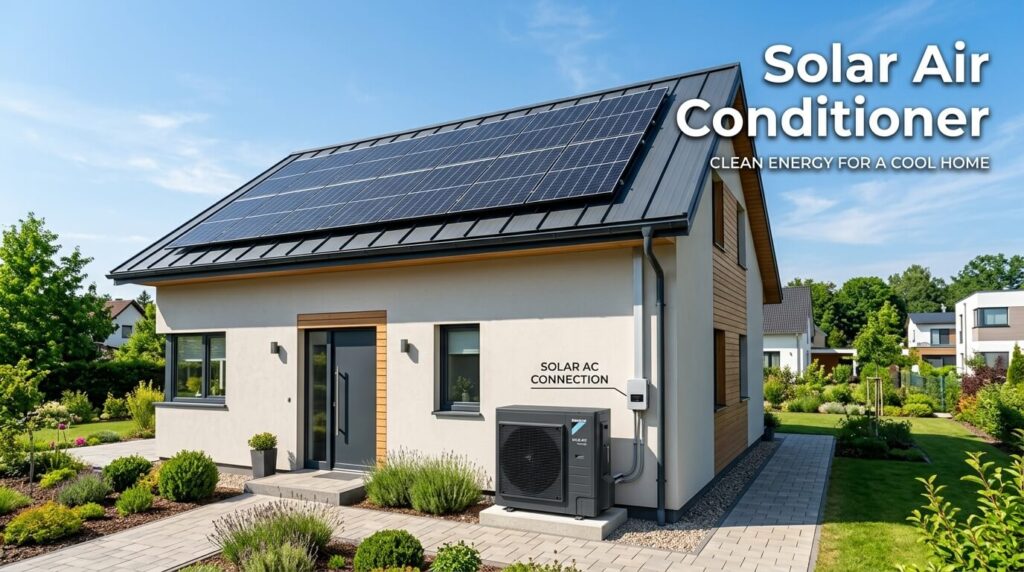
A solar air conditioner works by converting sunlight into either electricity or heat, then using that energy to drive the cooling cycle instead of pulling continuously from the grid.
Two technologies do this: solar photovoltaic (PV) and solar thermal, and they’re built for different jobs.
For specific regions, read our guide on the best solar air conditioners in Nigeria and Solar Powered AC for home use.
Solar PV air conditioners vs. solar thermal air conditioners
| Factor | Solar PV air conditioner | Solar thermal air conditioner |
|---|---|---|
| How it generates cooling | PV panels make DC electricity that powers a normal compressor | Solar collectors heat a transfer fluid that drives an absorption chiller |
| Electricity use | Runs the whole unit off solar or battery power | Only small pumps and fans use electricity; the cooling cycle itself doesn’t |
| Typical buyer | Homes, RVs, cabins | Large homes, commercial buildings |
| Residential availability | Common and growing | Rare for single homes — mostly commercial-scale |
For a typical home or RV, solar PV is the practical choice. Solar thermal systems exist and work well, but the absorption-chiller hardware is built for commercial cooling loads, not a single house.
Hybrid vs. pure-DC solar air conditioners
| Factor | Hybrid solar air conditioner | Pure-DC solar air conditioner |
|---|---|---|
| Power sources | Solar, battery, and grid — switches automatically | Solar and battery only |
| Works with no sun | Yes, falls back to the grid | Only if the battery still has charge |
| Equipment needed | Manages multiple inputs without a separate inverter in most designs | Simpler internally, but needs enough battery to cover every sunless hour |
| Best fit | Homes with grid access wanting lower bills | Off-grid cabins, RVs, and sheds with no grid connection |
Hybrid wins for anyone with a grid connection, since it removes the risk of the AC simply stopping. Pure-DC only makes sense where there’s no grid to fall back on in the first place.
If your existing unit is old enough to be the bigger problem here, it’s worth checking these signs your AC needs replacement before pairing any AC with a new solar setup.
How many solar panels do you actually need?
How many solar panels you need comes down to one formula, not a fixed number, and the wide range of answers floating around online exists because almost nobody shows that formula.
The sizing formula, and why online calculators disagree
The sizing formula: panels needed = (AC running watts × hours of use) ÷ (panel wattage × peak sun hours × 0.75 derate factor). The derate factor accounts for heat, wiring loss, and imperfect panel angle — real-world output never hits a panel’s rated maximum.
| Published estimate | Assumed panel wattage | Panels for a ~3,000W central AC load |
|---|---|---|
| Calculator A | 100W panels | 30 panels |
| Calculator B | 550W panels | 9–11 panels |
| This guide’s assumption | 400W panels | 10–12 panels |
All three are doing the same math correctly. They just plug in different panel wattages, which is the one number almost no calculator states up front. Ask what wattage a published figure assumes before comparing it to the panels you’re actually buying.
Panel counts by AC type and size
| AC type | Typical running watts | Panels needed (400W panels, daytime-only) |
|---|---|---|
| Window AC (5,000–8,000 BTU) | 500–900W | 2–3 panels |
| Mini-split, 1 ton (12,000 BTU) | 900–1,500W | 3–5 panels |
| Central AC, 3 ton | 3,000–3,500W | 10–12 panels |
Add a battery for evening or overnight cooling, and the panel count climbs further, because the battery has to recharge fully during the same sun hours that are also running the AC.
What a solar air conditioner costs in 2026
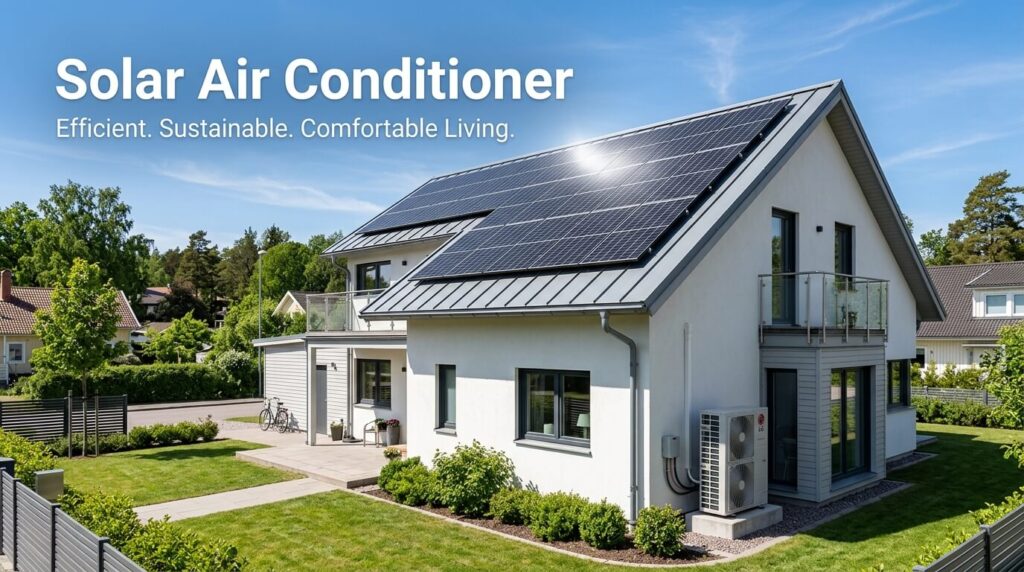
A solar air conditioner costs anywhere from $2,000 to $35,000, and that range only makes sense once you know which of the three setups described above you’re pricing.
Standalone solar AC unit vs. whole-home solar + AC system
| Setup | Typical cost | What’s included |
|---|---|---|
| Standalone hybrid or DC unit | $2,000–$5,000 installed | Small 9,000–24,000 BTU unit, no whole-home array |
| Whole-home array sized for central AC | $12,000–$22,000 | 3-ton inverter AC plus a 4–6 kW solar array, no battery |
| Whole-home solar + AC + battery backup | $8,000–$35,000+ | Full system sized by tonnage, SEER2 tier, and site complexity |
The standalone unit wins on upfront price, but it’s also the smallest BTU range and the least likely to cover a real central air conditioning load. It’s built for a single room or an RV, not a house.
What drives the price up or down
- Higher SEER2-rated equipment costs more upfront but needs fewer panels to offset the same cooling load.
- A battery for night or cloudy-day operation is usually the single biggest line item after the panels themselves.
- Roof complexity, shading, and the distance between the array and the AC’s electrical panel all add labor hours.
- A 2- to 3-ton residential system typically needs 4 to 6 kW of panels to offset most summer use, and smaller units scale down from there.
A higher SEER2 unit and a smaller panel count often cost about the same as a lower SEER2 unit with more panels — SEER2 rating explained breaks down where that trade-off actually pays off.
Does the federal tax credit still apply in 2026?
No — and this is the change most existing solar air conditioner guides haven’t caught up to. The federal solar tax credit 2026 status is simpler than it sounds: both credits that used to apply here expired on the same date.
What expired (Section 25D and 25C) and when
| Credit | 2026 status |
|---|---|
| Section 25D — Residential Clean Energy Credit (30% on solar) | Expired Dec 31, 2025, no phase-down, under the One Big Beautiful Bill Act |
| Section 25C — Energy Efficient Home Improvement Credit (AC, heat pumps) | Also expired Dec 31, 2025 |
| Systems placed in service by Dec 31, 2025 | Can still be claimed on a 2025 tax return |
| Cash or loan purchases completed in 2026 | $0 federal credit |
A contractor quoting “30% off with the tax credit” in 2026 is quoting 2025 numbers. That credit is gone for anyone buying outright.
The one path that still qualifies, and what state rebates remain
- Third-party-owned leases and power purchase agreements still qualify for the federal Section 48E commercial credit through December 31, 2027, with the installer claiming it and passing some value through the lease price.
- Many state energy offices run rebate programs that operate independently of federal tax law and remain active in 2026.
- Some utilities apply point-of-sale discounts directly to the invoice, which means no tax filing is needed to benefit.
- A licensed solar installer in your area will know exactly which of these currently apply to your address.
Battery, night use, and off-grid setups
Battery, night use, and off-grid setups all come down to the same fact: solar panels only produce power while the sun is up, and cooling demand often peaks right when output is falling.
Why most solar AC setups need a battery or grid backup
Panels stop producing the moment the sun sets, but air conditioning demand frequently peaks in the early evening, exactly when solar output is already dropping.
A grid-tied hybrid system switches over automatically and keeps cooling running without anyone noticing. An off-grid pure-DC setup without a battery just stops cooling once the panels can’t keep up, full stop.
Sizing the battery correctly matters as much as sizing the panels; this home battery storage cost breakdown covers what that adds to the budget.
Solar air conditioners for RVs and off-grid cabins
- A 12,000–15,000 BTU RV air conditioner running on DC typically needs 3 to 6 of today’s 400W panels plus a battery bank sized for several hours of nighttime runtime.
- Off-grid cabins are usually sized around the battery’s kWh capacity first, since the battery — not the panel count — determines how long cooling lasts after sunset.
- RV setups favor pure-DC units because they skip the inverter step entirely, which is one less component that can fail on the road.
- A shaded campsite or a cloudy week can cut output by half or more, so off-grid systems are usually built 20% to 30% larger than the daytime-only math suggests, a margin this off-grid solar system sizing guide walks through in detail.
Is a solar air conditioner worth it?
A solar air conditioner is worth it for two groups clearly, and a weak bet for a third.
Payback period by setup type
| Setup | Typical payback period |
|---|---|
| Standalone hybrid or DC unit | 3–6 years, mainly from reduced summer electricity use |
| Whole-home array offsetting central AC | 7–12 years without a federal tax credit, in most U.S. electricity markets |
| RV or off-grid system | Not measured in payback — the comparison is to having no cooling at all, not to a power bill |
Who it makes sense for, and who should skip it
- It makes the most sense for off-grid or RV owners who have no other way to run AC, since there’s no power bill to compare against in the first place.
- It also makes sense for homeowners in high-sun, high-electricity-cost states like Arizona, Texas, and California who are already adding whole-home solar and want the AC load included in that sizing.
- It makes less sense for homeowners with cheap electricity rates and a short cooling season, where the equipment cost won’t be recovered within the system’s working life.
- Skip the standalone “solar air conditioner” product entirely if you already have working central air and full-home solar — oversizing your existing array covers the AC load without buying separate equipment.
If you’re weighing which of these three setups fits your situation, a licensed solar installer can run the sizing math against your actual roof, your AC’s wattage, and your local sun hours. The numbers above are a starting point, not a substitute for a site-specific quote.
FAQ
How does a solar air conditioner work?
Solar panels generate DC electricity, which either runs the AC directly or passes through an inverter to power it like a normal grid-connected unit. Many setups add a battery so cooling continues after sunset.
How many solar panels do I need to run an air conditioner?
A 1-ton mini-split running on 400-watt panels typically needs 3 to 6 panels for daytime-only use; a central AC needs roughly 10 to 12. The exact count shifts with your panel wattage and local sun hours, which is why published calculators disagree so much.
Is a solar air conditioner worth it?
Yes for off-grid and RV setups with no other way to run AC, and yes for homeowners already adding whole-home solar in high-sun states. It’s a harder case for a stand-alone purchase where electricity is cheap and the cooling season is short.
How much does a solar air conditioner cost?
A standalone hybrid unit runs $2,000 to $5,000 installed. A whole-home array sized to offset a central AC system runs $12,000 to $22,000 without a battery, more with one.
Can a solar air conditioner run at night?
Only with a battery or a grid connection, panels stop producing once the sun sets. A pure off-grid DC unit without a battery simply stops cooling after dark.
Can I run a regular central AC unit on solar panels?
Yes, a standard central AC can run on whole-home solar without any special “solar AC” equipment, as long as the array is sized for its wattage. Most homeowners size the array for the whole house, not the AC alone.
Do solar air conditioners need a battery?
Not always, but most do for reliable cooling outside peak sun hours. Grid-tied hybrid systems can skip the battery and pull from the grid instead.
What’s the difference between a hybrid and a DC-only solar air conditioner?
A hybrid system switches between solar, battery, and grid power automatically, so it keeps running even without the sun.
A DC-only unit runs strictly on stored battery and panel power, which is simpler but means it stops once the battery runs out.